

What is Form 8379?
When you file a joint tax return, the IRS can apply (offset) the whole joint refund against a debt that only your spouse owes, such as past-due child support, spousal support, a federal student loan or other federal nontax debt, state income tax or state unemployment compensation. Form 8379, Injured Spouse Allocation, lets the spouse who doesn't owe the debt, the 'injured spouse', ask for their share of that refund back.
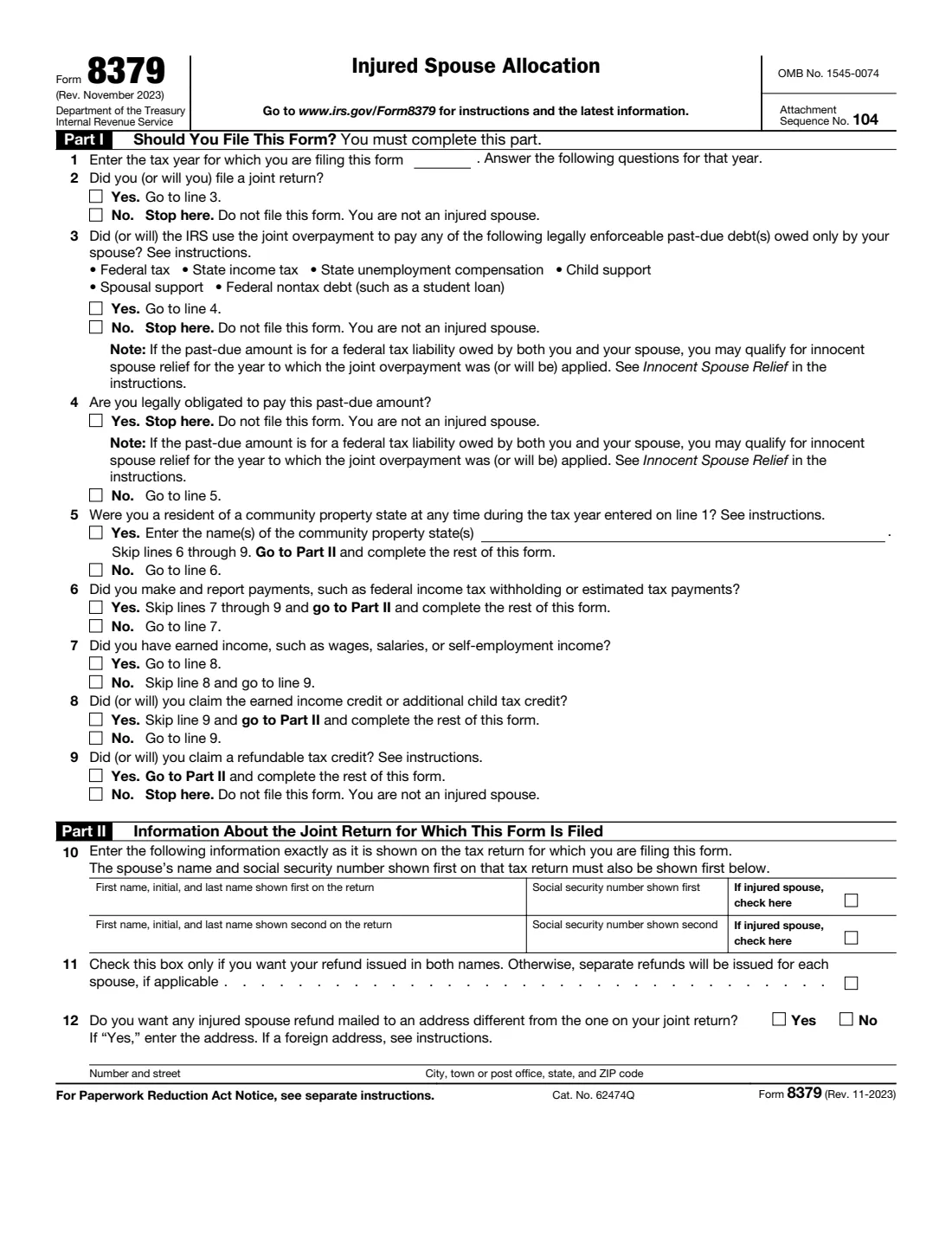
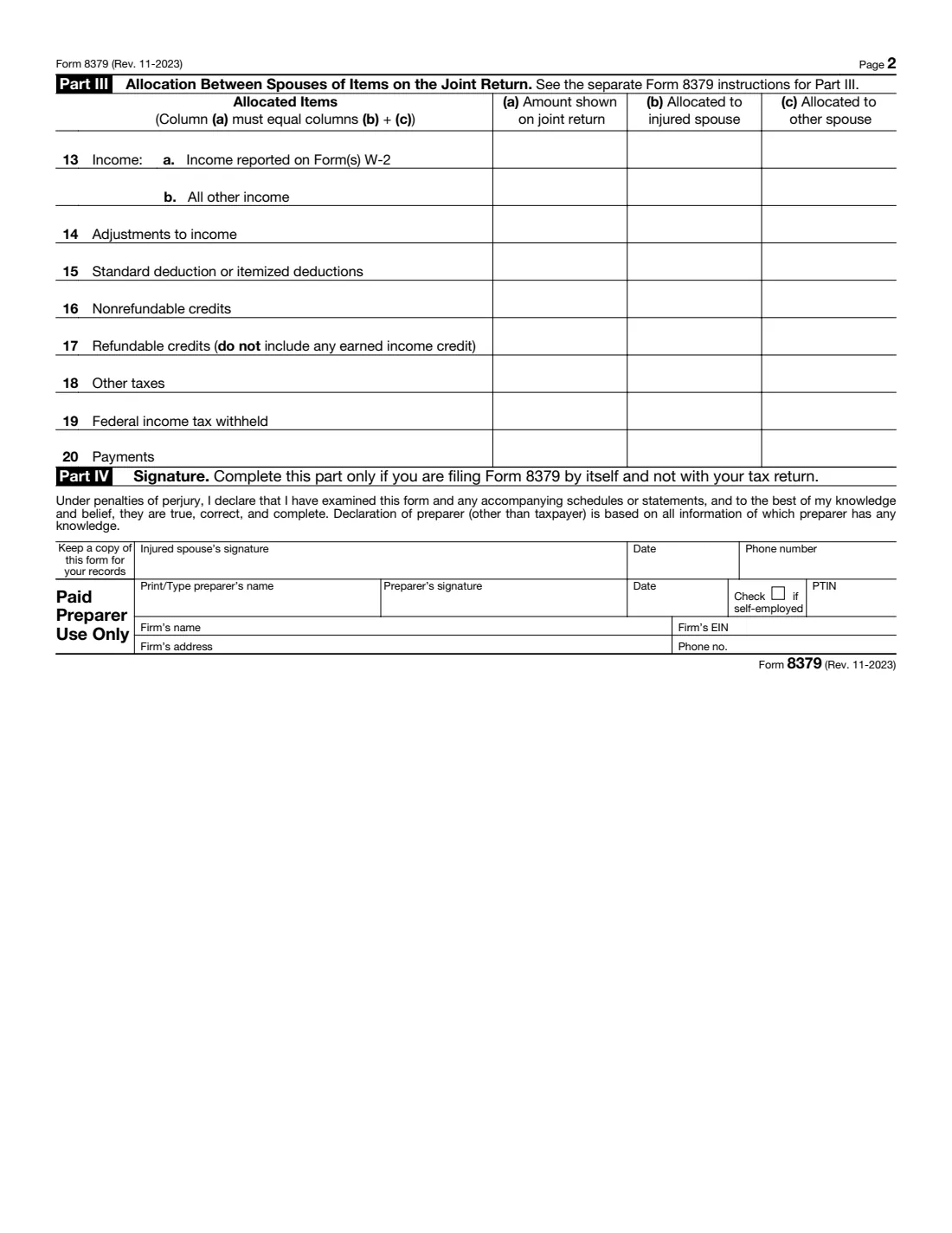
The form has two jobs. Part I is a short series of yes/no questions that decides whether you are an injured spouse at all. Parts II and III identify the joint return and split its income, adjustments, deductions, credits, taxes, withholding and payments between the two of you, following the rules in the Form 8379 instructions.
VergeHR guides you through Part I exactly as the form branches, stops you where the form says 'Stop here', works out column (c) so that column (a) always equals (b) + (c), and prints your answers into the official IRS PDF (Rev. November 2023). The finished form is saved in VergeHR Files. You attach it to your return, or print, sign and mail it on its own; VergeHR never files anything with the IRS.
- Who fills it
- The injured spouse: the spouse on a joint return who does not owe the past-due debt.
- Given to
- The Internal Revenue Service, with your joint return, with an amended return (Form 1040-X), or on its own after you filed.
- When
- When you learn that all or part of your share of a joint refund was, or is expected to be, applied to your spouse's past-due obligation.
- Time limit
- Within 3 years from the due date of the original return (including extensions) or 2 years from the date you paid the tax that was later offset, whichever is later.
- Signature
- Part IV is signed only when you file Form 8379 by itself, not with your return. A paid preparer signs their own box.
- Edition
- Rev. November 2023 (OMB No. 1545-0074)
Who needs to fill out Form 8379?
- A spouse who filed (or will file) a joint return and whose share of the refund was, or will be, taken for a debt owed only by the other spouse.
- Common cases: the other spouse's past-due child support or spousal support, a defaulted federal student loan or other federal nontax debt, state income tax or state unemployment compensation debt, or a separate federal tax debt.
- Not for a debt you are legally obligated to pay yourself. If the debt is a federal tax owed by both of you, look at innocent spouse relief (Form 8857) instead.
- People who lived in a community property state during the year can also file; the allocation then follows that state's law (see the instructions).
When to Use Form 8379
- With your joint return, if you already expect the refund to be offset. The instructions say processing then takes about 11 weeks for an e-filed return or 14 weeks for a paper return.
- On its own after you filed, once the offset notice arrives. The instructions say this takes about 8 weeks.
- With an amended return (Form 1040-X), if that is where the refund arises.
- No later than 3 years from the due date of the original return (including extensions) or 2 years after you paid the tax that was later offset, whichever is later.
What You Need Before You Start
- The joint tax return for the year, exactly as filed: the names and social security numbers in the order they appear.
- Both spouses' Forms W-2, W-2G and any Forms 1099 that show federal income tax withholding. The instructions ask you to attach copies when you file Form 8379 on its own.
- Each spouse's wages, other income, adjustments, deductions, credits, other taxes, withholding and estimated or other payments, so you can allocate them in Part III.
- The offset notice, if you received one, showing which debt the refund paid.
- An address for the refund, if you want it mailed somewhere other than the address on the return.
What’s On Form 8379
The 2023 edition has 2 pages. VergeHR asks for it in 5 parts:
- Part I. Should you file this form?Injured spouse
- Part II. Information about the joint returnInjured spouse
- Part III. Allocation between spouses of items on the joint returnInjured spouse
- Part IV. Signature (only if filing Form 8379 by itself)Injured spouse
- Paid preparer use onlyPaid preparer
How to fill out Form 8379, step by step
1 Part I. Should you file this form?
Enter the tax year, then answer lines 2 to 9. You must have filed a joint return (line 2), the refund must have gone or be going to a debt owed only by your spouse (line 3), and you must not be legally obligated to pay it (line 4). Line 5 asks about community property states; if Yes, you skip to Part II. Otherwise lines 6 to 9 check that you made payments or had earned income or refundable credits. VergeHR shows only the questions the form asks you to answer and warns you where the form says 'Stop here'.
2 Part II. Information about the joint return
Enter both names and social security numbers exactly as shown on the return, in the same order, and tick which spouse is the injured spouse. Line 11 asks whether you want the refund issued in both names; otherwise the IRS issues separate refunds. Line 12 lets you give a different mailing address for the injured spouse's refund.
3 Part III. Allocation between spouses
For each line (W-2 income, other income, adjustments, standard or itemized deductions, nonrefundable credits, refundable credits, other taxes, federal income tax withheld and payments), enter the amount on the joint return in column (a) and your share in column (b). VergeHR fills column (c) as (a) minus (b). The instructions explain how each item is allocated: in general, each spouse's separate wages, self-employment income and expenses, and credits go to the spouse who would have shown them on a separate return.
4 Part IV. Signature
Only when you file Form 8379 by itself: the injured spouse signs and dates it and gives a phone number. If a paid preparer prepared it, they complete the Paid Preparer Use Only section.
Common Mistakes to Avoid
- Listing the spouses in a different order than on the joint return. The spouse shown first on the return must be shown first on Form 8379.
- Forgetting to tick which spouse is the injured spouse on line 10.
- Filing when you are also liable for the debt. Form 8379 is only for a debt owed by your spouse alone.
- Column (a) not matching the joint return, or (b) + (c) not adding up to (a).
- Filing the form on its own without the copies of Forms W-2, W-2G and 1099 with withholding for both spouses.
- Filing too late: the time limit is 3 years from the return's due date or 2 years from the payment, whichever is later.
After You Fill It Out
Print the PDF and check every line. If you file it with your joint return, attach it to the return. If you file it on its own, sign Part IV, attach the W-2, W-2G and 1099 copies, and mail it to the IRS as the Form 8379 instructions describe. VergeHR does not submit it for you.
The IRS works out the injured spouse's share of the refund. The instructions give typical processing times of about 8 weeks when filed on its own, and 11 to 14 weeks when filed with the return.
Your completed Form 8379 stays in VergeHR Files under the person's folder, alongside the tax return for that year.
Fill Out Form 8379 Online with VergeHR
- Pick the employee. Choose an employee and VergeHR fills in their name, date of birth, email and other details it already knows.
- Answer plain-language questions. One part of the form at a time, with the official help text beside each question — 54 fields in all. Your answers save as you go.
- Check the live preview. Watch your answers land on the real Internal Revenue Service (IRS) form, and let VergeHR do any worksheet arithmetic.
- Generate the official PDF. VergeHR prints your answers into the agency’s own PDF and files it in that person’s folder in your vault.
VergeHR fills the form — it never files or submits anything for you. Deliver the finished form to whoever asked for it, the way the form’s instructions say.
Start Form 8379 Now — It’s FreeForm 8379: frequently asked questions
What is an injured spouse?
A spouse on a joint return whose share of the joint refund was, or is expected to be, used to pay a past-due debt that only the other spouse owes, such as child support, a federal student loan or a state tax debt. Part I of Form 8379 decides whether you qualify.
Is an injured spouse the same as an innocent spouse?
No. Injured spouse relief (Form 8379) returns your share of a refund taken for your spouse's separate debt. Innocent spouse relief (Form 8857) is about being relieved of tax owed on a joint return because of your spouse's errors.
Can I file Form 8379 with my tax return?
Yes. You can attach it to your joint return, to an amended return (Form 1040-X), or file it on its own after the return, once you learn of the offset.
Do I sign Form 8379?
Only when you file it by itself: then the injured spouse signs Part IV. When you attach it to your return, the form says to leave Part IV blank; you sign the return itself.
How long does the IRS take?
The Form 8379 instructions give about 8 weeks when you file it after your return was processed, and about 11 weeks (e-filed) or 14 weeks (paper) when you file it with the joint return.
What does column (c) mean?
Column (c) is the part of each item allocated to the other spouse. Column (a) must equal (b) plus (c), so VergeHR works (c) out from the amounts you enter.
I live in a community property state. Does that change anything?
Yes. If you lived in a community property state during the year, answer Yes on line 5 and go to Part II. The allocation follows that state's community property law; see the instructions.
Official Sources
- Blank form (PDF), published by Internal Revenue Service (IRS): https://www.irs.gov/pub/irs-pdf/f8379.pdf
- Official instructions and guidance: https://www.irs.gov/forms-pubs/about-form-8379
- Edition shown on this page: Rev. November 2023 (checked 2026-09-28).
VergeHR is not affiliated with or endorsed by Internal Revenue Service (IRS) or any government. This page explains the form in general terms and is not legal, tax or immigration advice. Always read the official instructions, and check that you are using the edition the recipient accepts. Page last reviewed 2026-09-28.