

What is Form WH-380-E?
When an employee asks for leave under the Family and Medical Leave Act (FMLA) because of their own serious health condition, the employer may require a medical certification from the employee's health care provider. Form WH-380-E is the Department of Labor's form for that certification. Using it is optional, but it asks the provider for the information a complete and sufficient certification needs under 29 C.F.R. § 825.306, and the employer may not ask for more than the FMLA regulations allow.
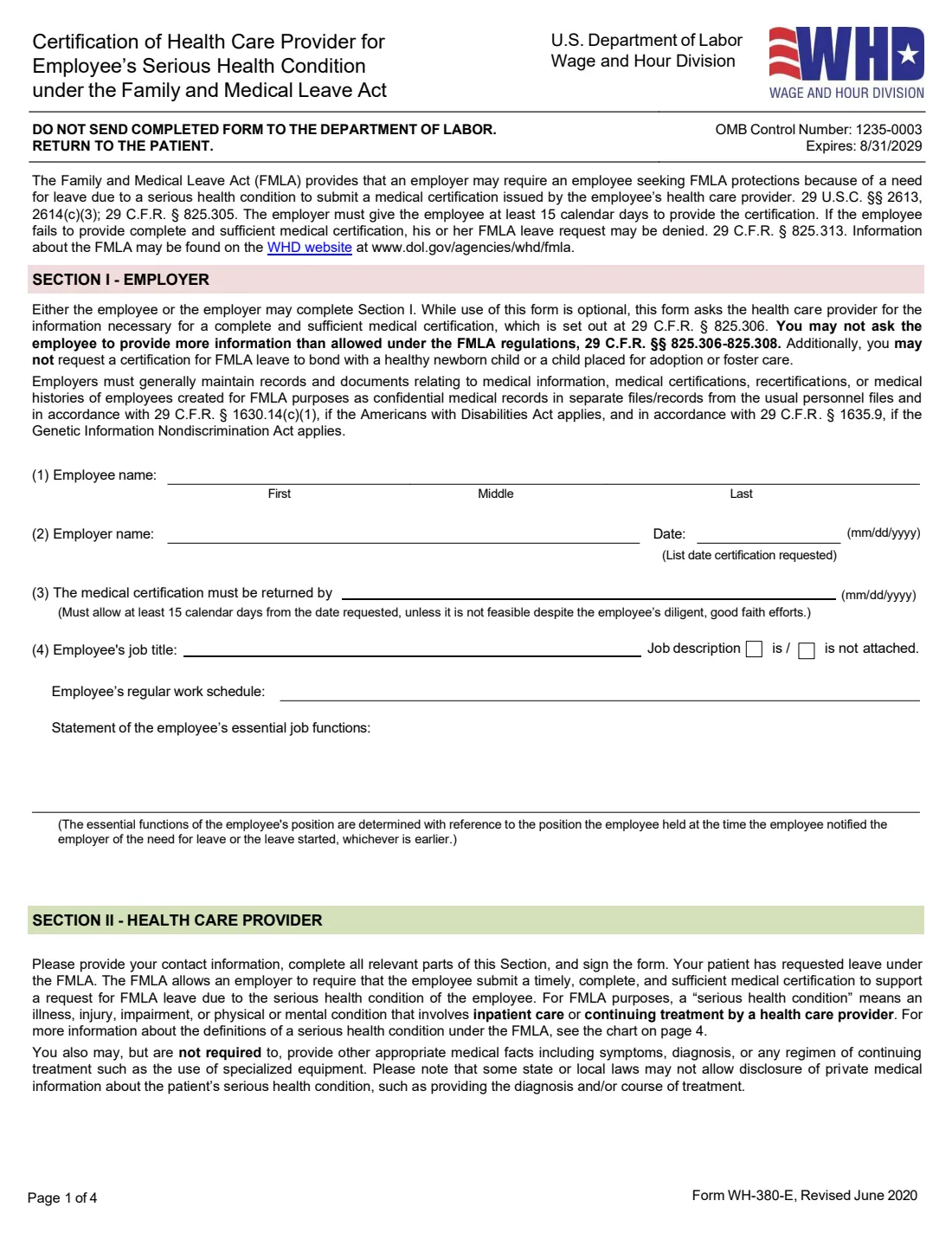
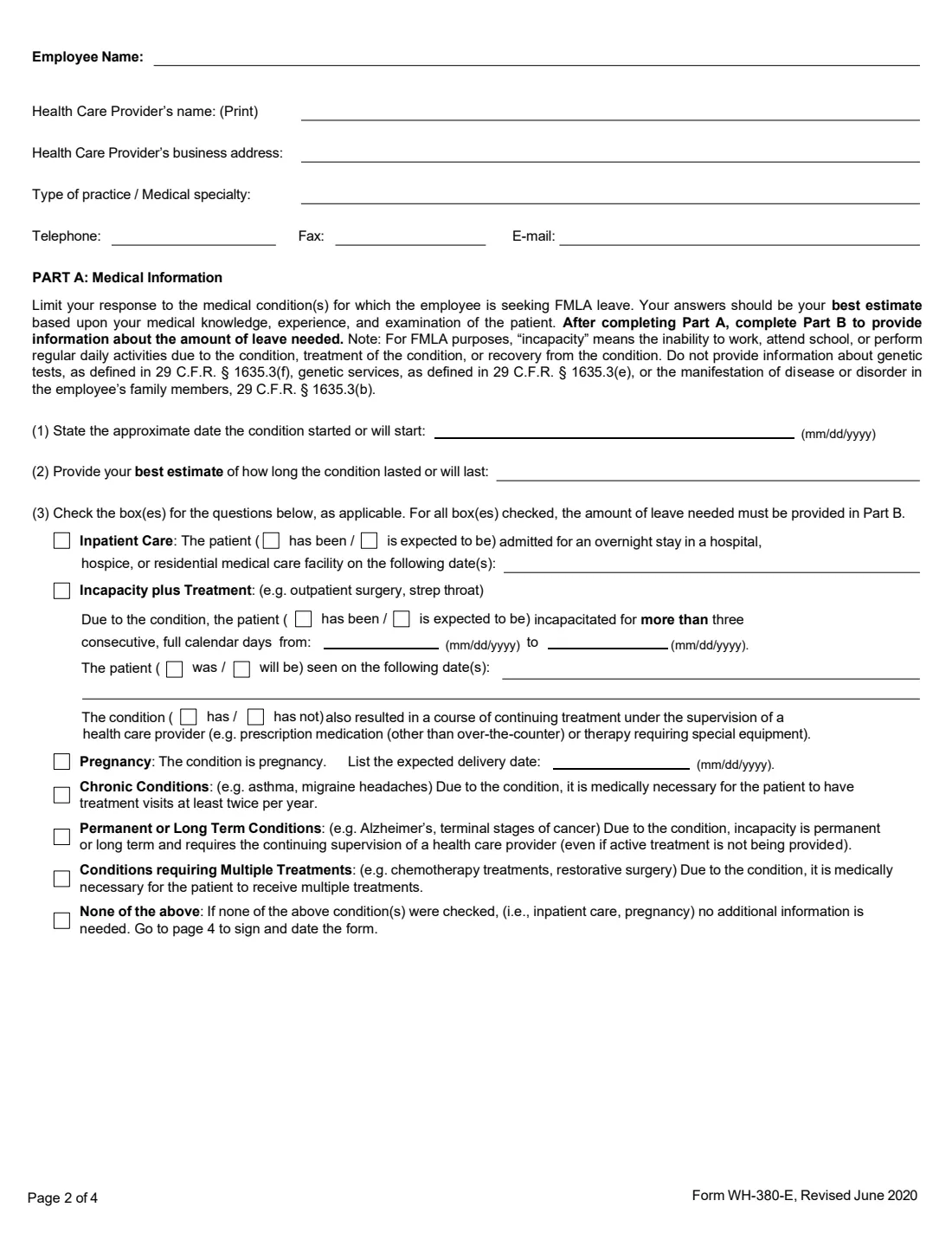
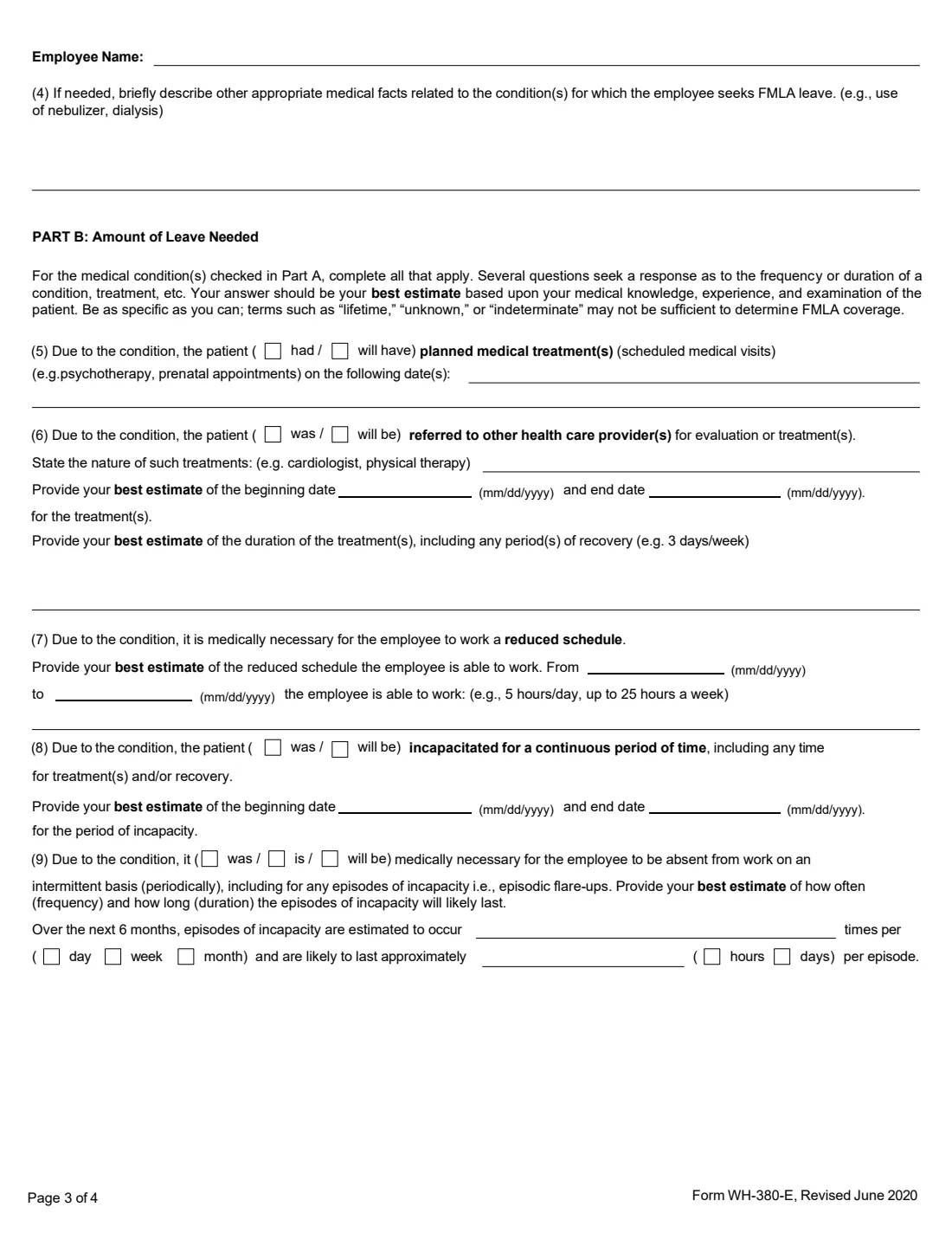
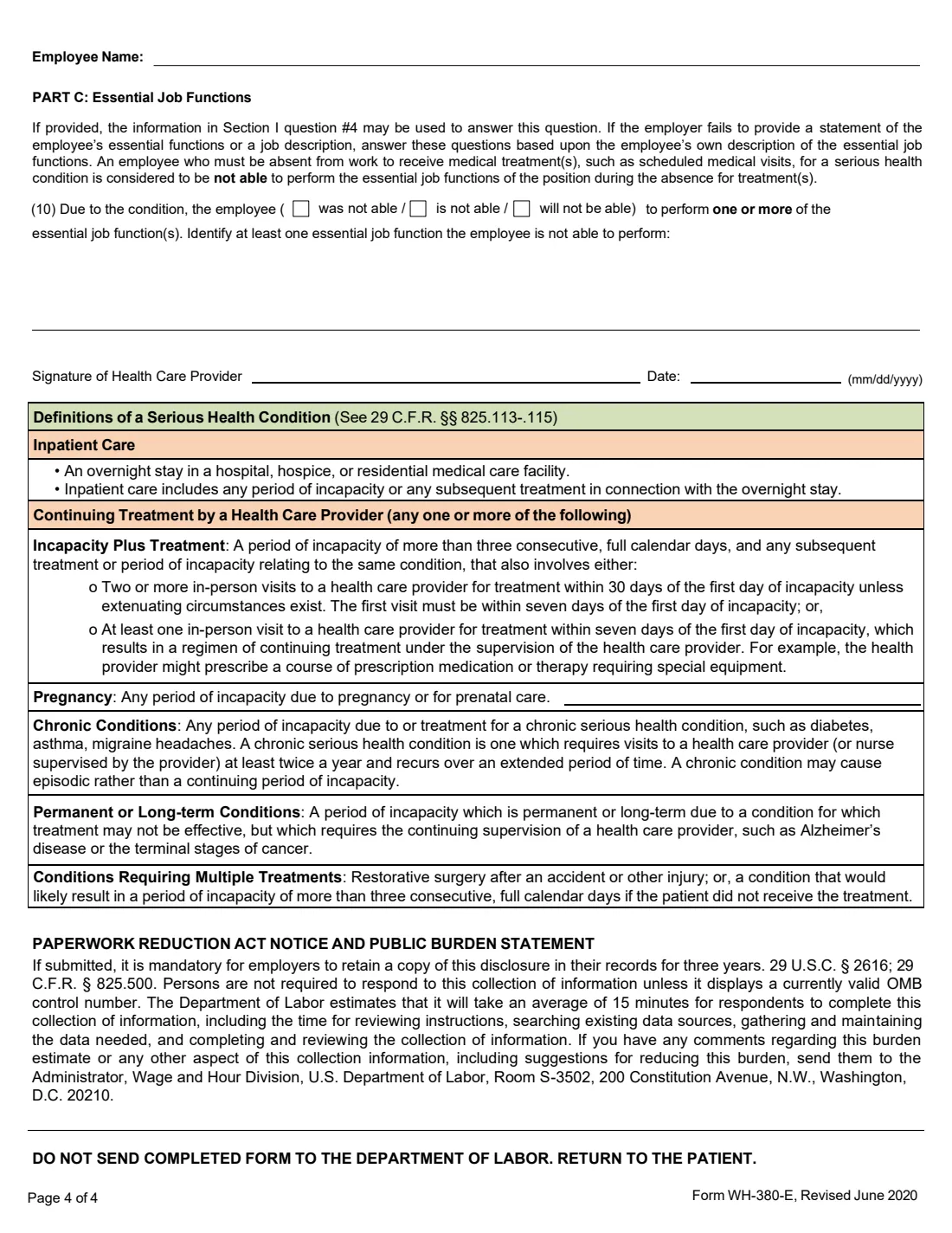
It has two sections. Section I is filled in by the employer or the employee: the employee's name, the employer, the date the certification was requested, the date it must be returned by (at least 15 calendar days later), and the employee's job title, schedule and essential job functions. Section II is completed by the health care provider: contact details, Part A (medical facts, including which type of serious health condition applies), Part B (the amount of leave needed: planned treatment, referrals, a reduced schedule, a continuous period, or intermittent episodes) and Part C (which essential job functions the employee can't perform), then the provider's signature.
VergeHR lets you fill in Section I, pre-filled from the People in Files, and if your provider gives you the answers or you work in the provider's office, Section II as well. It prints everything into the Department of Labor's own PDF, so you can hand it to your doctor or send it for signature. The completed form goes back to the employer, not to the Department of Labor.
- Who fills it
- Section I: the employer or the employee. Section II: the employee's health care provider, who signs it.
- Returned to
- The employer (the form says: do not send it to the Department of Labor; return it to the patient).
- Deadline
- The date the employer sets in Section I, at least 15 calendar days after the request, unless that isn't feasible despite the employee's diligent, good faith efforts.
- Signatures
- The health care provider signs and dates page 4.
- Edition
- Revised June 2020 (OMB 1235-0003, expires 8/31/2029)
- Agency
- U.S. Department of Labor, Wage and Hour Division
Who needs to fill out Form WH-380-E?
- Employees asking for FMLA leave because of their own serious health condition, whose employer asked for a medical certification.
- Employers and HR teams requesting a medical certification for an employee's FMLA leave.
- Employees needing leave for surgery, a hospital stay, pregnancy or prenatal care, a chronic condition such as asthma or migraines, or ongoing treatments such as chemotherapy.
- Employees who need intermittent leave or a reduced work schedule because of a condition.
- Health care providers and their office staff completing the certification for a patient.
When to Use Form WH-380-E
- When an employer requires medical certification for FMLA leave because of the employee's own serious health condition.
- For leave to care for a spouse, parent or child with a serious health condition, use Form WH-380-F instead.
- The form says an employer may not request a certification for FMLA leave to bond with a healthy newborn child or a child placed for adoption or foster care.
- Get it back to the employer by the date in Section I: the form says the employer must allow at least 15 calendar days, and an incomplete or late certification can lead to the leave request being denied.
What You Need Before You Start
- The employee's full name and the employer's name.
- The date the employer requested the certification and the date it must be returned by.
- The employee's job title, regular work schedule, and a statement of the essential job functions, or a job description to attach.
- The health care provider's name, business address, type of practice, phone, fax and email.
- The provider's best estimate of when the condition started, how long it will last, and the leave needed: treatment dates, referrals, reduced schedule, continuous incapacity, or frequency and duration of flare-ups.
What’s On Form WH-380-E
The 2020 edition has 4 pages. VergeHR asks for it in 5 parts, and it is signed by Health care provider:
- Section I: EmployerEmployer (or employee)
- Health care provider's detailsHealth care provider
- Part A: Medical informationHealth care provider
- Part B: Amount of leave neededHealth care provider
- Part C: Essential job functionsHealth care provider
How to fill out Form WH-380-E, step by step
1 Section I — Employer
Either the employee or the employer may complete Section I: (1) the employee's name, (2) the employer's name and the date the certification was requested, (3) the date it must be returned by, at least 15 calendar days later, and (4) the employee's job title, whether a job description is attached, the regular work schedule, and the essential job functions. Essential functions are based on the position the employee held when they told the employer they needed leave, or when leave started, whichever is earlier.
2 Section II — Provider details
The health care provider prints their name, business address, type of practice or specialty, telephone, fax and email. The provider may, but isn't required to, give other medical facts such as symptoms or diagnosis; some state or local laws may not allow disclosing them.
3 Part A — Medical information
The provider gives the approximate date the condition started, how long it lasted or will last, and ticks which applies: inpatient care, incapacity plus treatment (more than three consecutive, full calendar days), pregnancy, a chronic condition, a permanent or long-term condition, a condition requiring multiple treatments, or none of the above. Page 4 of the form defines each. The provider must not include genetic information about the employee's family members.
4 Part B — Amount of leave needed
For each condition ticked in Part A, the provider gives their best estimate of: planned medical treatment dates, referrals to other providers with start and end dates, the duration of treatment and recovery, any reduced schedule the employee can work, any continuous period of incapacity, and for intermittent leave how often episodes are likely over the next 6 months and how long each lasts. Answers like "lifetime" or "unknown" may not be enough.
5 Part C — Essential job functions
The provider says whether the employee was, is, or will be unable to perform one or more essential job functions, and names at least one. An employee who must be absent for treatment counts as unable to perform the functions during that absence. Then the provider signs and dates page 4.
Common Mistakes to Avoid
- Giving the provider fewer than 15 calendar days to return it.
- Leaving Part B vague: the form warns that "lifetime", "unknown" or "indeterminate" may not be sufficient to determine FMLA coverage.
- Ticking a condition in Part A but not giving the amount of leave for it in Part B.
- Not naming at least one essential job function the employee can't perform in Part C.
- Sending the form to the Department of Labor. It goes back to the employer.
- Including genetic information, such as diseases in the employee's family members, which the form says not to provide.
- Using this form for leave to care for a family member. That's Form WH-380-F.
After You Fill It Out
Give the form to the health care provider to complete Section II (or check the answers they gave you) and sign and date page 4. You can also send it for signature from VergeHR. VergeHR keeps a copy of the filled PDF in Files.
Return the completed certification to the employer by the date in Section I. The form says that if the employee fails to provide a complete and sufficient certification, the FMLA leave request may be denied.
The employer must keep medical certifications and records confidential and separate from the usual personnel files. The form's burden statement says employers must keep a copy of the disclosure for three years.
Fill Out Form WH-380-E Online with VergeHR
- Pick the employee. Choose an employee and VergeHR fills in their name, date of birth, email and other details it already knows.
- Answer plain-language questions. One part of the form at a time, with the official help text beside each question — 58 fields in all. Your answers save as you go.
- Check the live preview. Watch your answers land on the real U.S. Department of Labor, Wage and Hour Division form, and let VergeHR do any worksheet arithmetic.
- Generate the official PDF. VergeHR prints your answers into the agency’s own PDF and files it with that employee’s documents. Sign it, or send it for e-signature.
VergeHR fills the form — it never files or submits anything for you. Deliver the finished form to whoever asked for it, the way the form’s instructions say.
Start Form WH-380-E Now — It’s FreeForm WH-380-E: frequently asked questions
Can I fill out Form WH-380-E online?
Yes. VergeHR guides you through Section I and, if you have the provider's answers, Section II, and prints them into the Department of Labor's official PDF, saved in Files. The provider still has to sign it.
Is Form WH-380-E required?
The form itself is optional: an employer may use its own form, as long as it asks only for what the FMLA regulations allow. But if the employer requires medical certification, the employee must provide a complete and sufficient one, or the leave request may be denied.
How long do I have to return it?
The employer must give you at least 15 calendar days from the date it requested the certification, unless that isn't feasible despite your diligent, good faith efforts. The return date is in Section I.
Where do I send the completed form?
To your employer. The form says in bold: do not send the completed form to the Department of Labor.
What's the difference between WH-380-E and WH-380-F?
WH-380-E is for the employee's own serious health condition. WH-380-F is for leave to care for a spouse, parent or child with a serious health condition.
Does my doctor have to give a diagnosis?
No. The form says the provider may, but is not required to, provide other medical facts such as symptoms, diagnosis or a regimen of continuing treatment, and that some state or local laws may not allow disclosing them.
Official Sources
- Blank form (PDF), published by U.S. Department of Labor, Wage and Hour Division: https://www.dol.gov/sites/dolgov/files/WHD/legacy/files/WH-380-E.pdf
- Official instructions and guidance: https://www.dol.gov/agencies/whd/fmla
- Edition shown on this page: Revised June 2020 (OMB 1235-0003, expires 8/31/2029) (checked 2026-09-28).
VergeHR is not affiliated with or endorsed by U.S. Department of Labor, Wage and Hour Division or any government. This page explains the form in general terms and is not legal, tax or immigration advice. Always read the official instructions, and check that you are using the edition the recipient accepts. Page last reviewed 2026-09-28.