

What is a shareholders' agreement?
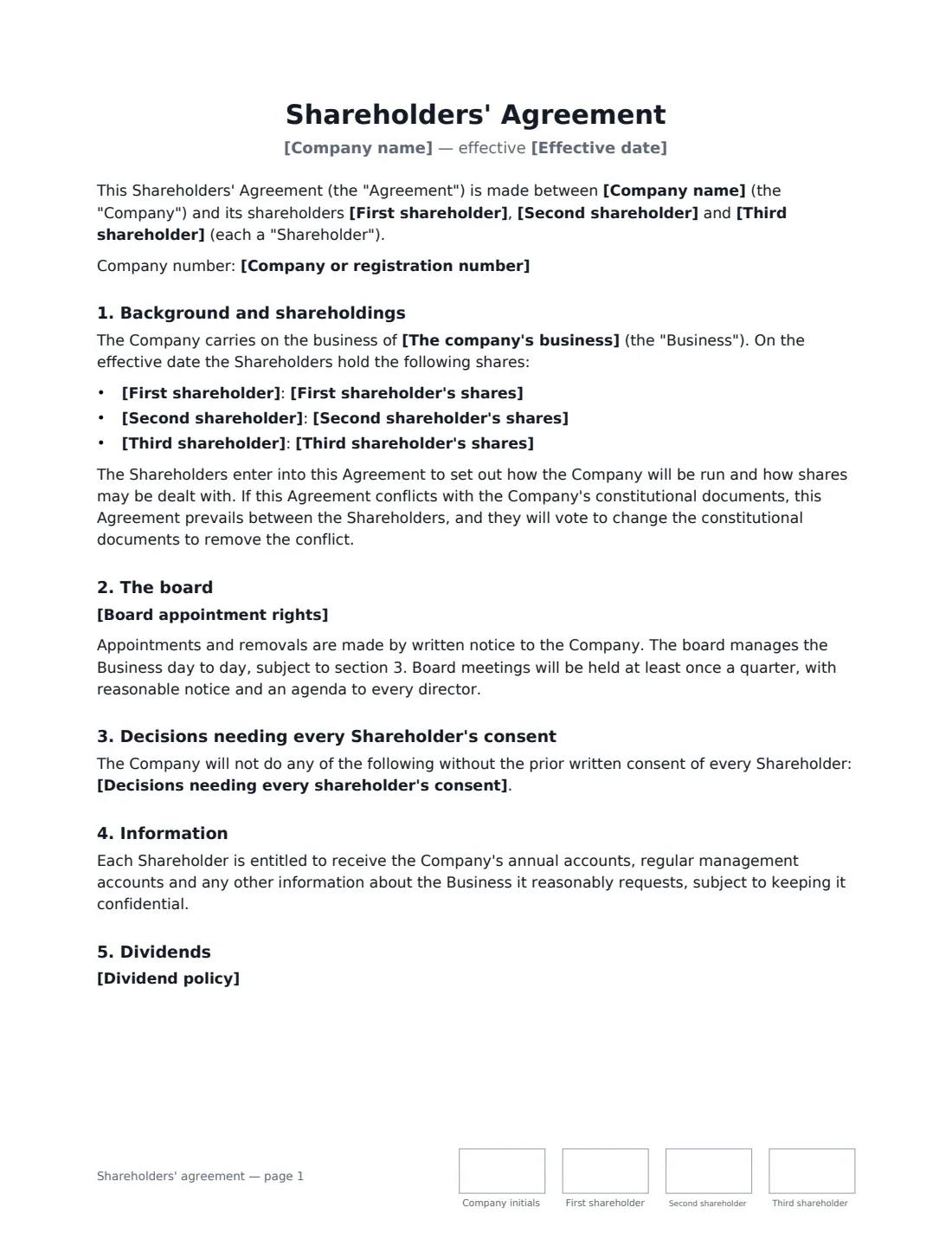
A company's articles or bylaws are often generic and public. A shareholders' agreement is the private contract between the owners that sits alongside them: who may appoint directors, which big decisions need everyone's say, what happens when someone wants to sell, and how a deadlock is broken. Writing it down early is much easier than negotiating it in the middle of a dispute.
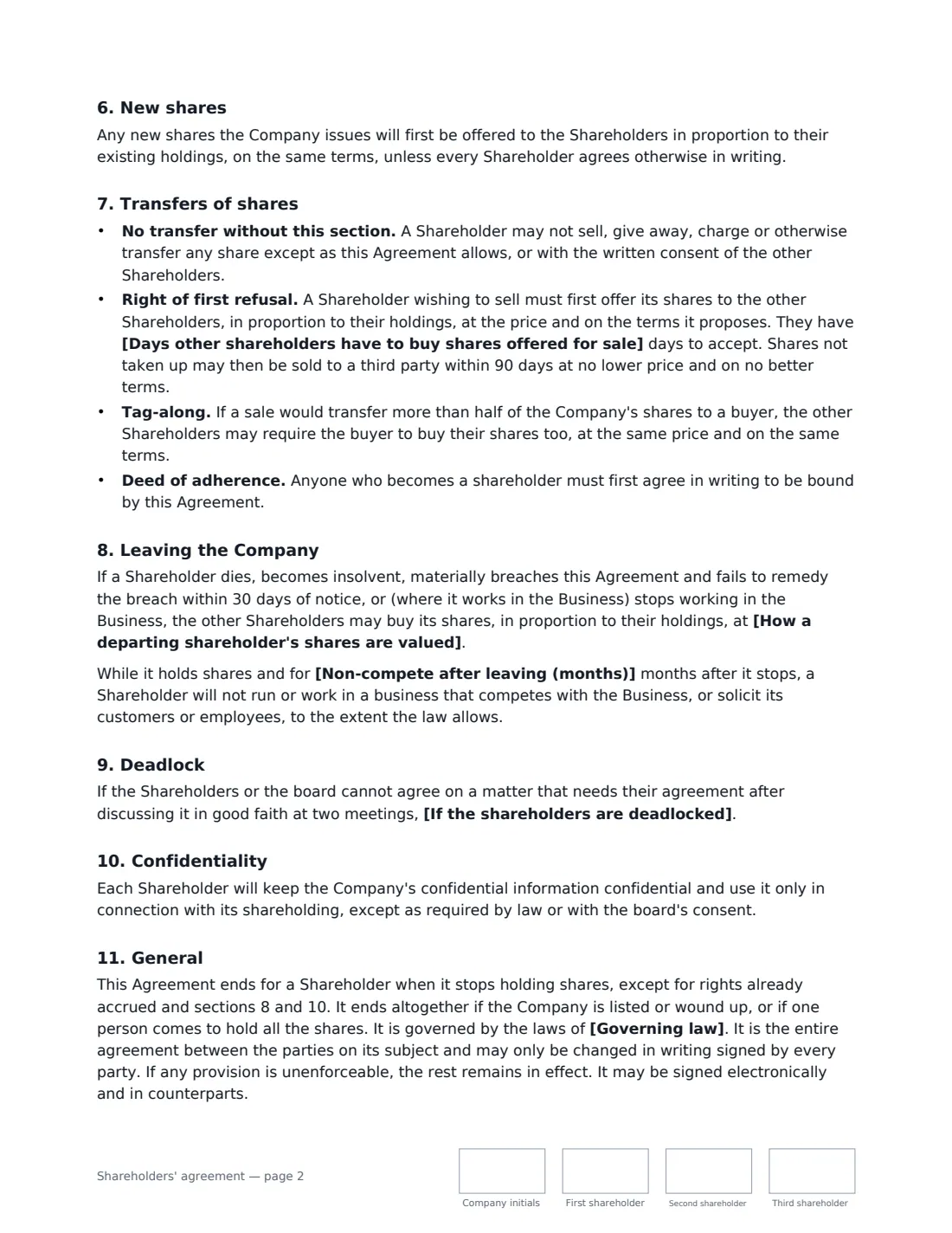
This template is for a company with three shareholders. It covers shareholdings, board appointment rights, a list of reserved matters that need unanimous consent, information rights, dividends, pre-emption on new shares, a right of first refusal, tag-along and an optional drag-along, buying out a departing shareholder, deadlock, confidentiality and an optional non-compete. The company signs too, so it is bound to respect the agreed rules.
- Best for
- Private companies with three shareholders, such as founders or a founder with two investors
- Signed by
- The company and each of the three shareholders
- Key protections
- Reserved matters, pre-emption, first refusal, tag-along, optional drag-along
- Length
- About 3 pages, initialled on every page
When to Use a shareholders' agreement
- Founders formalising how their company is run after incorporation
- Bringing in an investor who wants a say in major decisions
- Protecting a minority shareholder with tag-along and consent rights
- Planning in advance for a shareholder leaving or dying
- Agreeing a route out of a deadlock between equal owners
What You Fill In
19 blanks, then the name and email of each person who signs: company, first shareholder, second shareholder, third shareholder.
1 The company
- Effective date*
- Company name*
- Company or registration number
- The company's business*
2 The shareholders
- First shareholder*
- First shareholder's shares*
- Second shareholder*
- Second shareholder's shares*
- Third shareholder*
- Third shareholder's shares*
3 Running the company
- Board appointment rights*
- Decisions needing every shareholder's consent*
- Dividend policy
4 Shares
- Days other shareholders have to buy shares offered for sale*
- Shareholding needed to drag the others along* 50% · 66.67% · 75% · 90% · No drag-along
5 Leaving and disputes
- If the shareholders are deadlocked* the matter is referred to mediation, and if still unresolved any shareholder may offer to buy out the others · the matter is referred to mediation, and if still unresolved the shareholders will consider selling or winding up the company · the chair of the board has a casting vote
- How a departing shareholder's shares are valued* fair market value agreed between the shareholders or, failing agreement, set by an independent accountant · a price set by the formula in the Schedule attached to this Agreement
- Non-compete after leaving (months)
- Governing law*
6 Who signs
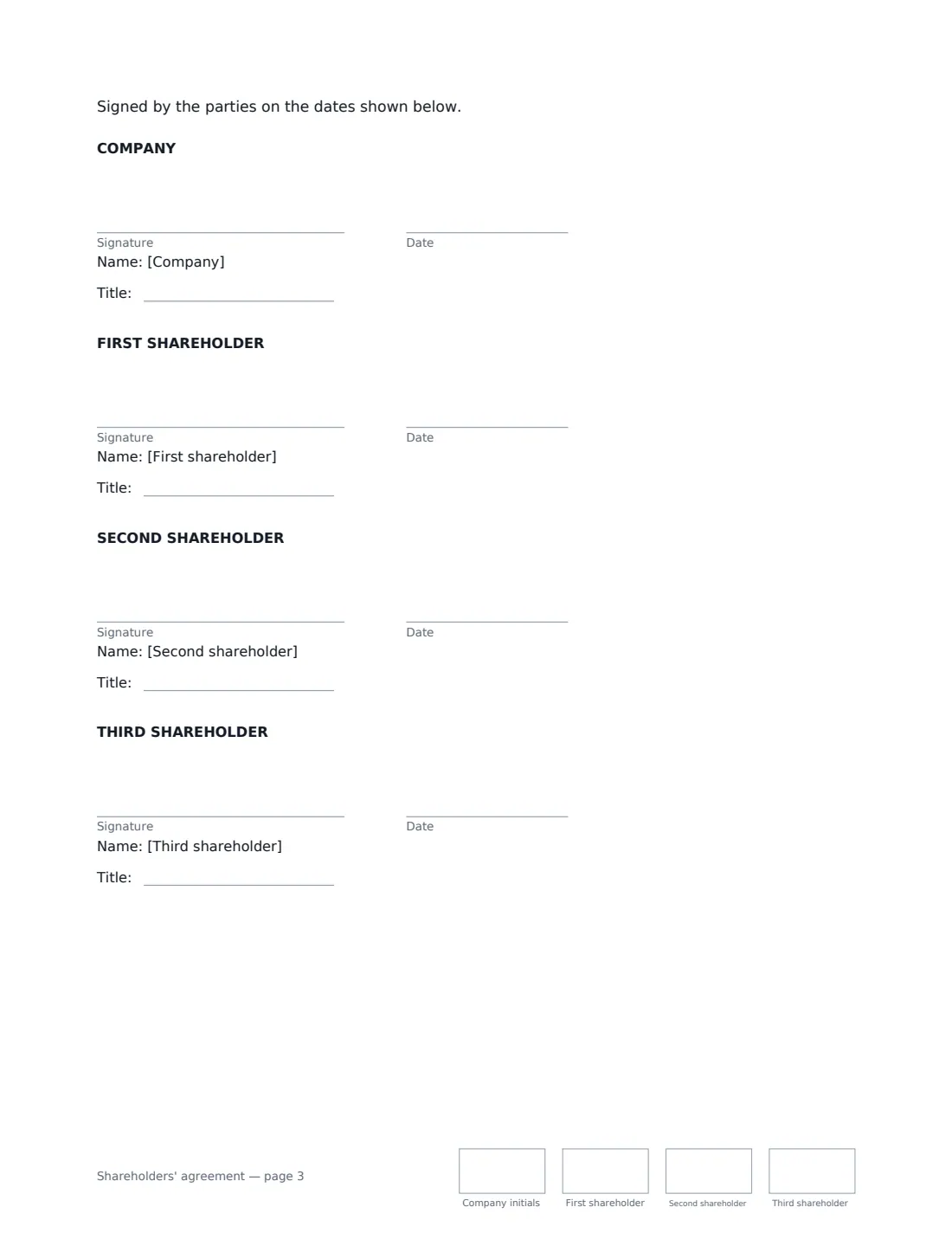
- Company signature and date, job title, initials on every page · A director signs for the company.
- First shareholder signature and date, job title, initials on every page
- Second shareholder signature and date, job title, initials on every page
- Third shareholder signature and date, job title, initials on every page
What the shareholders' agreement Covers
- Background and shareholdings
- The board
- Decisions needing every Shareholder's consent
- Information
- Dividends
- Dividends
- New shares
- Transfers of shares
- Leaving the Company
- Deadlock
- Confidentiality
- General
Using the shareholders' agreement, step by step
1 Enter the company and shareholdings
Name the company, describe its business, and list each shareholder's shares and percentage.
2 Set the governance rules
Decide who can appoint directors and which decisions need every shareholder's consent. The default list covers the usual reserved matters; edit it to suit.
3 Choose share and exit terms
Set how long shareholders have to buy shares offered for sale, the drag-along threshold (or none), how a departing shareholder's shares are valued, the deadlock route and any non-compete.
4 Sign
Add a director to sign for the company and the three shareholders. Each page carries initials boxes for all four signers, and the signed copy is stored in Files.
Tips Before You Send It
- Make sure the articles or bylaws do not contradict the agreement; the template commits the shareholders to amend them if they do.
- Reserved matters protect minority shareholders but can slow decisions. Keep the list to what really matters.
- Non-compete restrictions are limited or unenforceable in some places. Leave the field empty if in doubt.
- Have each shareholder take independent legal advice, especially an investor or a minority holder.
Sign It Online In Minutes
- Fill in the blanks. Names, dates and amounts go straight into the agreement — the preview shows exactly where.
- Name who signs. Tick “This is me” for your own part. VergeHR builds the PDF with every signature, date and initials box on the right line, and you can check or move anything before sending.
- Send it. Each signer gets a secure link and signs from any device — no account needed. The signed PDF, with an audit trail and a Certificate of Completion, is filed in Files and emailed to everyone.
Shareholders' agreement: frequently asked questions
Do we need a shareholders' agreement if we have articles or bylaws?
Not legally, but the constitution usually doesn't cover things like reserved matters, exits, valuation or deadlock in the way the owners want. The agreement fills those gaps and stays private.
What are tag-along and drag-along rights?
Tag-along lets minority shareholders sell on the same terms when a majority sells. Drag-along lets a large enough majority require the others to join a sale of the whole company, so one holder cannot block it.
What if we have two or four shareholders?
This template has blocks for exactly three shareholders plus the company. For a different number, draft your own agreement and upload it to VergeHR eSignature.
Is this enough for a venture capital round?
Usually not. Institutional investors bring their own, much longer documents. This template suits founders and small private companies.