

What is a co-founder agreement?
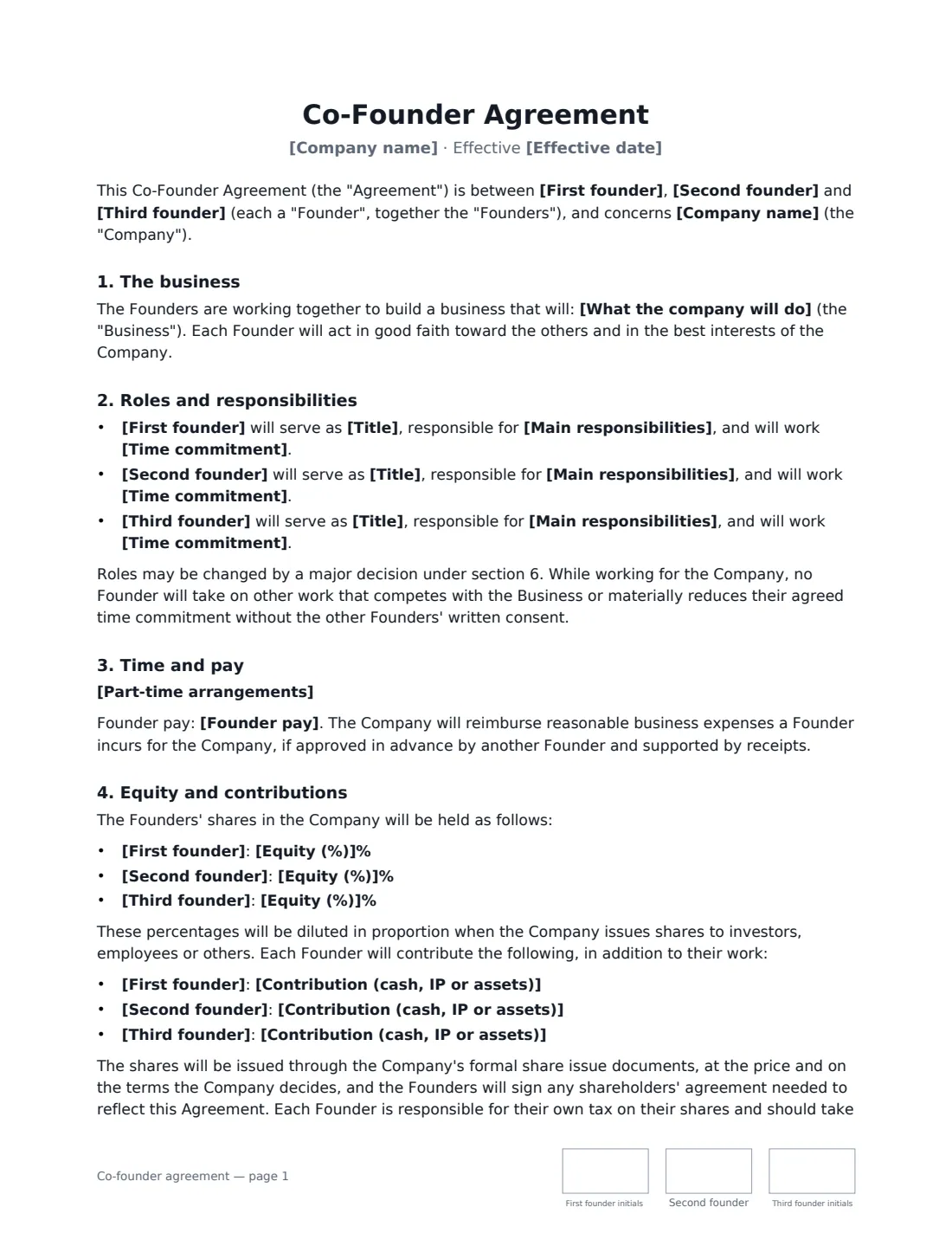
A co-founder agreement records the deal between the people starting a company. It is written before a shareholders' agreement or formal share issue, or alongside them. Many disputes between founders come from things nobody wrote down: one founder working part time, a disagreement over a big decision, or a founder leaving early with a large stake. Writing it down early, when it is easy, avoids expensive arguments later.
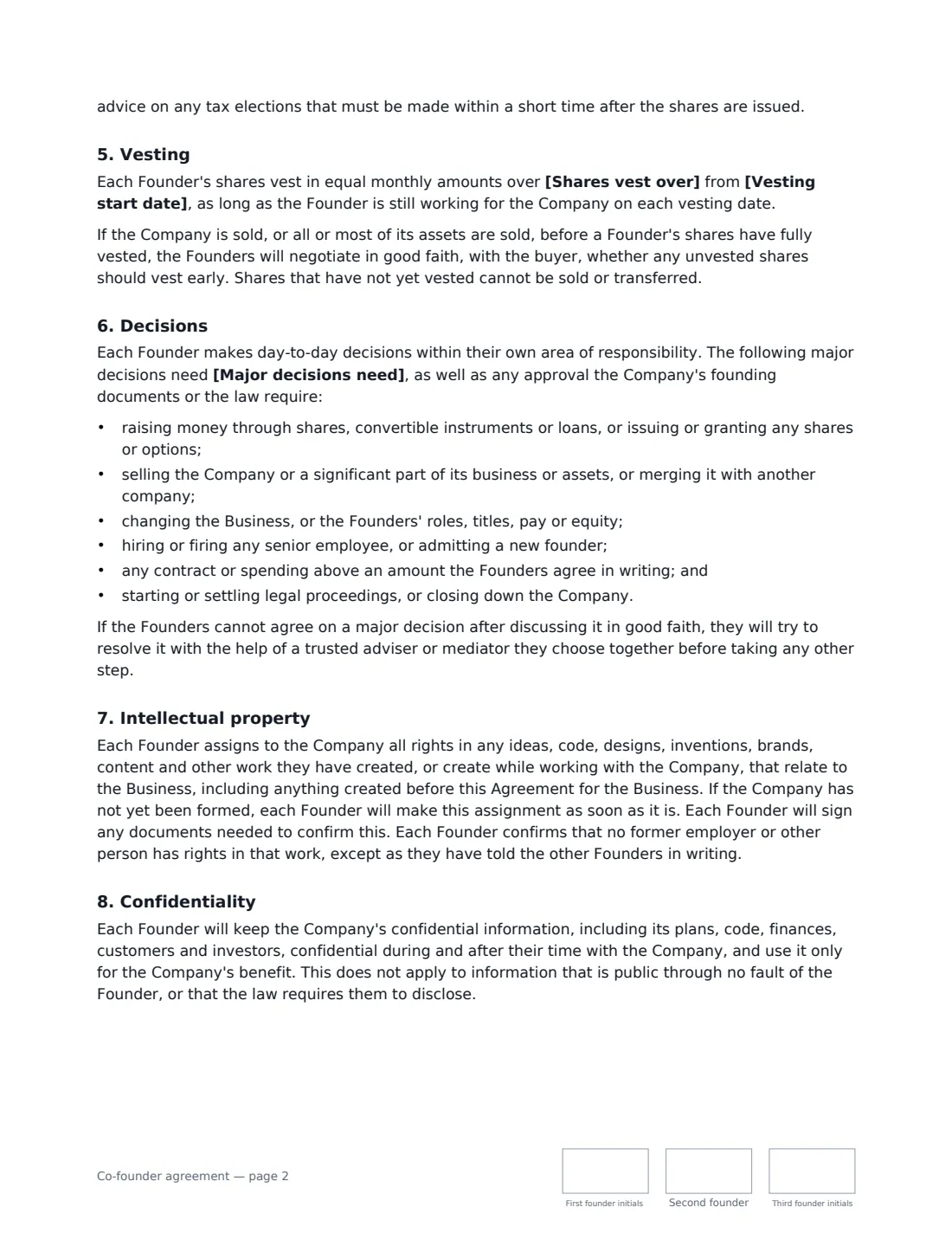
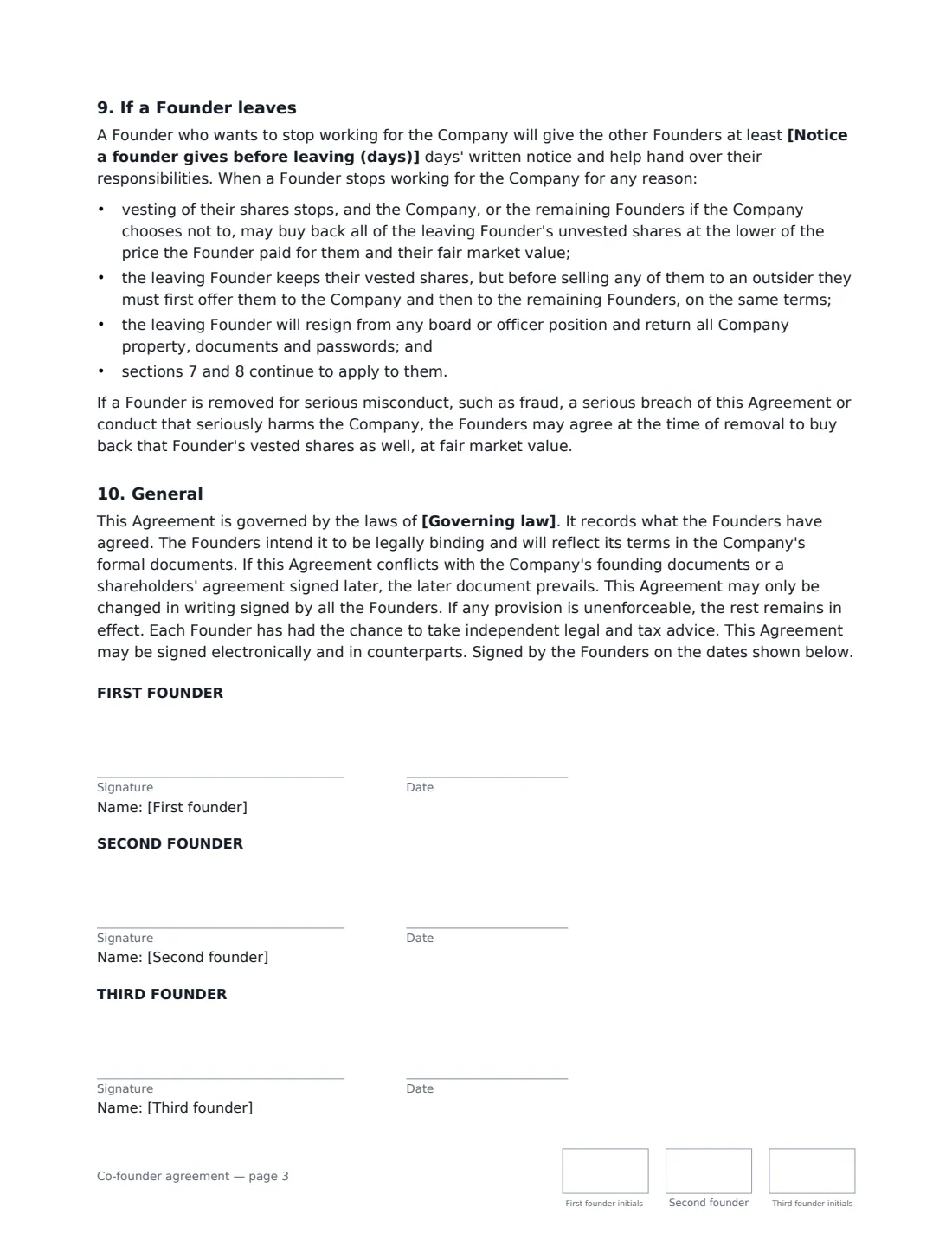
This template is for three founders. For each founder it records a title, responsibilities, a time commitment (full time, 30 or 20 hours a week, or part time as explained), an equity percentage and any cash, IP or assets they contribute. It sets founder pay, vesting over 24, 36 or 48 months with an optional 6- or 12-month cliff, and which major decisions need all three or two of the three founders, with mediation if you are stuck. Each founder assigns their work on the business to the company and keeps its information confidential. If a founder leaves, unvested shares can be bought back at the lower of cost and fair value, vested shares are offered to the company and the other founders first, and an optional non-solicit applies. It works whether or not the company has been incorporated yet.
- Best for
- Three people starting a company together, before or just after incorporating
- Signed by
- All three founders
- Vesting
- 24, 36 or 48 months, with no cliff or a 6- or 12-month cliff
- Length
- About 3 to 4 pages, initialled by every founder on every page
When to Use a co-founder agreement
- Three friends or colleagues turning a side project into a company
- Founders who have not yet incorporated but are already writing code or talking to customers
- Recording an equity split before approaching investors
- One founder working full time while another stays part time until funding
- Putting vesting in place so a founder who leaves early does not keep a full stake
What You Fill In
28 blanks, then the name and email of each person who signs: first founder, second founder, third founder.
1 The company
- Effective date*
- Company name*
- Has the company been formed?* Yes, it has been incorporated · No, not yet
- What the company will do*
2 First founder
- Title*
- Main responsibilities*
- Time commitment* full time · at least 30 hours a week · at least 20 hours a week · part time, as set out in section 3
- Equity (%)*
- Contribution (cash, IP or assets)
3 Second founder
- Title*
- Main responsibilities*
- Time commitment* full time · at least 30 hours a week · at least 20 hours a week · part time, as set out in section 3
- Equity (%)*
- Contribution (cash, IP or assets)
4 Third founder
- Title*
- Main responsibilities*
- Time commitment* full time · at least 30 hours a week · at least 20 hours a week · part time, as set out in section 3
- Equity (%)*
- Contribution (cash, IP or assets)
5 Time and pay
- Part-time arrangements
- Founder pay*
6 Vesting
- Shares vest over* 24 months · 36 months · 48 months
- Cliff* no cliff · 6 months · 12 months
- Vesting start date*
7 Decisions
- Major decisions need* the agreement of all three founders · the agreement of at least two founders
8 Leaving
- Notice a founder gives before leaving (days)*
- No poaching staff or customers after leaving (months)* none · 6 months · 12 months
- Governing law*
9 Who signs
- First founder signature and date, initials on every page
- Second founder signature and date, initials on every page
- Third founder signature and date, initials on every page
What the co-founder agreement Covers
- The business
- Roles and responsibilities
- Time and pay
- Equity and contributions
- Vesting
- Decisions
- Intellectual property
- Confidentiality
- If a Founder leaves
- General
Using the co-founder agreement, step by step
1 Describe the company
Enter the company name (or the name you intend to use), say whether it has been incorporated, and describe what it will do. If it has not been formed yet, the agreement commits the founders to form it and carry these terms into its documents.
2 Fill in each founder
For each founder give a title, main responsibilities, a time commitment and an equity percentage, plus anything they bring such as cash or prototype code. The names come from the signers you add, so they appear throughout the document.
3 Set pay and vesting
Say how founders will be paid (the default is no salary until the company's board approves one), choose the vesting period and cliff, and set the vesting start date, often the day founders started working on the company full time.
4 Agree decisions and leaving, then sign
Choose whether major decisions need all three founders or two of three, the notice a leaving founder gives, and whether a no-poaching promise applies after leaving. Add the governing law and send it to the other two founders.
Tips Before You Send It
- Vesting protects every founder, including you: if someone leaves in month three, the company can buy back most of their shares.
- In some countries, founders who receive shares that vest need to make a tax election within a short deadline, such as a US 83(b) election. Take tax advice as soon as shares are issued.
- This agreement records your deal; it does not issue shares. Follow it with the company's formal share issue documents and, usually, a shareholders' agreement.
- Make sure any code or designs created before the company existed are covered. The IP clause assigns them, but a separate IP assignment can help with investors.
Sign It Online In Minutes
- Fill in the blanks. Names, dates and amounts go straight into the agreement — the preview shows exactly where.
- Name who signs. Tick “This is me” for your own part. VergeHR builds the PDF with every signature, date and initials box on the right line, and you can check or move anything before sending.
- Send it. Each signer gets a secure link and signs from any device — no account needed. The signed PDF, with an audit trail and a Certificate of Completion, is filed in Files and emailed to everyone.
Co-founder agreement: frequently asked questions
Is a co-founder agreement legally binding?
It is written to be binding, and says so. Its terms should also be carried into the company's formal documents, such as share issue paperwork and a shareholders' agreement. If those later documents conflict with this agreement, the later ones prevail.
What if there are only two founders?
This template needs three signers. For two founders, draft your own agreement and upload it to VergeHR eSignature to place the signature boxes, or use a general partnership agreement if you are not forming a company.
What is a cliff?
A cliff is a period at the start when no shares vest. With a 12-month cliff, a founder who leaves in the first year keeps no vested shares. At the one-year mark, a full year's worth vest at once, and the rest vest monthly after that.
Can we sign it electronically?
Electronic signatures are generally valid for ordinary contracts like this in the US (ESIGN Act and UETA), the UK, the EU (eIDAS) and Canada. Company share certificates or registers may have their own formalities, which this agreement does not replace.