

What is a mutual non-disclosure agreement?
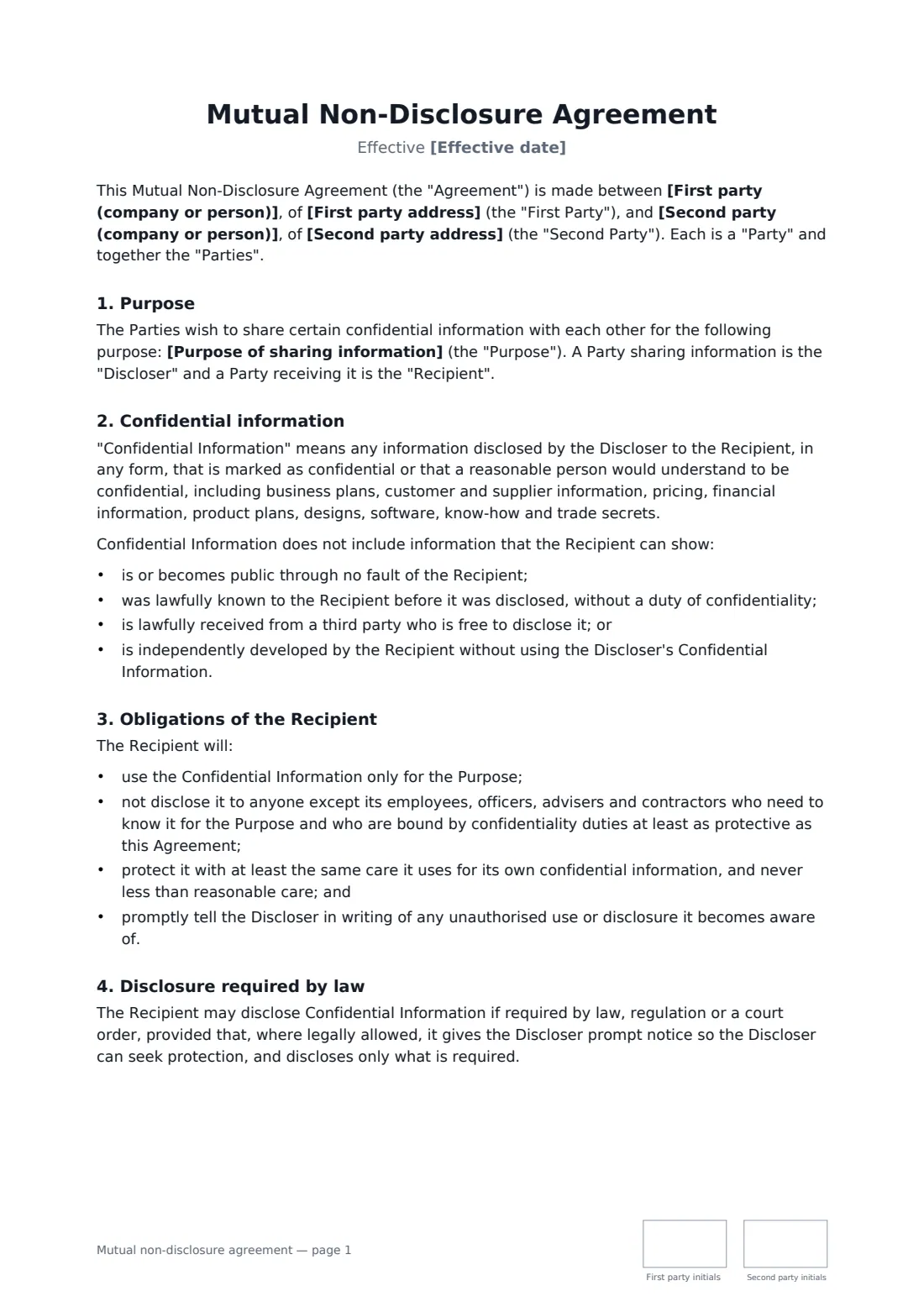
A mutual non-disclosure agreement is the paperwork you sign before two businesses open up to each other: before a partnership conversation, a supplier sharing pricing, an acquisition's due diligence, or two companies comparing notes on a joint product. Each side is both a discloser and a recipient, so each makes the same promises — use the other's confidential information only for the agreed purpose, keep it to the people who need it, and hand it back or destroy it when asked.
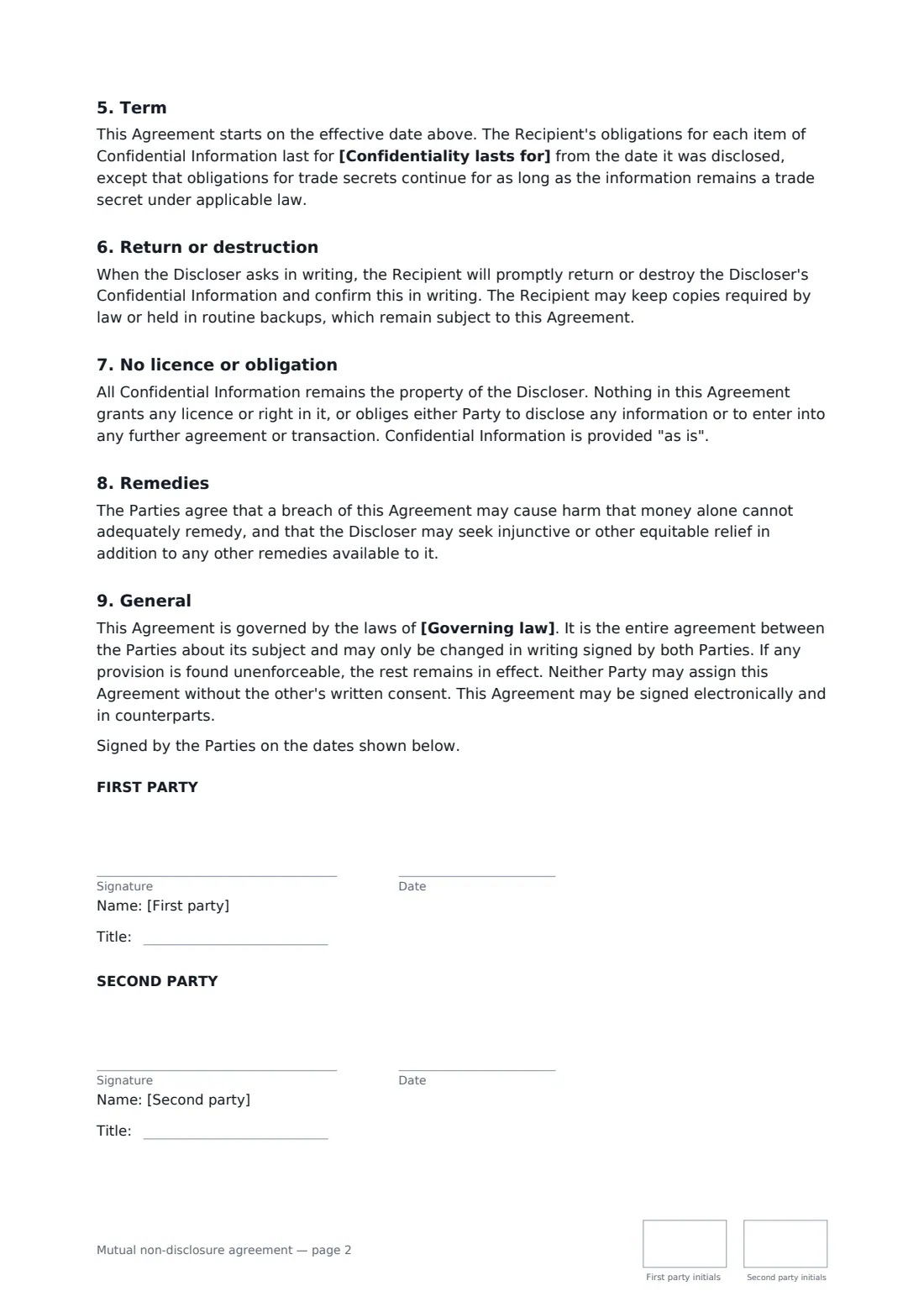
This template covers the clauses most mutual NDAs share: what counts as confidential (and the usual exceptions for public or independently developed information), how the recipient must protect it, disclosures required by law, how long the obligations last, return or destruction, no licence or obligation to do a deal, remedies, and the governing law. You choose the purpose, the length of confidentiality and the governing law; VergeHR puts both parties' signature, date, job-title and initials boxes in place.
- Best for
- Partnership talks, supplier and vendor discussions, due diligence, joint projects
- Signed by
- Both parties — usually an authorised person at each company
- Confidentiality period
- You choose: 1, 2, 3, 5 or 7 years (trade secrets for as long as they stay secret)
- Length
- 2 pages, initialled on every page
When to Use a mutual non-disclosure agreement
- Two companies exploring a partnership or distribution deal
- A buyer and seller exchanging information before an acquisition or investment
- A business and a new supplier sharing pricing, specifications or volumes
- Co-founders or collaborators discussing a joint product before anything is agreed
- An agency and a prospective client sharing strategy before a proposal
What You Fill In
8 blanks, then the name and email of each person who signs: first party, second party.
1 The agreement
- Effective date*
- Purpose of sharing information*
- Confidentiality lasts for* 1 year · 2 years · 3 years · 5 years · 7 years
- Governing law*
2 First party
- First party (company or person)*
- First party address
3 Second party
- Second party (company or person)*
- Second party address
4 Who signs
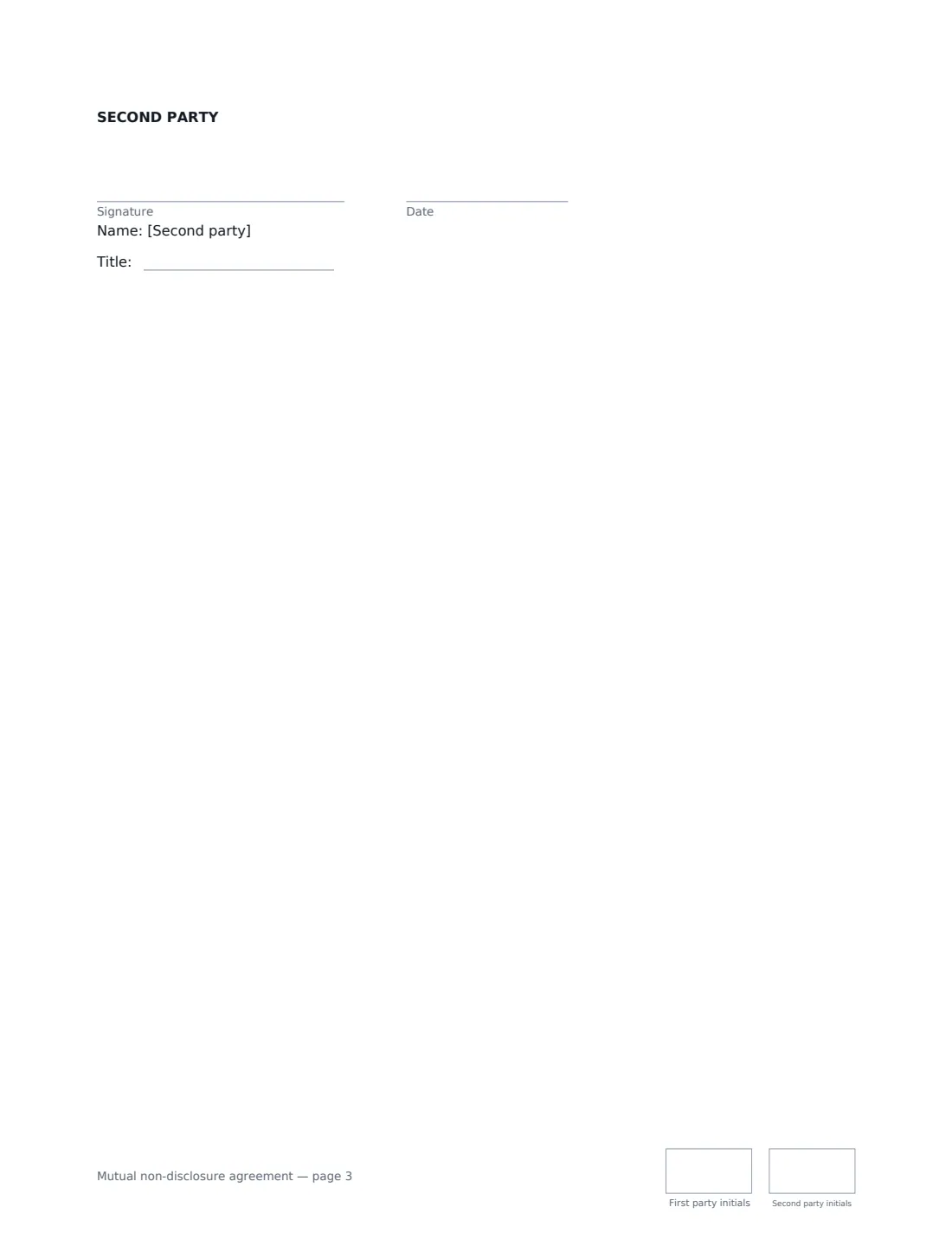
- First party signature and date, job title, initials on every page
- Second party signature and date, job title, initials on every page
What the mutual non-disclosure agreement Covers
- Purpose
- Confidential information
- Obligations of the Recipient
- Disclosure required by law
- Term
- Return or destruction
- No licence or obligation
- Remedies
- General
Using the mutual non-disclosure agreement, step by step
1 Set the purpose
The purpose is the heart of the agreement: confidential information may only be used for it. Describe it in one sentence that is specific enough to mean something — "evaluating a possible distribution partnership for our products in Canada" rather than "business discussions".
2 Choose how long confidentiality lasts
Three years is a common default for commercial information. Pick longer if the information stays valuable for longer. Trade secrets stay protected for as long as they remain trade secrets, whatever you choose.
3 Name the parties and the governing law
Use each party's full legal name — the company, not just the person signing — and its address. The governing law is usually the country, state or province where the party proposing the NDA is based.
4 Add who signs and send
Tick "This is me" for your side and add the other signer's name and email. VergeHR builds the PDF with both signature blocks and the initials boxes on each page. Check it in the editor, then send; the signed copy is filed in Files and emailed to both of you.
Tips Before You Send It
- Make sure each signer is authorised to bind their company — usually a director, officer or manager with signing authority.
- Keep the purpose narrow. A vague purpose makes it harder to show later that information was misused.
- If only one side is sharing information, a one-way NDA is simpler and fairer to the recipient.
- Mark documents you share as "Confidential" — the definition also covers anything a reasonable person would treat as confidential, but a label removes doubt.
Sign It Online In Minutes
- Fill in the blanks. Names, dates and amounts go straight into the agreement — the preview shows exactly where.
- Name who signs. Tick “This is me” for your own part. VergeHR builds the PDF with every signature, date and initials box on the right line, and you can check or move anything before sending.
- Send it. Each signer gets a secure link and signs from any device — no account needed. The signed PDF, with an audit trail and a Certificate of Completion, is filed in Files and emailed to everyone.
Mutual non-disclosure agreement: frequently asked questions
What is the difference between a mutual NDA and a one-way NDA?
In a mutual NDA both parties share confidential information and both are bound to protect what they receive. In a one-way (unilateral) NDA only one side discloses and only the recipient is bound.
Is an NDA signed electronically legally binding?
In most countries, including the US (ESIGN Act and UETA), the UK, the EU (eIDAS) and Canada, an electronic signature is valid for an ordinary commercial contract like an NDA. VergeHR keeps an audit trail and a Certificate of Completion with the signed PDF as evidence of who signed and when.
Can I change the wording of the template?
You fill in the blanks — parties, purpose, term and governing law. If you need different clauses, draft your own document and upload it to VergeHR eSignature instead; you can still place the signature boxes in the editor.
Is this template free?
Yes. The template is free to use with the eSignature app in VergeHR. Signers don't need a VergeHR login.