

What is a one-way non-disclosure agreement?
A one-way (unilateral) non-disclosure agreement is for situations where only one side is sharing secrets: pitching an idea to an investor, briefing a freelancer or agency, showing a manufacturer your designs, or letting a potential buyer look at your figures. The disclosing party is protected; the recipient takes on all the obligations and is not expected to share confidential information of its own.
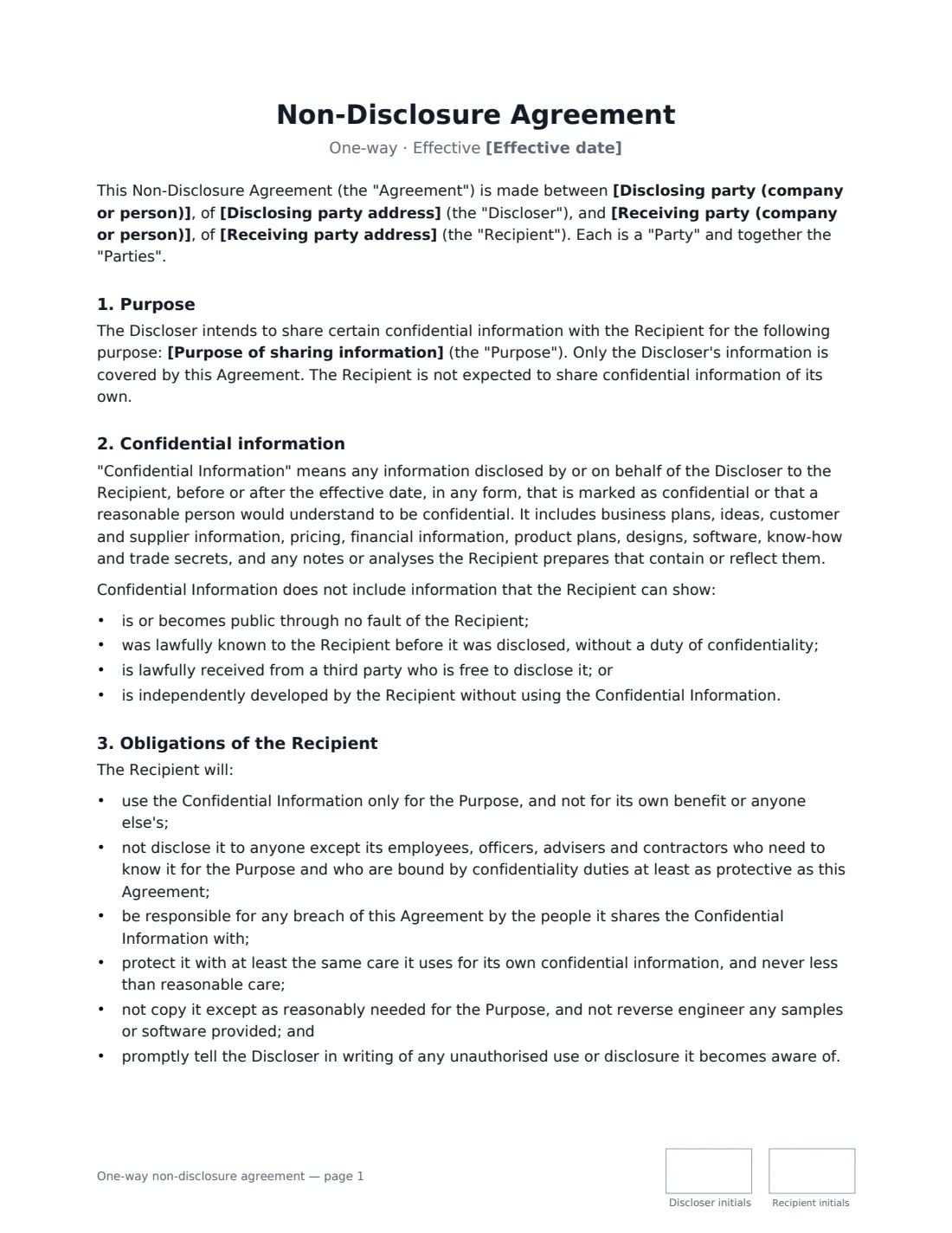
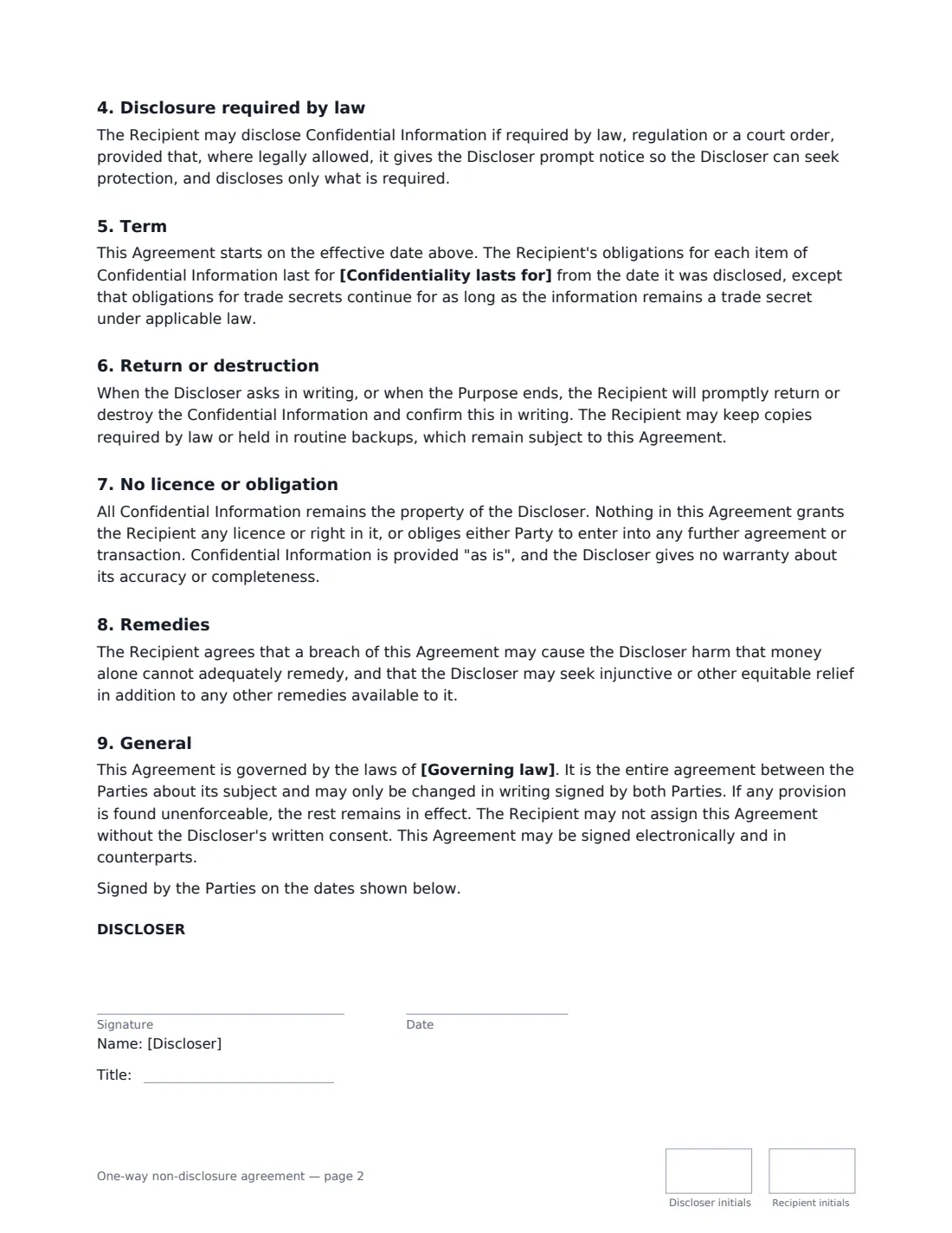
This template defines confidential information broadly — including notes and analyses the recipient makes from it — with the usual exceptions for information that is public, already known, received lawfully from someone else or independently developed. The recipient must use it only for the purpose you state, share it only with people who need to know and are bound to confidentiality, answer for anyone it shares it with, protect it with reasonable care, copy it only as needed, not reverse engineer samples or software, and report any leak. It also covers disclosures required by law, how long confidentiality lasts (trade secrets for as long as they remain secret), return or destruction, no licence, and remedies. Both parties sign and initial every page.
- Best for
- Pitches, hiring freelancers or advisers, supplier briefings, buyer due diligence
- Signed by
- The discloser (usually you) and the recipient
- Who is bound
- The recipient only
- Confidentiality period
- You choose: 1, 2, 3, 5 or 7 years (trade secrets for as long as they stay secret)
- Length
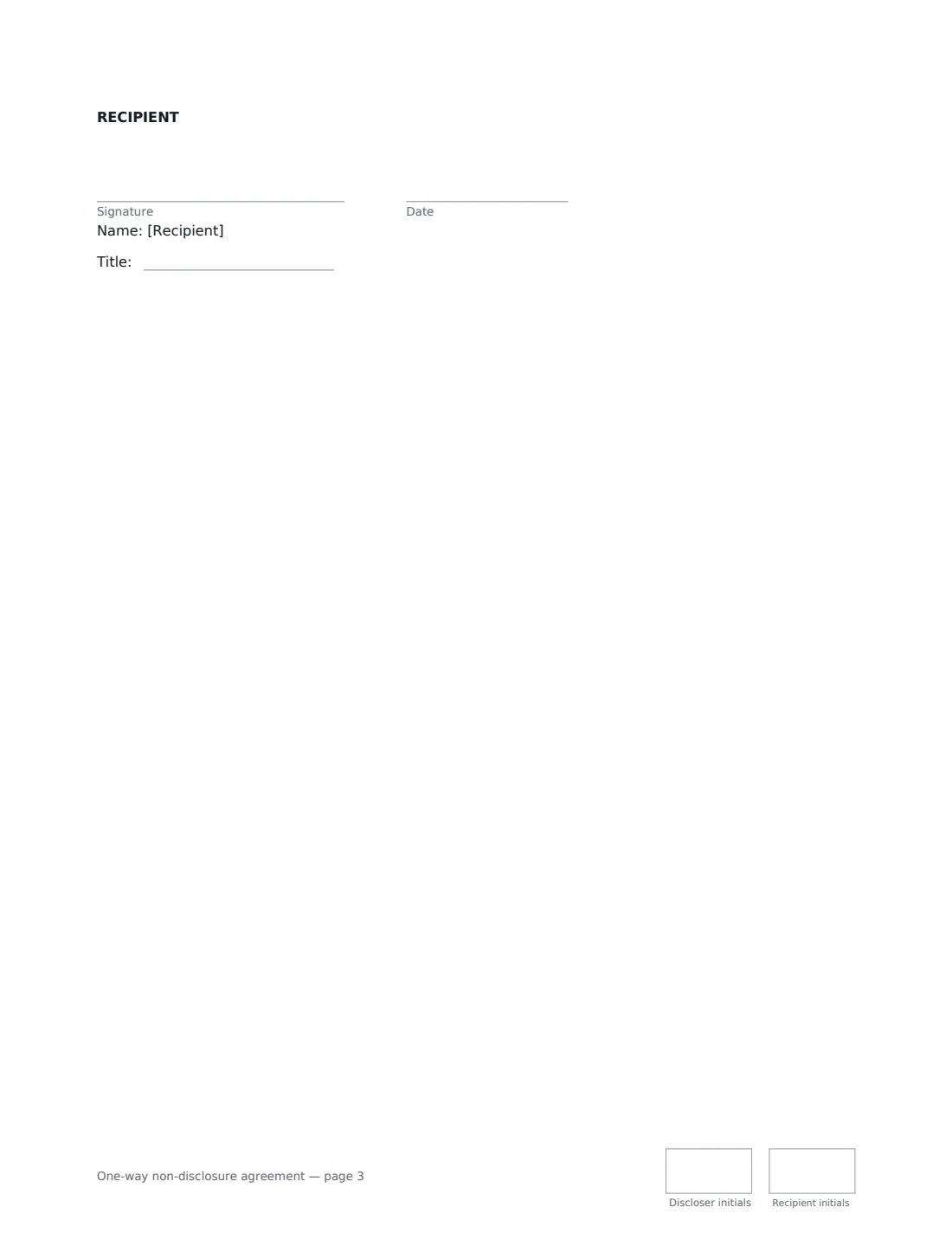
- 3 pages, initialled on every page
When to Use a one-way non-disclosure agreement
- Pitching a business idea or product to a potential investor or partner
- Briefing a freelancer, designer, developer or agency on an unreleased project
- Sharing drawings or specifications with a manufacturer for a quote
- Letting a prospective buyer review your financials before a sale
- Bringing in a consultant or adviser who will see internal information
What You Fill In
8 blanks, then the name and email of each person who signs: discloser, recipient.
1 The agreement
- Effective date*
- Purpose of sharing information*
- Confidentiality lasts for* 1 year · 2 years · 3 years · 5 years · 7 years
- Governing law*
2 Disclosing party
- Disclosing party (company or person)*
- Disclosing party address
3 Receiving party
- Receiving party (company or person)*
- Receiving party address
4 Who signs
- Discloser signature and date, job title, initials on every page
- Recipient signature and date, job title, initials on every page
What the one-way non-disclosure agreement Covers
- Purpose
- Confidential information
- Obligations of the Recipient
- Disclosure required by law
- Term
- Return or destruction
- No licence or obligation
- Remedies
- General
Using the one-way non-disclosure agreement, step by step
1 State the purpose precisely
The recipient may use your information only for the purpose you write here, so make it specific: "evaluating whether to manufacture the Discloser's folding bike frame and quoting for 500 units" rather than "a possible business relationship".
2 Choose how long confidentiality lasts
The period runs from the date each item is disclosed. Three years is a common default for commercial information; choose longer if it stays valuable longer. Trade secrets stay protected for as long as they remain trade secrets.
3 Name both parties and the governing law
Use full legal names — the company rather than the individual where a company is involved — and addresses. The governing law is usually where the discloser is based.
4 Send it before you share anything
Add the recipient's signer and send. VergeHR places both signature, job-title and initials boxes. Wait until it is signed before sending confidential material; the signed copy is filed in Files and emailed to both of you.
Tips Before You Send It
- Get the NDA signed before the first confidential conversation or file, not after.
- Mark documents "Confidential" when you send them. The definition also covers information a reasonable person would treat as confidential, but a label removes doubt.
- Share only what the recipient needs for the purpose, and keep a note of what you sent and when.
- If both sides will share confidential information, use a mutual NDA so the obligations run both ways.
- Check the recipient's signer can bind their company — usually a director, officer or manager.
Sign It Online In Minutes
- Fill in the blanks. Names, dates and amounts go straight into the agreement — the preview shows exactly where.
- Name who signs. Tick “This is me” for your own part. VergeHR builds the PDF with every signature, date and initials box on the right line, and you can check or move anything before sending.
- Send it. Each signer gets a secure link and signs from any device — no account needed. The signed PDF, with an audit trail and a Certificate of Completion, is filed in Files and emailed to everyone.
One-way non-disclosure agreement: frequently asked questions
What is the difference between a one-way NDA and a mutual NDA?
In a one-way NDA only one party discloses and only the recipient is bound. In a mutual NDA both parties share information and both promise to protect what they receive. Use a one-way NDA when the information flows in one direction.
What if I shared something before the NDA was signed?
The definition of confidential information covers information disclosed before or after the effective date, so earlier disclosures made for the same purpose are included. It is still safer to get the NDA signed before you share anything.
What information is not covered?
Information the recipient can show is or becomes public through no fault of theirs, was lawfully known to them before you disclosed it, was received lawfully from someone free to share it, or was developed independently without using your information. The recipient may also disclose information when the law or a court requires it, after notifying you where it legally can.
What happens when the project ends?
When you ask in writing, or when the purpose ends, the recipient must return or destroy your information and confirm this in writing. Copies required by law or held in routine backups may be kept but remain confidential.
Is an NDA signed electronically legally binding?
In the US (ESIGN Act and UETA), the UK, the EU (eIDAS) and Canada, electronic signatures are generally valid for ordinary commercial contracts like an NDA. VergeHR keeps an audit trail and a Certificate of Completion with the signed PDF as evidence of who signed and when.
Can I change the wording of the template?
You fill in the blanks — parties, purpose, term and governing law. If you need different clauses, draft your own document and upload it to VergeHR eSignature; you can still place the signature boxes in the editor.
Is this template free?
Yes. The template is free to use with the eSignature app in VergeHR. The recipient doesn't need a VergeHR login.