

What is a visitor confidentiality acknowledgement?
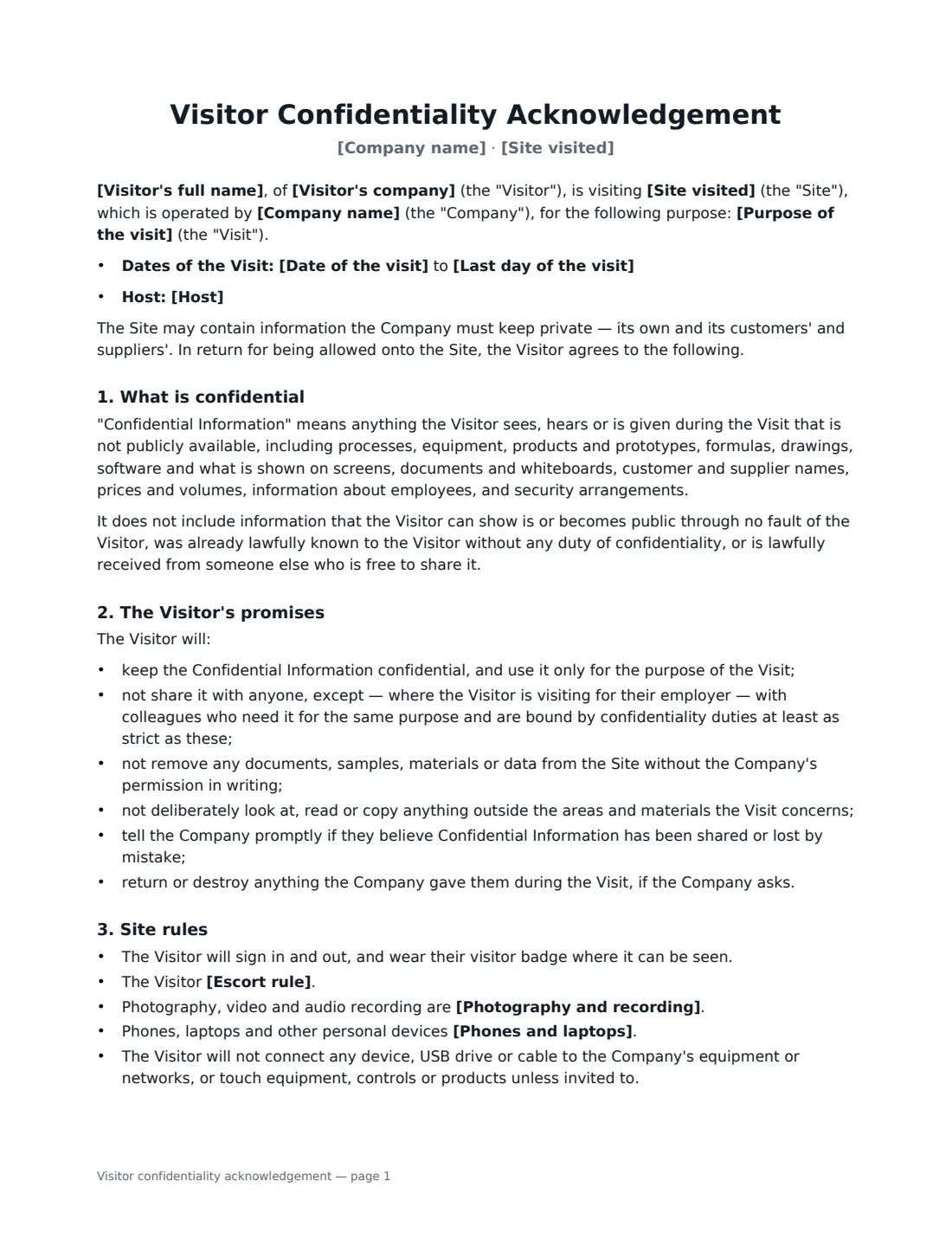
When a supplier, auditor, candidate, customer or contractor visits your lab, factory floor or office, they may see far more than you intended — a prototype on a bench, a whiteboard, a customer's name on a pallet. A visitor confidentiality acknowledgement (often called a visitor NDA) is the short agreement they sign at reception: they keep what they see confidential, and they follow your site rules while they are there.
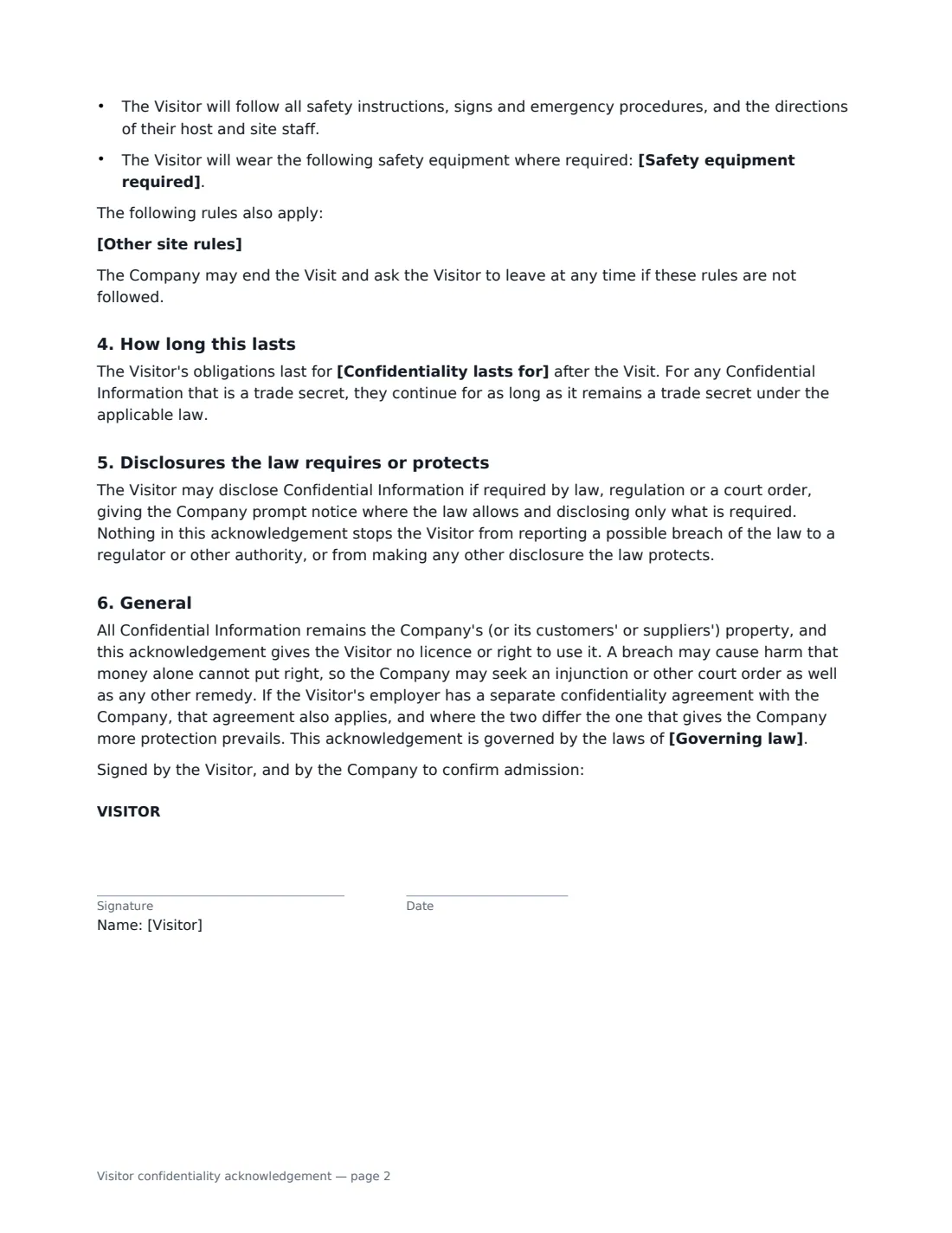
This template records the site, host, purpose and dates of the visit, then defines confidential information broadly — processes, equipment, prototypes, screens and whiteboards, customer and supplier names, prices, employee information and security arrangements — with the usual exceptions for public or already-known information. The visitor promises to use it only for the visit, not to remove materials, and to report accidental disclosures. You choose the site rules: escort at all times or only in restricted areas; photography banned, allowed with the host's permission, or only in reception; and phones either carried (with cameras used only as the photography rule allows) or left at reception. It also covers required safety equipment, a ban on connecting devices to your network, how long the obligations last, whistleblowing protection, and governing law.
- Best for
- Factories, labs, R&D centres, data centres, studios and offices with confidential work
- Signed by
- The visitor, and the host or reception on behalf of the company
- Confidentiality period
- You choose: 2, 3, 5 or 7 years (trade secrets for as long as they stay secret)
- Length
- 2 pages
When to Use a visitor confidentiality acknowledgement
- Supplier and customer audits of a production line
- Candidates or new partners touring a lab or R&D space
- Contractors and maintenance engineers visiting a secure facility
- Investors, journalists or students on a factory tour
- Multi-day visits by a client's project team
What You Fill In
15 blanks, then the name and email of each person who signs: visitor, company.
1 The company and site
- Company name*
- Site visited*
- Host
2 The visit
- Visitor's full name*
- Visitor's company
- Purpose of the visit*
- Date of the visit*
- Last day of the visit
3 Site rules
- Escort rule* must be accompanied by their host at all times · must be accompanied in production, laboratory and restricted areas
- Photography and recording* not allowed anywhere on the Site · allowed only where the host gives permission first · allowed only in reception and meeting rooms
- Phones and laptops* may be carried, but their cameras and recording functions may be used only as the photography rule above allows · must be left at reception for the duration of the Visit
- Safety equipment required
- Other site rules
4 Legal
- Confidentiality lasts for* 2 years · 3 years · 5 years · 7 years
- Governing law*
5 Who signs
- Visitor signature and date · The person visiting the site.
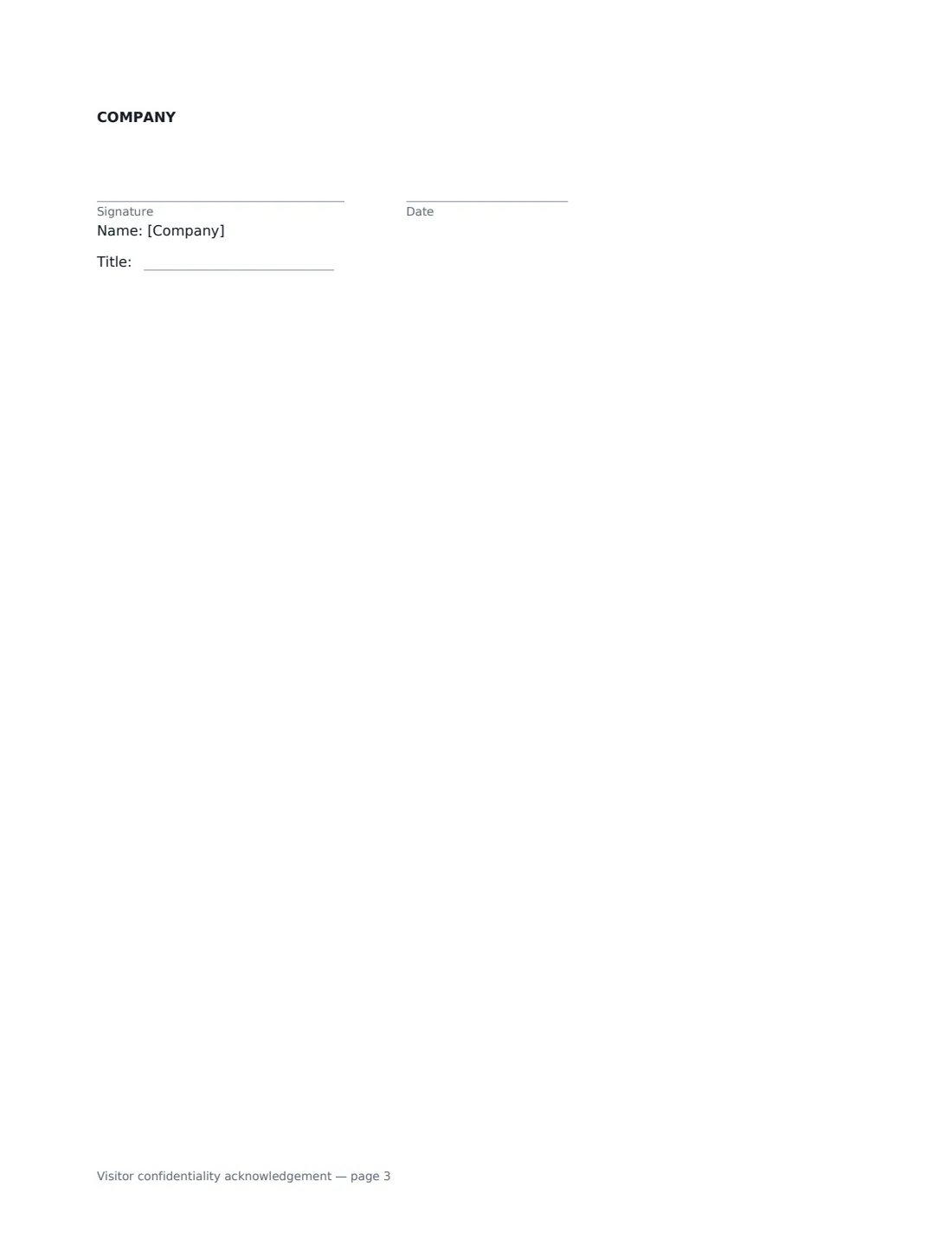
- Company signature and date, job title · The host or the reception or security staff member who admits the visitor.
What the visitor confidentiality acknowledgement Covers
- What is confidential
- The Visitor's promises
- Site rules
- How long this lasts
- Disclosures the law requires or protects
- General
Using the visitor confidentiality acknowledgement, step by step
1 Describe the visit
Enter the site, the host, the visitor and their company, and the purpose — for example "a supplier quality audit of the packaging line". Add a last day for a visit lasting more than one day.
2 Set the site rules
Choose the escort rule, the photography rule and whether phones and laptops can be carried or must stay at reception. Add any safety equipment needed (such as safety glasses and hairnets) and any other rules.
3 Choose the term and governing law
Three years is a sensible default for most visits; choose longer for sensitive R&D. Governing law is usually where the site is.
4 Sign at reception
Send the signing link ahead of the visit, or when they arrive so they can sign on their phone at reception. The host or receptionist then signs for the company. The signed copy is filed in Files with the date of the visit.
Tips Before You Send It
- Send it before the visit so the visitor can read it calmly, rather than signing in a queue.
- If the visitor's employer already has an NDA with you, keep both — the acknowledgement says the stricter terms prevail.
- Brief hosts not to show visitors anything outside the purpose of the visit; an NDA is a backstop, not a substitute.
- Stick a no-photography notice at the entrance too, so the rule is visible as well as signed.
Sign It Online In Minutes
- Fill in the blanks. Names, dates and amounts go straight into the agreement — the preview shows exactly where.
- Name who signs. Tick “This is me” for your own part. VergeHR builds the PDF with every signature, date box on the right line, and you can check or move anything before sending.
- Send it. Each signer gets a secure link and signs from any device — no account needed. The signed PDF, with an audit trail and a Certificate of Completion, is filed in Files and emailed to everyone.
Visitor confidentiality acknowledgement: frequently asked questions
Is a visitor NDA enforceable?
It is a contract like any other NDA, and whether a particular clause is enforceable depends on the facts and the governing law. Keeping it short, specific to the visit and signed before entry gives it the best footing.
Can a visitor still report wrongdoing they see?
Yes. The acknowledgement says nothing stops the visitor reporting a possible breach of law to a regulator or authority, or making any other disclosure the law protects.
Do I need a full mutual NDA instead?
For a one-off visit, this is usually enough. If you and the visitor's company will be sharing information back and forth over time, use a mutual or one-way NDA as well.
Is an electronic signature valid?
Electronic signatures are generally valid for ordinary contracts like this in the US (ESIGN Act and UETA), the UK, the EU (eIDAS) and Canada. VergeHR keeps an audit trail and a Certificate of Completion showing who signed and when.