

What is a supplier quality agreement?
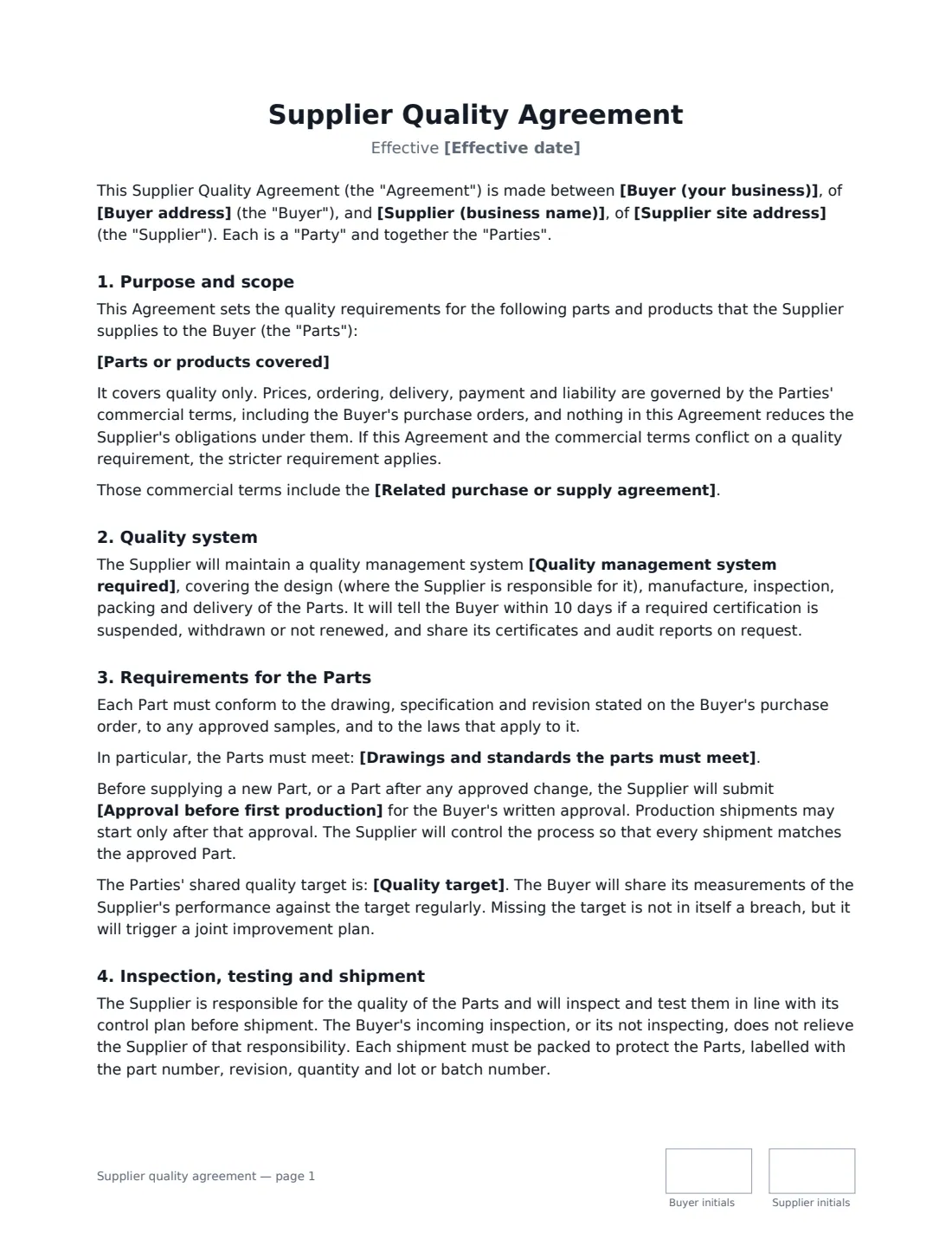
A supplier quality agreement (SQA) sits beside the commercial terms with a supplier and deals only with quality: what quality system the supplier runs, how a new part is approved, what the supplier must tell you before changing anything, and exactly what happens — and how fast — when a bad part gets through. Quality and purchasing teams use it to turn expectations that usually live in emails into commitments both sides have signed.
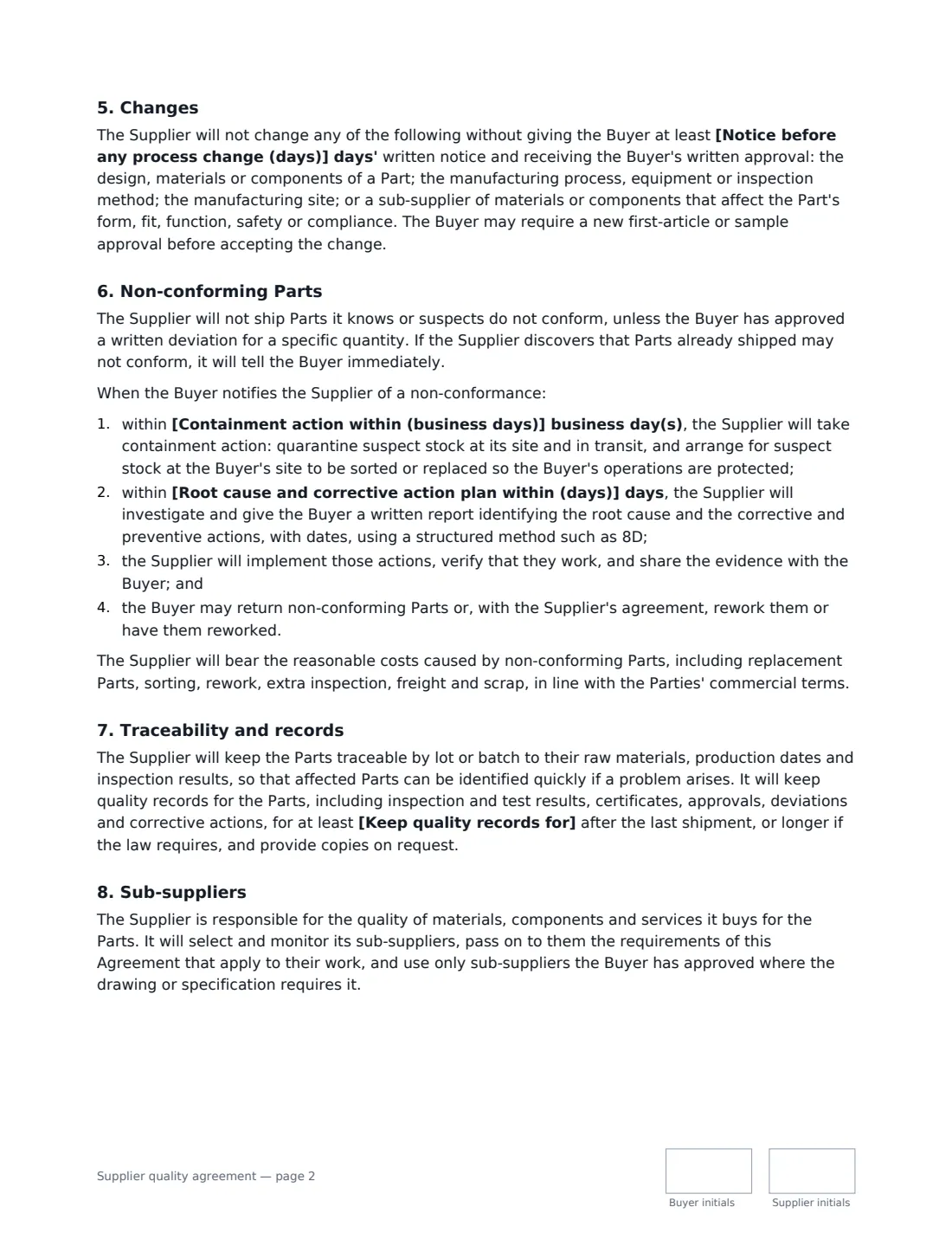
In this template you list the parts covered and, optionally, the supply agreement it supports. You choose the quality management system required (ISO 9001, IATF 16949, ISO 13485, AS9100, or a documented system without certification), the approval needed before first production (first article inspection report, PPAP package or a production sample), and whether a certificate of conformity comes with each shipment. You set the notice for process changes, the business days for containment, the days for a root cause and corrective action report, how long records are kept, the notice for routine audits, and an optional quality target such as a parts-per-million level. Traceability, sub-supplier flow-down, cost recovery for non-conforming parts and an escalation path are included.
- Best for
- Manufacturers and assemblers managing suppliers of parts and components
- Signed by
- Usually the quality managers or directors of the buyer and supplier
- Works with
- Your supply agreement or purchase order terms, which keep prices and liability
- Length
- About 3 pages, initialled on every page
When to Use a supplier quality agreement
- Onboarding a new supplier of machined, moulded or electronic parts
- Meeting a customer or certification requirement to have quality agreements with key suppliers
- Resetting expectations with a supplier after repeated non-conformances
- Requiring advance notice before a supplier moves production or changes a material
- Documenting first article or PPAP requirements for a new part
What You Fill In
20 blanks, then the name and email of each person who signs: buyer, supplier.
1 The parties
- Buyer (your business)*
- Buyer address*
- Supplier (business name)*
- Supplier site address*
2 Scope
- Effective date*
- Parts or products covered*
- Related purchase or supply agreement
3 Standards
- Quality management system required* certified to ISO 9001 · certified to IATF 16949 · certified to ISO 13485 · certified to AS9100 · that is documented and effective but need not be certified
- Drawings and standards the parts must meet
- Approval before first production* a first article inspection report · a full production part approval process (PPAP) package · a production sample
- Certificate of conformity with each shipment* Yes · No
- Quality target
4 Responses and records
- Notice before any process change (days)*
- Containment action within (business days)*
- Root cause and corrective action plan within (days)*
- Keep quality records for* 3 years · 5 years · 10 years · 15 years
- Notice before a routine audit (days)*
5 Contacts
- Buyer quality contact
- Supplier quality contact
- Governing law*
6 Who signs
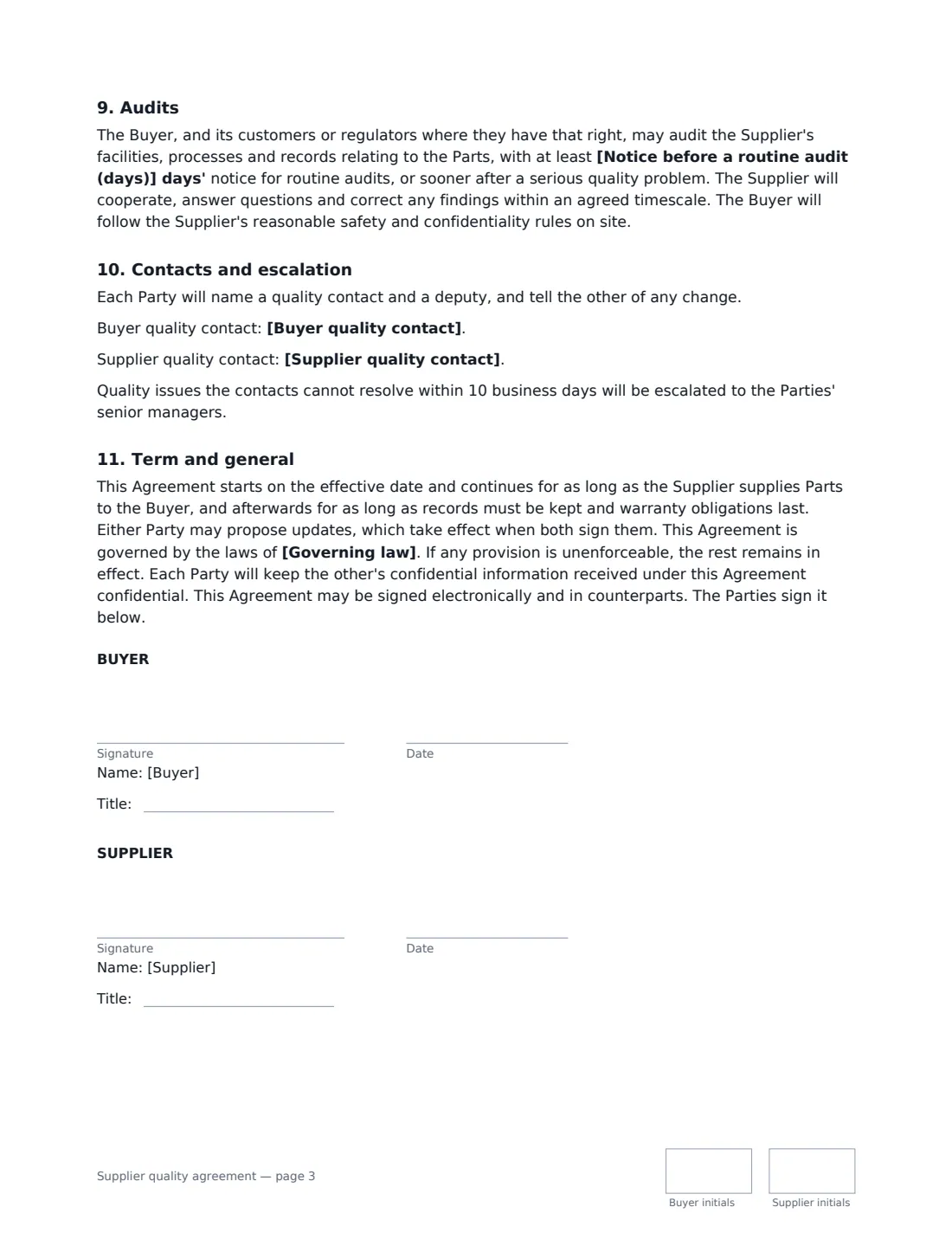
- Buyer signature and date, job title, initials on every page · Usually the buyer's quality or purchasing manager.
- Supplier signature and date, job title, initials on every page · Usually the supplier's quality manager or a director.
What the supplier quality agreement Covers
- Purpose and scope
- Quality system
- Requirements for the Parts
- Inspection, testing and shipment
- Changes
- Non-conforming Parts
- Traceability and records
- Sub-suppliers
- Audits
- Contacts and escalation
- Term and general
Using the supplier quality agreement, step by step
1 Define the scope
List the parts or product families covered and, if you have one, name the supply agreement. The SQA covers quality only; where it and the commercial terms differ on a quality requirement, the stricter one applies.
2 Choose the standards and approvals
Pick the quality management system the supplier must maintain, name the drawings and standards, and choose the approval required before first production. Decide whether each shipment needs a certificate of conformity.
3 Set the response times
Enter the notice needed before any change to design, materials, process, site or sub-supplier, how many business days the supplier has to contain a problem, and how many days to deliver a root cause and corrective action report (for example an 8D).
4 Records, audits and contacts
Choose how long quality records are kept and the notice for routine audits. Add each side's quality contact so issues reach the right person, then name the signers and send.
Tips Before You Send It
- Choose a record retention period at least as long as your industry, customers or regulators require — some require far longer than the default.
- Make the containment time realistic for the supplier's location; a same-day requirement is hard to meet across time zones.
- Share the quality target and your measurements regularly — the agreement treats missing it as a trigger for an improvement plan, not a breach.
- Keep prices, liability caps and warranty remedies in the supply agreement so the two documents don't contradict each other.
- Review the SQA when you add new part families or the supplier changes its certification.
Sign It Online In Minutes
- Fill in the blanks. Names, dates and amounts go straight into the agreement — the preview shows exactly where.
- Name who signs. Tick “This is me” for your own part. VergeHR builds the PDF with every signature, date and initials box on the right line, and you can check or move anything before sending.
- Send it. Each signer gets a secure link and signs from any device — no account needed. The signed PDF, with an audit trail and a Certificate of Completion, is filed in Files and emailed to everyone.
Supplier quality agreement: frequently asked questions
Do I still need a supply agreement if I have an SQA?
Yes, or at least purchase order terms. The SQA covers quality only — standards, approvals, changes, non-conformances, records and audits. Prices, ordering, delivery, payment and liability stay in the commercial terms.
What happens when a non-conforming part is found?
The supplier contains it within the business days you set, sends a written root cause and corrective action report within the days you set, implements and verifies the fixes, and bears the reasonable costs of sorting, rework, replacement, freight and scrap.
Can a supplier change its process after approval?
Not without giving the notice you choose and getting your written approval. That applies to changes in design, materials, process, equipment, inspection method, site, or sub-suppliers that affect form, fit, function, safety or compliance.
Is an electronically signed quality agreement valid?
Electronic signatures are generally valid for ordinary commercial agreements in the US (ESIGN Act and UETA), the UK, the EU (eIDAS) and Canada. VergeHR keeps an audit trail and a Certificate of Completion with the signed PDF, which is useful evidence in audits.