

What is a manufacturing agreement?
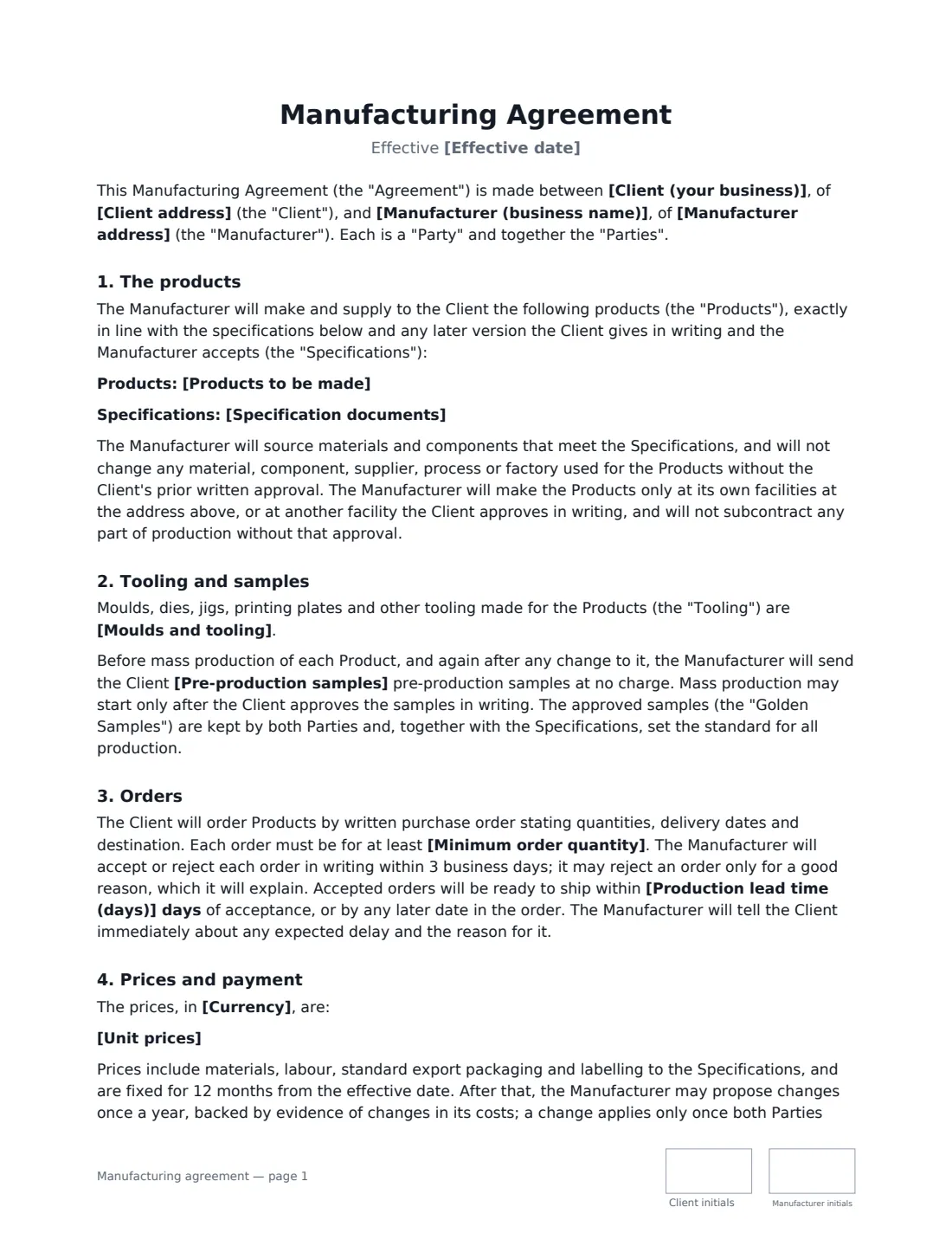
A manufacturing agreement (or contract manufacturing agreement) is signed between a brand and the factory that makes its products. The brand owns the design and sells the product; the manufacturer builds it to the brand's specification. The agreement makes sure every production run matches what was approved, that the brand's designs and molds stay the brand's, and that the manufacturer can't sell the same product to someone else.
In this template you name the products and the specification documents, choose whether tooling is paid for and owned by you, by the manufacturer, or not needed, and set the number of pre-production samples — approved samples become the "golden samples" every order must match. You enter unit prices, the minimum order quantity, lead time, an optional deposit and when the balance is paid (after pre-shipment inspection, or a number of days after delivery), plus Incoterms delivery terms and an optional inspection standard such as an AQL level. It also covers change control, factory audits, rework at the manufacturer's cost, warranty and recalls, product liability insurance, no overruns or copies, confidentiality, and optional arbitration.
- Best for
- Product brands using a contract or private-label manufacturer, at home or abroad
- Signed by
- An authorised signer at the brand and at the manufacturer
- Quality
- Golden samples, pre-shipment inspection and factory audits
- Length
- About 4 pages, initialled on every page
When to Use a manufacturing agreement
- A consumer product brand moving from prototypes to its first production run
- An e-commerce brand using an overseas factory for a private-label product
- A company paying for custom molds and wanting clear ownership of them
- Formalising terms with an existing factory after a quality problem
- Adding a second manufacturer to reduce supply risk
What You Fill In
24 blanks, then the name and email of each person who signs: client, manufacturer.
1 The parties
- Client (your business)*
- Client address*
- Manufacturer (business name)*
- Manufacturer address*
2 The products
- Effective date*
- Products to be made*
- Specification documents*
3 Tooling and samples
- Moulds and tooling* paid for by the Client and owned by the Client · paid for and owned by the Manufacturer · not applicable, as the Products need no special tooling
- Tooling cost
- Pre-production samples*
4 Prices and orders
- Currency*
- Unit prices*
- Minimum order quantity*
- Production lead time (days)*
- Deposit with each order (%)
- The balance is paid* after the goods pass pre-shipment inspection and before they are shipped · within an agreed number of days after delivery
- Days after delivery (if paid after delivery)
5 Quality and delivery
- Delivery terms*
- Inspection standard
- Warranty against defects (months)*
6 Other terms
- Term* 1 year · 2 years · 3 years · 5 years
- Notice not to renew (days)*
- Governing law*
- Where disputes are decided
7 Who signs
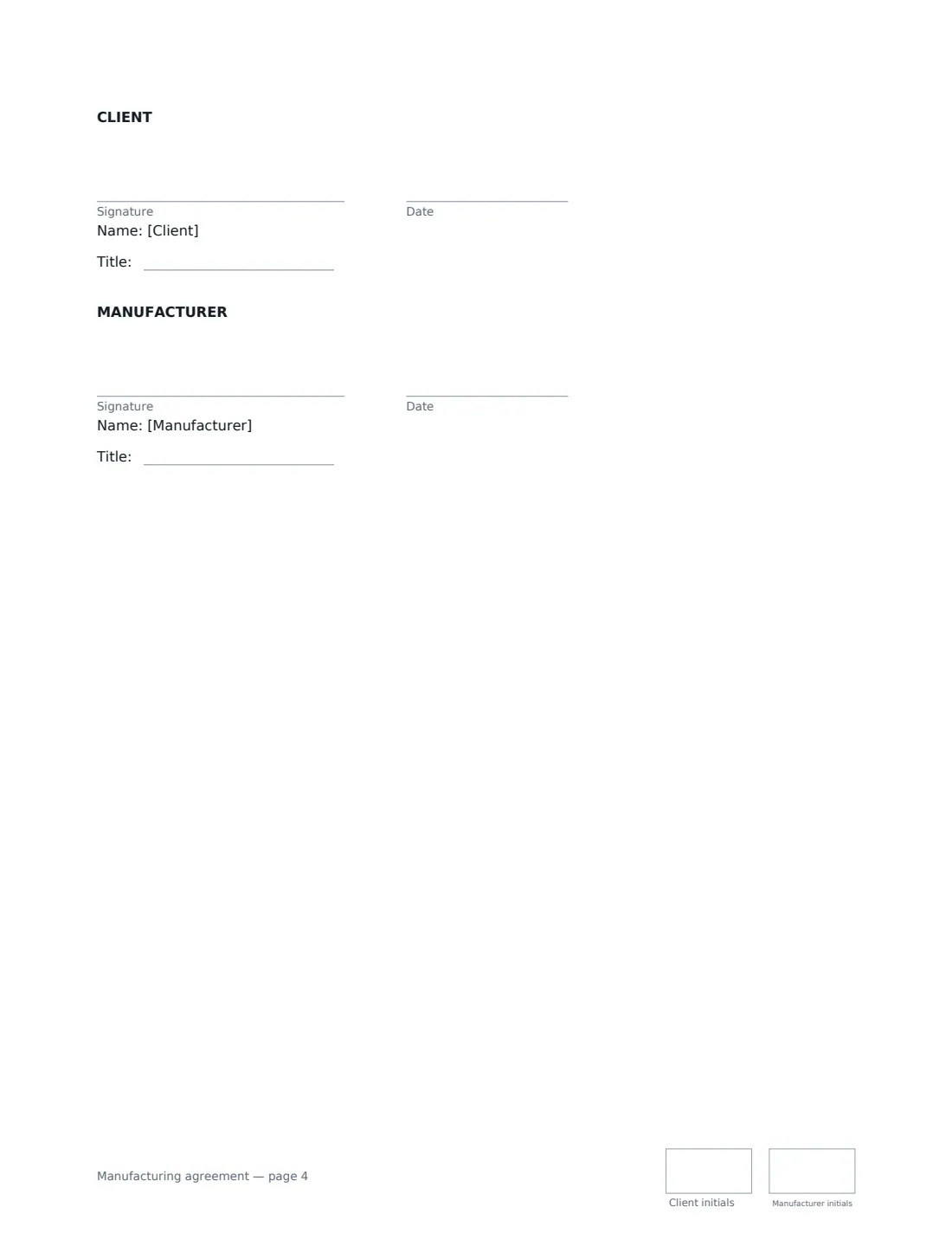
- Client signature and date, job title, initials on every page · Someone authorised to sign for the brand ordering the products.
- Manufacturer signature and date, job title, initials on every page · Someone authorised to sign for the manufacturer.
What the manufacturing agreement Covers
- The products
- Tooling and samples
- Orders
- Prices and payment
- Quality control and inspection
- Delivery
- Warranty and defects
- Intellectual property and exclusivity
- Confidentiality
- Term and ending the Agreement
- General
Using the manufacturing agreement, step by step
1 Name the products and specifications
List the products and every document they must match: drawings, bills of materials, packaging artwork, safety or chemical standards for your market. The manufacturer can't change materials, suppliers or the factory without your written approval.
2 Settle tooling and samples
If you pay for molds or other tooling, enter the cost: you pay half at the start and half on sample approval, and own the tooling once it is paid for. Set how many free pre-production samples you receive. Mass production starts only after you approve them.
3 Enter prices, MOQ and payment
Put unit prices on separate lines (fixed for 12 months), the minimum order quantity and the production lead time. Choose an optional deposit per order and whether the balance is paid after pre-shipment inspection but before shipping, or a set number of days after delivery.
4 Set quality and delivery terms
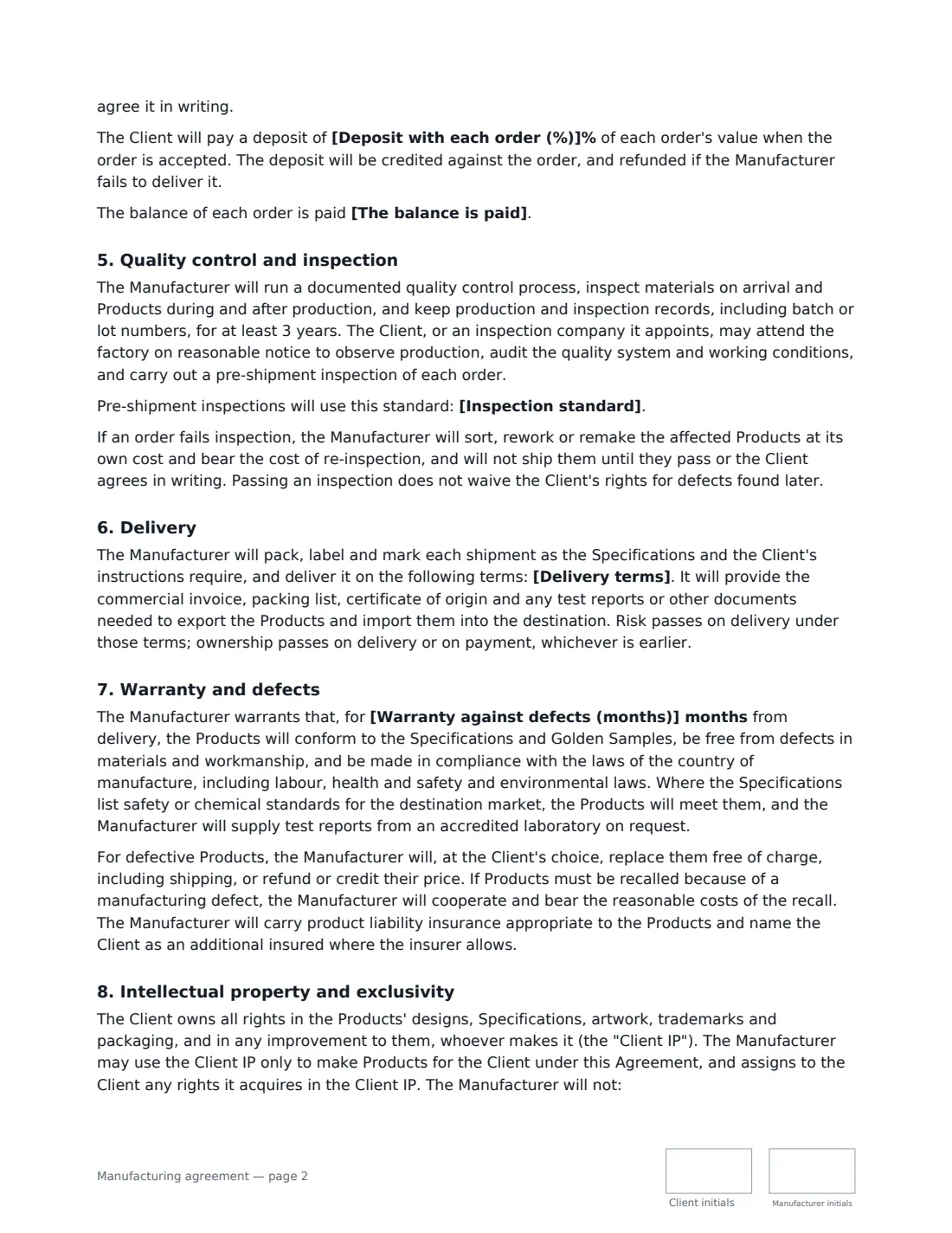
Enter the Incoterms delivery terms and, if you use one, the inspection standard. Orders that fail inspection are reworked or remade at the manufacturer's cost before they ship.
5 Choose governing law and disputes
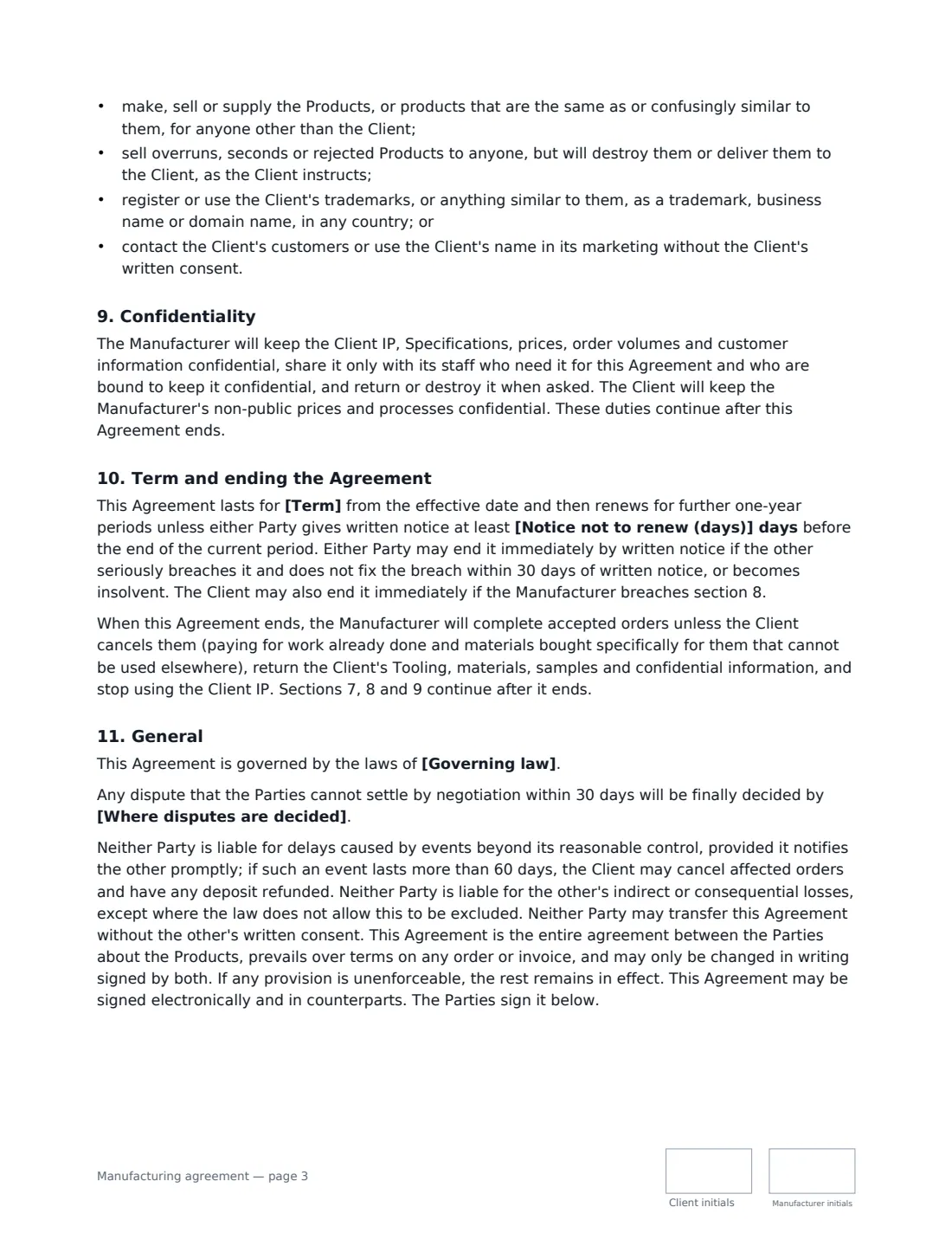
Pick the governing law and, especially with a factory in another country, where disputes are decided. Then choose the term and renewal notice, name the signers and send.
Tips Before You Send It
- Keep a signed golden sample at both ends — it settles most quality arguments quickly.
- With an overseas manufacturer, arbitration is often easier to enforce than a court judgment. Take advice on the right forum and seat.
- Register your trademarks in the manufacturer's country too; the contract promise not to register them is easier to rely on with your own registration in place.
- Budget for independent pre-shipment inspections on the first orders at least.
- Pair this with a mutual NDA before you share designs during factory selection.
Sign It Online In Minutes
- Fill in the blanks. Names, dates and amounts go straight into the agreement — the preview shows exactly where.
- Name who signs. Tick “This is me” for your own part. VergeHR builds the PDF with every signature, date and initials box on the right line, and you can check or move anything before sending.
- Send it. Each signer gets a secure link and signs from any device — no account needed. The signed PDF, with an audit trail and a Certificate of Completion, is filed in Files and emailed to everyone.
Manufacturing agreement: frequently asked questions
Who owns the molds and tooling?
You choose. If you pay for the tooling it belongs to you once paid for: the manufacturer marks it as yours, keeps it insured, uses it only for your products and hands it over when you ask. If the manufacturer pays, it keeps the tooling but may use it only for your products.
Can the manufacturer sell my product to others?
No. The manufacturer may use your designs only to make your products, may not make the same or confusingly similar products for anyone else, and must destroy or deliver to you any overruns and rejects rather than sell them.
What if a production run fails inspection?
The manufacturer sorts, reworks or remakes the affected products at its own cost, pays for re-inspection, and may not ship them until they pass or you agree in writing. Passing inspection doesn't waive your rights for defects found later.
Can I sign this with a factory in another country electronically?
Electronic signatures are generally valid for ordinary commercial contracts in the US (ESIGN Act and UETA), the UK, the EU (eIDAS) and Canada, and are widely accepted elsewhere for business contracts. Check the rules in the manufacturer's country if you are unsure. VergeHR keeps an audit trail and a Certificate of Completion with the signed PDF.