

What is a white label agreement?
In a white label arrangement, one business (the provider) makes a product or runs a service, and another business (the partner) sells it to its own customers under the partner's brand. End customers see only the partner. It is common with SaaS platforms, marketing and IT services, supplements and cosmetics, and managed services.
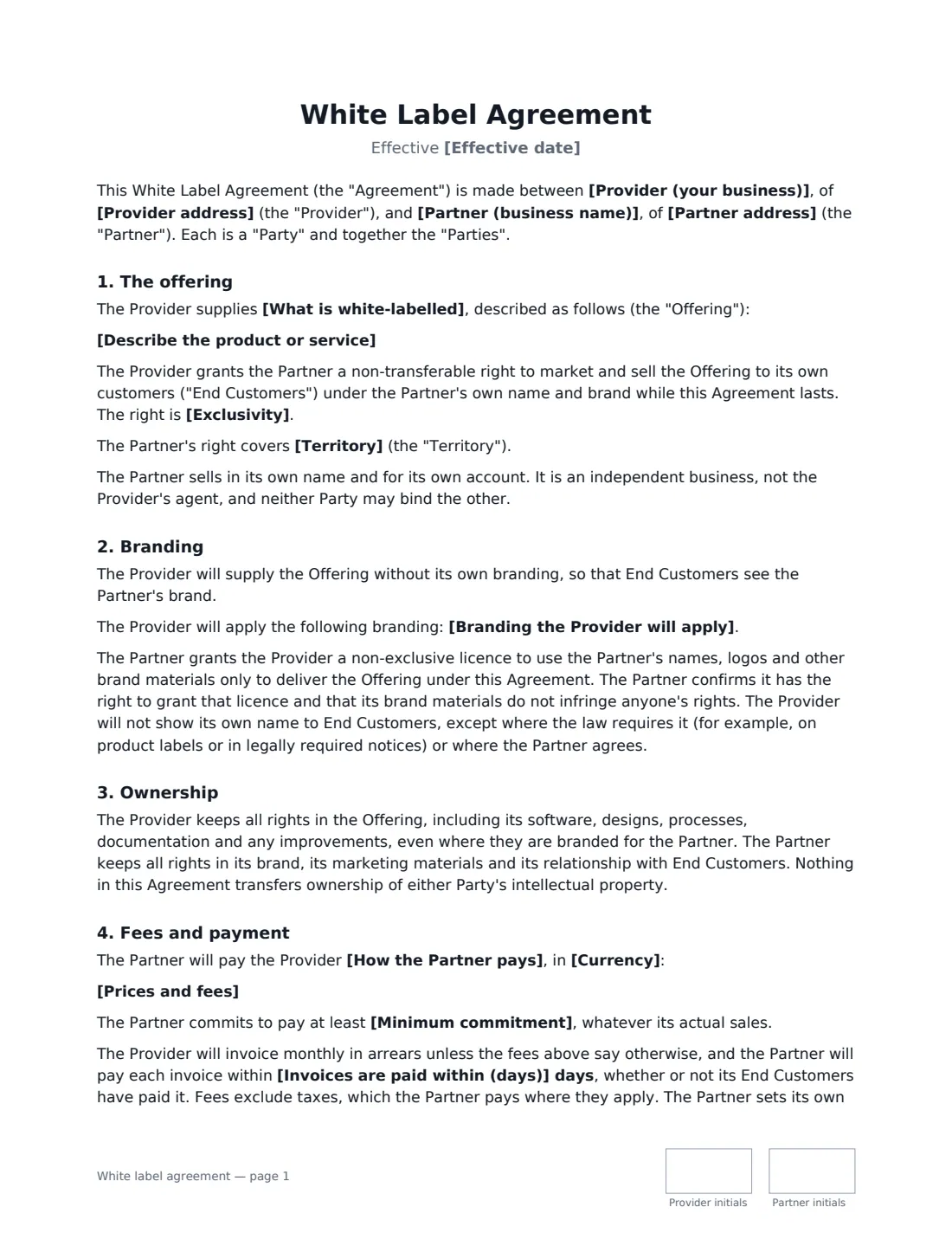
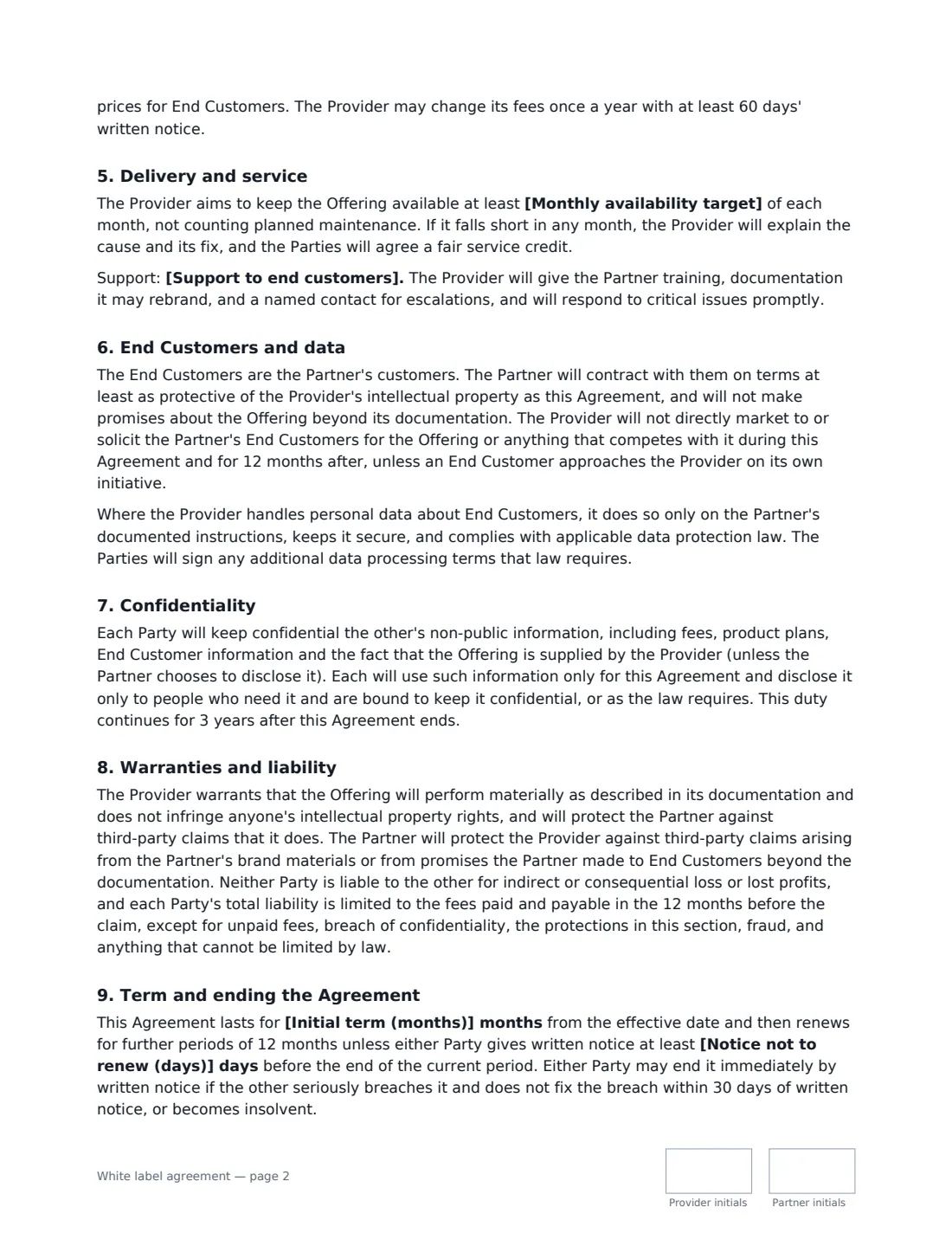
This template works for a software or online service, physical products, or a professional or managed service, and adds the right delivery clause for each. You describe the offering and the branding the provider will apply, set an optional territory and choose non-exclusive or exclusive rights. Pricing can be wholesale prices, a revenue share (with monthly statements and an annual records check) or a platform fee plus per-customer charges, with an optional minimum commitment. You choose how support works, optionally set a monthly availability target, and set the term, renewal notice and a transition period after the end during which the provider keeps serving existing customers and exports their data. Ownership, the provider's promise not to solicit the partner's customers, data protection, confidentiality (including of the white label arrangement itself) and liability are covered.
- Best for
- SaaS platforms, agencies, service providers and product makers offering partner-branded versions
- Signed by
- An authorised signer at the provider and at the partner
- Pricing models
- Wholesale prices, revenue share, or platform fee plus per-customer charges
- Length
- About 3 pages, initialled on every page
When to Use a white label agreement
- A SaaS company letting agencies offer its platform on their own domain and brand
- An SEO or marketing firm delivering services an agency resells as its own
- A supplement or cosmetics maker producing products under a retailer's brand
- A managed IT provider supplying a help desk that answers under the partner's name
- Moving an informal rebranding arrangement onto written terms
What You Fill In
22 blanks, then the name and email of each person who signs: provider, partner.
1 The parties
- Provider (your business)*
- Provider address*
- Partner (business name)*
- Partner address*
2 The offering
- Effective date*
- What is white-labelled* a software or online service · physical products · a professional or managed service
- Describe the product or service*
- Branding the Provider will apply
- Territory
- Exclusivity* non-exclusive · exclusive in the Territory
3 Fees
- Currency*
- How the Partner pays* the wholesale prices below · a share of the Partner's revenue from the offering · a monthly platform fee plus the per-customer charges below
- Prices and fees*
- Provider's share of revenue (%)
- Minimum commitment
- Invoices are paid within (days)*
4 Support
- Support to end customers* The Partner gives first-line support and the Provider supports the Partner · The Provider supports end customers directly, under the Partner's brand
- Monthly availability target
5 Term
- Initial term (months)*
- Notice not to renew (days)*
- Transition period after the end (days)*
- Governing law*
6 Who signs
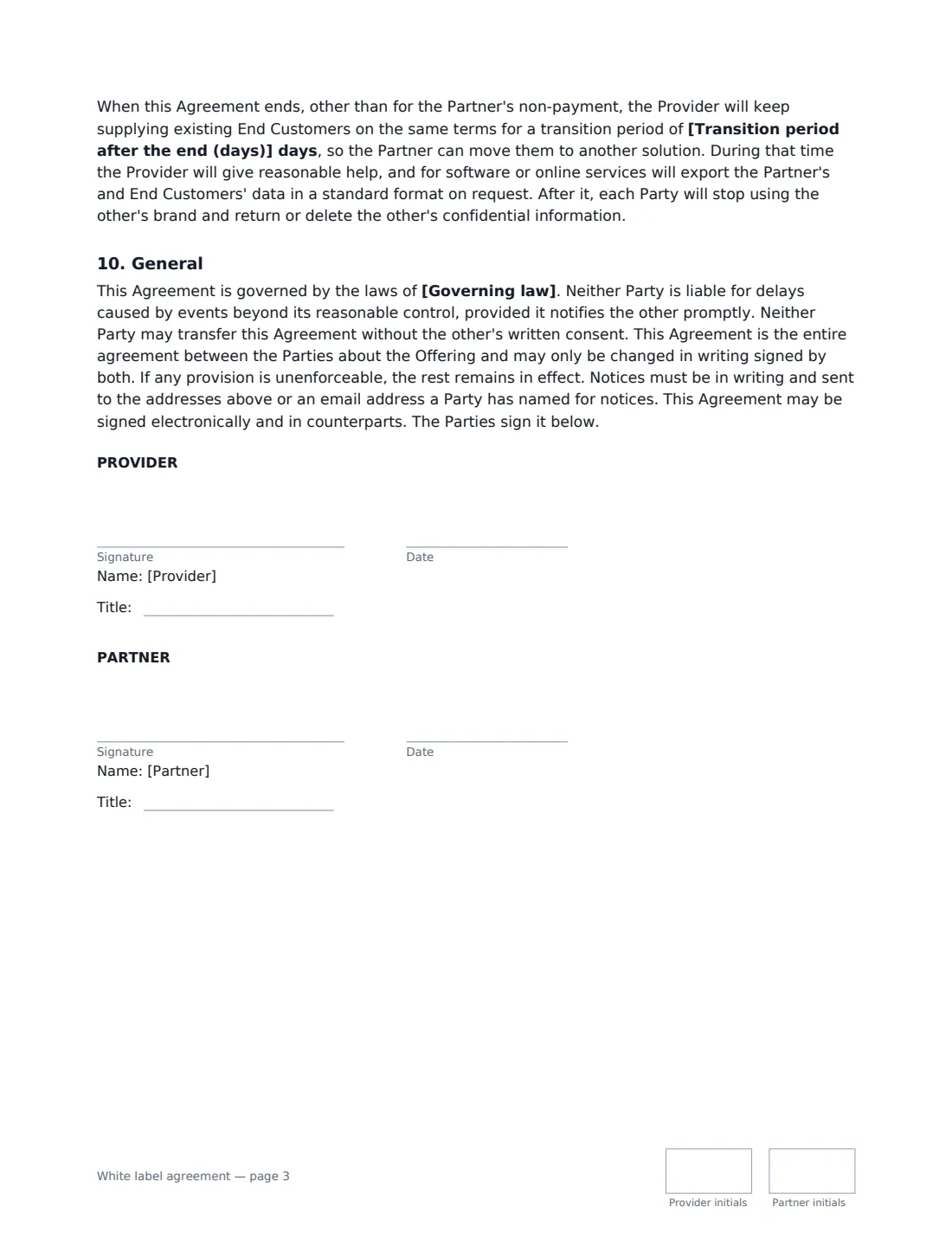
- Provider signature and date, job title, initials on every page · Someone authorised to sign for the business whose product or service is white-labelled.
- Partner signature and date, job title, initials on every page · Someone authorised to sign for the business selling it under its own brand.
What the white label agreement Covers
- The offering
- Branding
- Ownership
- Fees and payment
- Delivery and service
- End Customers and data
- Confidentiality
- Warranties and liability
- Term and ending the Agreement
- General
Using the white label agreement, step by step
1 Describe the offering and the branding
Choose the type of offering and describe it, then list the branding the provider applies — logo, colours, domain, emails, packaging. The provider keeps its name off everything the customer sees, except where the law requires it.
2 Set territory and exclusivity
Leave the territory empty for no limit, or name one. If you choose exclusive, the provider won't white-label the same offering for another partner in that territory.
3 Pick the pricing model
Enter the wholesale prices or fees; for a revenue share, enter the provider's percentage and describe what counts as revenue. Add a minimum commitment if the partner guarantees a monthly amount. The partner sets its own retail prices.
4 Decide support and service levels
Choose whether the partner handles first-line support or the provider supports customers directly under the partner's brand. For software, you can add a monthly availability target with a fair service credit if it is missed.
5 Plan the exit
Set the initial term, renewal notice and a transition period after the end, during which the provider keeps serving existing customers and helps the partner move them, including a data export for software.
Tips Before You Send It
- In some markets, product labels must still show the maker's or importer's details — the agreement allows this wherever the law requires it.
- Agree who owns the customer relationship up front. Here, the customers belong to the partner and the provider may not solicit them for 12 months after the end.
- If the provider handles customer personal data, sign data processing terms alongside this agreement where the law requires them.
- For an arrangement where the partner sells under your brand instead, use a reseller agreement.
- Confidentiality covers the fact that the provider is behind the offering, unless the partner chooses to disclose it.
Sign It Online In Minutes
- Fill in the blanks. Names, dates and amounts go straight into the agreement — the preview shows exactly where.
- Name who signs. Tick “This is me” for your own part. VergeHR builds the PDF with every signature, date and initials box on the right line, and you can check or move anything before sending.
- Send it. Each signer gets a secure link and signs from any device — no account needed. The signed PDF, with an audit trail and a Certificate of Completion, is filed in Files and emailed to everyone.
White label agreement: frequently asked questions
What is the difference between white label and reselling?
A reseller sells your product under your brand. A white label partner sells it under its own brand, and customers usually never see yours.
Who owns the product and the customers?
The provider keeps all rights in the product, software and processes, even when branded for the partner. The partner keeps its brand and owns its customer relationships.
What happens to customers when the agreement ends?
Unless it ended for the partner's non-payment, the provider keeps supplying existing customers on the same terms for the transition period you choose, gives reasonable help moving them, and for software exports the data in a standard format on request.
Is a white label agreement signed online legally binding?
Electronic signatures are generally valid for ordinary commercial contracts in the US (ESIGN Act and UETA), the UK, the EU (eIDAS) and Canada. VergeHR keeps an audit trail and a Certificate of Completion with the signed PDF.