

What is a master services agreement?
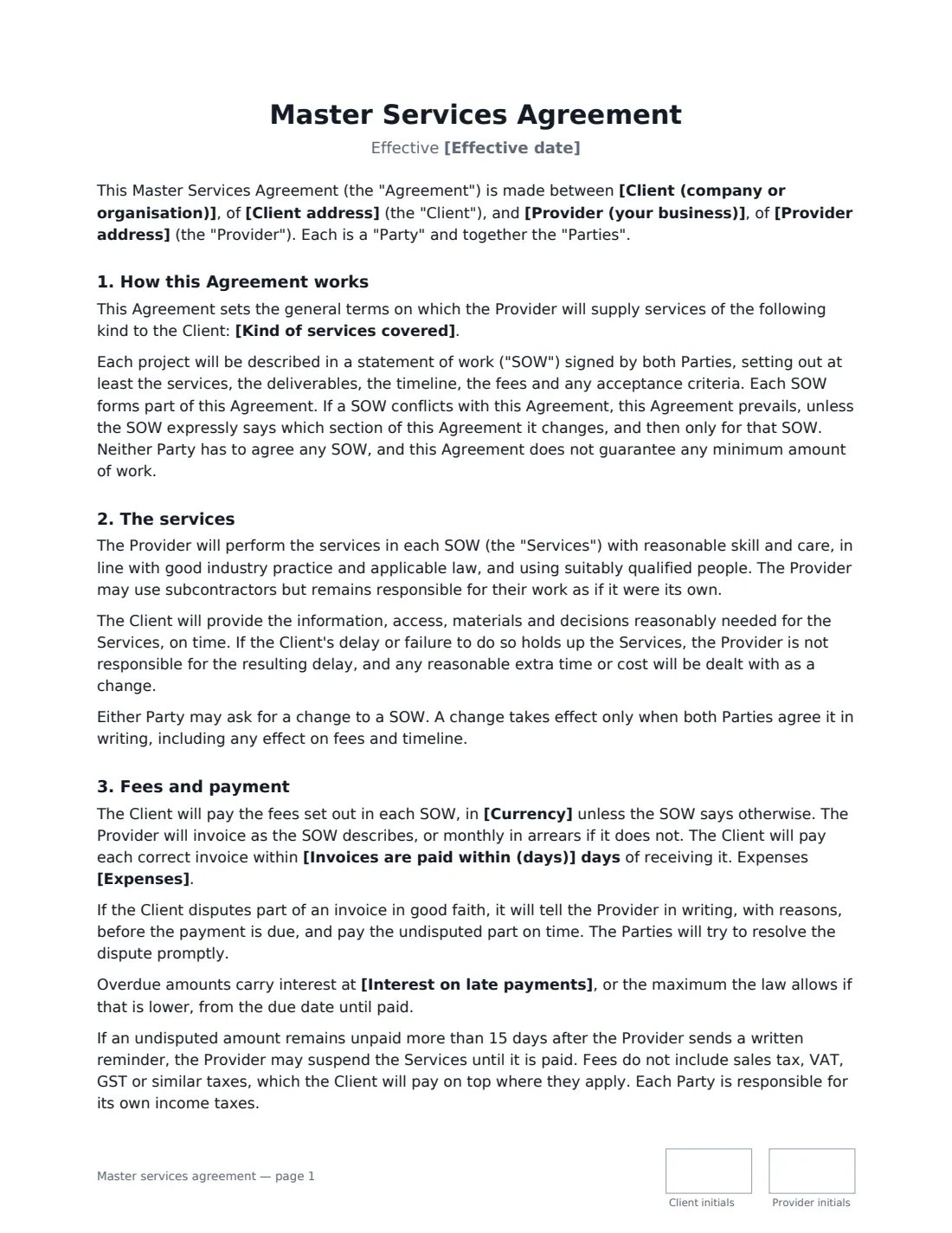
A master services agreement (MSA) is the umbrella contract between a service business and a client it expects to work with more than once. It holds the terms that rarely change from project to project: how invoices are paid, who owns the work, how confidential information is handled, what each side is liable for, and how the relationship ends. Each project is then written up in a statement of work (SOW) that sits under the MSA and only needs to describe the scope, deliverables, timeline and fees.
This template sets out that framework in fourteen clauses. You choose how expenses are handled, how many days the client has to review deliverables, whether the client or the provider owns the deliverables, the liability cap (twelve months of fees, the fees under the SOW concerned, or a fixed amount), whether there is an initial term, the notice periods, and whether either side may recruit the other's staff. The agreement also covers disputed invoices, acceptance, personal data, warranties, protection against third-party IP claims, insurance and force majeure.
- Best for
- Agencies, consultancies, IT and software firms, and other B2B service providers with repeat clients
- Signed by
- An authorised signer at the client and at the provider, with job titles
- Works with
- A statement of work for each project
- Length
- About 4 pages, initialled on every page
When to Use a master services agreement
- A software development firm starting a long-term relationship with a client that will commission several projects
- A marketing or design agency that wants each campaign to be a quick statement of work, not a new contract
- A managed IT or consulting business setting standard terms before the first engagement
- A client's procurement team asking for an MSA before any work can start
- Replacing a patchwork of old quotes and emails with one set of signed terms
What You Fill In
23 blanks, then the name and email of each person who signs: client, provider.
1 The parties
- Provider (your business)*
- Provider address*
- Client (company or organisation)*
- Client address*
2 The agreement
- Effective date*
- Kind of services covered*
- How long the agreement lasts* continues until either Party ends it under section 13 · lasts for an initial term of the number of months below, then continues until either Party ends it under section 13
- Initial term (months)
- Notice to end the agreement without cause (days)*
- Time to fix a serious breach (days)*
3 Fees and payment
- Currency*
- Invoices are paid within (days)*
- Expenses* are reimbursed at cost only if the Client approved them in writing beforehand · are reimbursed as set out in each SOW · are included in the fees and are not charged separately
- Interest on late payments
4 Delivery and ownership
- Days the Client has to review a deliverable*
- Who owns the deliverables* The Client owns the deliverables once paid for · The Provider owns the deliverables and licenses them to the Client
- Days to report defects after delivery*
5 Risk
- Each party's total liability is limited to* the fees paid and payable under this Agreement in the 12 months before the event giving rise to the claim · the fees paid and payable under the SOW that the claim relates to · the fixed amount below
- Fixed liability cap
- Insurance the Provider will carry
6 Other terms
- Neither side hires the other's staff* Yes, during the agreement and for 12 months after · No
- Governing law*
- Courts that hear disputes
7 Who signs
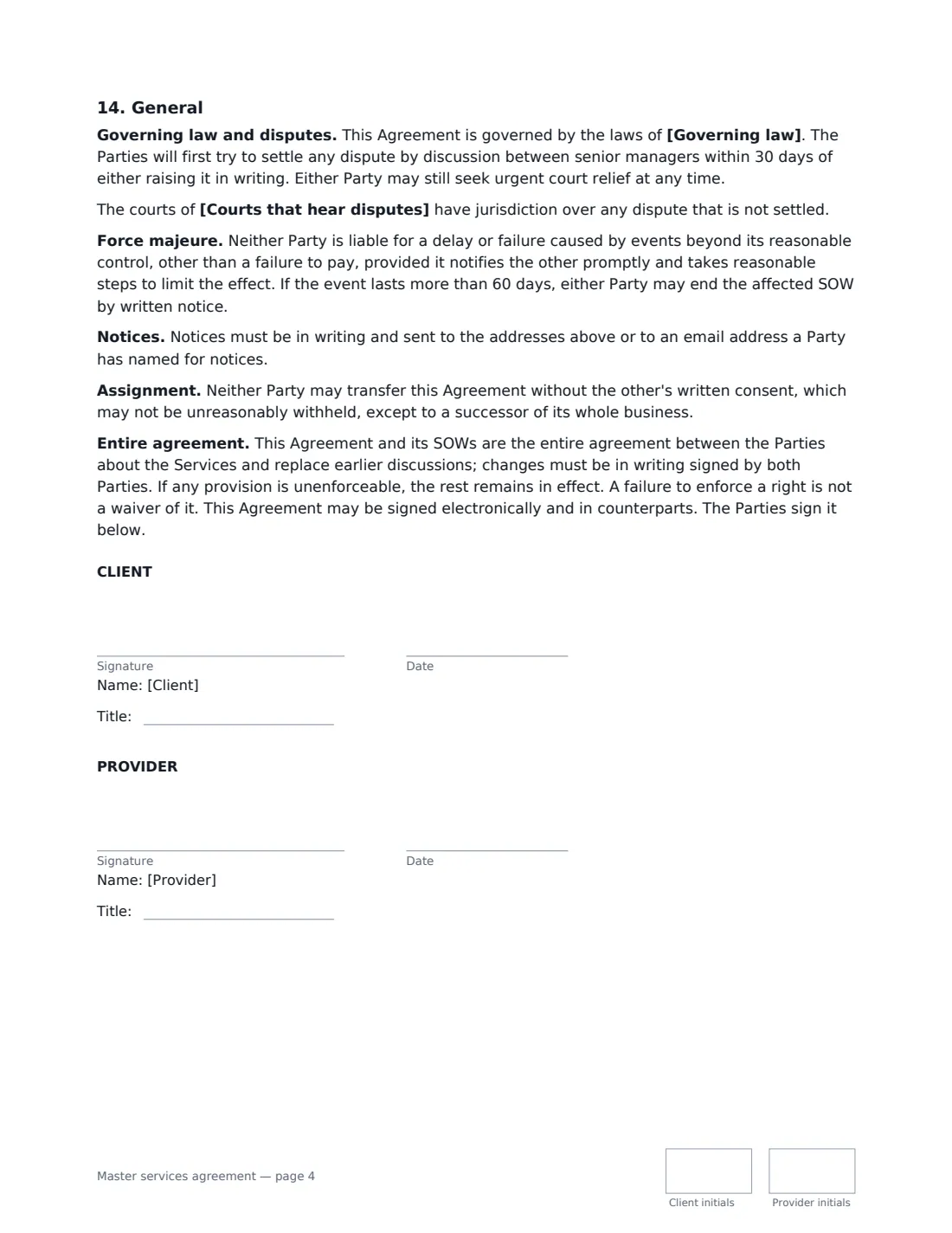
- Client signature and date, job title, initials on every page · Someone authorised to sign contracts for the client.
- Provider signature and date, job title, initials on every page · Someone authorised to sign contracts for the business providing the services.
What the master services agreement Covers
- How this Agreement works
- The services
- Fees and payment
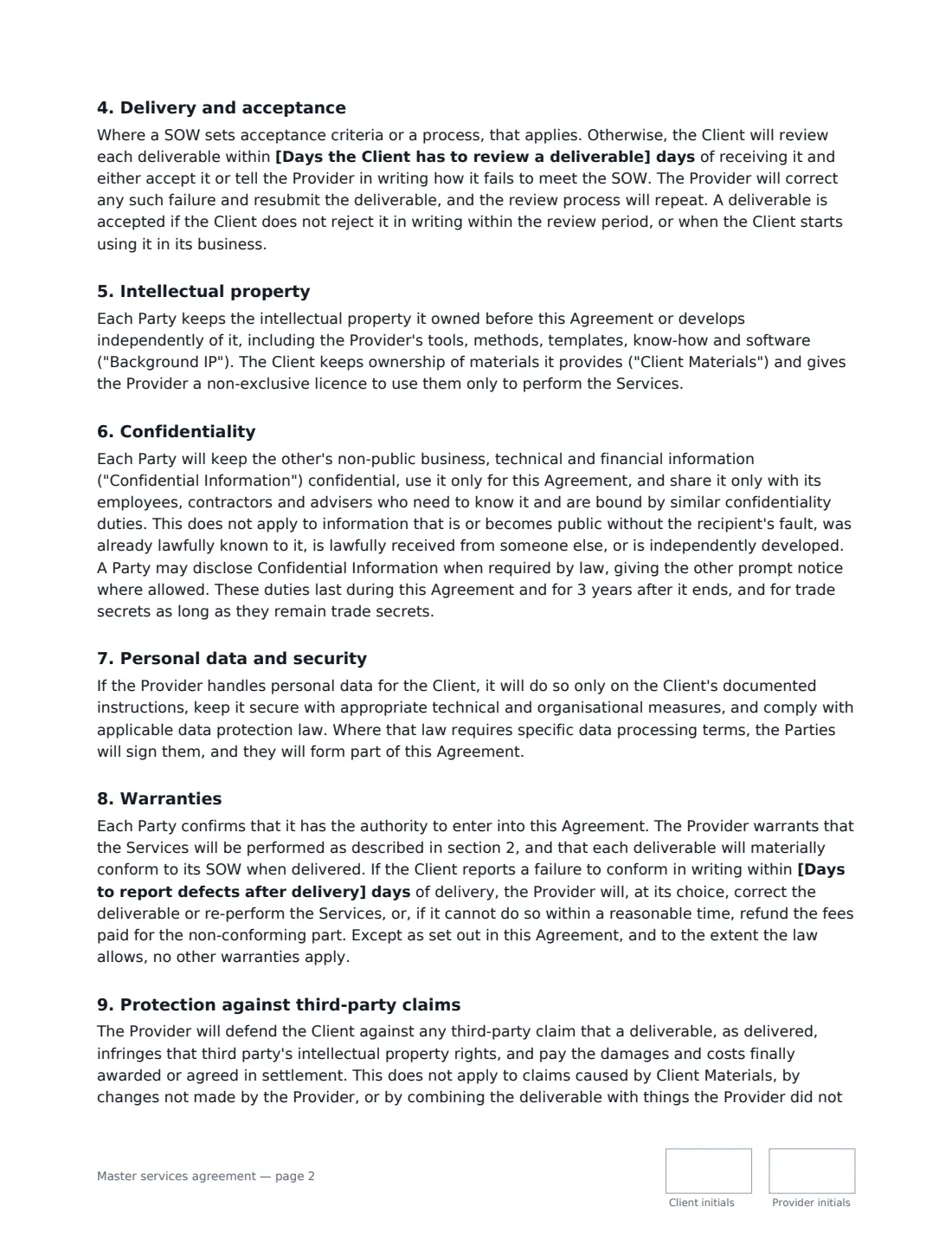
- Delivery and acceptance
- Intellectual property
- Confidentiality
- Personal data and security
- Warranties
- Protection against third-party claims
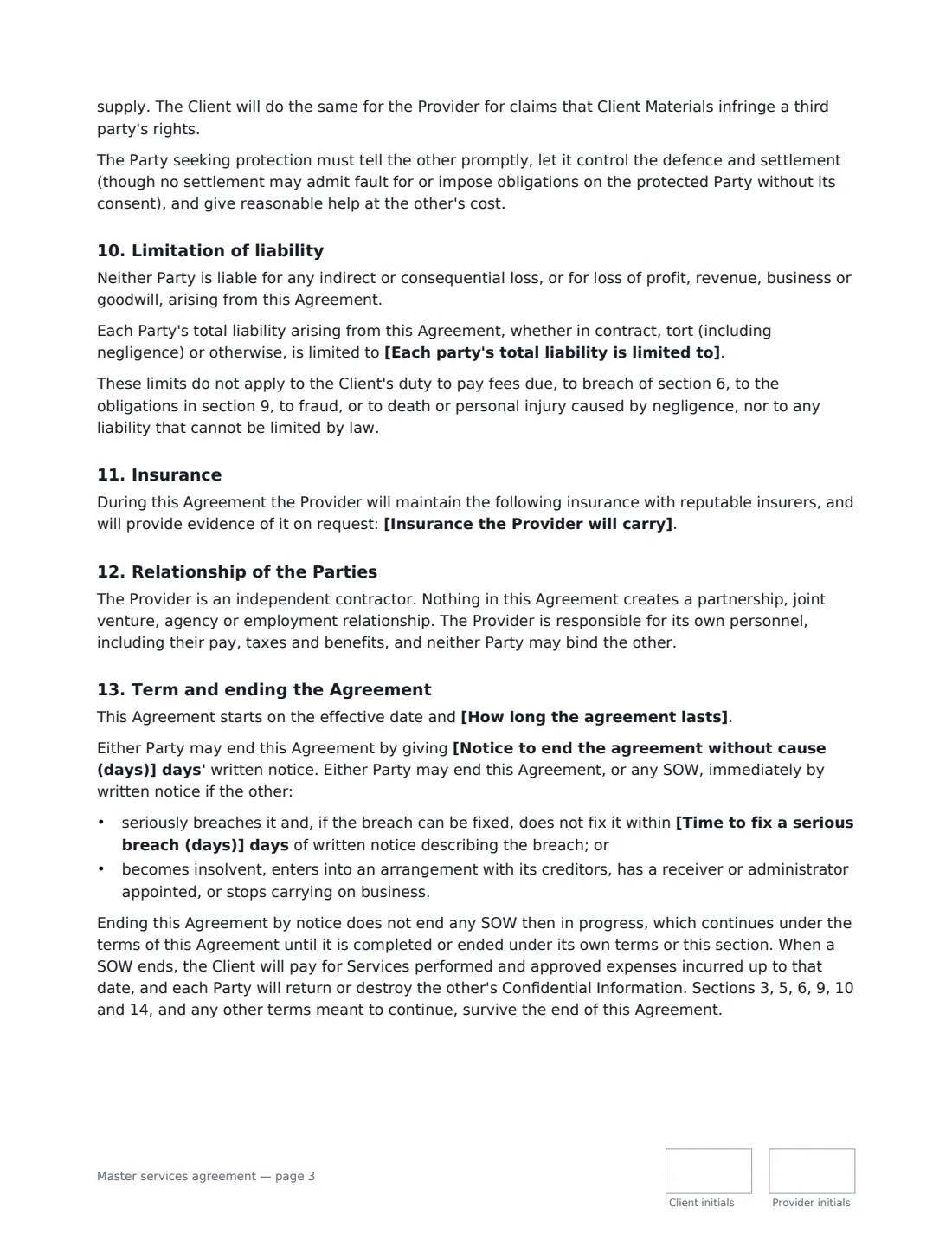
- Limitation of liability
- Insurance
- Relationship of the Parties
- Term and ending the Agreement
- General
Using the master services agreement, step by step
1 Describe the kind of services, not the project
The services description in section 1 should be broad enough to cover future work — for example "software development, design and related consulting". The specifics of each project belong in its statement of work.
2 Set payment and acceptance terms
Choose the payment period, how expenses are treated, and optionally an interest rate on late payments (the agreement applies the legal maximum if your rate is higher). The acceptance period is the default window for the client to approve or reject a deliverable when a statement of work doesn't set its own.
3 Decide who owns the deliverables
Either the client owns the deliverables once they are paid for, or the provider keeps ownership and grants the client a perpetual licence. In both cases the provider keeps its pre-existing tools and know-how ("Background IP") and the client keeps what it supplied.
4 Choose the liability cap and the exit terms
Pick the cap that fits the risk. Choose whether the agreement simply continues until someone gives notice or has an initial fixed term, and set the notice and cure periods. Ending the MSA does not cancel statements of work already in progress.
5 Add the signers and send
Enter the governing law and, if you want, the courts that hear disputes. Name an authorised signer on each side; VergeHR places the signature, date, job-title and initials boxes, and files the signed PDF in Files. Then send the first statement of work.
Tips Before You Send It
- Sign the MSA before or together with the first statement of work, and refer to the MSA by name and date in every SOW.
- If a project needs different terms — a different liability cap, say — write that into its SOW and name the MSA section it changes. Otherwise the MSA wins.
- Check with your insurer that the liability cap and insurance clause match the cover you actually hold.
- If you will process personal data for the client, have the data processing terms ready; many data protection laws require them in writing.
- Non-solicitation clauses are restricted in some places. If in doubt, choose "No" or take local advice.
Sign It Online In Minutes
- Fill in the blanks. Names, dates and amounts go straight into the agreement — the preview shows exactly where.
- Name who signs. Tick “This is me” for your own part. VergeHR builds the PDF with every signature, date and initials box on the right line, and you can check or move anything before sending.
- Send it. Each signer gets a secure link and signs from any device — no account needed. The signed PDF, with an audit trail and a Certificate of Completion, is filed in Files and emailed to everyone.
Master services agreement: frequently asked questions
What is the difference between an MSA and a statement of work?
The MSA holds the general legal terms that apply to every project: payment, ownership, confidentiality, liability and termination. A statement of work describes one project: what will be delivered, by when and for what fee. You sign the MSA once and a new SOW for each project.
What happens if the MSA and a statement of work say different things?
Under this template the MSA prevails, unless the SOW expressly says which section of the MSA it changes, in which case the change applies to that SOW only.
Does ending the MSA cancel projects in progress?
No. Ending the MSA by notice leaves any statement of work in progress running under the MSA's terms until it is completed or ended separately. Either side can still end a SOW immediately for serious breach or insolvency.
Is an MSA signed electronically legally binding?
Electronic signatures are generally valid for ordinary commercial contracts like an MSA in the US (ESIGN Act and UETA), the UK, the EU (eIDAS) and Canada. VergeHR keeps an audit trail and a Certificate of Completion with the signed PDF.
Is this template legal advice?
No. It is a well-structured starting point in plain English. For high-value or regulated work, have a lawyer review the liability, IP and data protection terms for your jurisdiction.