

What is a trademark license agreement?
A trademark license agreement allows another business (the licensee) to use your brand name or logo on specified products or services, while you (the licensor) keep ownership of the brand. It is the contract behind licensed merchandise, brand extensions into new product categories, and regional partners trading under an established name.
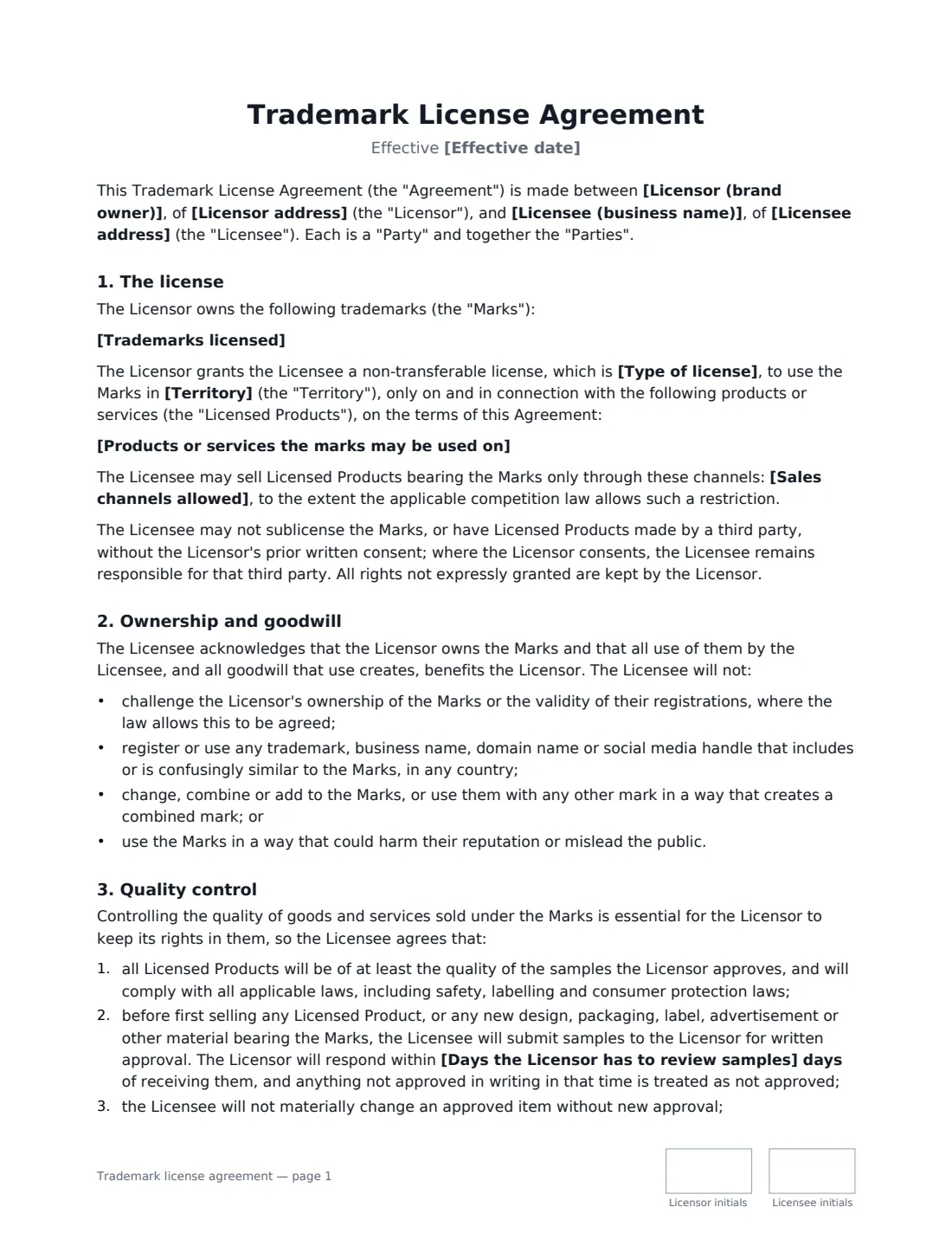
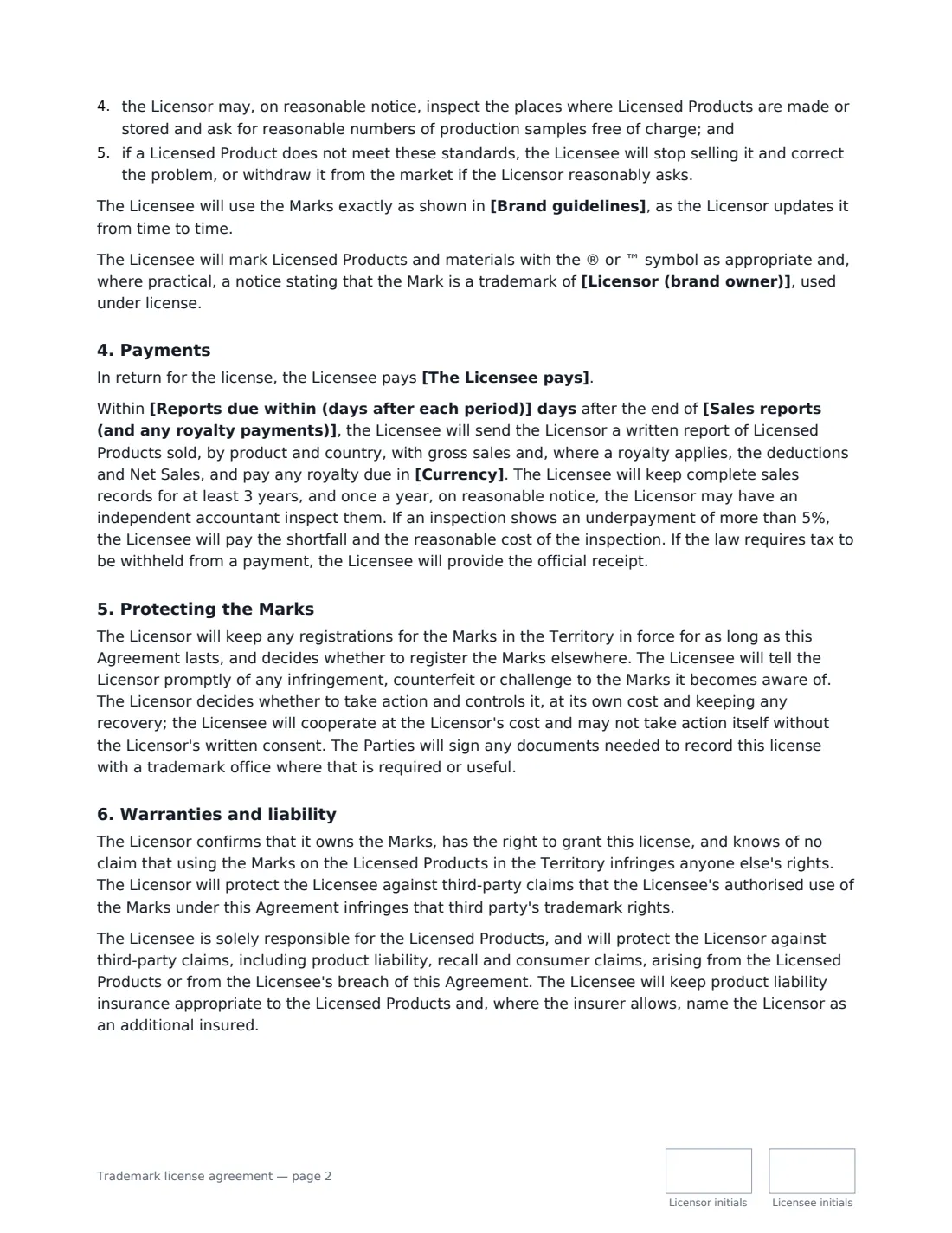
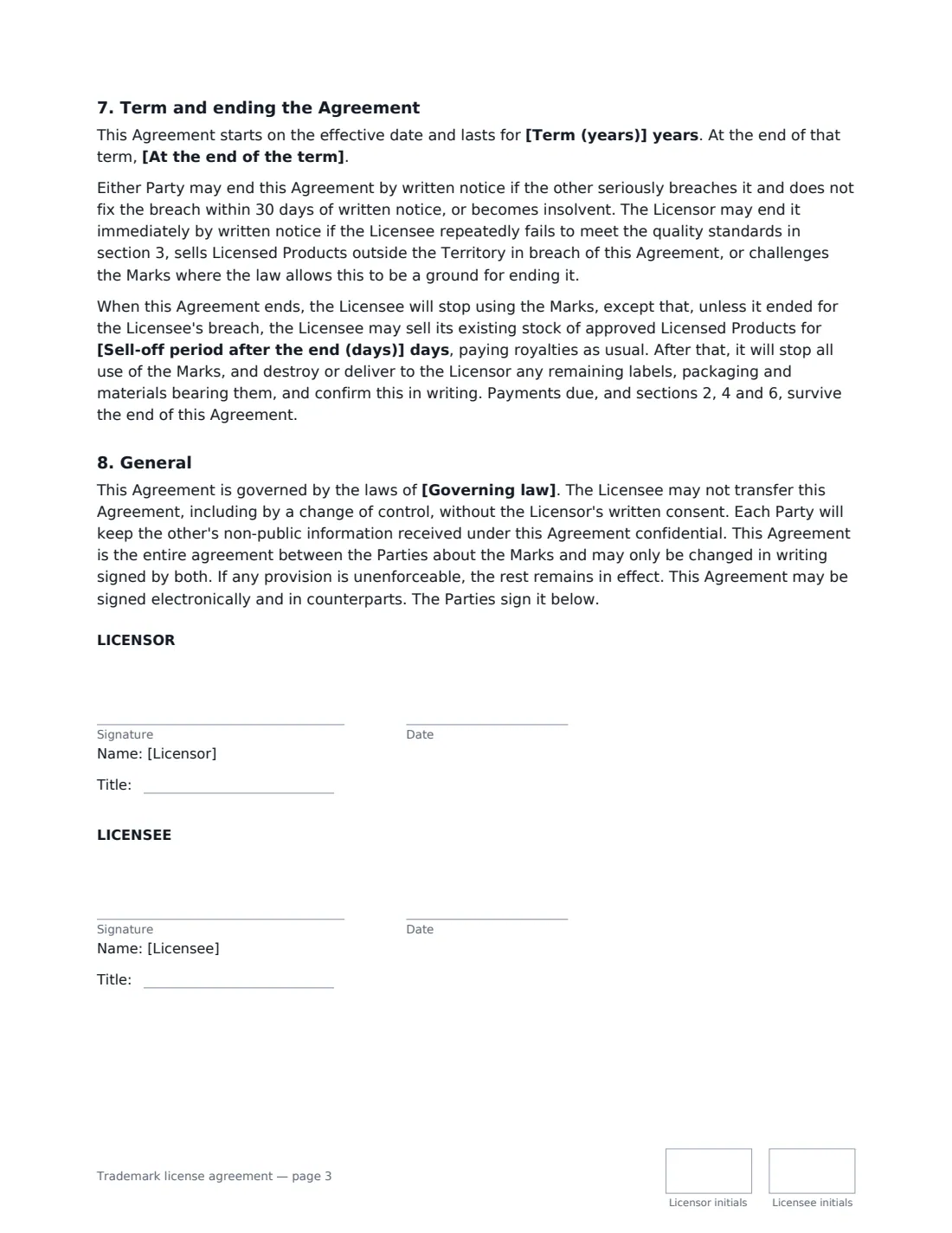
Because a brand's value depends on the quality of what is sold under it, quality control is at the centre of this template: products must match approved samples and comply with the law, every new product, package or advert needs your written approval within the review period you set (silence means not approved), and you may inspect production and require withdrawal of sub-standard goods. You list the marks with registration numbers, the licensed products, the territory, optional sales channels and exclusive or non-exclusive rights. Payment can be a percentage royalty on net sales with an optional annual minimum, a fixed annual fee, or royalty-free. The agreement also covers ownership and goodwill, proper trademark notices, enforcement against infringers, warranties, product liability insurance, the term and renewal, termination for quality failures and a sell-off period.
- Best for
- Brand owners licensing merchandise, brand extensions or regional use
- Signed by
- An authorised signer for the brand owner and the licensee
- Quality control
- Sample approval, brand guidelines and inspection rights
- Length
- About 3 pages, initialled on every page
When to Use a trademark license agreement
- An outdoor brand licensing its name for socks and apparel made by a specialist manufacturer
- A restaurant or café brand licensing its name for packaged food products
- A sports club or event licensing its logo for merchandise
- A company letting a regional partner trade under its brand in another country
- Formalising a family or group company's use of a brand owned by one entity
What You Fill In
23 blanks, then the name and email of each person who signs: licensor, licensee.
1 The parties
- Licensor (brand owner)*
- Licensor address*
- Licensee (business name)*
- Licensee address*
2 The license
- Effective date*
- Trademarks licensed*
- Products or services the marks may be used on*
- Territory*
- Sales channels allowed
- Type of license* exclusive · non-exclusive
3 Payments
- Currency*
- The Licensee pays* a royalty based on a percentage of Net Sales · a fixed annual license fee · no fee (royalty-free)
- Royalty rate (%)
- Annual license fee
- Minimum royalty each year
- Sales reports (and any royalty payments)* each calendar month · each calendar quarter · every six months
- Reports due within (days after each period)*
4 Quality control
- Brand guidelines
- Days the Licensor has to review samples*
5 Term
- Term (years)*
- At the end of the term* the Agreement ends unless the Parties agree in writing to renew it · the Agreement renews for further one-year periods unless either Party gives 90 days' written notice
- Sell-off period after the end (days)*
- Governing law*
6 Who signs
- Licensor signature and date, job title, initials on every page · The brand owner, or someone authorised to sign for it.
- Licensee signature and date, job title, initials on every page · Someone authorised to sign for the business using the brand.
What the trademark license agreement Covers
- The license
- Ownership and goodwill
- Quality control
- Payments
- Protecting the Marks
- Warranties and liability
- Term and ending the Agreement
- General
Using the trademark license agreement, step by step
1 List the marks and products
Enter each word mark and logo with its registration or application number, and describe the products or services the marks may appear on. Everything not licensed stays with you.
2 Set territory, channels and exclusivity
Name the territory, optionally limit sales channels (applied as far as competition law allows), and choose exclusive or non-exclusive. Sublicensing and third-party manufacturing need your written consent.
3 Build in quality control
Link your brand guidelines if you have them and set how many days you have to review samples. Nothing may be sold under the marks until you approve it in writing.
4 Choose the payment model
Choose a percentage royalty on net sales (with an optional annual minimum), a fixed annual fee, or royalty-free. Set how often the licensee reports and pays.
5 Set the term and exit
Enter the term in years and whether it renews. After the end, the licensee may sell approved stock for the sell-off period, then must stop all use and destroy or return branded materials.
Tips Before You Send It
- In many countries, licensing a trademark without controlling quality can weaken the owner's rights — use the approval and inspection clauses, and keep records that you did.
- Where you can, register the marks in the territory before licensing them there — registered rights are easier to enforce against infringers.
- Some countries let or require a trademark license to be recorded with the trademark office — the agreement requires both sides to cooperate.
- Keep the licensed products narrow; you can always license new categories later.
- To license patents, designs or know-how rather than a brand, use the IP license agreement.
Sign It Online In Minutes
- Fill in the blanks. Names, dates and amounts go straight into the agreement — the preview shows exactly where.
- Name who signs. Tick “This is me” for your own part. VergeHR builds the PDF with every signature, date and initials box on the right line, and you can check or move anything before sending.
- Send it. Each signer gets a secure link and signs from any device — no account needed. The signed PDF, with an audit trail and a Certificate of Completion, is filed in Files and emailed to everyone.
Trademark license agreement: frequently asked questions
Why does a trademark license need quality control?
A trademark tells buyers who stands behind a product. If the owner lets others use it without any control over quality, in many countries the mark can lose its value or even its legal protection. This template requires approvals, inspections and withdrawal of sub-standard products.
Who owns the goodwill the licensee builds?
The licensor. All use of the marks by the licensee, and the goodwill it creates, benefits the licensor, and the licensee may not register similar marks, business names or domain names anywhere.
What happens to unsold stock when the license ends?
Unless the license ended for the licensee's breach, it may sell existing approved stock for the sell-off period you choose, paying royalties as usual. After that it must stop all use and destroy or return any remaining labels, packaging and materials.
Can a trademark license be signed electronically?
Electronic signatures are generally valid for ordinary commercial contracts like a license in the US (ESIGN Act and UETA), the UK, the EU (eIDAS) and Canada. Some trademark offices have their own requirements for recording a license. VergeHR keeps an audit trail and a Certificate of Completion with the signed PDF.