

What is a distribution agreement?
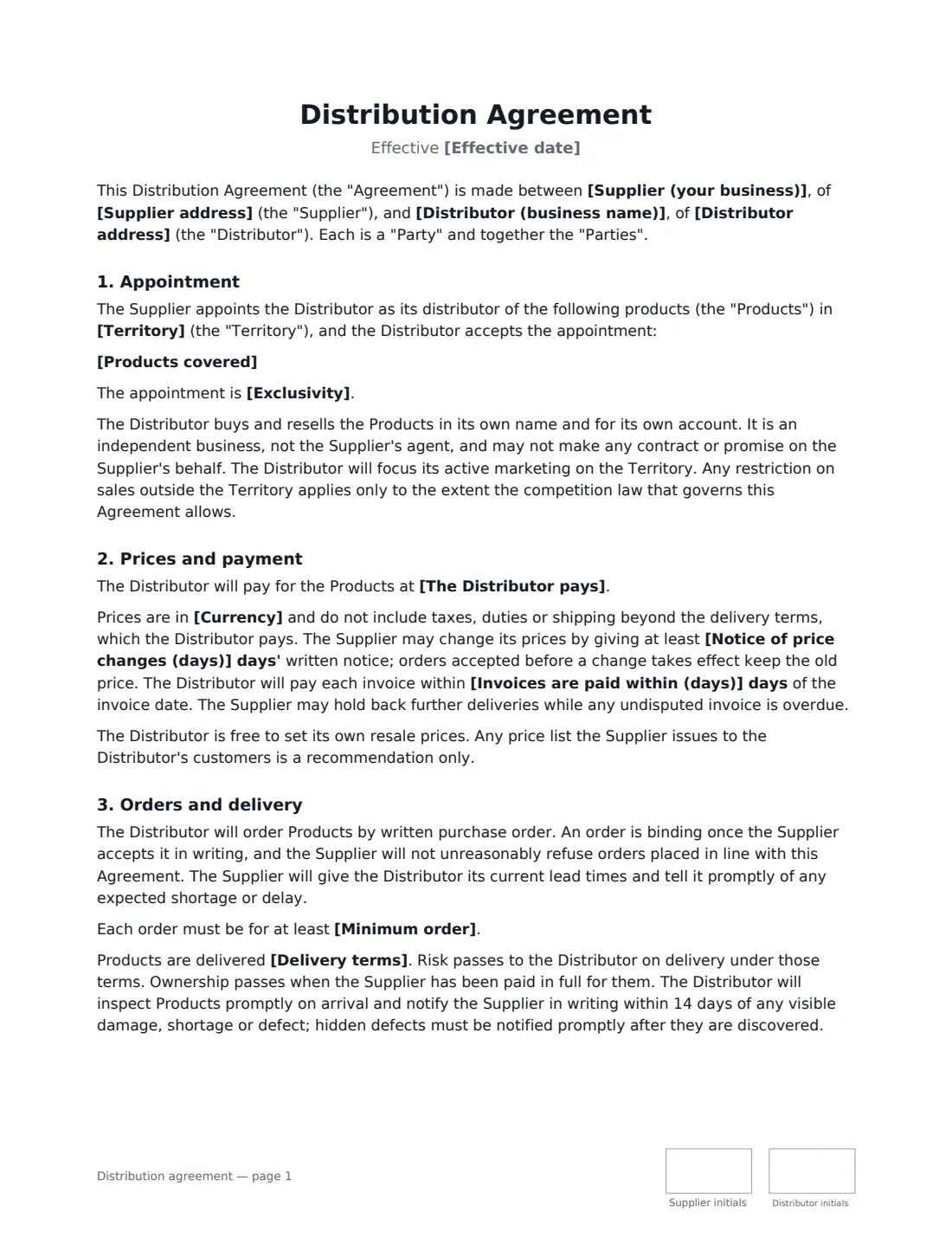
A distribution agreement is used when a supplier (often a manufacturer or brand) appoints another business to buy its products and resell them in a particular territory. Unlike a sales agent, a distributor takes ownership of the stock and sells in its own name at its own prices, so the agreement focuses on the terms of supply, the territory, the distributor's duties and how the brand is protected.
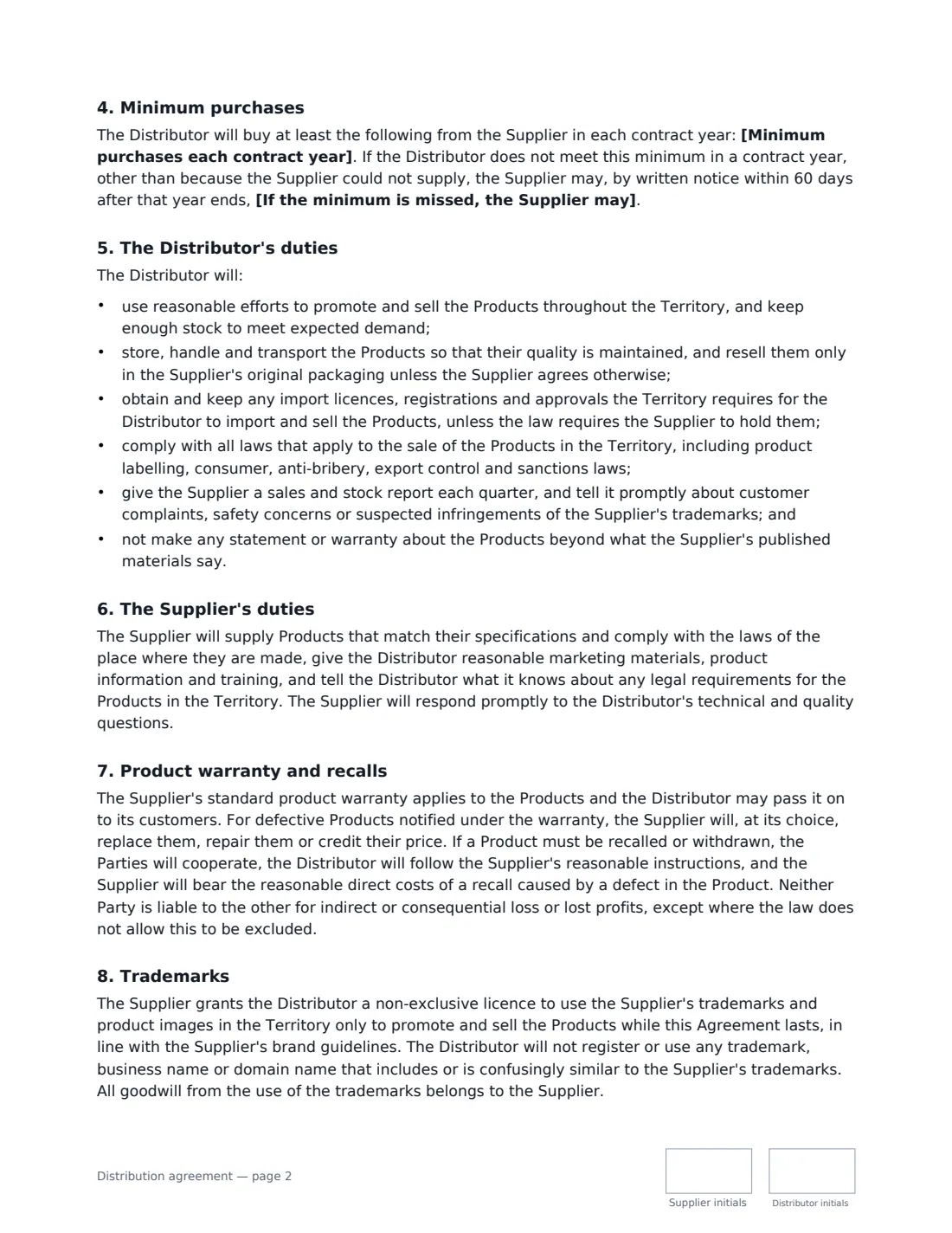
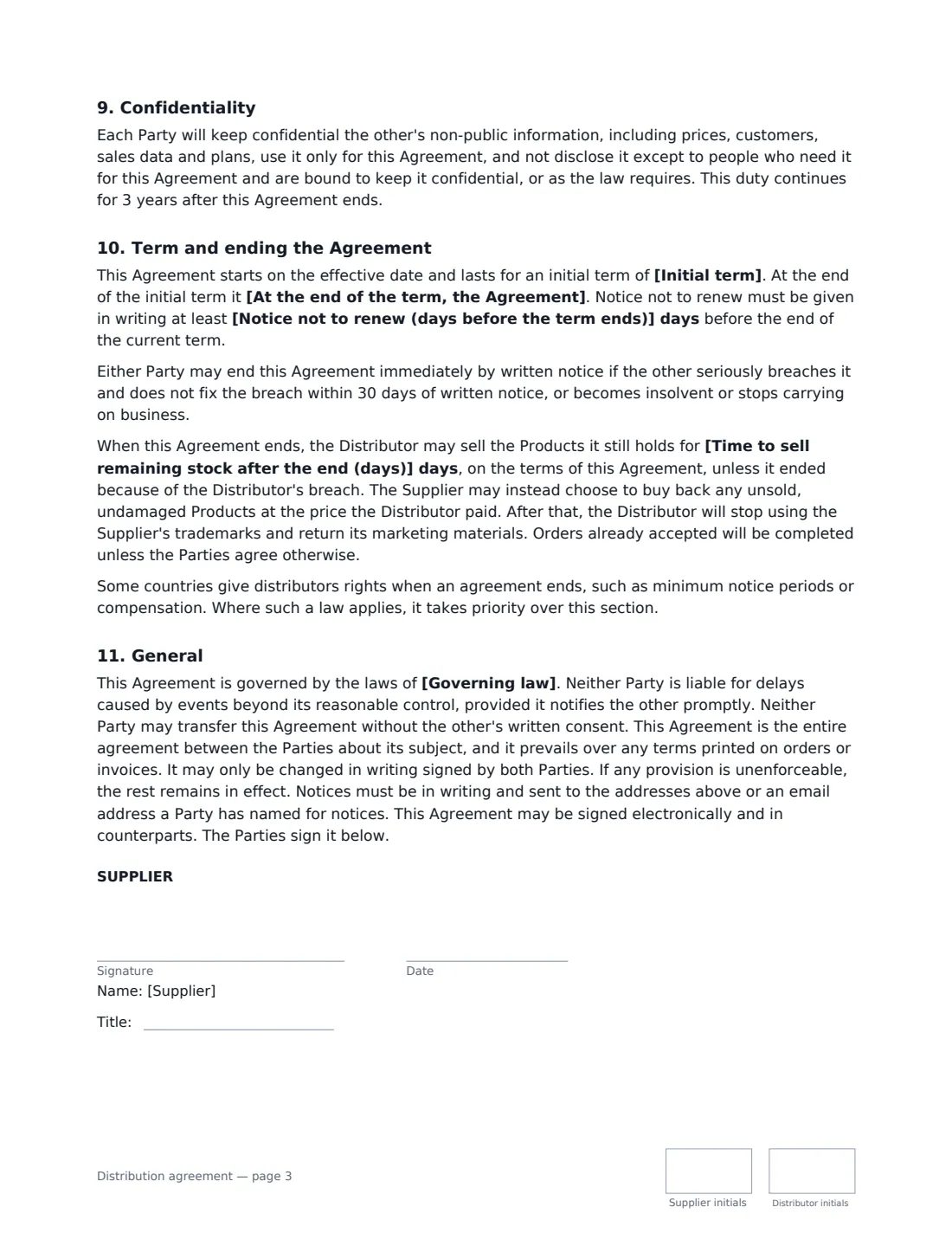
In this template you name the products and territory and choose exclusive, exclusive with no direct sales by the supplier, or non-exclusive. You set whether the distributor pays a distributor price list or a discount off retail, the notice for price changes, payment terms, Incoterms delivery terms and any minimum order. An optional annual minimum purchase lets the supplier remove exclusivity or end the agreement if it is missed. The agreement also covers the distributor's duties (stock, import approvals, compliance, quarterly reports), product warranty and recalls, a trademark licence, confidentiality, the initial term and renewal, and a sell-off period for remaining stock.
- Best for
- Brands and manufacturers entering a new country or region through a local distributor
- Signed by
- An authorised signer at the supplier and at the distributor
- Exclusivity
- Exclusive, exclusive with no direct sales, or non-exclusive
- Length
- About 4 pages, initialled on every page
When to Use a distribution agreement
- A food or cosmetics brand appointing an importer-distributor for a new country
- An equipment manufacturer giving a regional dealer exclusive rights in return for minimum purchases
- A supplier formalising a long-standing wholesale relationship with written terms
- Adding a second, non-exclusive distributor in a large territory
- Starting a new distributor on a one-year non-exclusive appointment before agreeing a longer exclusive term
What You Fill In
22 blanks, then the name and email of each person who signs: supplier, distributor.
1 The parties
- Supplier (your business)*
- Supplier address*
- Distributor (business name)*
- Distributor address*
2 Products and territory
- Effective date*
- Products covered*
- Territory*
- Exclusivity* exclusive · exclusive, and the Supplier will not sell directly in the Territory · non-exclusive
3 Prices and payment
- Currency*
- The Distributor pays* the prices in the Supplier's distributor price list in force when the order is accepted · the Supplier's recommended retail price less the discount below
- Discount off recommended retail price (%)
- Notice of price changes (days)*
- Invoices are paid within (days)*
4 Orders and delivery
- Delivery terms*
- Minimum order
5 Targets
- Minimum purchases each contract year
- If the minimum is missed, the Supplier may make the appointment non-exclusive · end this Agreement · make the appointment non-exclusive or end this Agreement
6 Term
- Initial term* 1 year · 2 years · 3 years · 5 years
- At the end of the term, the Agreement* renews automatically for further one-year periods unless either Party gives notice · ends unless the Parties agree in writing to renew it
- Notice not to renew (days before the term ends)*
- Time to sell remaining stock after the end (days)*
7 Other terms
- Governing law*
8 Who signs
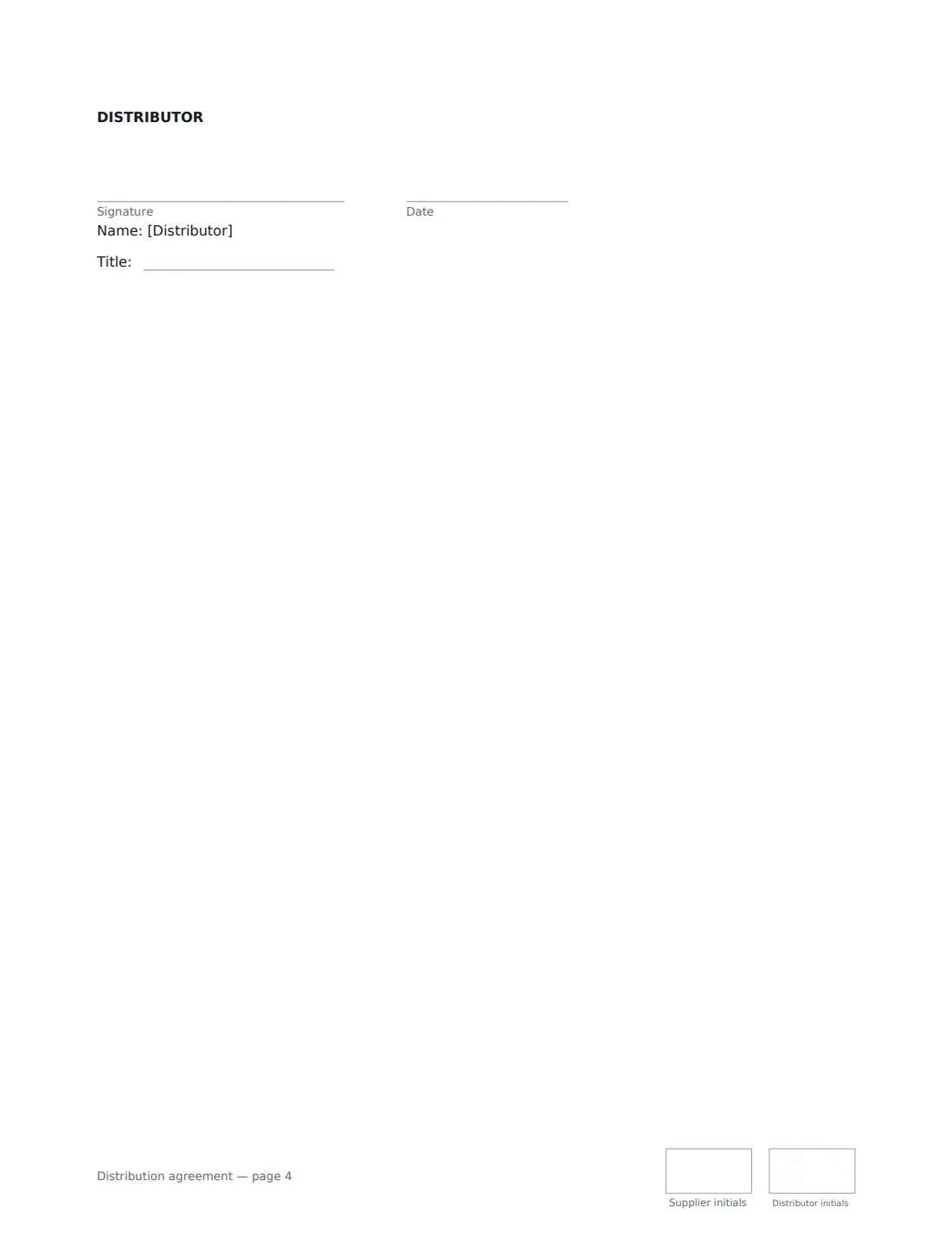
- Supplier signature and date, job title, initials on every page · Someone authorised to sign for the business whose products are distributed.
- Distributor signature and date, job title, initials on every page · Someone authorised to sign for the distributor.
What the distribution agreement Covers
- Appointment
- Prices and payment
- Orders and delivery
- Minimum purchases
- The Distributor's duties
- The Supplier's duties
- Product warranty and recalls
- Trademarks
- Confidentiality
- Term and ending the Agreement
- General
Using the distribution agreement, step by step
1 Define the products and territory
List the products, or a range and whether new products join it automatically. Name the territory as countries, states or regions.
2 Choose the kind of exclusivity
Exclusive means you appoint no other distributor there but may still sell directly; the second exclusive option also stops your own direct sales in the territory. Competition law in some places limits how far territory restrictions can go, and the agreement applies them only as far as the governing law allows.
3 Set prices, payment and delivery
Choose the price basis and discount, the notice before price changes, the payment period and the delivery terms (Incoterms such as FCA or DAP are the usual way to say who pays freight and duties). The distributor sets its own resale prices.
4 Add a minimum and decide the consequence
If you want a performance commitment, write the annual minimum purchases and choose whether missing it lets you make the appointment non-exclusive, end the agreement, or either.
5 Set the term and exit
Pick the initial term, whether it renews automatically, the notice not to renew, and how long the distributor may sell off remaining stock after the end. Then name the signers and send.
Tips Before You Send It
- Some countries give distributors statutory rights on termination, such as minimum notice or compensation — the agreement says those laws take priority, but check before you appoint.
- Tie exclusivity to a realistic minimum purchase target so the territory is not locked up by an inactive distributor.
- Share your brand guidelines with the distributor; the trademark licence requires it to follow them.
- Agree who registers the products with local regulators before the first shipment — the default is the distributor, unless the law requires the supplier.
- If the other business will sell on commission without buying stock, use a sales representative agreement instead.
Sign It Online In Minutes
- Fill in the blanks. Names, dates and amounts go straight into the agreement — the preview shows exactly where.
- Name who signs. Tick “This is me” for your own part. VergeHR builds the PDF with every signature, date and initials box on the right line, and you can check or move anything before sending.
- Send it. Each signer gets a secure link and signs from any device — no account needed. The signed PDF, with an audit trail and a Certificate of Completion, is filed in Files and emailed to everyone.
Distribution agreement: frequently asked questions
What is the difference between a distributor and a sales agent?
A distributor buys the products, owns the stock and resells it in its own name at its own prices, taking the commercial risk. A sales agent or representative finds customers for you and earns commission, while you sell directly to the customer.
Can I set the prices my distributor charges?
This template leaves resale prices to the distributor and treats any price list you issue as a recommendation. In many countries, fixing a distributor's resale prices is restricted by competition law.
What happens to unsold stock when the agreement ends?
Unless the agreement ended because of the distributor's breach, it may keep selling its remaining stock for the sell-off period you choose. The supplier may instead buy back unsold, undamaged products at the price the distributor paid.
Is a distribution agreement valid if signed electronically?
Electronic signatures are generally valid for ordinary commercial contracts like this one in the US (ESIGN Act and UETA), the UK, the EU (eIDAS) and Canada. VergeHR keeps an audit trail and a Certificate of Completion with the signed PDF.