

What is a iP license agreement?
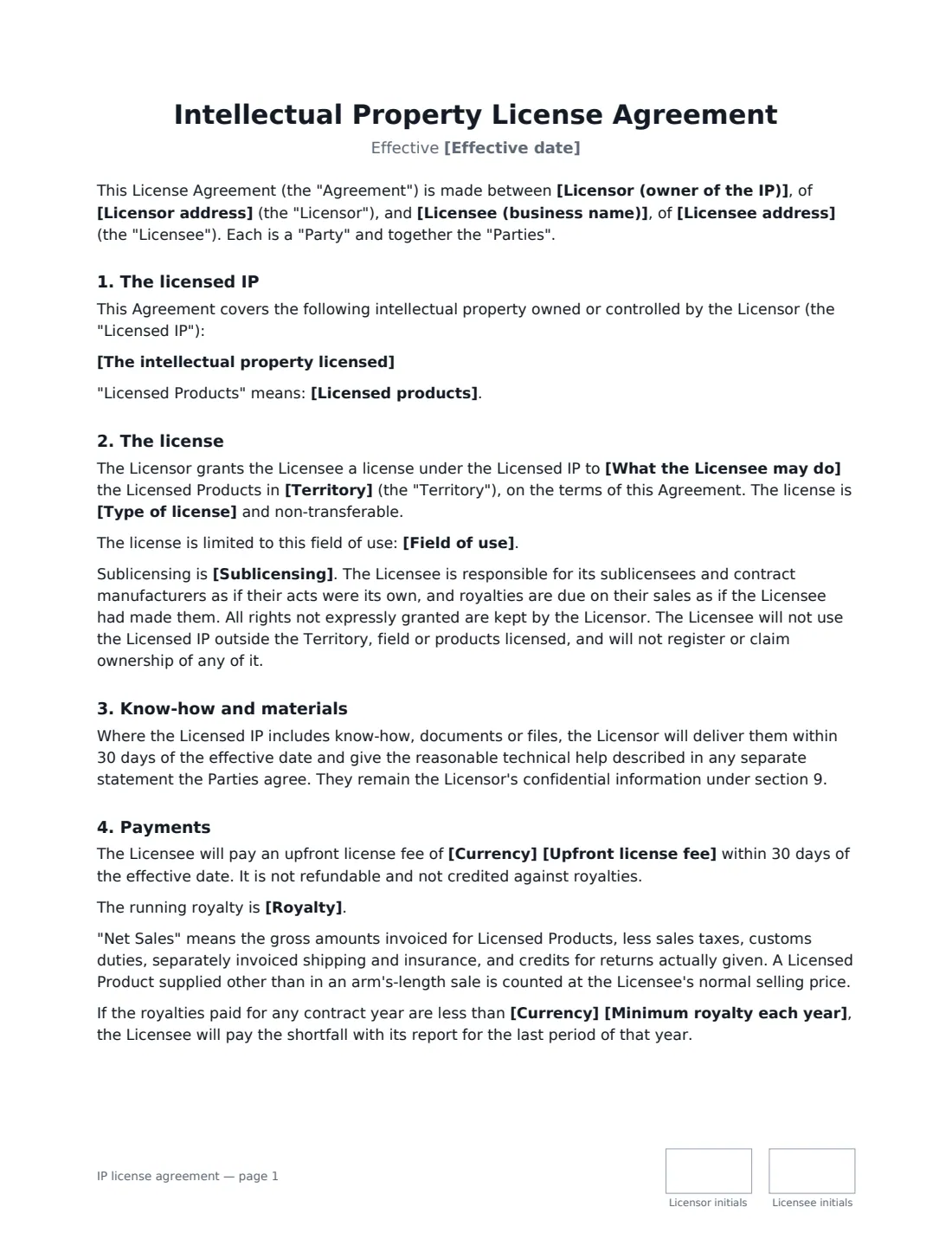
An IP license agreement lets the owner of intellectual property (the licensor) allow another business (the licensee) to use it, without selling it. The licensor keeps ownership; the licensee gets defined rights — to make and sell products using a patent, to reproduce a copyright work, or to use know-how — in a defined territory and field, usually in return for a fee and royalties.
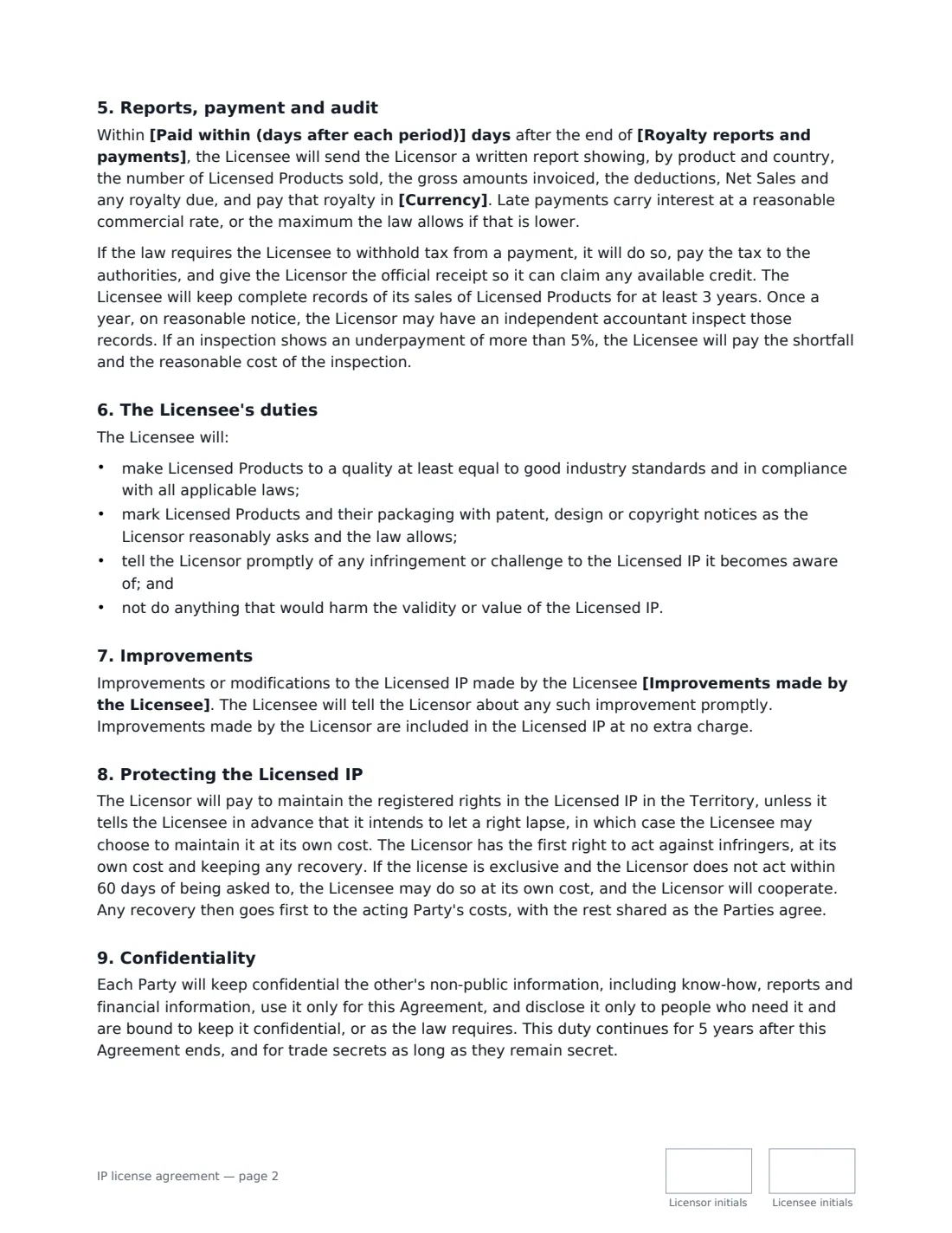
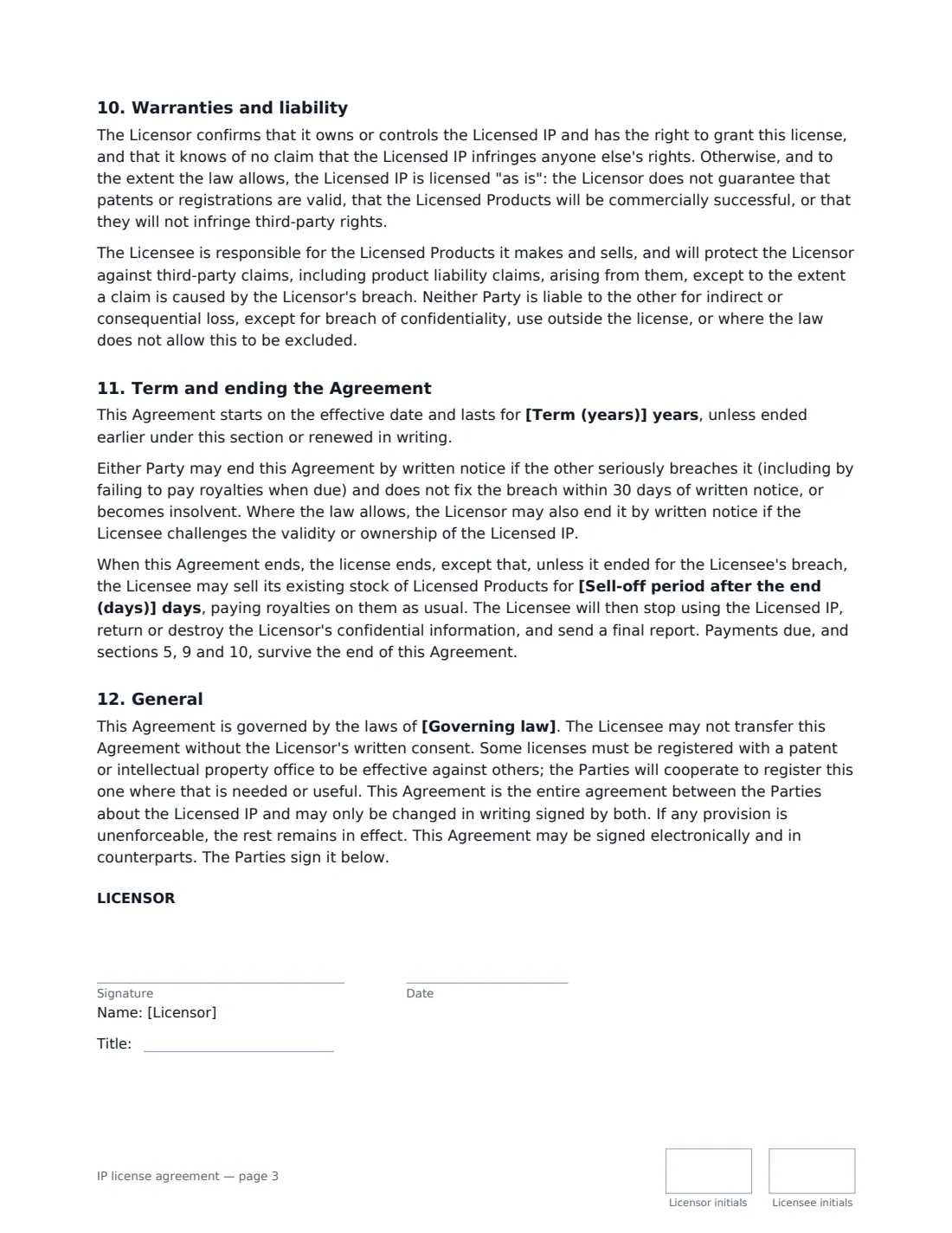
In this template you describe the licensed IP (with patent, design or registration numbers), the licensed products, what the licensee may do (make, have made, use, sell and import; use and sell; reproduce, adapt, publish and distribute; or internal use only), an optional field of use and the territory. You choose exclusive, sole or non-exclusive and whether sublicensing is allowed. Payments can include an upfront fee, a running royalty as a percentage of net sales or a fixed amount per unit (or none), and an annual minimum, with monthly, quarterly or half-yearly reports, a defined net sales figure, withholding tax handling and an annual audit right. The agreement also covers the licensee's duties, ownership of improvements, maintaining and enforcing the IP, confidentiality, warranties, the term (fixed years or until the last patent expires), termination and a sell-off period.
- Best for
- Inventors, designers, universities, creators and companies licensing technology or content
- Signed by
- An authorised signer for the licensor and the licensee
- License types
- Exclusive, sole or non-exclusive
- Length
- About 4 pages, initialled on every page
When to Use a iP license agreement
- An inventor licensing a patented design to a manufacturer for a royalty
- A design studio licensing registered designs for a product line in one region
- A company licensing its process know-how to a partner in another country
- A publisher or creator licensing content to be reproduced and distributed
- Granting a manufacturer an exclusive license in one field while keeping others open
What You Fill In
23 blanks, then the name and email of each person who signs: licensor, licensee.
1 The parties
- Licensor (owner of the IP)*
- Licensor address*
- Licensee (business name)*
- Licensee address*
2 What is licensed
- Effective date*
- The intellectual property licensed*
- What the Licensee may do* make, have made, use, sell and import · use and sell · reproduce, adapt, publish and distribute · use, for its internal purposes only,
- Licensed products*
- Field of use
- Territory*
- Type of license* exclusive · sole · non-exclusive
- Sublicensing* not allowed · allowed only with the Licensor's prior written consent · allowed to the Licensee's affiliates and contract manufacturers
3 Payments
- Currency*
- Upfront license fee
- Royalty* a percentage of Net Sales · a fixed amount per unit sold · not payable, as the upfront fee is the only payment
- Royalty rate or amount
- Minimum royalty each year
- Royalty reports and payments* each calendar month · each calendar quarter · every six months
- Paid within (days after each period)*
4 Other terms
- Improvements made by the Licensee* belong to the Licensee, which grants the Licensor a non-exclusive license to use them · belong to the Licensee · belong to the Licensor
- Term (years)
- Sell-off period after the end (days)*
- Governing law*
5 Who signs
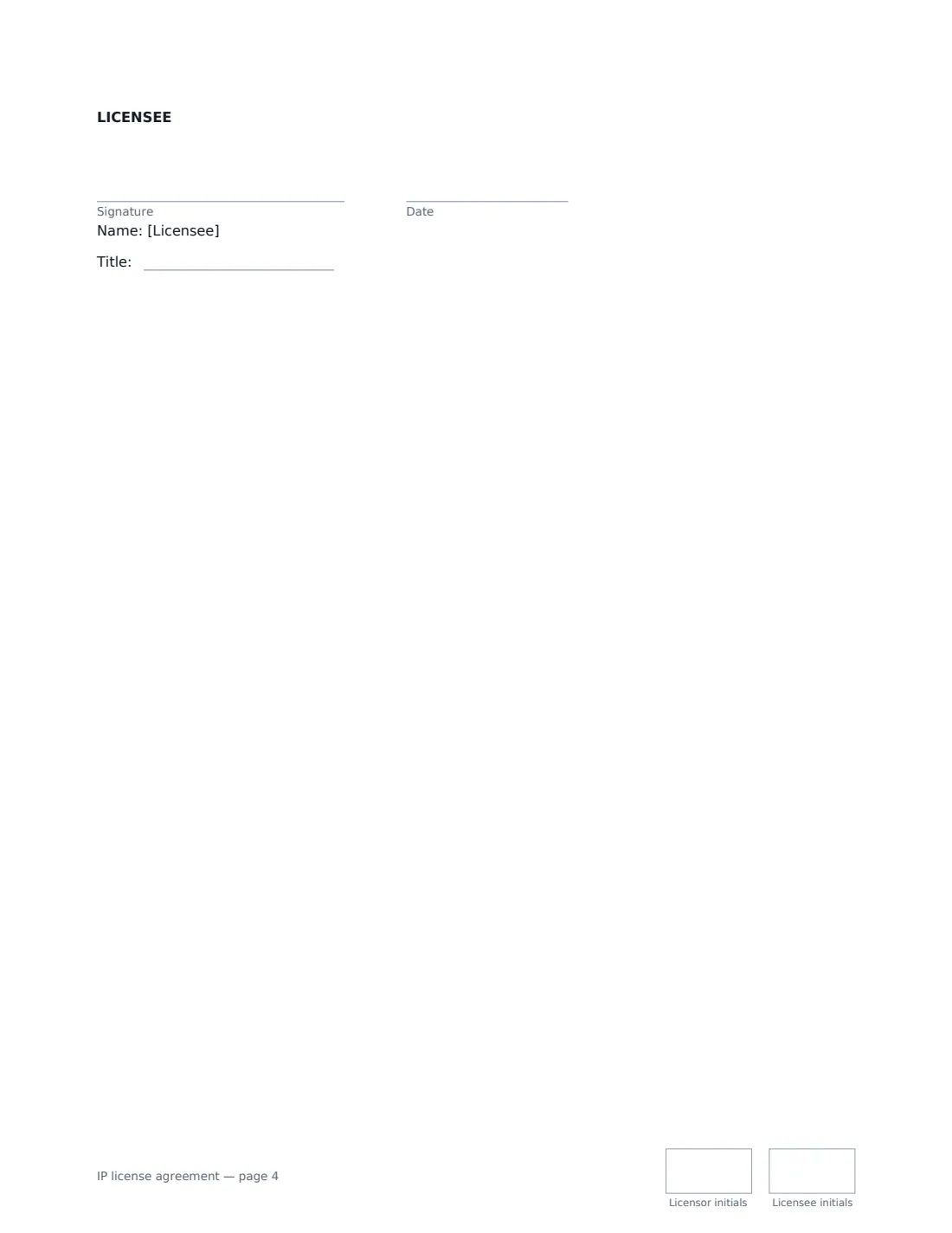
- Licensor signature and date, job title, initials on every page · The owner of the intellectual property, or someone authorised to sign for it.
- Licensee signature and date, job title, initials on every page · Someone authorised to sign for the business receiving the license.
What the iP license agreement Covers
- The licensed IP
- The license
- Know-how and materials
- Payments
- Reports, payment and audit
- The Licensee's duties
- Improvements
- Protecting the Licensed IP
- Confidentiality
- Warranties and liability
- Term and ending the Agreement
- General
Using the iP license agreement, step by step
1 Identify the IP precisely
List each patent, design, application or copyright work with its number or title, and describe any know-how. Then describe the licensed products the license covers.
2 Set the scope
Choose what the licensee may do, add a field of use if you want to keep other fields for yourself, and name the territory. Exclusive keeps even you out of that territory and field; sole lets you use it yourself but license no one else.
3 Agree the money
Add any upfront fee, choose a percentage royalty or a fixed amount per unit (or none), and an optional annual minimum royalty. Set how often the licensee reports and pays, and the payment period after each period ends.
4 Decide improvements and the term
Choose who owns improvements the licensee makes. Enter a term in years, or leave it empty so the license runs until the last licensed patent or registration expires. Set the sell-off period after the end.
Tips Before You Send It
- Royalties paid across borders may be subject to withholding tax; the agreement requires the licensee to provide the official receipt so you can claim any credit. Ask an adviser about tax treaties.
- Minimum royalties protect an exclusive licensor from a licensee that sits on the rights.
- Some licenses must be recorded with a patent or IP office to be effective against others — the agreement requires both sides to cooperate.
- Clauses that stop a licensee challenging a patent are restricted in some places; this template only allows termination for a challenge where the law permits it.
- For brand names and logos, use a trademark license agreement, which adds the quality control a brand license needs.
Sign It Online In Minutes
- Fill in the blanks. Names, dates and amounts go straight into the agreement — the preview shows exactly where.
- Name who signs. Tick “This is me” for your own part. VergeHR builds the PDF with every signature, date and initials box on the right line, and you can check or move anything before sending.
- Send it. Each signer gets a secure link and signs from any device — no account needed. The signed PDF, with an audit trail and a Certificate of Completion, is filed in Files and emailed to everyone.
IP license agreement: frequently asked questions
What is the difference between an exclusive, sole and non-exclusive license?
Exclusive: only the licensee may use the IP in the territory and field, not even the licensor. Sole: the licensor licenses no one else but may still use it itself. Non-exclusive: the licensor may license any number of others.
How are royalties calculated?
Either as a percentage of net sales — the amounts invoiced less sales taxes, duties, separately invoiced shipping and insurance, and credits for returns — or as a fixed amount per unit sold. Products supplied other than in an arm's-length sale count at the licensee's normal selling price.
Does the licensor guarantee the patents are valid?
No. The licensor confirms it owns or controls the IP and knows of no infringement claim, but to the extent the law allows the IP is licensed as is, without a guarantee of validity or commercial success.
Can an IP license be signed electronically?
Electronic signatures are generally valid for ordinary commercial contracts like a license in the US (ESIGN Act and UETA), the UK, the EU (eIDAS) and Canada. Assignments or registrations with a patent office may have their own formal requirements. VergeHR keeps an audit trail and a Certificate of Completion with the signed PDF.