

What is a joint venture agreement?
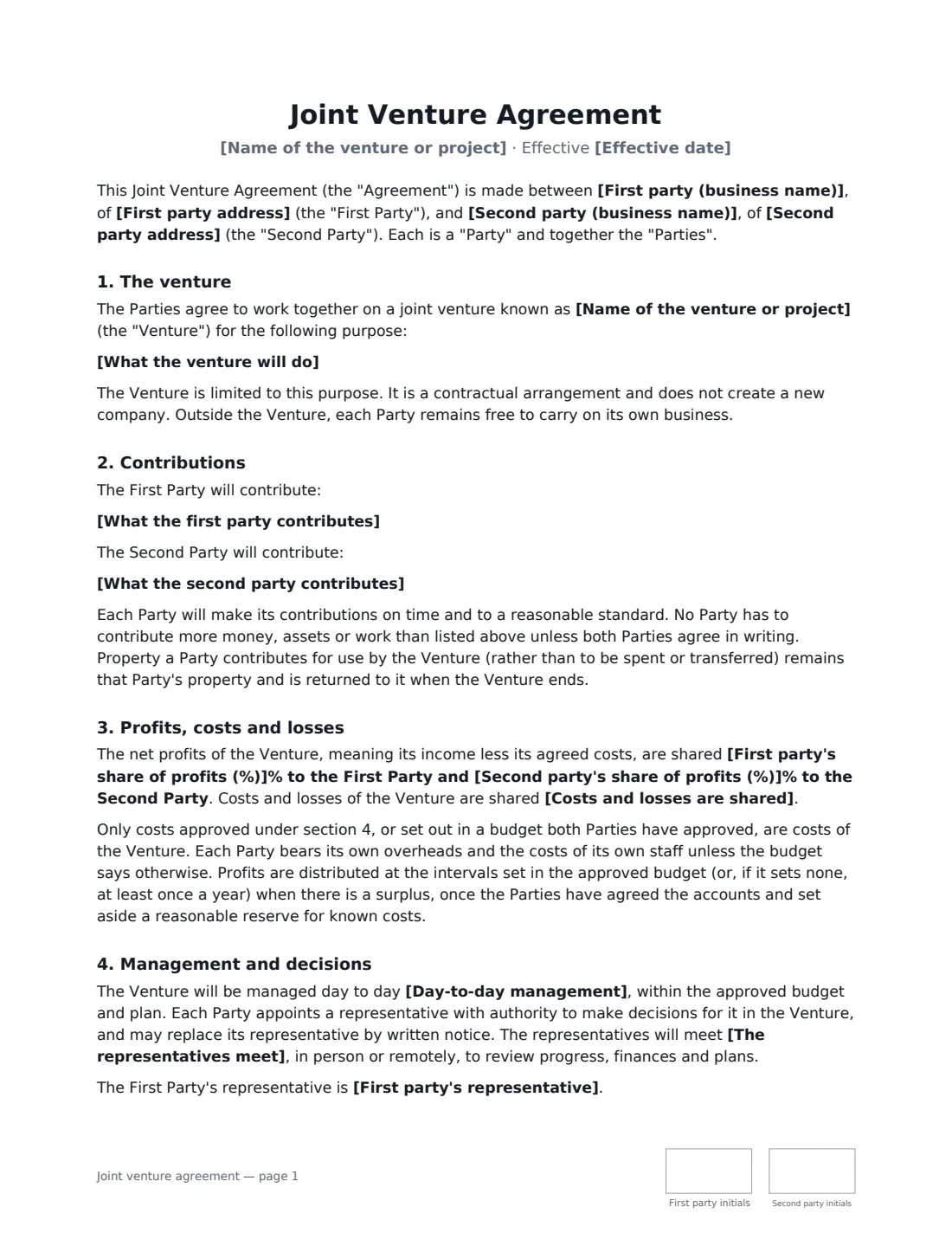
A joint venture is two businesses pooling money, skills or assets to pursue a specific project together — an event, a product launch, a bid for a contract, a property development — while each carries on its own business outside it. This template is for a contractual joint venture: the parties work together under a written agreement rather than forming a new company.
You describe the venture's purpose and what each side contributes, set the profit split as percentages, decide whether costs and losses follow the same split, and choose who runs the venture day to day. Major decisions — the budget, borrowing, hiring, legal claims, bringing in a new party — always need both parties' written approval, and you can set a spending limit above which any commitment needs both. The agreement also covers separate accounts, ownership of new IP, confidentiality, an optional promise not to run a competing project, a deadlock process, and a step-by-step wind-up when the venture ends.
- Best for
- One-off or time-limited projects between two businesses
- Signed by
- An authorised signer at each business, with job titles
- Structure
- Contractual joint venture — no new company is formed
- Length
- About 4 pages, initialled on every page
When to Use a joint venture agreement
- Two event companies co-producing a festival or conference
- A manufacturer and a retailer developing and launching a co-branded product
- Two contractors teaming up to bid for and deliver a larger contract
- A landowner and a developer working together on one property project
- A software company and a consultancy building a joint offering for a specific market
What You Fill In
26 blanks, then the name and email of each person who signs: first party, second party.
1 The parties
- First party (business name)*
- First party address*
- Second party (business name)*
- Second party address*
2 The venture
- Effective date*
- Name of the venture or project*
- What the venture will do*
- The venture ends* when the project described above is completed · on the end date below · when either Party ends it by notice under section 10
- End date
- Notice to leave the venture (days)*
3 Contributions
- What the first party contributes*
- What the second party contributes*
4 Profits and costs
- First party's share of profits (%)*
- Second party's share of profits (%)*
- Costs and losses are shared* in the same percentages as profits · as described below
- How costs and losses are shared
- Spending one party can approve alone, up to
- Currency*
5 Management
- Day-to-day management* by both Parties jointly · by the First Party · by the Second Party
- First party's representative
- Second party's representative
- The representatives meet* weekly · every two weeks · monthly · quarterly
- Venture accounts are kept by* the First Party · the Second Party
6 Other terms
- New intellectual property created by the venture* is owned jointly by the Parties in equal shares · is owned jointly by the Parties in their profit-sharing percentages · is owned by the Party that creates it, which licenses it to the other for the Venture
- Neither party runs a competing project* Yes · No
- Governing law*
7 Who signs
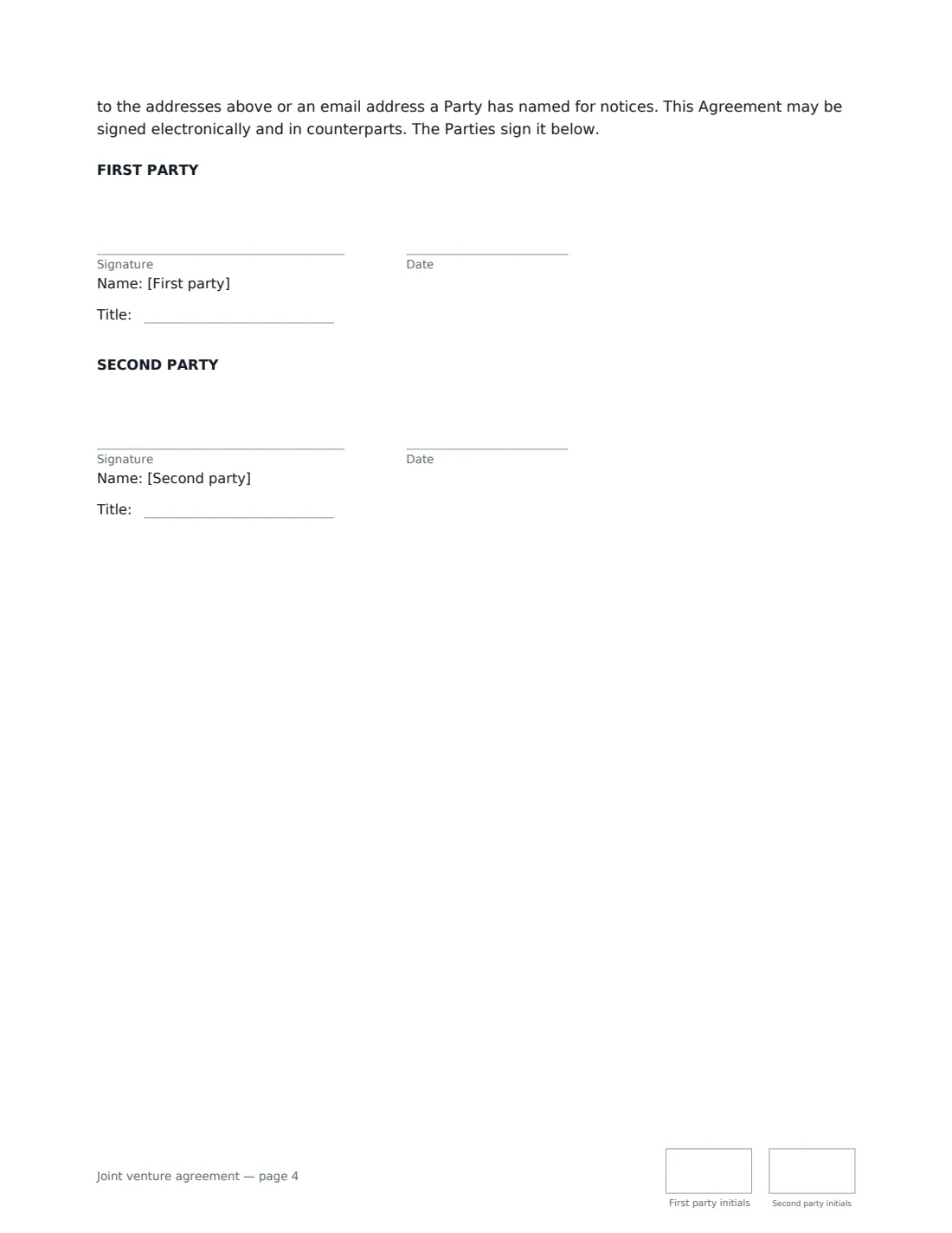
- First party signature and date, job title, initials on every page · Someone authorised to sign for the first business.
- Second party signature and date, job title, initials on every page · Someone authorised to sign for the second business.
What the joint venture agreement Covers
- The venture
- Contributions
- Profits, costs and losses
- Management and decisions
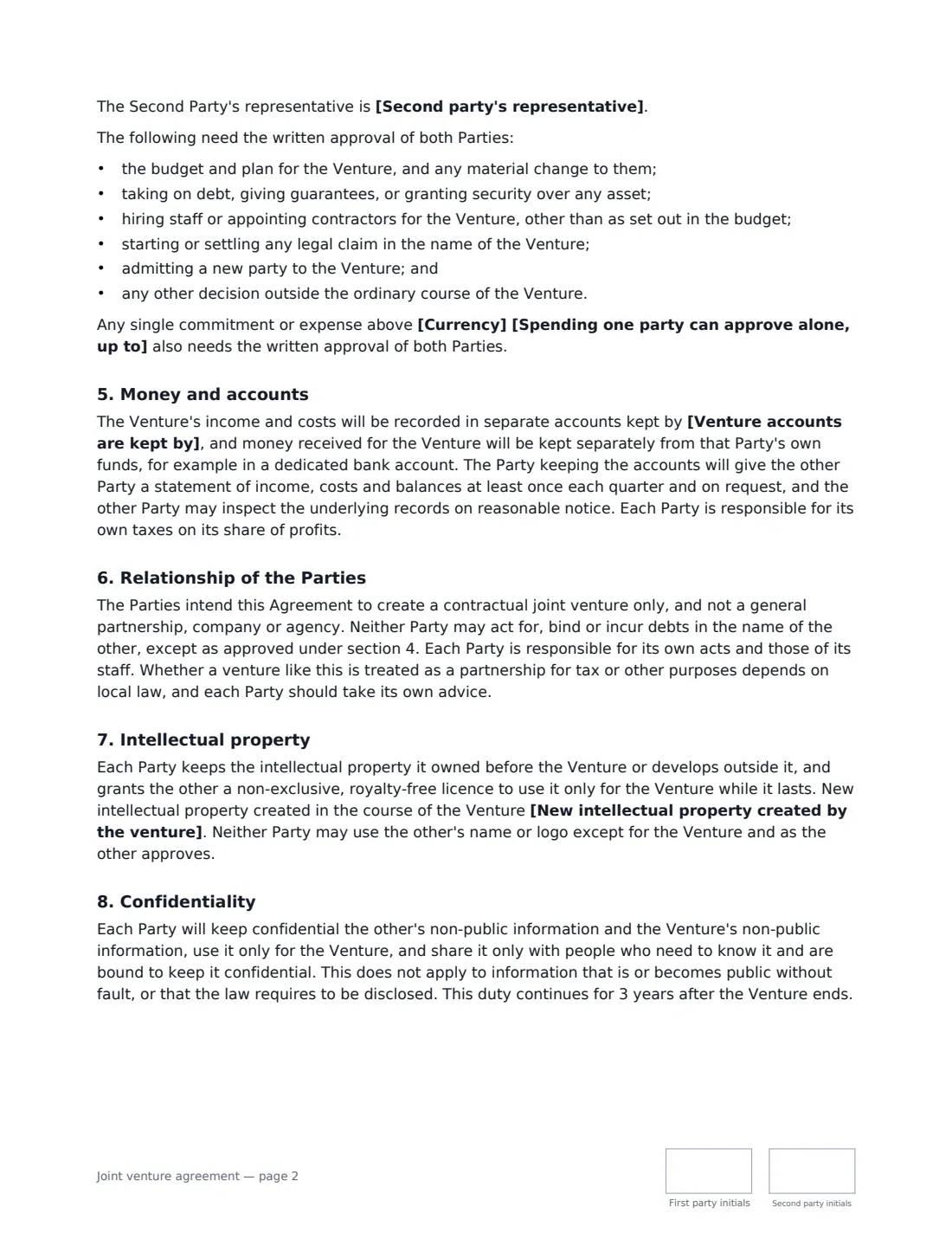
- Money and accounts
- Relationship of the Parties
- Intellectual property
- Confidentiality
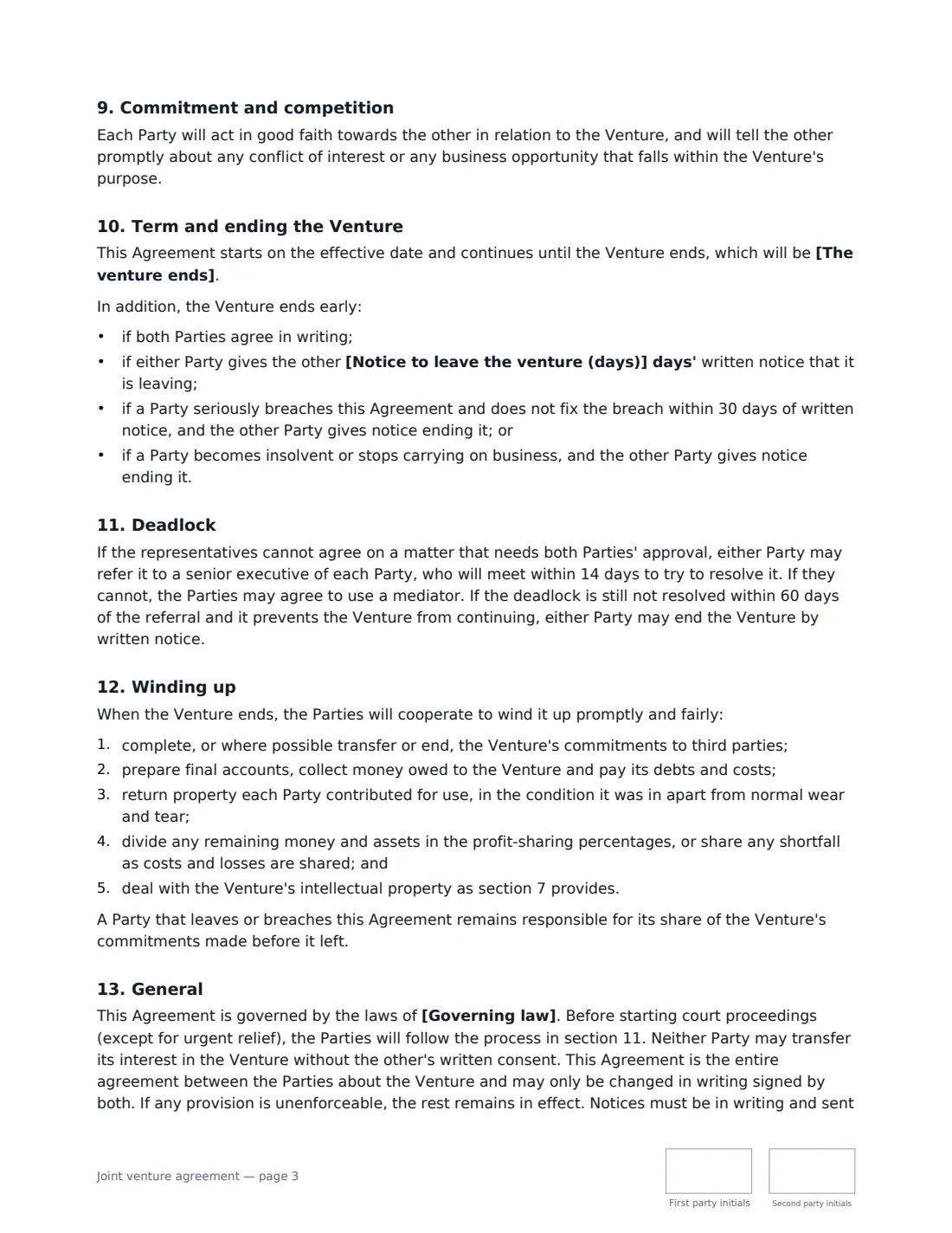
- Commitment and competition
- Term and ending the Venture
- Deadlock
- Winding up
- General
Using the joint venture agreement, step by step
1 Pin down the purpose
Describe exactly what the venture will do. The agreement limits the venture to that purpose and confirms each party stays free to run its own business outside it, so a precise description avoids arguments later.
2 List each side's contributions
Put each contribution on its own line: cash with amounts and dates, equipment, staff time, customer relationships, premises. Property contributed for the venture's use stays with its owner and goes back when the venture ends.
3 Set the money split
Enter each party's percentage of profits (they should add up to 100) and choose whether costs and losses are shared the same way or as you describe. Add an optional spending limit so no single commitment above it can be made without both parties.
4 Decide how it is run
Choose who manages day to day, name each side's representative, how often they meet, and which party keeps the venture's accounts. The agreement lists the decisions that always need both parties.
5 Plan the ending
Choose whether the venture ends on completion, on a date, or when either side gives notice, and set the notice period. The deadlock and winding-up clauses then tell you what happens if you can't agree or when it is over.
Tips Before You Send It
- Agree a written budget and plan alongside the agreement — only costs in an approved budget or approved under section 4 count as venture costs.
- Open a dedicated bank account for the venture so its money stays separate from either party's own funds.
- Whether a contractual joint venture is treated as a partnership for tax or liability purposes depends on local law. Ask an accountant or lawyer before you start trading.
- If you plan to run the venture as a jointly owned company, you need a shareholders' agreement instead.
- Restrictions on competing activities are limited in some places — keep the optional non-compete tied to the venture's purpose.
Sign It Online In Minutes
- Fill in the blanks. Names, dates and amounts go straight into the agreement — the preview shows exactly where.
- Name who signs. Tick “This is me” for your own part. VergeHR builds the PDF with every signature, date and initials box on the right line, and you can check or move anything before sending.
- Send it. Each signer gets a secure link and signs from any device — no account needed. The signed PDF, with an audit trail and a Certificate of Completion, is filed in Files and emailed to everyone.
Joint venture agreement: frequently asked questions
What is the difference between a joint venture and a partnership?
A joint venture is usually limited to one project or purpose and a set period, with each party keeping its own separate business. A general partnership is an ongoing business run together. This template says the parties do not intend to form a partnership, but how the law treats the arrangement depends on local law and on how the venture actually operates.
Does this template create a new company?
No. It is a contractual joint venture: the two businesses cooperate under this agreement. If you want a separate company owned by both, you need to incorporate it and sign a shareholders' agreement.
What happens if we can't agree on a decision?
Section 11 sets out a deadlock process: the matter goes to a senior executive of each party, then optionally to a mediator. If it is still unresolved after 60 days and blocks the venture, either party can end it, and the winding-up steps apply.
Can a joint venture agreement be signed electronically?
Yes. Electronic signatures are generally valid for ordinary business contracts in the US (ESIGN Act and UETA), the UK, the EU (eIDAS) and Canada. VergeHR records an audit trail and a Certificate of Completion with the signed PDF.