

What is a teaming agreement?
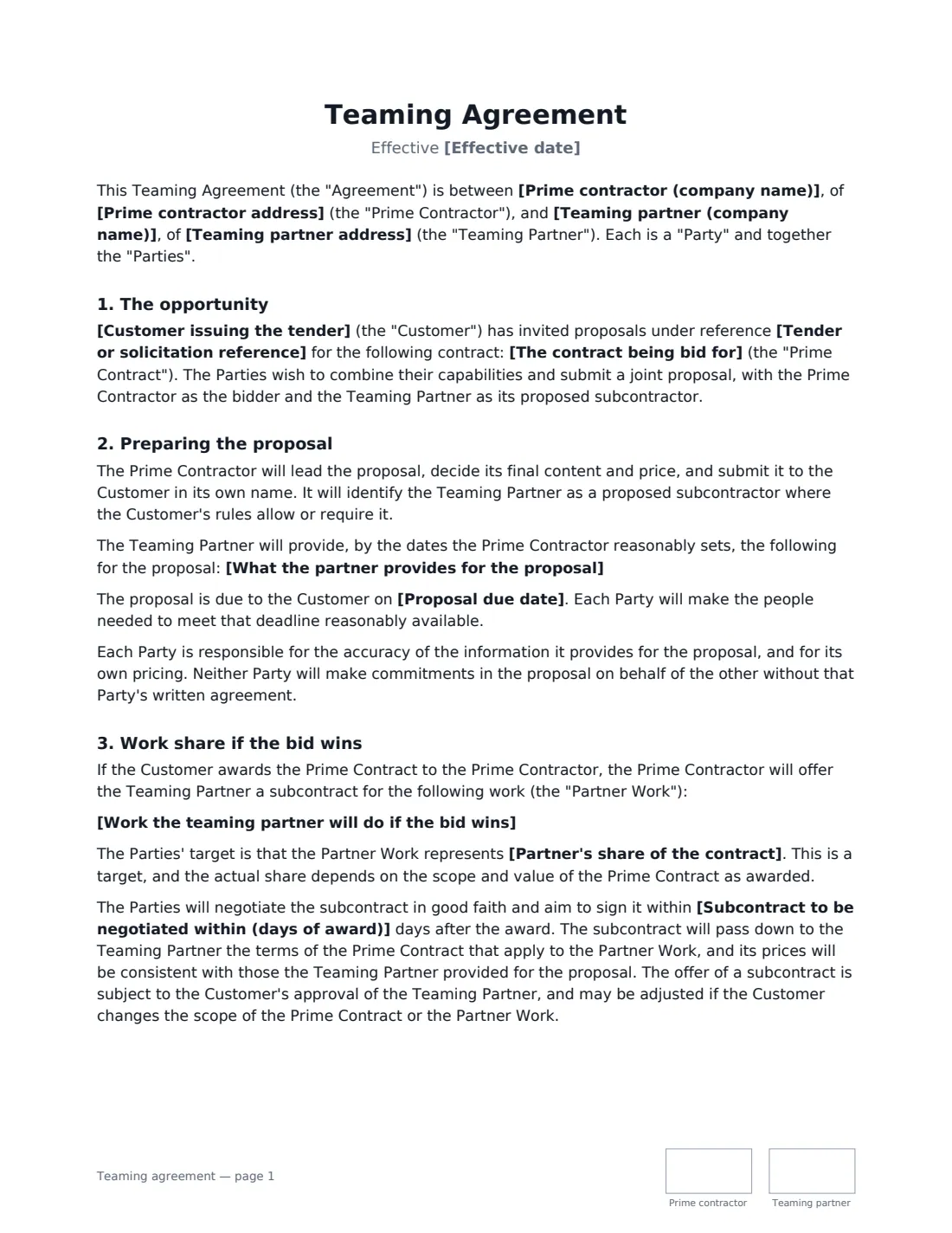
A teaming agreement is what two companies sign before they bid for a contract together. One becomes the prime contractor: it writes and submits the proposal and, if it wins, holds the contract with the customer. The other is the teaming partner: it contributes expertise, pricing and staff to the bid and, if the bid succeeds, is offered a subcontract for an agreed part of the work. It's common for government tenders and large private RFPs where no single company covers the whole scope.
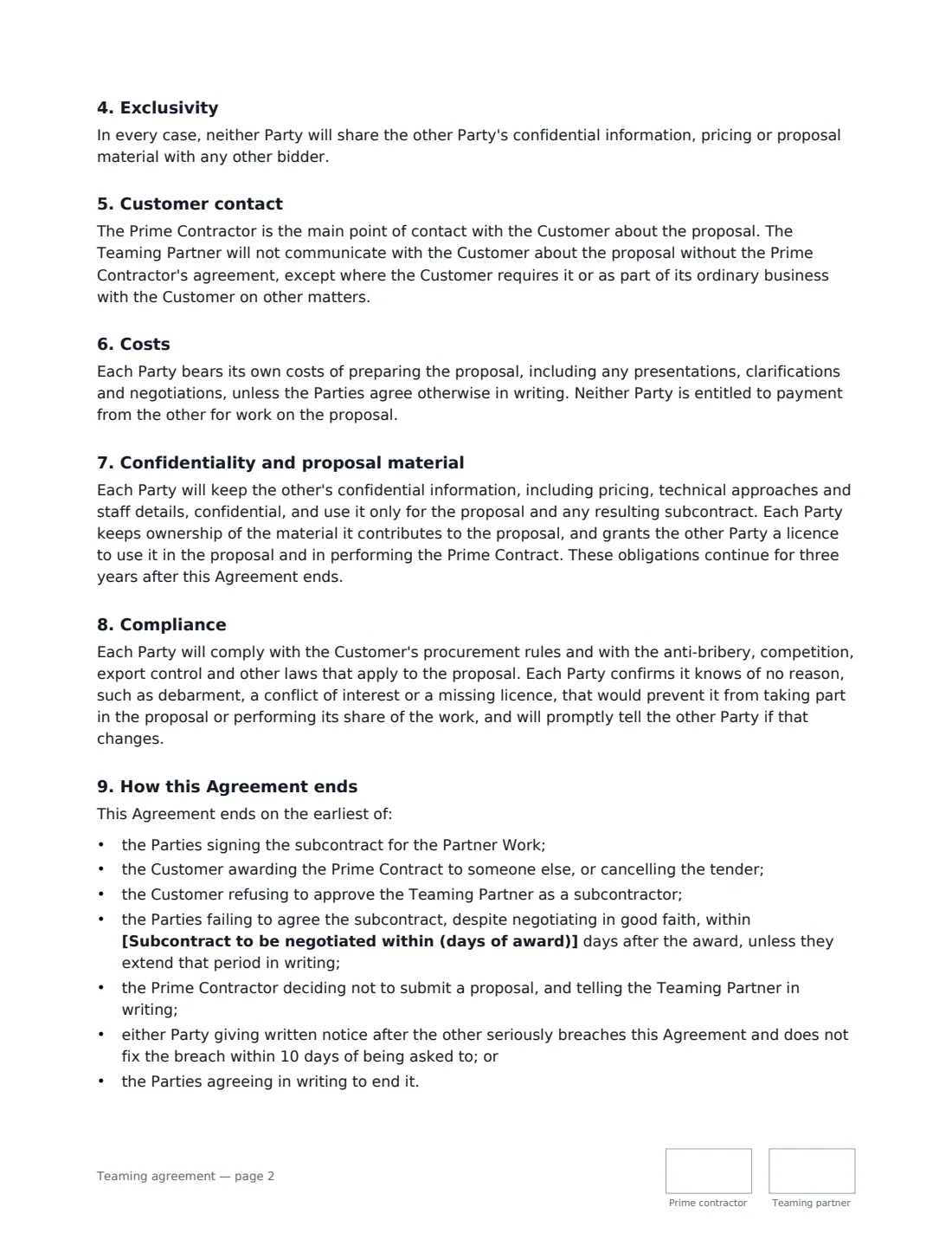
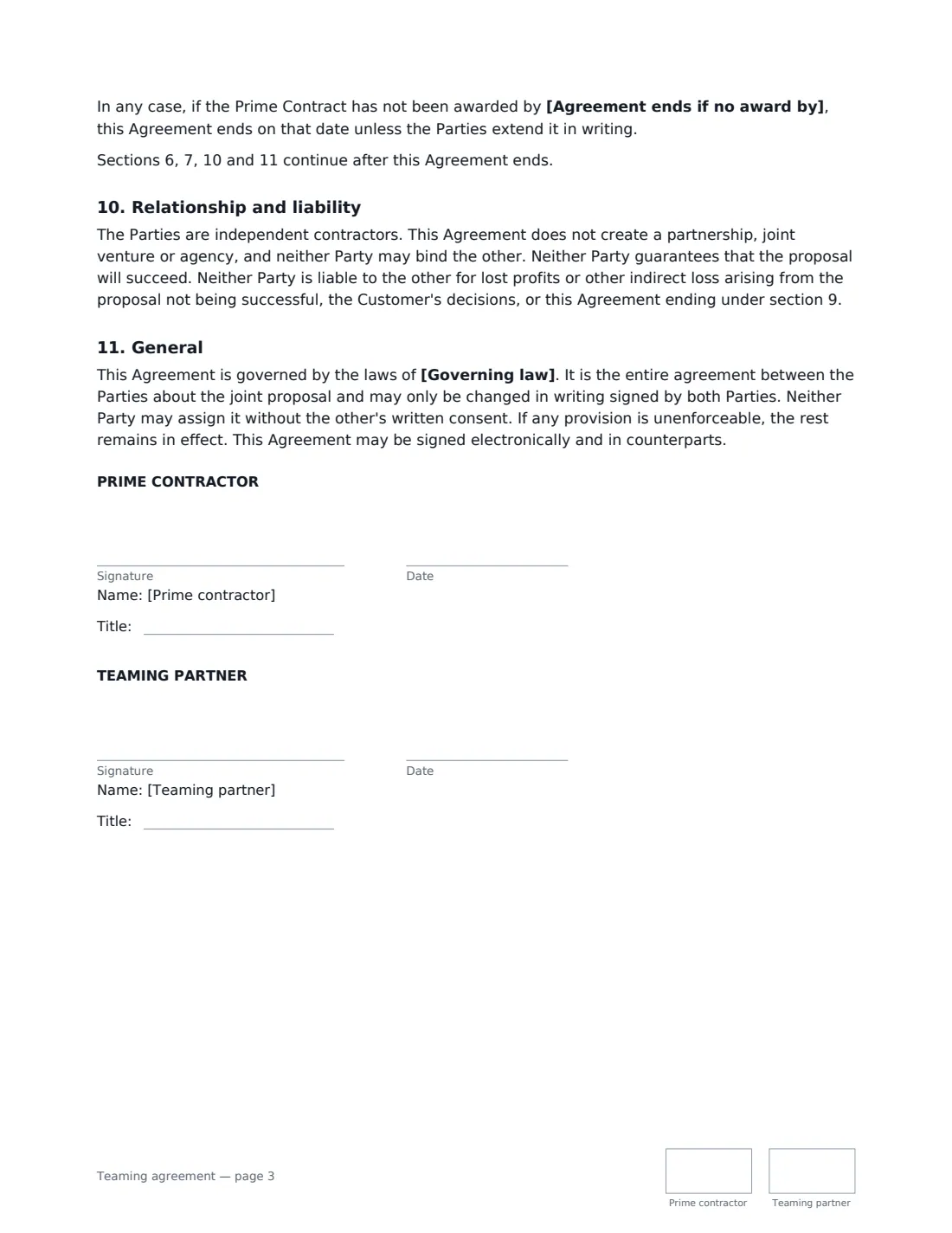
This template sets out the opportunity and the customer, how the proposal is prepared, the partner's work share if the bid wins, how the subcontract will be negotiated and by when, exclusivity (or not), who talks to the customer, costs, confidentiality of pricing and proposal material, compliance with procurement rules, and the events that end the agreement — including the customer awarding the contract to someone else. The work share, negotiation period, exclusivity and a long-stop date are yours to set.
- Best for
- Joint bids for public tenders, RFPs and large private contracts
- Signed by
- The prime contractor and the teaming partner, each by an authorised person
- Exclusivity
- You choose: exclusive (neither joins a competing bid) or non-exclusive
- Length
- 3 pages, initialled on every page
When to Use a teaming agreement
- A software company teaming with a hardware installer to bid for a city's IT managed-services tender
- A general contractor bringing in a specialist firm to strengthen a construction bid
- A small business partnering with a larger prime to meet a tender's experience or size requirements
- A consultancy and a training provider bidding jointly for a public-sector programme
- Two agencies combining creative and media capabilities for a large client pitch
What You Fill In
16 blanks, then the name and email of each person who signs: prime contractor, teaming partner.
1 The parties
- Effective date*
- Prime contractor (company name)*
- Prime contractor address
- Teaming partner (company name)*
- Teaming partner address
2 The opportunity
- The contract being bid for*
- Customer issuing the tender*
- Tender or solicitation reference
- Proposal due date
3 Work share
- Work the teaming partner will do if the bid wins*
- Partner's share of the contract
- What the partner provides for the proposal
- Subcontract to be negotiated within (days of award)*
4 Other terms
- Exclusivity* Exclusive — neither company joins a competing bid · Non-exclusive
- Agreement ends if no award by
- Governing law*
5 Who signs
- Prime contractor signature and date, job title, initials on every page · The company that submits the bid and would hold the contract with the customer.
- Teaming partner signature and date, job title, initials on every page · The company that supports the bid and would become the subcontractor.
What the teaming agreement Covers
- The opportunity
- Preparing the proposal
- Work share if the bid wins
- Exclusivity
- Customer contact
- Costs
- Confidentiality and proposal material
- Compliance
- How this Agreement ends
- Relationship and liability
- General
Using the teaming agreement, step by step
1 Describe the opportunity
Name the customer, describe the contract in a sentence and add the tender reference if there is one. Add the proposal due date so both teams work to the same deadline.
2 Define the partner's work precisely
The partner's work is what the prime promises to offer as a subcontract if the bid wins, so describe it as specifically as you can: sites, services, deliverables. A target share of the contract value is optional and is written as a target, not a guarantee.
If the partner owes specific items for the proposal — CVs, pricing, references — list them; otherwise the template uses general wording.
3 Set exclusivity and the end date
Choose whether both companies are kept out of competing bids. Then set how long you'll negotiate the subcontract after award (30 days by default) and, optionally, a long-stop date so the agreement ends if the customer never awards.
4 Add signers and send
Tick "This is me" for your company and add the other company's signer. VergeHR builds the PDF with both signature blocks, title boxes and initials on each page, and you check it in the editor before sending.
Tips Before You Send It
- Check the tender documents before choosing exclusive teaming — some public procurement and competition rules restrict exclusive arrangements.
- Sign an NDA first if you need to share pricing or technical approaches before the teaming agreement is in place.
- Keep the partner's proposal pricing realistic: the subcontract prices must be consistent with what went into the bid.
- Agree who presents to the customer and who answers clarification questions — the template makes the prime the main point of contact.
- Once you win, sign a full subcontractor agreement for the partner's work; the teaming agreement ends when you do.
Sign It Online In Minutes
- Fill in the blanks. Names, dates and amounts go straight into the agreement — the preview shows exactly where.
- Name who signs. Tick “This is me” for your own part. VergeHR builds the PDF with every signature, date and initials box on the right line, and you can check or move anything before sending.
- Send it. Each signer gets a secure link and signs from any device — no account needed. The signed PDF, with an audit trail and a Certificate of Completion, is filed in Files and emailed to everyone.
Teaming agreement: frequently asked questions
Is a teaming agreement the same as a joint venture?
No. In this template the companies stay independent: the prime alone bids and holds the contract, and the partner becomes its subcontractor. A joint venture usually means the companies bid and perform together, sharing risk and profit. The template says expressly that it does not create a partnership or joint venture.
Does the teaming partner get guaranteed work if the bid wins?
The prime promises to offer a subcontract for the partner's described work and to negotiate it in good faith, subject to the customer approving the partner and any change the customer makes to the scope. How firmly an agreement to negotiate a future contract can be enforced varies between jurisdictions, which is why describing the partner's work precisely matters.
What happens if we lose the bid?
The agreement ends when the customer awards the contract to someone else or cancels the tender. Each company bears its own bid costs, and neither is liable to the other for lost profits from not winning. Confidentiality continues.
Can a teaming agreement be signed electronically?
In most countries, including the US (ESIGN Act and UETA), the UK, the EU (eIDAS) and Canada, an electronic signature is generally valid for an ordinary commercial contract like this one. VergeHR keeps an audit trail and a Certificate of Completion with the signed PDF as evidence of who signed and when.
Is this template free?
Yes. The template is free to use with the eSignature app in VergeHR, and the people you send it to don't need a VergeHR login to sign.