

What is a subcontractor agreement?
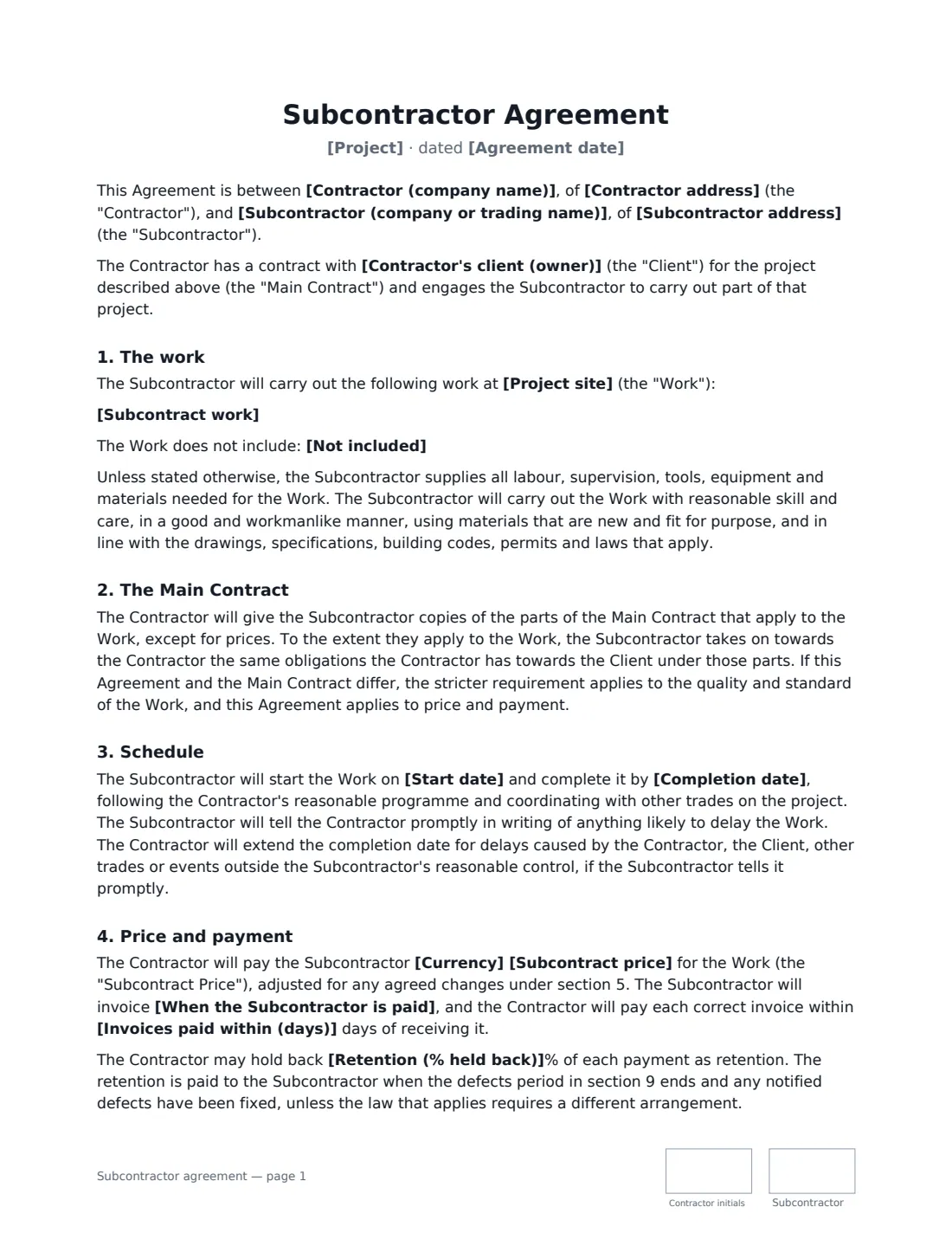
A subcontractor agreement is the contract between a main (general) contractor and a business it brings in to do part of a project: the electrician on a fit-out, the roofer on a new build, the network installer on an IT rollout. The main contractor stays responsible to its client; the subcontractor is responsible to the main contractor for its piece of the work, on terms that mirror the main contract where they matter.
This template covers the scope and any exclusions, how the relevant main-contract terms flow down, the start and completion dates and extensions for delay, the price and when invoices are paid, optional retention, written change orders, site safety, the subcontractor's workers, licences and suppliers, insurance and indemnities, a defects period, termination, disputes and the governing law. You set the scope, dates, price, payment basis, retention percentage, insurance and the defects period.
- Best for
- Construction, renovation, installation and other projects with trade subcontractors
- Signed by
- The main contractor and the subcontractor
- Payment
- Monthly, on milestones or on completion — with optional retention
- Length
- 3 pages, initialled on every page
When to Use a subcontractor agreement
- A general contractor hiring an electrical or plumbing subcontractor for a commercial fit-out
- A builder engaging a roofing or groundworks company on a new home
- An IT integrator subcontracting cabling and hardware installation at client sites
- A landscaping firm bringing in a specialist for irrigation or paving on a larger job
- A prime contractor on a public contract engaging its teaming partner after winning the bid
What You Fill In
22 blanks, then the name and email of each person who signs: contractor, subcontractor.
1 The parties
- Agreement date*
- Contractor (company name)*
- Contractor address
- Subcontractor (company or trading name)*
- Subcontractor address
2 The project
- Project*
- Project site
- Contractor's client (owner)
3 The work
- Subcontract work*
- Not included
- Start date*
- Completion date*
4 Price and payment
- Currency*
- Subcontract price*
- When the Subcontractor is paid* monthly, for work completed in the month · on completing the milestones set out below · in full on completion
- Payment milestones
- Invoices paid within (days)*
- Retention (% held back)
5 Insurance and warranty
- Insurance the Subcontractor must carry*
- Defects period after completion* 6 months · 12 months · 18 months · 24 months
6 Other terms
- Notice to fix a breach (days)*
- Governing law*
7 Who signs
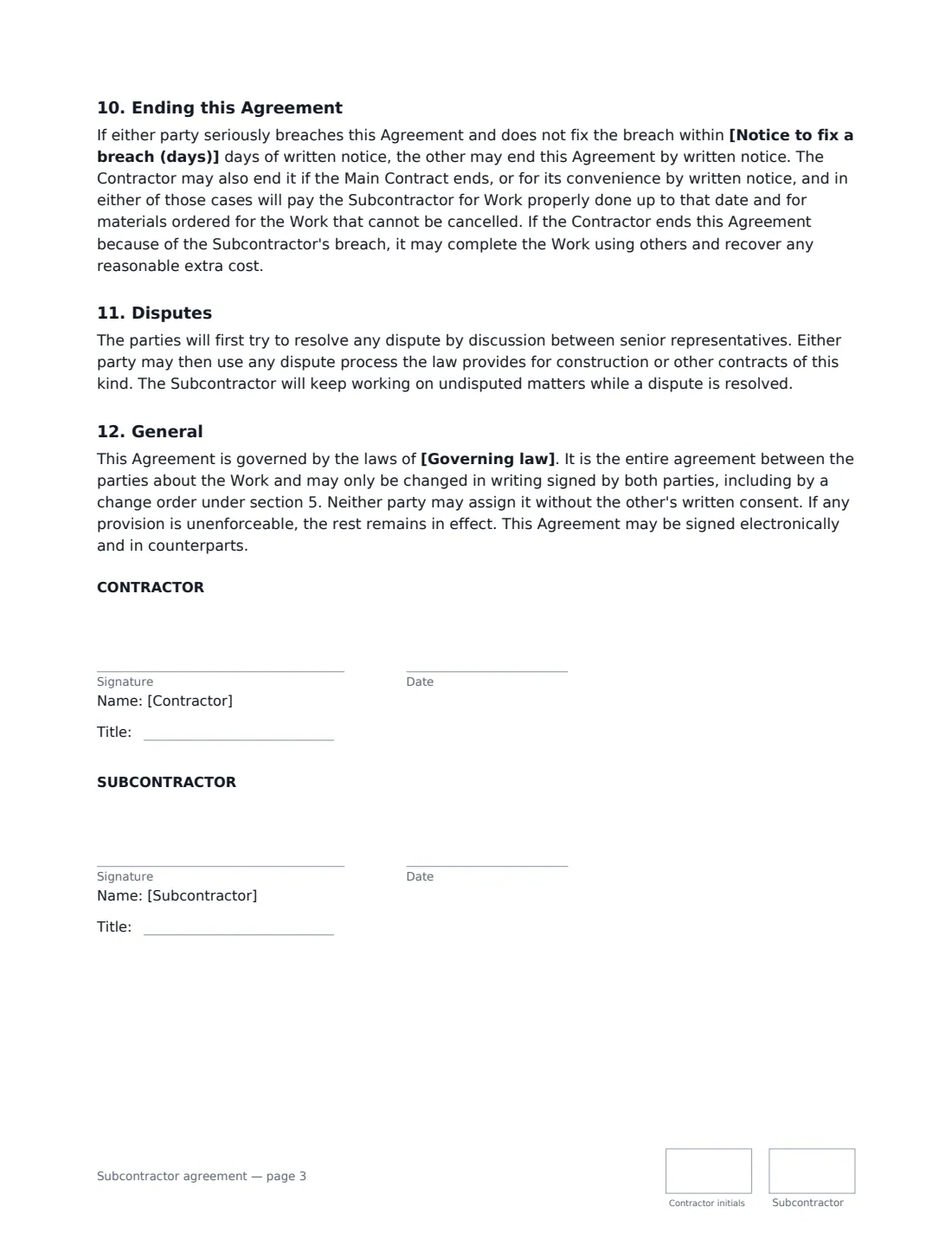
- Contractor signature and date, job title, initials on every page · The main (general) contractor that holds the contract with the client.
- Subcontractor signature and date, job title, initials on every page · The business carrying out part of the work.
What the subcontractor agreement Covers
- The work
- The Main Contract
- Schedule
- Price and payment
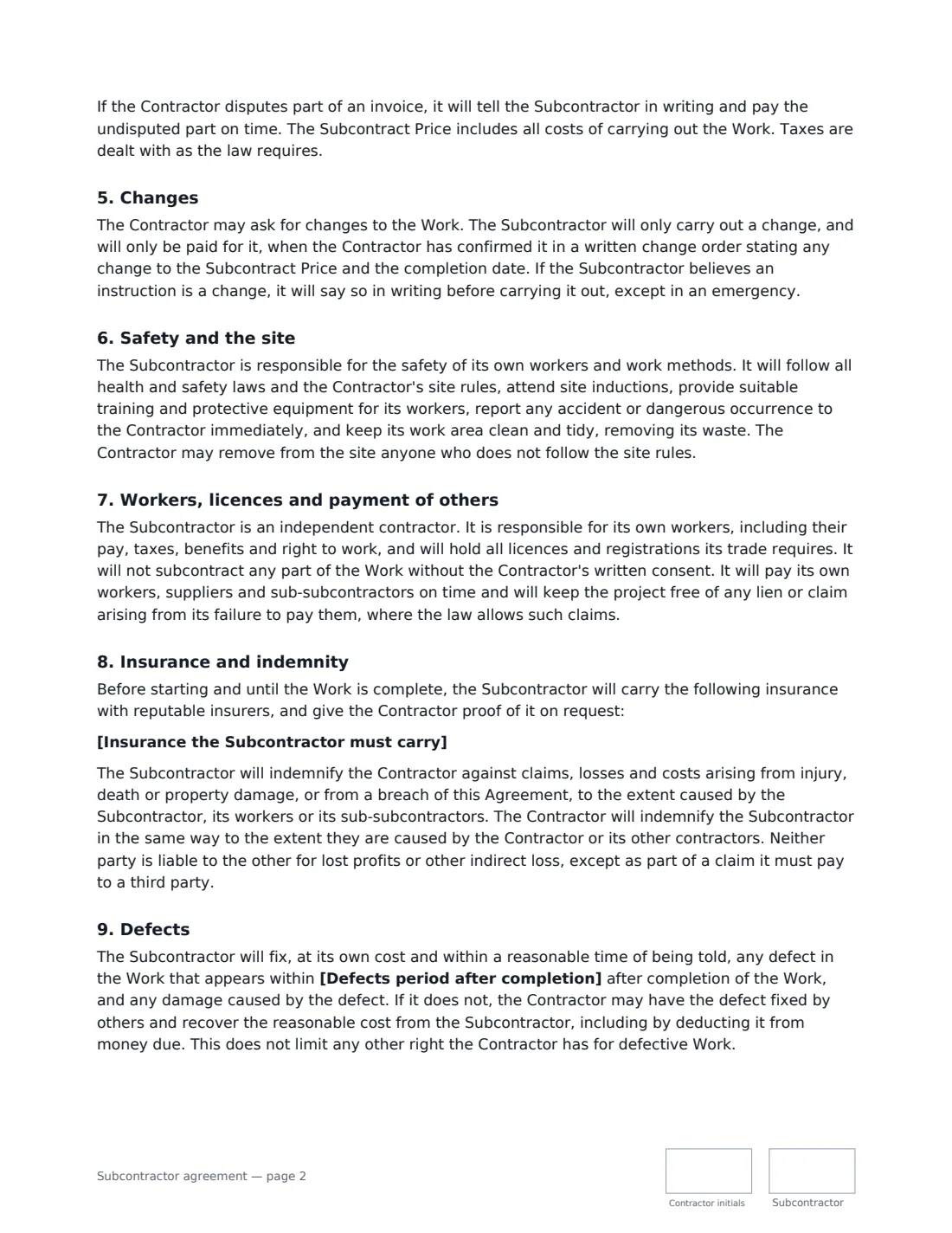
- Changes
- Safety and the site
- Workers, licences and payment of others
- Insurance and indemnity
- Defects
- Ending this Agreement
- Disputes
- General
Using the subcontractor agreement, step by step
1 Describe the project and the work
Name the project and site, and optionally the client. Then describe the subcontract work with the drawings or specifications it follows, and list anything expressly excluded — exclusions prevent most scope arguments later.
2 Set dates, price and payment
Enter the start and completion dates and the subcontract price. Choose whether invoices are monthly for work done, by milestone (then list the milestones) or on completion, and how quickly they are paid.
Add a retention percentage only if your industry uses one. Payment periods and retention are regulated in some places, so check the local rules before you fill these in.
3 Insurance and defects
The insurance list comes pre-filled with the usual types of cover; add minimum amounts to match what your main contract requires. Choose a defects period — the subcontractor fixes defects that appear in that time at its own cost.
4 Send for signature
Add the subcontractor's signer and send. Both signature blocks, job-title boxes and initials on every page are placed for you, and the signed copy is filed in Files.
Tips Before You Send It
- Give the subcontractor copies of the main-contract sections that apply to its work — the flow-down clause relies on them.
- Ask for proof of insurance before the subcontractor starts on site, not after.
- Insist on written change orders. The template only pays for changes confirmed in writing with the price and time impact.
- Some places have statutory payment rules or dispute processes for construction contracts; they apply alongside this agreement.
- Check that the subcontractor holds any licence or registration its trade needs where the work is done.
Sign It Online In Minutes
- Fill in the blanks. Names, dates and amounts go straight into the agreement — the preview shows exactly where.
- Name who signs. Tick “This is me” for your own part. VergeHR builds the PDF with every signature, date and initials box on the right line, and you can check or move anything before sending.
- Send it. Each signer gets a secure link and signs from any device — no account needed. The signed PDF, with an audit trail and a Certificate of Completion, is filed in Files and emailed to everyone.
Subcontractor agreement: frequently asked questions
What is a flow-down clause?
It passes the main contract's requirements for the subcontracted work down to the subcontractor, so the main contractor isn't left owing its client something the subcontractor never promised. In this template, where the two documents differ, the stricter standard applies to the quality of the work and this agreement applies to price and payment.
What is retention?
Retention is a percentage of each payment the main contractor holds back as security for defects. In this template it is paid out when the defects period ends and notified defects are fixed. Leave the field empty for no retention. Some places limit retention or regulate how it is held.
Can the main contractor end the subcontract early?
Yes: for a serious breach that isn't fixed after notice, if the main contract ends, or for convenience. In the last two cases the subcontractor is paid for work properly done and for materials ordered that can't be cancelled.
Is an electronically signed subcontract valid?
In most countries, including the US (ESIGN Act and UETA), the UK, the EU (eIDAS) and Canada, an electronic signature is generally valid for an ordinary commercial contract like this one. VergeHR keeps an audit trail and a Certificate of Completion with the signed PDF as evidence of who signed and when.
Is this template free?
Yes. The template is free to use with the eSignature app in VergeHR, and the people you send it to don't need a VergeHR login to sign.