

What is a joint check agreement?
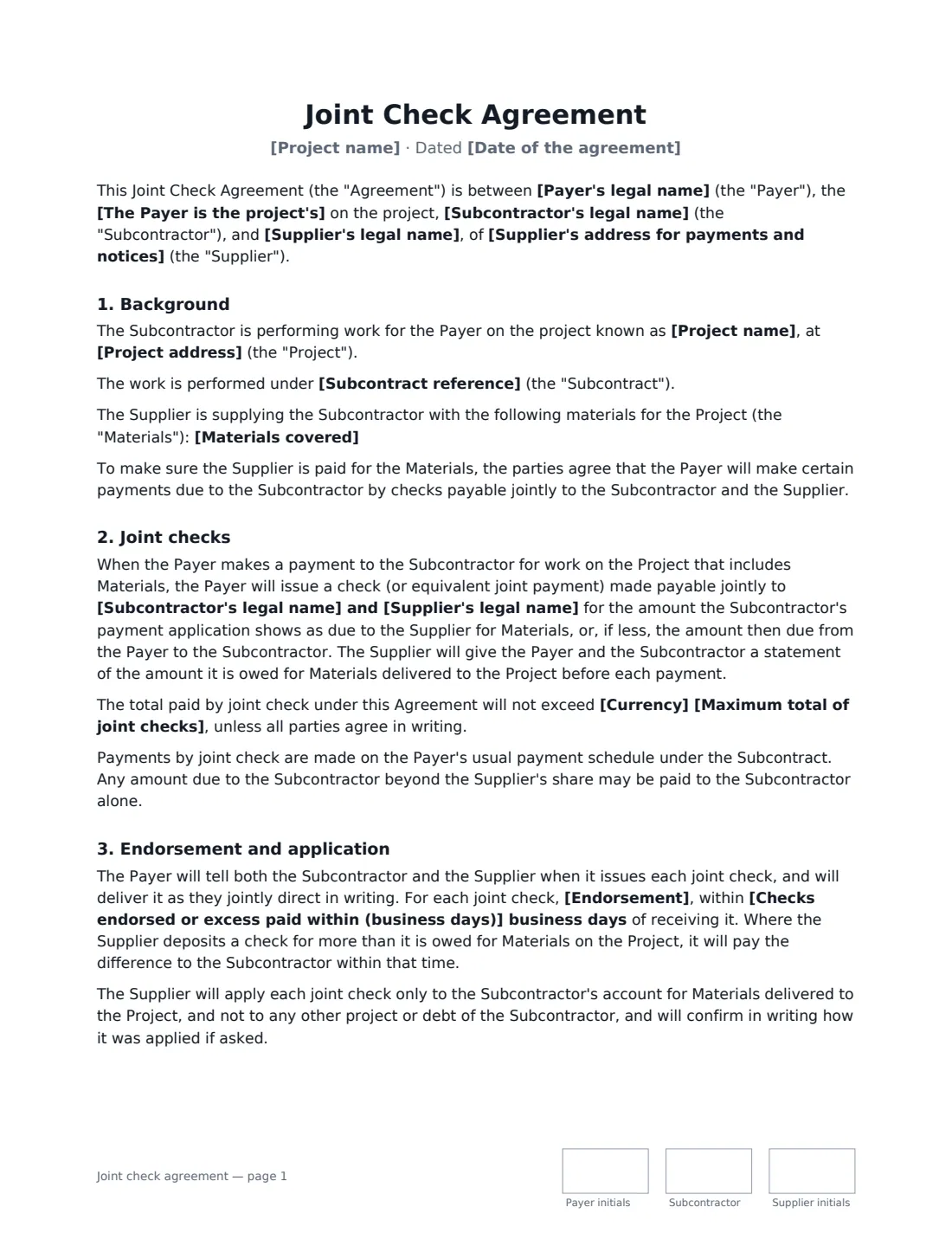
A joint check agreement is a three-party agreement used on construction projects. The owner or general contractor (the payer) agrees to pay part of what it owes a subcontractor by checks made out jointly to the subcontractor and its material supplier. The supplier gets comfort that it will be paid for the materials it delivered, the subcontractor keeps its supply line open, and the payer reduces the risk of a supplier's lien or payment bond claim.
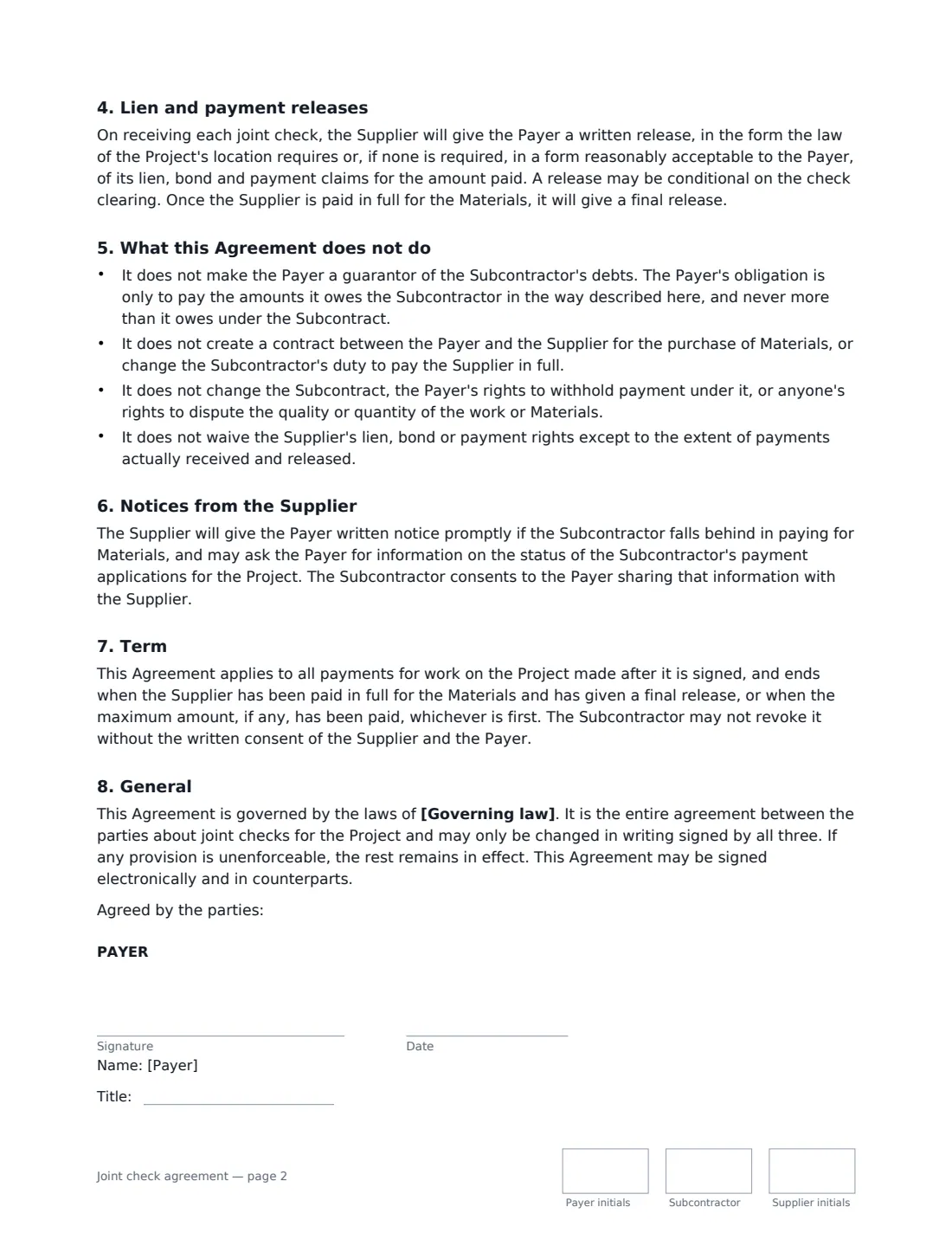
This template covers the project and the materials, how the joint check amount is worked out, an optional maximum, endorsement and deposit (with any excess going back to the subcontractor), applying payments only to this project's account, lien and payment releases in the form local law requires, and what the agreement doesn't do — in particular, it doesn't make the payer a guarantor of the subcontractor's debts or change the subcontract.
- Best for
- Construction projects where a supplier wants security for materials
- Signed by
- The payer (owner or GC), the subcontractor and the supplier
- Releases
- Supplier gives a lien and payment release for each amount paid
- Length
- 3 pages, initialled on every page by all three
When to Use a joint check agreement
- A supplier opening credit for a new or smaller subcontractor on a large job
- A general contractor protecting the project from supplier lien claims
- A subcontractor that needs a big materials order approved
- An owner paying a trade contractor where materials are a large share of the cost
What You Fill In
15 blanks, then the name and email of each person who signs: payer, subcontractor, supplier.
1 The parties
- Date of the agreement*
- Payer's legal name*
- The Payer is the project's* general contractor · owner · higher-tier subcontractor
- Subcontractor's legal name*
- Supplier's legal name*
- Supplier's address for payments and notices
2 The project
- Project name*
- Project address*
- Subcontract reference
- Materials covered*
3 Payment
- Currency*
- Maximum total of joint checks
- Endorsement* the Subcontractor will endorse it to the Supplier · the Supplier will deposit it, with the Subcontractor endorsing it where needed
- Checks endorsed or excess paid within (business days)*
4 Other terms
- Governing law*
5 Who signs
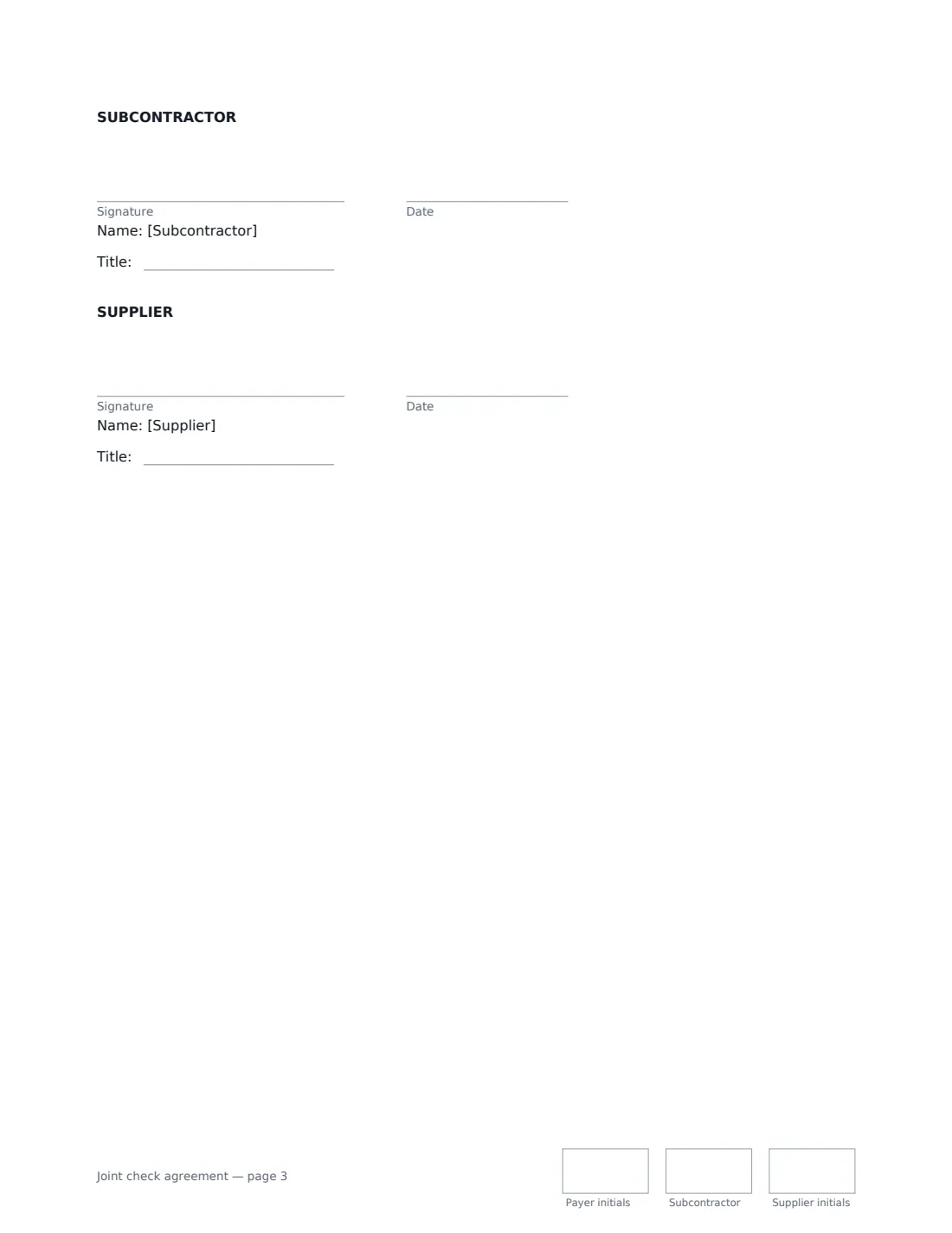
- Payer signature and date, job title, initials on every page · The owner or general contractor who pays the subcontractor.
- Subcontractor signature and date, job title, initials on every page · The subcontractor buying the materials.
- Supplier signature and date, job title, initials on every page · The material supplier asking to be paid by joint check.
What the joint check agreement Covers
- Background
- Joint checks
- Endorsement and application
- Lien and payment releases
- What this Agreement does not do
- Notices from the Supplier
- Term
- General
Using the joint check agreement, step by step
1 Name the three parties
Enter the payer and whether it's the general contractor, owner or a higher-tier subcontractor, then the subcontractor and the supplier.
2 Describe the project and materials
Add the project name and address, the subcontract reference if you have it, and the materials covered — ideally with the supplier's account number for the job.
3 Set the payment terms
Optionally set a maximum total for joint checks. Choose whether the subcontractor endorses each check to the supplier or the supplier deposits it, and how many business days either has to do so or pay back any excess.
4 Send to all three
Send it to the other two parties. Each signs and initials every page, and all three receive the signed copy.
Tips Before You Send It
- Construction lien, bond and prompt-payment rules differ a lot between places — some have statutory release forms that must be used. Check the rules where the project is.
- Suppliers: keep your preliminary notices and lien deadlines up to date even with a joint check agreement in place.
- Payers: only the amount you actually owe the subcontractor is ever paid. The template states you are not a guarantor.
- Keep copies of each joint check and release together with the signed agreement in Files.
Sign It Online In Minutes
- Fill in the blanks. Names, dates and amounts go straight into the agreement — the preview shows exactly where.
- Name who signs. Tick “This is me” for your own part. VergeHR builds the PDF with every signature, date and initials box on the right line, and you can check or move anything before sending.
- Send it. Each signer gets a secure link and signs from any device — no account needed. The signed PDF, with an audit trail and a Certificate of Completion, is filed in Files and emailed to everyone.
Joint check agreement: frequently asked questions
Does a joint check agreement make the general contractor liable for the subcontractor's debts?
Not under this template. It says expressly that the payer is not a guarantor and only has to pay the amounts it owes the subcontractor, in the way described. How courts treat joint check arrangements varies by place, so take local advice if this is important.
Does the supplier give up its lien rights?
Only for amounts it is actually paid. For each joint check it gives a release for the amount paid (which can be conditional on the check clearing), and a final release once it is paid in full.
Can a three-party agreement be signed electronically?
In most countries, including the US (ESIGN Act and UETA), the UK, the EU (eIDAS) and Canada, an electronic signature is generally valid for an ordinary commercial contract like this one. VergeHR keeps an audit trail and a Certificate of Completion with the signed PDF as evidence of who signed and when. Each of the three parties signs from their own device.
Is this template free?
Yes. The template is free to use with the eSignature app in VergeHR, and the people you send it to don't need a VergeHR login to sign.