


What is a workmanship warranty?
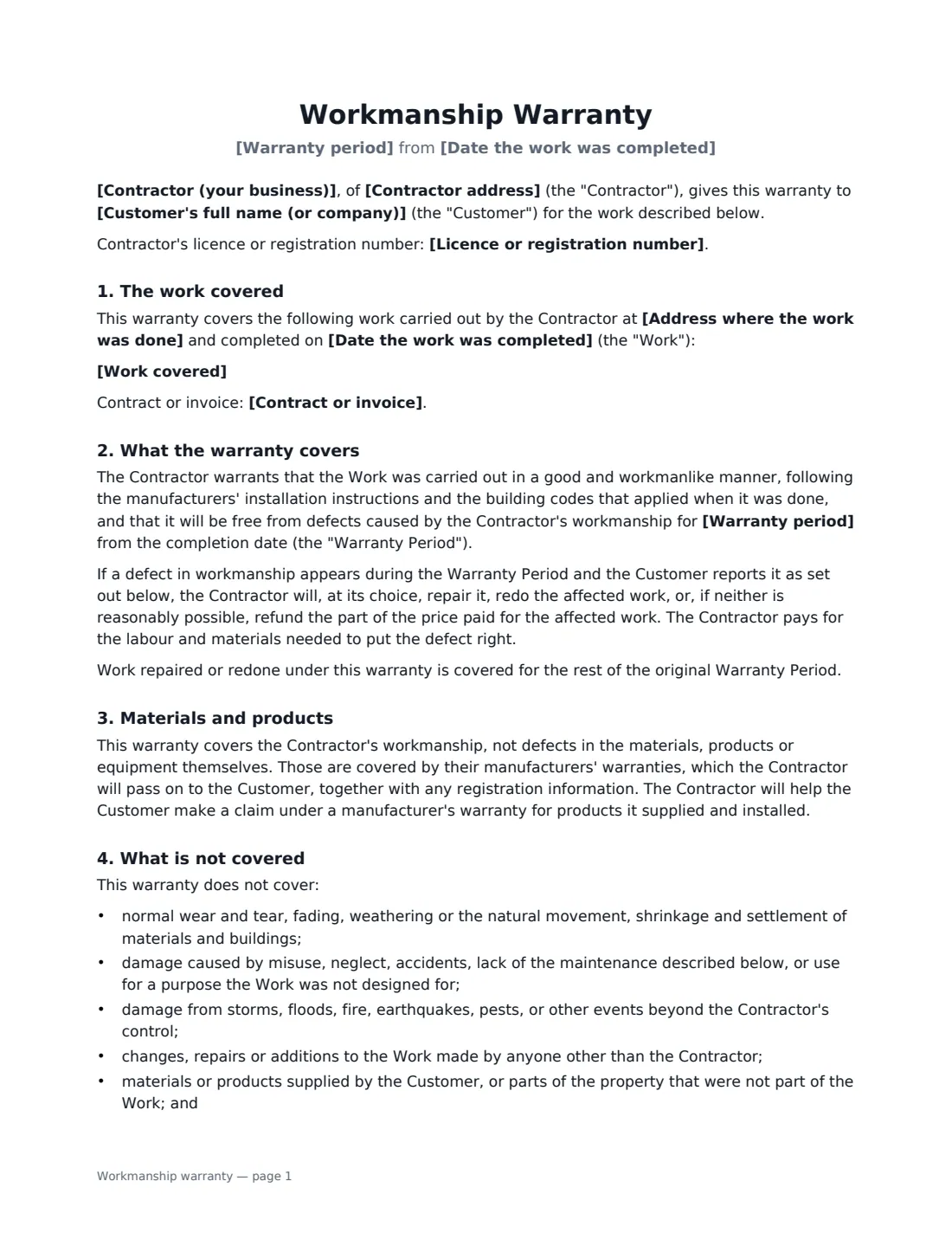
A workmanship warranty (also called a labor warranty or contractor's warranty) is a contractor's written promise that the work it did was done properly and that it will put right defects in its workmanship for a set period. It's separate from the manufacturer's warranty on the materials: a roofer warrants the installation, the shingle maker warrants the shingles. A clear written warranty gives customers confidence and gives contractors a defined, limited commitment instead of an open-ended one.
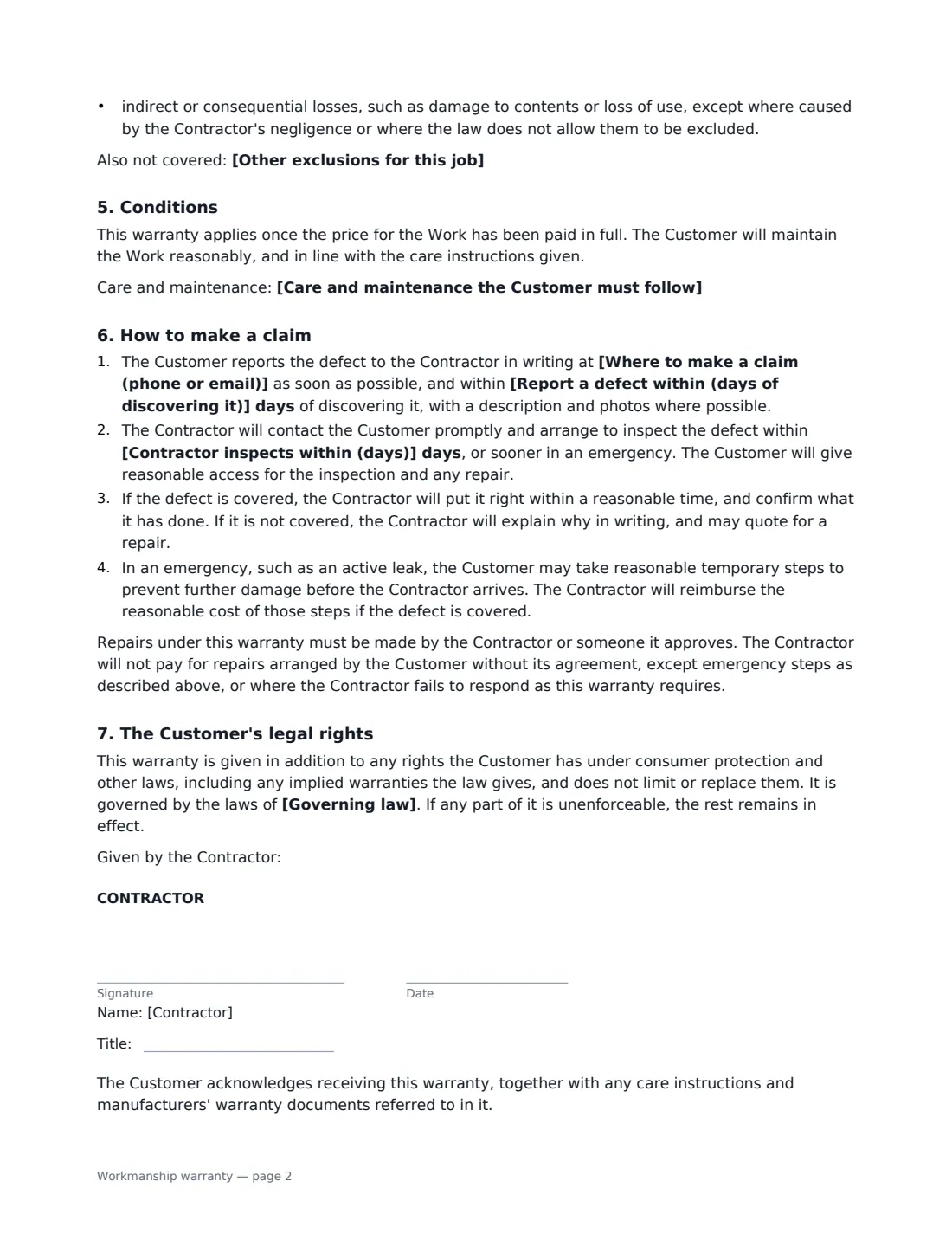
This template describes the work covered, the property and the completion date, and gives a warranty period from 90 days to 10 years. It covers defects caused by workmanship, with the contractor choosing to repair, redo or refund, and repaired work covered for the rest of the period. It passes on manufacturers' warranties, lists standard exclusions (wear and tear, misuse, storms, alterations by others, customer-supplied materials) plus any job-specific ones, adds care conditions, and says whether the warranty transfers to a new owner. A step-by-step claims process sets how quickly defects must be reported and inspected, and allows reasonable emergency steps. It is expressly in addition to the customer's legal rights.
- Best for
- Roofers, builders, remodelers, plumbers, electricians, installers and other trades
- Signed by
- The contractor gives it; the customer signs to acknowledge receipt
- Warranty period
- You choose: 90 days, 6 months, or 1, 2, 3, 5 or 10 years
- Length
- About 2-3 pages
When to Use a workmanship warranty
- A roofer giving a labor warranty on a new roof
- A remodeler handing over a warranty with the final invoice
- An installer warranting windows, flooring or cabinetry installation
- A plumber or electrician warranting a completed job
- Offering a transferable warranty as a selling point for homeowners
What You Fill In
16 blanks, then the name and email of each person who signs: contractor, customer.
1 The parties
- Contractor (your business)*
- Contractor address
- Where to make a claim (phone or email)*
- Licence or registration number
- Customer's full name (or company)*
2 The work
- Address where the work was done*
- Work covered*
- Contract or invoice
- Date the work was completed*
3 The warranty
- Warranty period* 90 days · 6 months · 1 year · 2 years · 3 years · 5 years · 10 years
- If the property is sold* the warranty stays with the Customer · the warranty transfers to the new owner
- Other exclusions for this job
- Care and maintenance the Customer must follow
4 Claims
- Report a defect within (days of discovering it)*
- Contractor inspects within (days)*
- Governing law*
5 Who signs
- Contractor signature and date, job title · The contractor or trade business giving the warranty.
- Customer signature and date · The customer receiving the warranty.
What the workmanship warranty Covers
- The work covered
- What the warranty covers
- Materials and products
- What is not covered
- Conditions
- How to make a claim
- The Customer's legal rights
Using the workmanship warranty, step by step
1 Describe the work
Enter your business details and where customers should make claims, the customer, the property address, a description of the work, the invoice or contract reference and the completion date.
2 Set the warranty terms
Choose the warranty period and whether it stays with the customer or transfers to a new owner if the property is sold. Add any exclusions specific to this job and the care the customer must follow.
3 Set the claims timings
Choose how many days the customer has to report a defect after discovering it, and how quickly you'll inspect. The template sets out the rest of the claims process step by step.
4 Sign and send
Sign as the contractor and send it to the customer, who signs to acknowledge receiving the warranty, care instructions and any manufacturers' warranty documents.
Tips Before You Send It
- Only warrant what you control. The workmanship warranty covers your installation; pass on manufacturers' warranties for the materials.
- Write job-specific exclusions plainly — for example existing parts of the building that weren't part of your work.
- Consumer protection laws may give customers rights beyond your written warranty, and the template says it doesn't limit them.
- Keep photos of the finished work with the signed warranty; they help when a claim comes in years later.
Sign It Online In Minutes
- Fill in the blanks. Names, dates and amounts go straight into the agreement — the preview shows exactly where.
- Name who signs. Tick “This is me” for your own part. VergeHR builds the PDF with every signature, date box on the right line, and you can check or move anything before sending.
- Send it. Each signer gets a secure link and signs from any device — no account needed. The signed PDF, with an audit trail and a Certificate of Completion, is filed in Files and emailed to everyone.
Workmanship warranty: frequently asked questions
What's the difference between a workmanship warranty and a manufacturer's warranty?
A workmanship warranty covers defects caused by how the work was done — the installation. A manufacturer's warranty covers defects in the product or material itself. This template covers workmanship and passes on the manufacturers' warranties.
What does the contractor have to do if there's a defect?
Inspect within the number of days you set, then, if the defect is covered, repair it, redo the work, or — if neither is reasonably possible — refund the part of the price for the affected work. If it isn't covered, the contractor explains why in writing.
Can a warranty transfer to a new homeowner?
If you choose so. The warranty then passes to the new owner for the rest of the period. Otherwise it stays personal to the original customer.
Why does the customer sign a warranty?
The customer's signature acknowledges receiving the warranty, the care instructions and the manufacturers' warranty documents — useful evidence if a claim later turns on maintenance or notice.
Is this template free?
Yes. The template is free to use with the eSignature app in VergeHR, and your customer doesn't need a VergeHR login to sign.