

What is a memorandum of understanding?
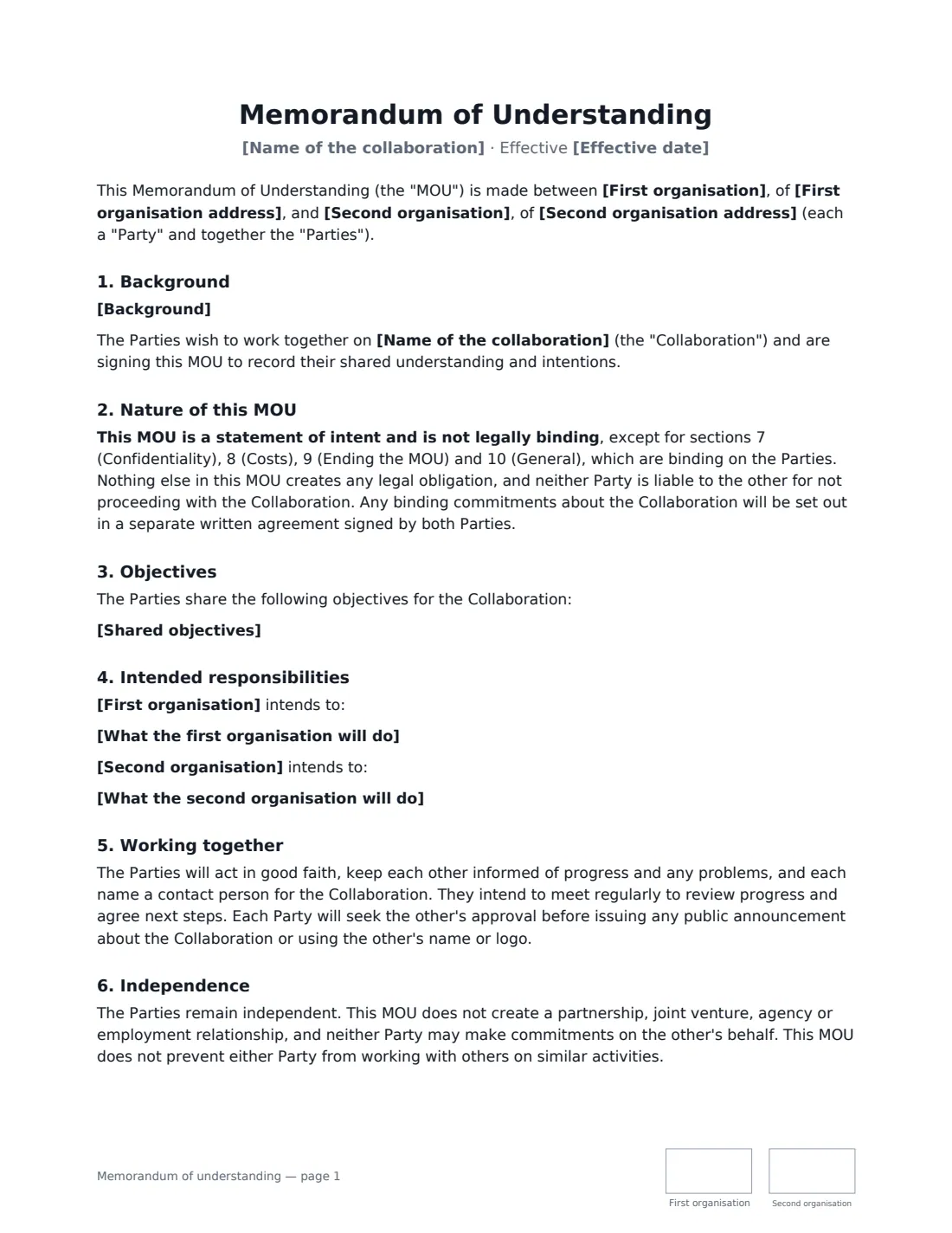
A memorandum of understanding records a shared plan between two organisations: a charity and a school running a programme together, two businesses testing a co-marketing idea, a sponsor and an event, or a university and a company starting a research collaboration. It puts the objectives and each side's role on paper so everyone starts with the same expectations, without yet committing to a full contract.
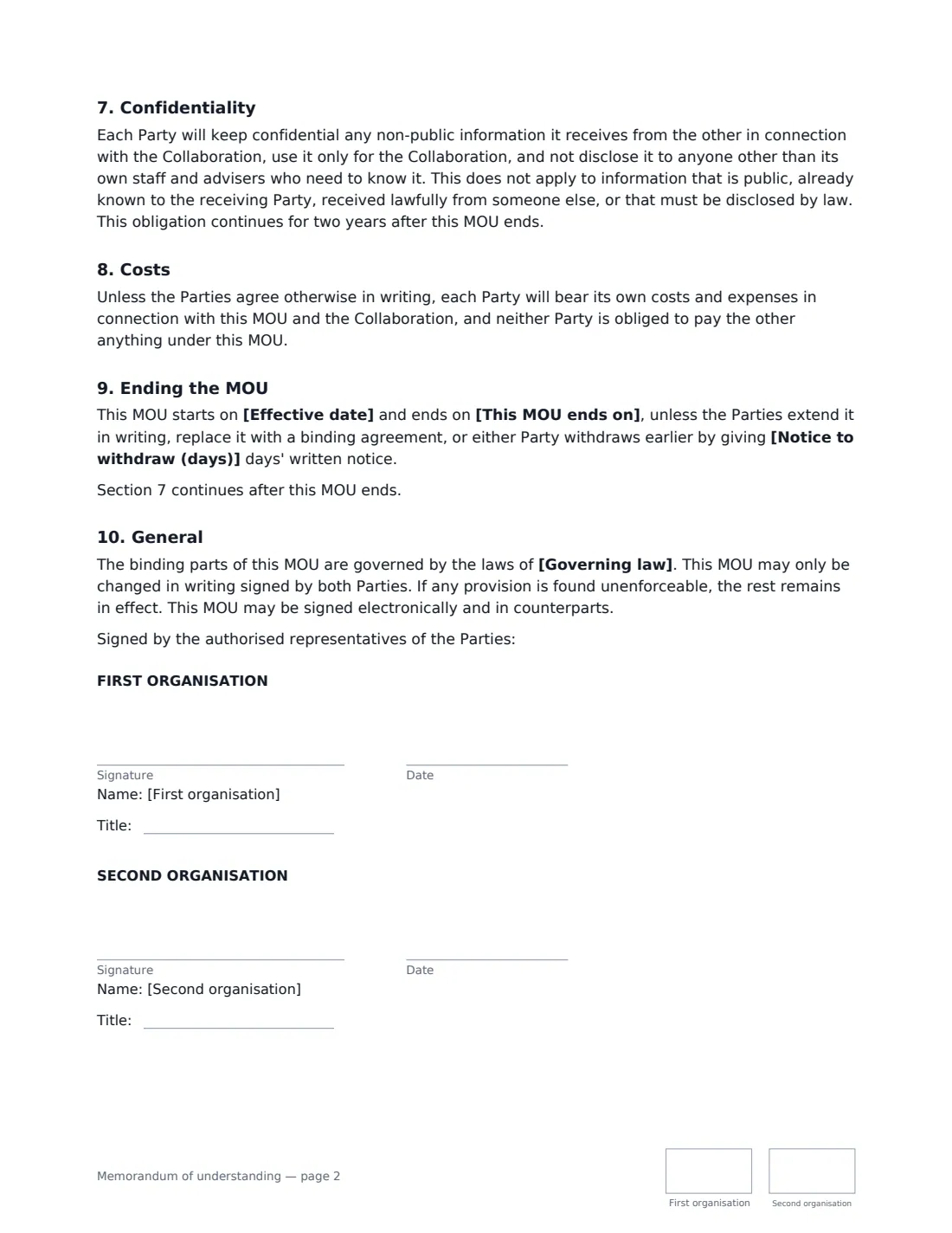
This template is deliberately clear about what binds and what does not. The objectives, responsibilities and ways of working are a statement of intent and are not legally binding. Only the sections on confidentiality, costs, ending the MOU and general terms are binding. It also confirms that the organisations stay independent and neither may commit the other, that each pays its own costs, and that each side expects to name a contact person and to seek the other's approval before any public announcement or use of its logo. You choose the end date (or none) and the notice period for withdrawing, and both organisations sign and initial every page.
- Best for
- Joint projects, collaborations, community programmes, early-stage partnerships
- Signed by
- An authorised representative of each organisation
- Binding?
- Mostly not — only confidentiality, costs, ending the MOU and general terms bind
- Confidentiality
- Continues for two years after the MOU ends
- Length
- 2 pages, initialled on every page
When to Use a memorandum of understanding
- A non-profit and a school agreeing to run a programme together
- Two businesses exploring a joint product, event or marketing campaign
- A company and a university setting up a research or internship collaboration
- A local authority and a community group coordinating a service
- A sponsor and an organiser recording their plans before the sponsorship contract
- Organisations agreeing roles before applying for a grant together
What You Fill In
13 blanks, then the name and email of each person who signs: first organisation, second organisation.
1 The collaboration
- Effective date*
- Name of the collaboration*
- Background
- Shared objectives*
2 Responsibilities
- What the first organisation will do*
- What the second organisation will do*
3 Other terms
- This MOU ends on
- Notice to withdraw (days)*
- Governing law*
4 The organisations
- First organisation*
- First organisation address
- Second organisation*
- Second organisation address
5 Who signs
- First organisation signature and date, job title, initials on every page
- Second organisation signature and date, job title, initials on every page
What the memorandum of understanding Covers
- Background
- Nature of this MOU
- Objectives
- Intended responsibilities
- Working together
- Independence
- Confidentiality
- Costs
- Ending the MOU
- General
Using the memorandum of understanding, step by step
1 Name the collaboration and its background
Give the collaboration a short name — it appears at the top of the document. The background is optional: a sentence or two on why you are working together helps anyone who reads the MOU later.
2 Set the objectives
Write the shared objectives as concrete outcomes, with numbers and dates where you can: "run three 10-week courses for 60 students by June" is far more useful than "promote digital skills".
3 Split the responsibilities
Describe what each organisation intends to do — who provides staff, space, money, equipment or promotion. Gaps and overlaps show up quickly when both lists sit side by side.
4 Choose the term and send
Add an end date, or leave it empty so the MOU runs until you replace it with a binding agreement or someone withdraws. Set the withdrawal notice and the governing law for the binding parts, add the other organisation's signer, and send. VergeHR places both signature and initials boxes and files the signed copy in Files.
Tips Before You Send It
- If you need the other side to be legally committed to deliver something — money, work, a deadline — use a contract instead of, or after, the MOU.
- Agree who each side's contact person is early. The template expects each organisation to name one.
- Make sure each signer has authority to sign for their organisation, even though most of the MOU is not binding.
- Revisit the MOU at your regular progress meetings and turn it into a formal agreement once the plan is settled.
- If you will share sensitive information before the MOU is signed, sign an NDA first.
Sign It Online In Minutes
- Fill in the blanks. Names, dates and amounts go straight into the agreement — the preview shows exactly where.
- Name who signs. Tick “This is me” for your own part. VergeHR builds the PDF with every signature, date and initials box on the right line, and you can check or move anything before sending.
- Send it. Each signer gets a secure link and signs from any device — no account needed. The signed PDF, with an audit trail and a Certificate of Completion, is filed in Files and emailed to everyone.
Memorandum of understanding: frequently asked questions
Is a memorandum of understanding legally binding?
This template says clearly that it is a statement of intent and is not legally binding, except for the sections on confidentiality, costs, ending the MOU and general terms. Whether a document is binding ultimately depends on its wording and how the parties behave, so keep the MOU consistent with that intent and put firm commitments in a separate contract.
What is the difference between an MOU and a letter of intent?
Both record intentions before a formal agreement. An MOU usually describes an ongoing collaboration and each side's role in it. A letter of intent usually outlines the main terms of a specific deal, such as a sale or investment, that the parties expect to sign later.
Can one organisation walk away from an MOU?
Yes. Either organisation can withdraw by giving the written notice you set, and neither is liable to the other for not going ahead with the collaboration. The confidentiality duty continues for two years after the MOU ends.
Is an MOU signed electronically valid?
In the US (ESIGN Act and UETA), the UK, the EU (eIDAS) and Canada, electronic signatures are generally valid for ordinary agreements like an MOU. VergeHR keeps an audit trail and a Certificate of Completion with the signed PDF.
Can I change the wording?
You fill in the collaboration, objectives, responsibilities, dates and governing law. If you need different clauses, draft your own document and upload it to VergeHR eSignature; you can still place the signature boxes in the editor.
Is this template free?
Yes. The template is free to use with the eSignature app in VergeHR. The other organisation's signer doesn't need a VergeHR login.