

What is a employee confidentiality and invention assignment agreement?
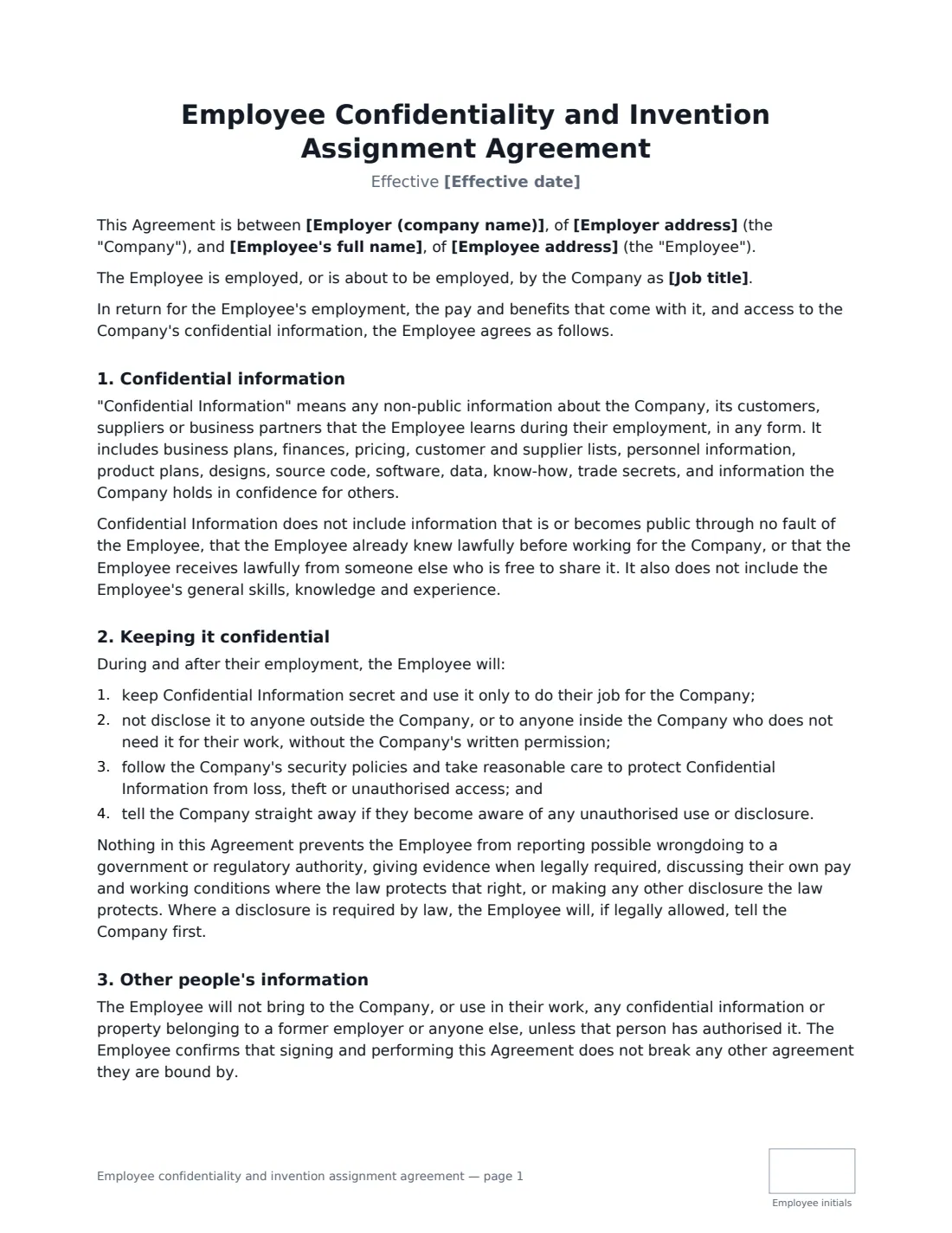
An employee confidentiality and invention assignment agreement (sometimes called a PIIA or employee NDA) is what a company asks new staff to sign so that its information and the work its people create stay with the business. It defines confidential information, sets out how the employee must protect it during and after their employment, and assigns to the company the inventions, code, designs and other work the employee creates in connection with the job. It is especially important for technology, product and creative businesses, and for any company whose investors or buyers will ask whether it owns its IP.
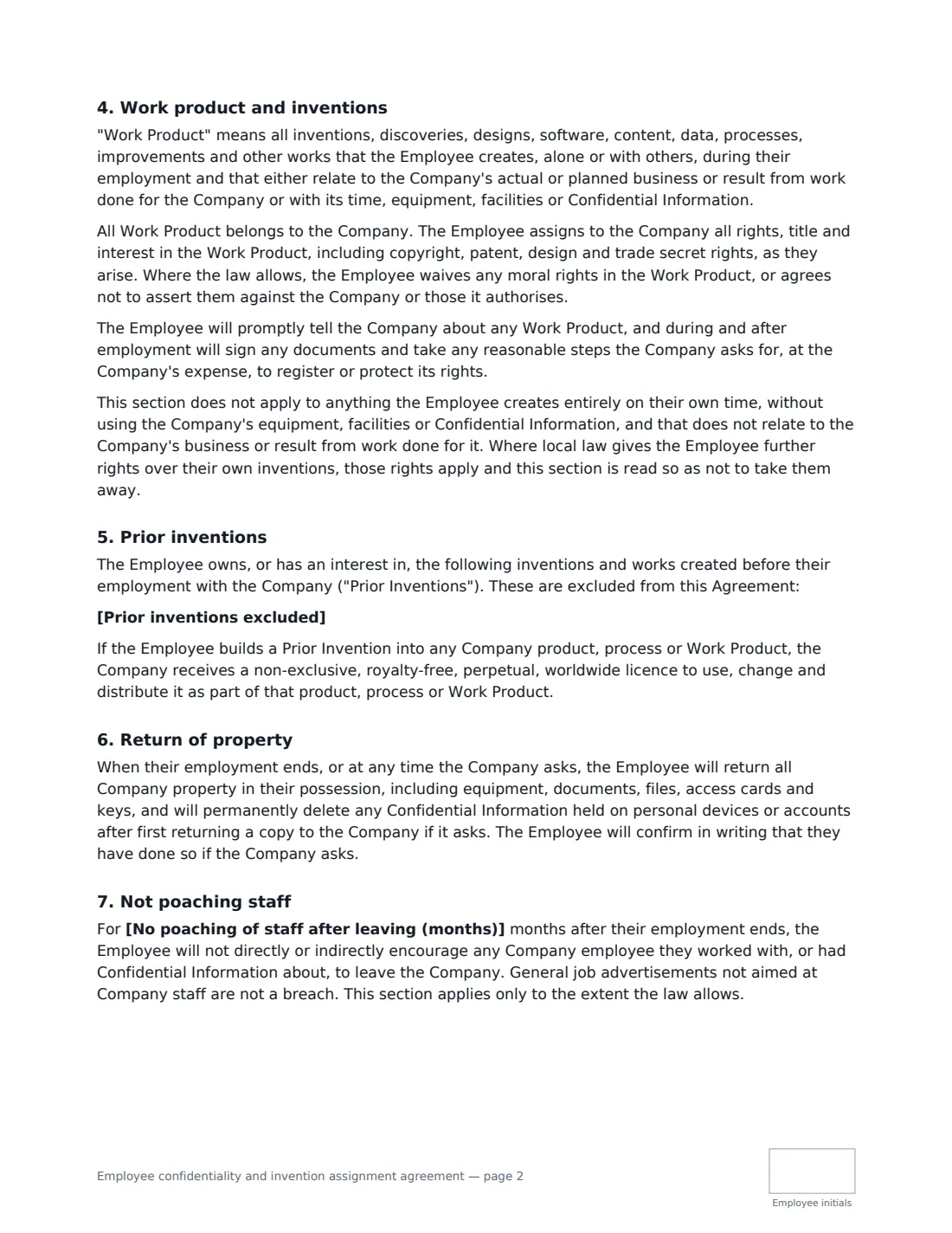
This template covers what counts as confidential (with the usual exceptions, including the employee's general skills), how it must be protected, the employee's right to report wrongdoing and make other legally protected disclosures, not bringing a former employer's information, assignment of work product with a carve-out for things made entirely on the employee's own time, a list of prior inventions the employee keeps, return of property, an optional promise not to poach staff, and the governing law. The employee initials every page.
- Best for
- New hires and existing employees at companies that rely on confidential information or create IP
- Signed by
- The employer (with a job title) and the employee, who initials every page
- Optional
- Prior inventions list and a no-poaching-staff promise for a number of months you choose
- Length
- About 3 pages
When to Use a employee confidentiality and invention assignment agreement
- Onboarding engineers, designers and product staff who will create IP
- Staff with access to customer lists, pricing or financial information
- Tidying up IP ownership before a funding round or sale
- Existing employees who never signed a confidentiality agreement
- Employees joining with side projects or inventions they want to keep
What You Fill In
9 blanks, then the name and email of each person who signs: employer, employee.
1 The agreement
- Effective date*
- Governing law*
2 The employer
- Employer (company name)*
- Employer address
3 The employee
- Employee's full name*
- Job title
- Employee address
4 Prior inventions
- Prior inventions excluded
5 Other terms
- No poaching of staff after leaving (months)
6 Who signs
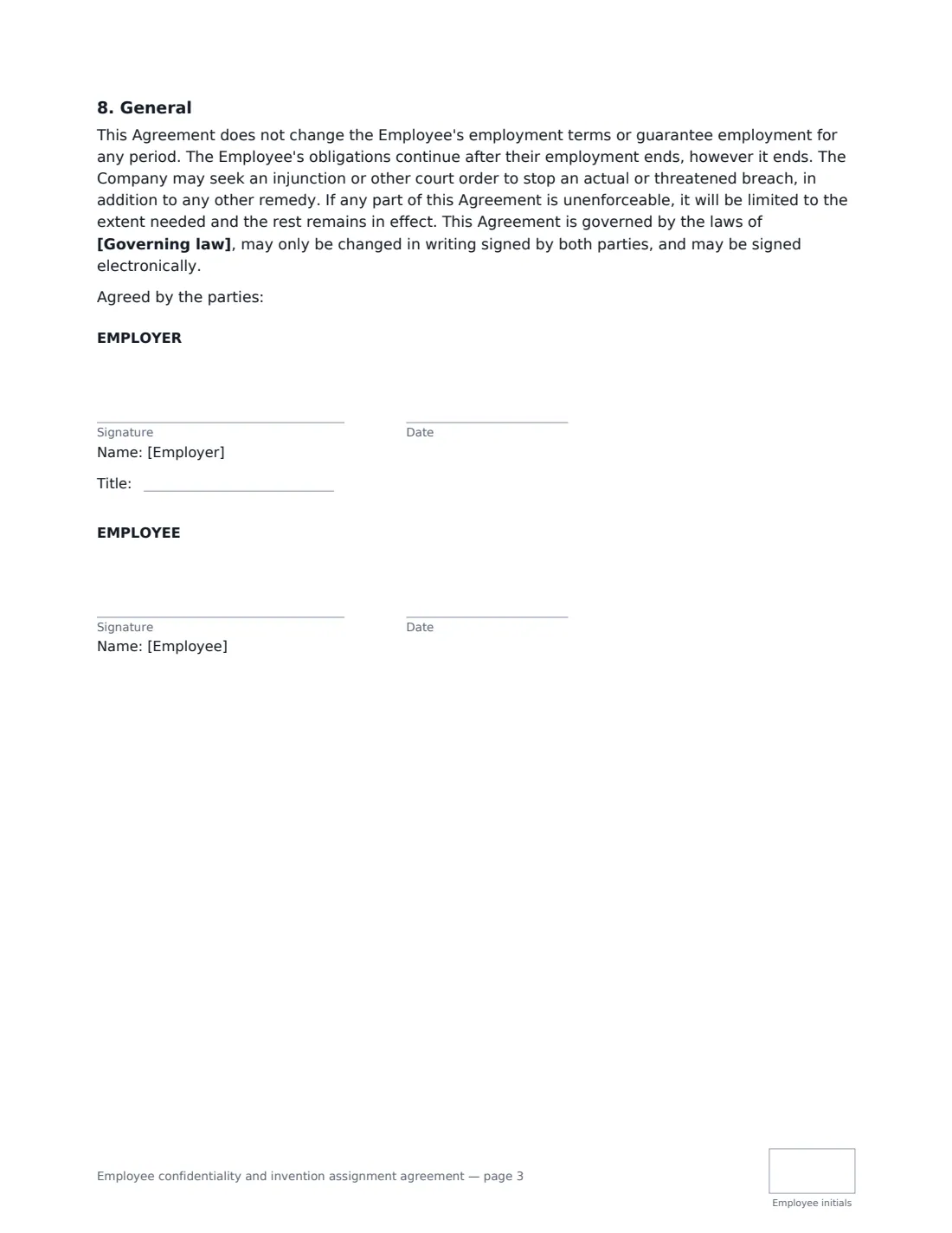
- Employer signature and date, job title, initials on every page
- Employee signature and date, initials on every page
What the employee confidentiality and invention assignment agreement Covers
- Confidential information
- Keeping it confidential
- Other people's information
- Work product and inventions
- Prior inventions
- Return of property
- Not poaching staff
- General
- General
Using the employee confidentiality and invention assignment agreement, step by step
1 Enter the parties and effective date
Add the company's legal name and the employee's full name, and optionally their job title and addresses. The effective date is usually the start date for a new hire, or the signing date for an existing employee.
2 List any prior inventions
Ask the employee before you send it whether they have anything they created before joining that they want to keep — a side project, open-source library or patent application. List each one; if there are none, the agreement records that. If they later build a prior invention into company work, the company gets a licence to use it.
3 Decide on the no-poaching promise
Optionally enter a number of months during which the employee won't encourage colleagues to leave after they go. Leave it empty to leave the clause out. Rules on these promises differ widely, so check they are enforceable where you are.
4 Choose the governing law and send
Enter the country, state or province whose law applies — usually where the employee works. Add the employee's name and email; they sign and initial each page online, and the signed copy is filed in Files.
Tips Before You Send It
- Ask new hires to sign before or on their first day, alongside the offer letter or employment contract, so it's clearly part of the deal.
- Rules on what an employer can claim, and on post-employment restrictions, vary between countries and states. Some places give employees rights over inventions made on their own time; the agreement carves those out and says any further rights under local law still apply.
- For an existing employee, some places require something extra in return for new obligations. Check local law before asking current staff to sign.
- Keep the prior-inventions list specific. "Various side projects" invites a dispute later.
- In the US, federal trade-secret law has its own whistleblower-immunity notice for employees. The agreement's reporting clause is general, so ask an adviser whether you should also give that notice, for example in your handbook.
- This agreement doesn't include a non-compete. If you need one, check it is permitted where the employee works and use a separate agreement.
Sign It Online In Minutes
- Fill in the blanks. Names, dates and amounts go straight into the agreement — the preview shows exactly where.
- Name who signs. Tick “This is me” for your own part. VergeHR builds the PDF with every signature, date and initials box on the right line, and you can check or move anything before sending.
- Send it. Each signer gets a secure link and signs from any device — no account needed. The signed PDF, with an audit trail and a Certificate of Completion, is filed in Files and emailed to everyone.
Employee confidentiality and invention assignment agreement: frequently asked questions
Does this stop employees reporting wrongdoing?
No. The agreement expressly says the employee can report possible wrongdoing to a government or regulatory authority, give evidence when legally required, discuss their own pay and conditions where the law protects that, and make any other legally protected disclosure.
What does the employee keep?
Their general skills, knowledge and experience; anything they create entirely on their own time, without the company's equipment, facilities or confidential information, that doesn't relate to the company's business or result from work done for it; any prior inventions listed in the agreement (the company gets a licence only if one is built into company work); and any further rights local law gives them over their own inventions.
Does signing change the employee's employment terms?
No. The agreement says it doesn't change the employment terms or guarantee employment for any period. Its obligations continue after employment ends.
Is an agreement signed electronically valid?
Electronic signatures are generally valid for ordinary employment documents like this in the US (ESIGN Act and UETA), the UK, the EU (eIDAS) and Canada. VergeHR keeps an audit trail and a Certificate of Completion with the signed PDF.
Is this template free?
Yes. It is free to use with the eSignature app in VergeHR, and the employee doesn't need a VergeHR login to sign.