

What is a non-compete agreement?
A non-compete agreement (also called a covenant not to compete) is a promise not to run, join or invest in a competing business for a period after a deal or relationship ends. It is most widely accepted when someone sells a business: the buyer pays for the customers and reputation, and the seller agrees not to open the same kind of business down the street. Partners and shareholders leaving a business often give similar promises. Non-competes for employees are a different matter. Many places ban them or limit them strictly, and some US states, such as California, treat most of them as void.
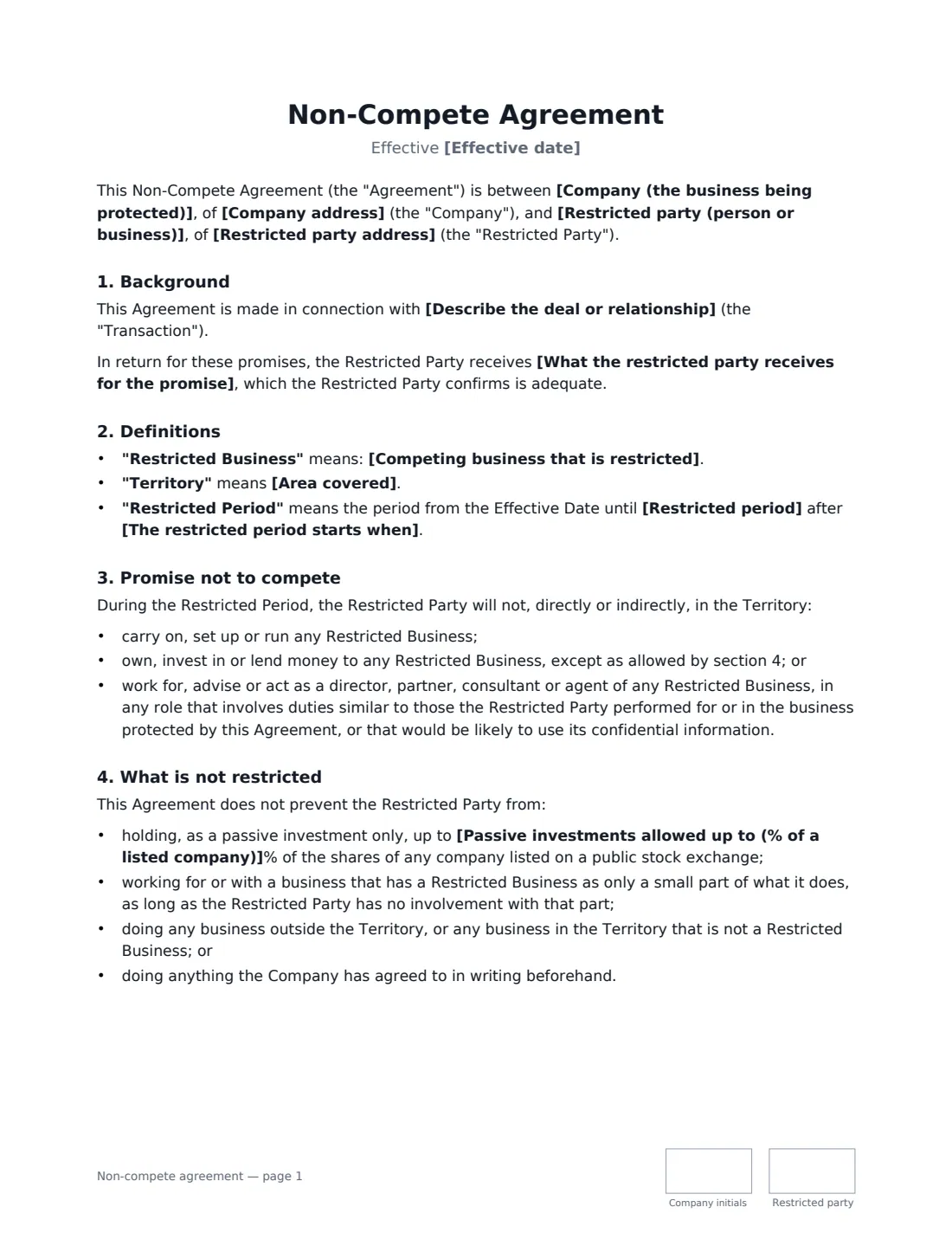
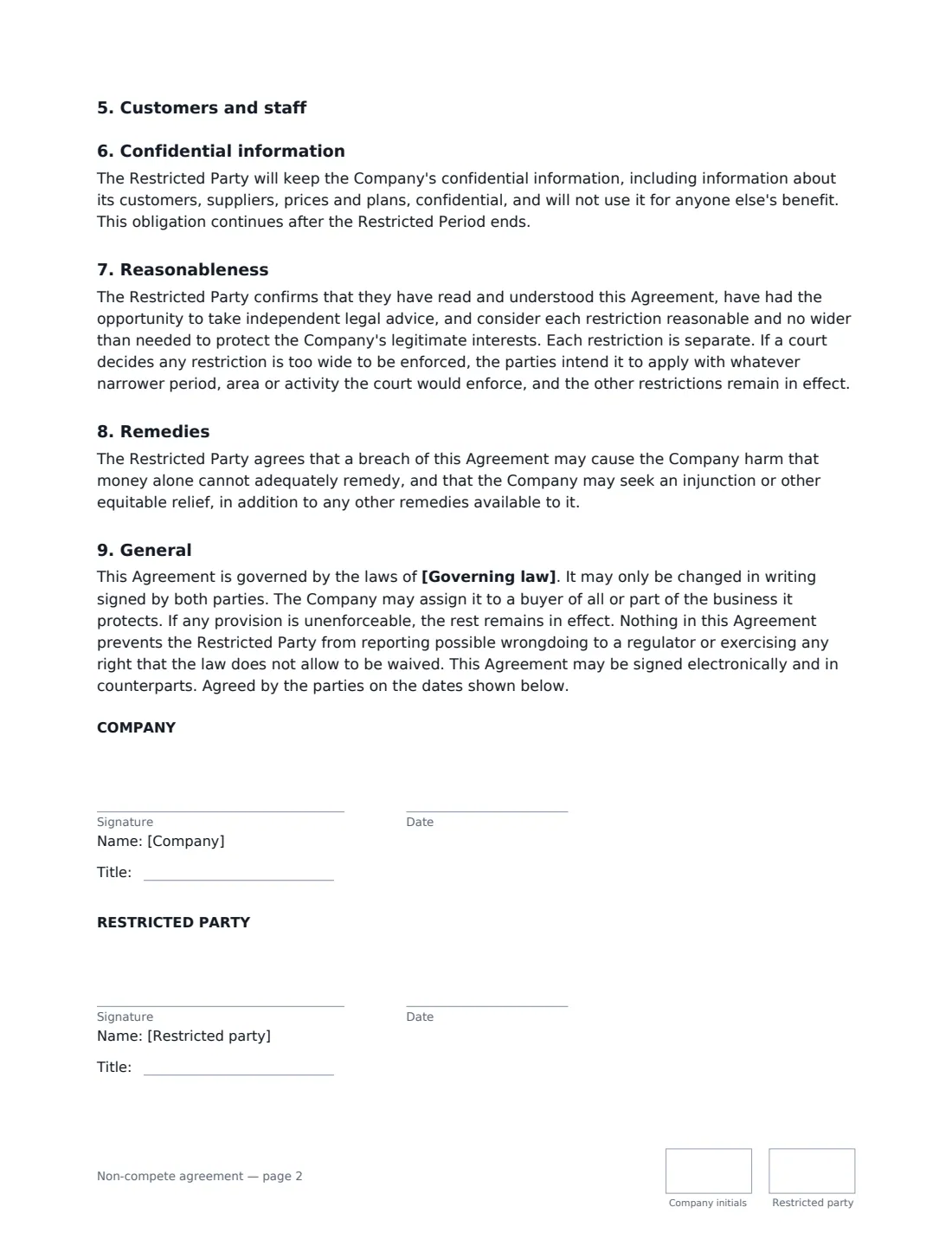
The template asks why the restriction is given (a business sale, a partner or shareholder relationship, or a key employee or contractor role) and writes the background to match. You define the restricted business narrowly, the area, when the period starts and how long it lasts (6 to 36 months). Passive investments in listed companies up to a percentage you set, work for a large business with no involvement in the competing part, and anything outside the area or the restricted business stay allowed. There is an optional customer and staff non-solicit, a confidentiality clause, a reasonableness clause that asks a court to narrow rather than strike out a restriction, and a carve-out for reporting wrongdoing.
- Best for
- Business sales, departing partners and shareholders; employees only where local law allows
- Signed by
- The company being protected and the restricted party
- Period
- 6, 12, 18, 24 or 36 months from an event you define
- Length
- About 2 to 3 pages, initialled on every page
When to Use a non-compete agreement
- Buying a bakery, salon, agency or practice and stopping the seller from opening a rival nearby
- A partner or shareholder selling out of a business
- A co-owner who is leaving but has deep knowledge of the business's customers and plans
- A senior person with access to trade secrets, where local law allows a non-compete
- Adding a stand-alone non-compete to a share or asset purchase
What You Fill In
15 blanks, then the name and email of each person who signs: company, restricted party.
1 The parties
- Effective date*
- Company (the business being protected)*
- Company address
- Restricted party (person or business)*
- Restricted party address
2 The background
- Why the restriction is given* the sale of a business · a partner, member or shareholder relationship · a key employee or contractor role
- Describe the deal or relationship*
- What the restricted party receives for the promise
3 The restriction
- Competing business that is restricted*
- Area covered*
- The restricted period starts when*
- Restricted period* 6 months · 12 months · 18 months · 24 months · 36 months
- Passive investments allowed up to (% of a listed company)*
- Also agree not to poach customers and staff?* Yes · No
- Governing law*
4 Who signs
- Company signature and date, job title, initials on every page
- Restricted party signature and date, job title, initials on every page · The person or business agreeing not to compete.
What the non-compete agreement Covers
- Background
- Definitions
- Promise not to compete
- What is not restricted
- Customers and staff
- Confidential information
- Reasonableness
- Remedies
- General
Using the non-compete agreement, step by step
1 Explain why it is needed
Choose the context and describe the deal or relationship, such as the sale of a named business under a purchase agreement. Record what the restricted party receives in return, which some places require, or leave it to refer to the deal itself.
2 Define the restriction narrowly
Describe the competing business as specifically as you can, and limit the area to where the business actually trades. A restriction wider than the business you are protecting is less likely to be enforced.
3 Set the period and extras
Choose when the period starts (for example, when the sale completes) and how long it lasts. Set the passive investment limit and decide whether to add the customer and staff non-solicit.
4 Check local law and send
Enter the governing law, check that a non-compete of this kind is allowed where the restricted party lives and works, then add the signer and send.
Tips Before You Send It
- Shorter, narrower restrictions are more likely to be enforced. Longer periods are usually only accepted for the sale of a business.
- If you only need to stop someone poaching customers and staff, a non-solicitation agreement is less restrictive and more widely enforceable.
- Rules on non-competes change often, especially for employees. Check the current position before relying on one, and take local legal advice for anything important.
- A court may apply the law of the place where the restricted party works, whatever governing law you choose.
Sign It Online In Minutes
- Fill in the blanks. Names, dates and amounts go straight into the agreement — the preview shows exactly where.
- Name who signs. Tick “This is me” for your own part. VergeHR builds the PDF with every signature, date and initials box on the right line, and you can check or move anything before sending.
- Send it. Each signer gets a secure link and signs from any device — no account needed. The signed PDF, with an audit trail and a Certificate of Completion, is filed in Files and emailed to everyone.
Non-compete agreement: frequently asked questions
Are non-compete agreements enforceable?
It depends heavily on where you are and on the circumstances. Many places enforce reasonable non-competes tied to the sale of a business. For employees, some places ban them outright, some allow them only above certain earnings or with payment during the restricted period, and others enforce them only if reasonable. This template is a starting point, not a guarantee of enforceability.
What is the difference between a non-compete and a non-solicitation agreement?
A non-compete stops someone working in or running a competing business at all. A non-solicitation agreement only stops them approaching your customers or staff, and leaves them free to compete otherwise. That is why non-solicits are more widely accepted.
What does the reasonableness clause do?
It records that both parties consider the restrictions reasonable, and asks a court that finds one too wide to apply a narrower version instead of striking it out. Whether a court will do that depends on local law.
Can a non-compete be signed electronically?
Electronic signatures are generally valid for ordinary contracts in the US (ESIGN Act and UETA), the UK, the EU (eIDAS) and Canada. Some places set extra conditions for employee non-competes, such as giving the employee time to review it or advice to see a lawyer.