

What is a separation agreement and general release?
A separation agreement (often called a severance agreement) is what an employer offers a departing employee when it wants a clean, agreed ending: the employee receives a severance payment and sometimes continued benefits or an agreed reference, and in return gives up the right to bring claims about their employment. It's common in layoffs and restructures, negotiated exits and performance-related departures.
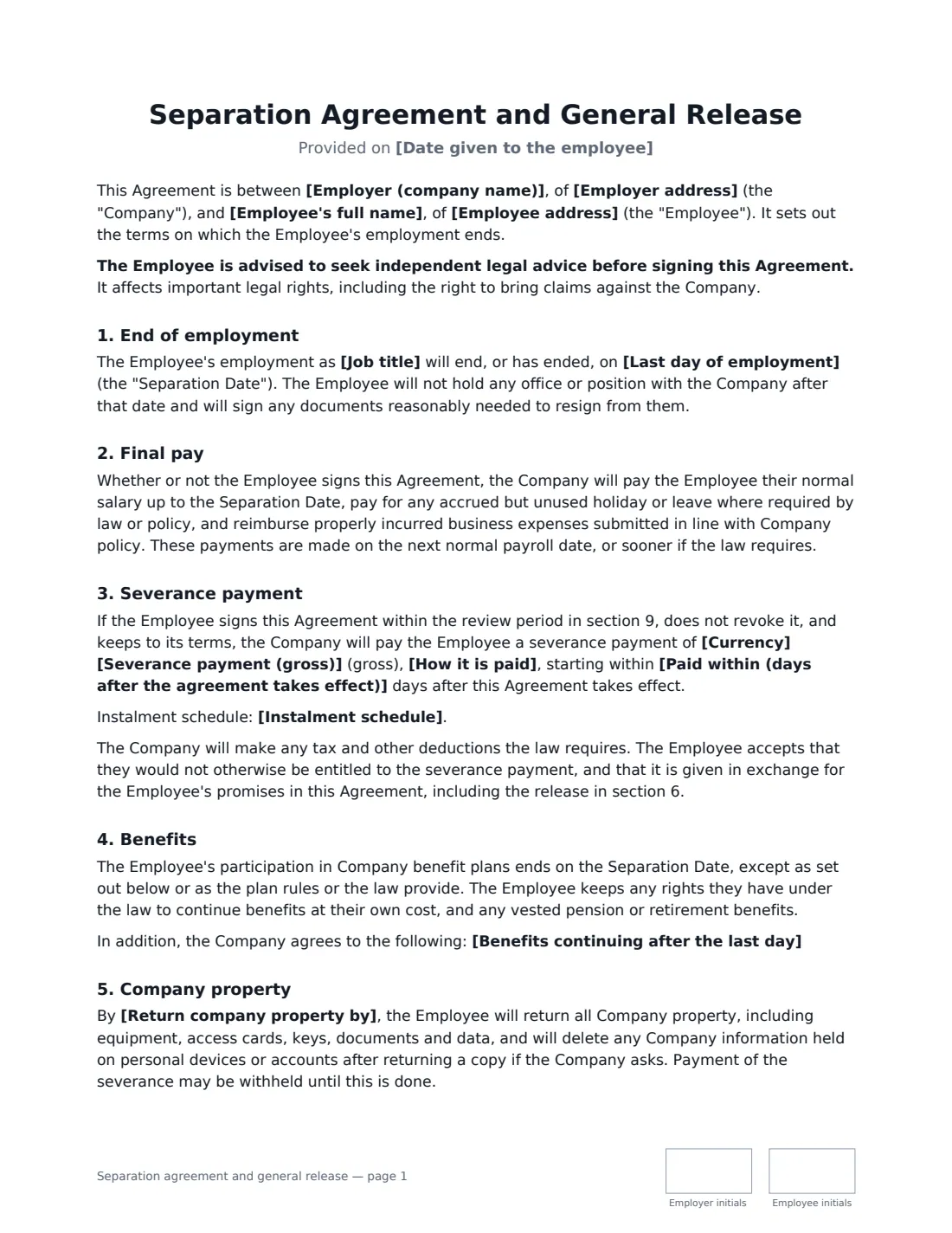
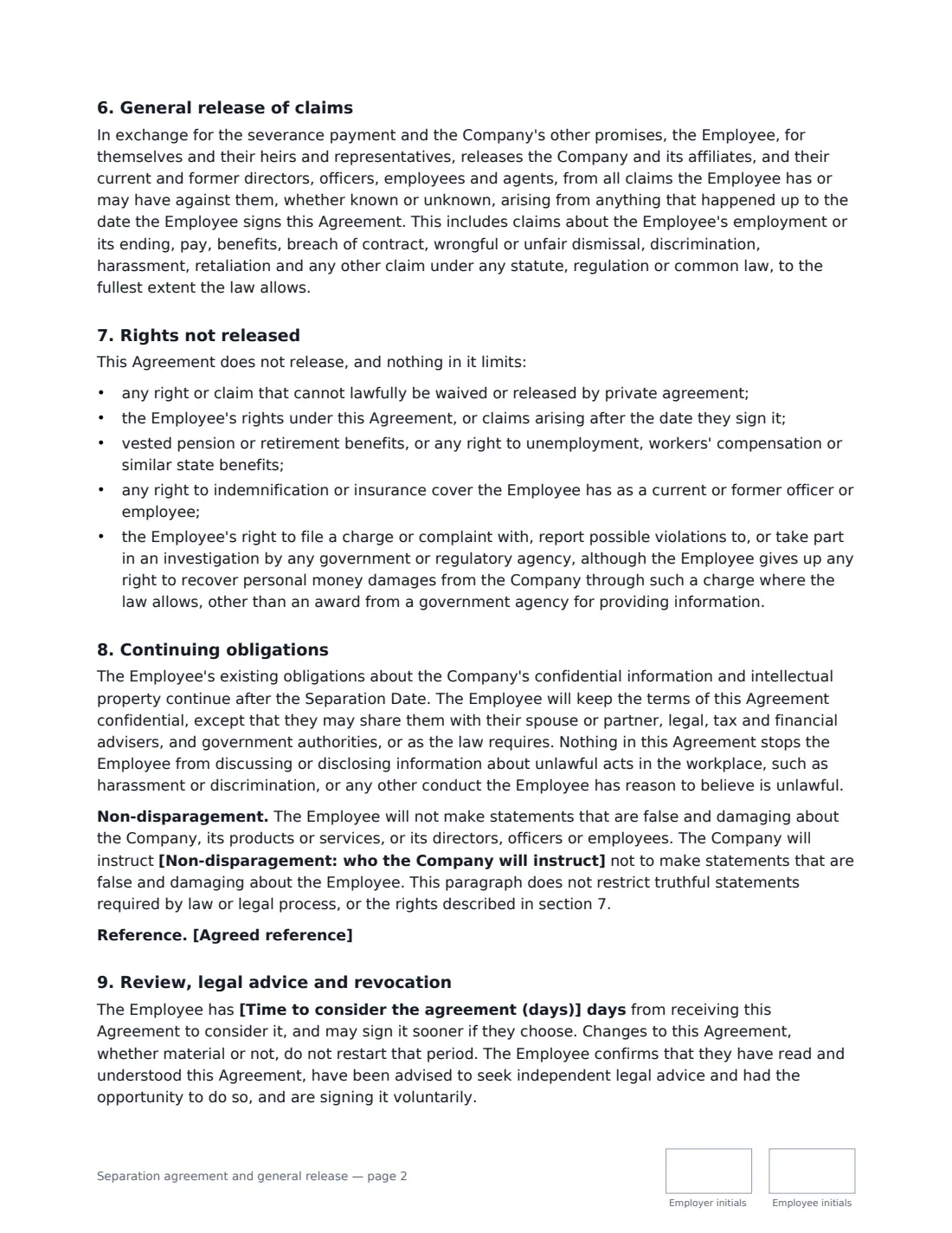
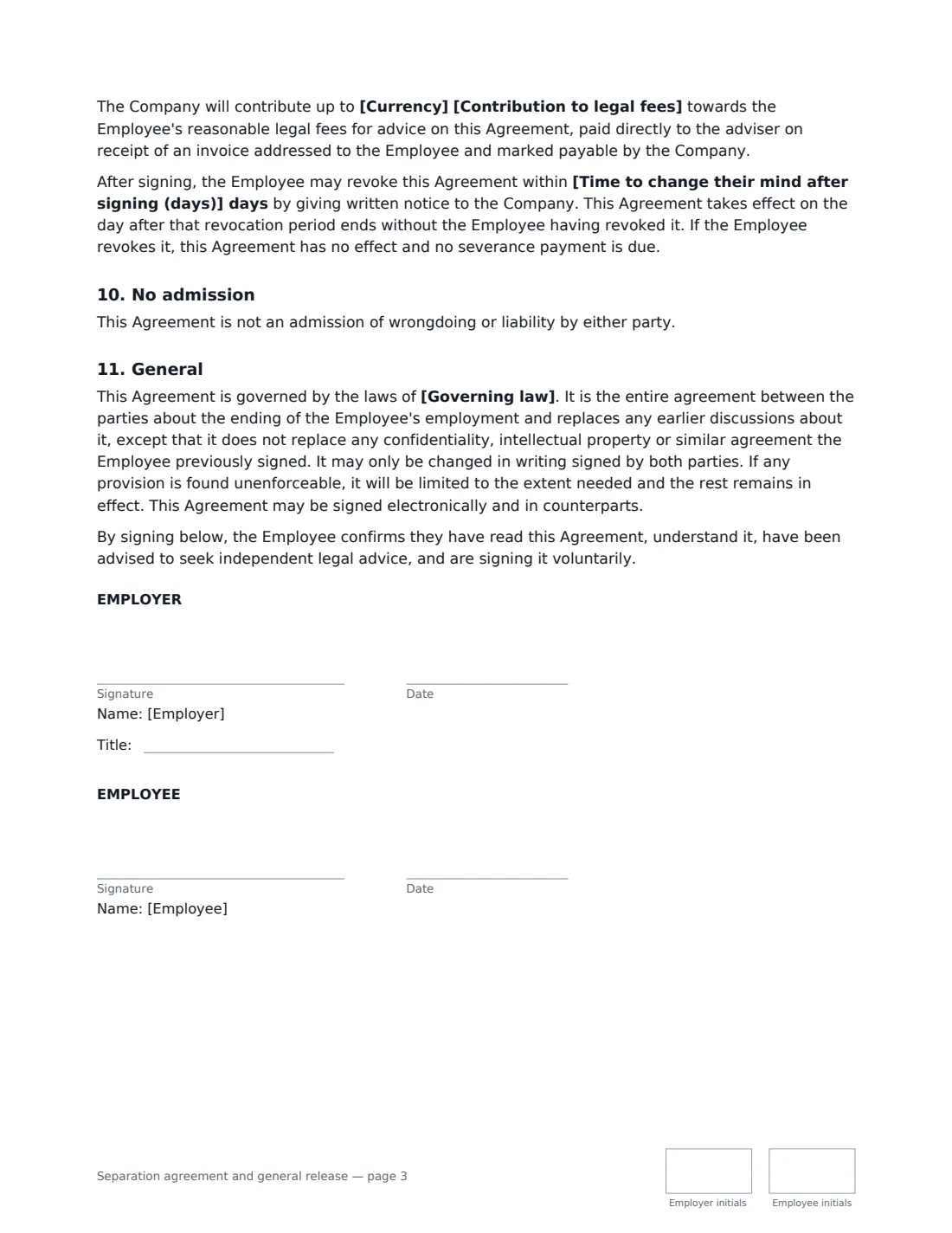
This template sets out the last day of employment, the final pay the employee receives whether or not they sign, the severance amount and how it's paid, continuing benefits, the return of company property, a general release of claims and the rights that are not released, continuing confidentiality, optional two-way non-disparagement and an agreed reference, a review period, an optional revocation period and legal-fee contribution, and a no-admission clause. It tells the employee plainly to take independent legal advice before signing.
Rules on releasing employment claims vary a lot by country, state and province — for example minimum review or revocation periods for older workers or group layoffs, or a requirement that the employee receives legal advice for the release to count. Check the local rules, or ask a lawyer, before you send it.
- Best for
- Layoffs, restructures and negotiated exits with a severance payment
- Signed by
- The employer (an authorised signer) and the employee
- Review period
- You choose — 21 days by default, plus an optional revocation period (7 days by default)
- Length
- About 3 pages, initialled on every page
When to Use a separation agreement and general release
- A role is being made redundant and the employer is offering severance
- An employer and employee agree to part ways after a performance or fit issue
- A restructure where departing staff receive extended health cover or other benefits
- Settling possible disputes about the ending of employment without going to court
- A negotiated exit that includes an agreed reference and non-disparagement
What You Fill In
20 blanks, then the name and email of each person who signs: employer, employee.
1 The parties
- Date given to the employee*
- Employer (company name)*
- Employer address
- Employee's full name*
- Employee address
- Job title
2 Leaving
- Last day of employment*
3 Severance
- Currency*
- Severance payment (gross)*
- Paid within (days after the agreement takes effect)*
- How it is paid* in a single lump sum · in instalments on the normal payroll dates, as set out below
- Instalment schedule
4 Benefits
- Benefits continuing after the last day
5 Other terms
- Return company property by
- Agreed reference
- Non-disparagement: who the Company will instruct
6 Review and legal advice
- Time to consider the agreement (days)*
- Time to change their mind after signing (days)
- Contribution to legal fees
- Governing law*
7 Who signs
- Employer signature and date, job title, initials on every page
- Employee signature and date, initials on every page
What the separation agreement and general release Covers
- End of employment
- Final pay
- Severance payment
- Benefits
- Company property
- General release of claims
- Rights not released
- Continuing obligations
- Review, legal advice and revocation
- No admission
- General
Using the separation agreement and general release, step by step
1 Set the last day and the severance
Enter the separation date, the gross severance amount and whether it's paid as a lump sum or in instalments, and how many days after the agreement takes effect payment starts. Final pay, accrued leave and expenses are paid regardless — they're not part of the deal.
2 Add benefits, property and reference
Describe any benefits that continue after the last day, such as health insurance premiums or keeping a phone. Set a date to return company property if it's not the last day, and add an agreed reference if you've offered one.
3 Decide on non-disparagement
If you name who in the company will be instructed not to make false and damaging statements, the non-disparagement paragraph appears and runs both ways. Leave it blank to leave it out.
4 Set the review terms and send
Choose the review period, any revocation period and any contribution to legal fees, then the governing law. Add the employee's email and send; VergeHR places both signature blocks and initials, and files the signed copy in Files.
Tips Before You Send It
- Don't shorten the review or revocation periods without checking the local minimums — in some places a release may not hold up if they're too short.
- Give the employee real time to take advice and don't pressure them to sign early. A release signed under pressure may be easier to challenge.
- Make sure the severance is something extra — not pay or benefits the employee is already owed. The release is given in exchange for it.
- In some countries (the UK, for example) a binding settlement of statutory employment claims has its own formal requirements, such as advice from a qualified independent adviser. Check before relying on this template there.
Sign It Online In Minutes
- Fill in the blanks. Names, dates and amounts go straight into the agreement — the preview shows exactly where.
- Name who signs. Tick “This is me” for your own part. VergeHR builds the PDF with every signature, date and initials box on the right line, and you can check or move anything before sending.
- Send it. Each signer gets a secure link and signs from any device — no account needed. The signed PDF, with an audit trail and a Certificate of Completion, is filed in Files and emailed to everyone.
Separation agreement and general release: frequently asked questions
Does the employee have to sign a separation agreement?
No. Signing is voluntary. If the employee doesn't sign, they still receive their final pay, accrued leave where required and expenses, but not the severance payment offered in exchange for the release.
What claims can't be released?
The agreement itself lists them: rights that cannot lawfully be waived, rights under the agreement and claims arising after signing, vested pension benefits, unemployment, workers' compensation and similar state benefits, indemnification or insurance rights, and the right to file a charge with or report to a government agency. Exactly what can be waived depends on local law.
Can a separation agreement be signed electronically?
In the US (ESIGN Act and UETA), the UK, the EU (eIDAS) and Canada, electronic signatures are generally valid for employment agreements like this one. Some places add formal requirements for settling employment claims, so check those separately. VergeHR keeps an audit trail and a Certificate of Completion with the signed PDF.
Is this template free?
Yes. The template is free to use with the eSignature app in VergeHR, and the employee doesn't need a VergeHR login to sign.