

What is a non-disparagement agreement?
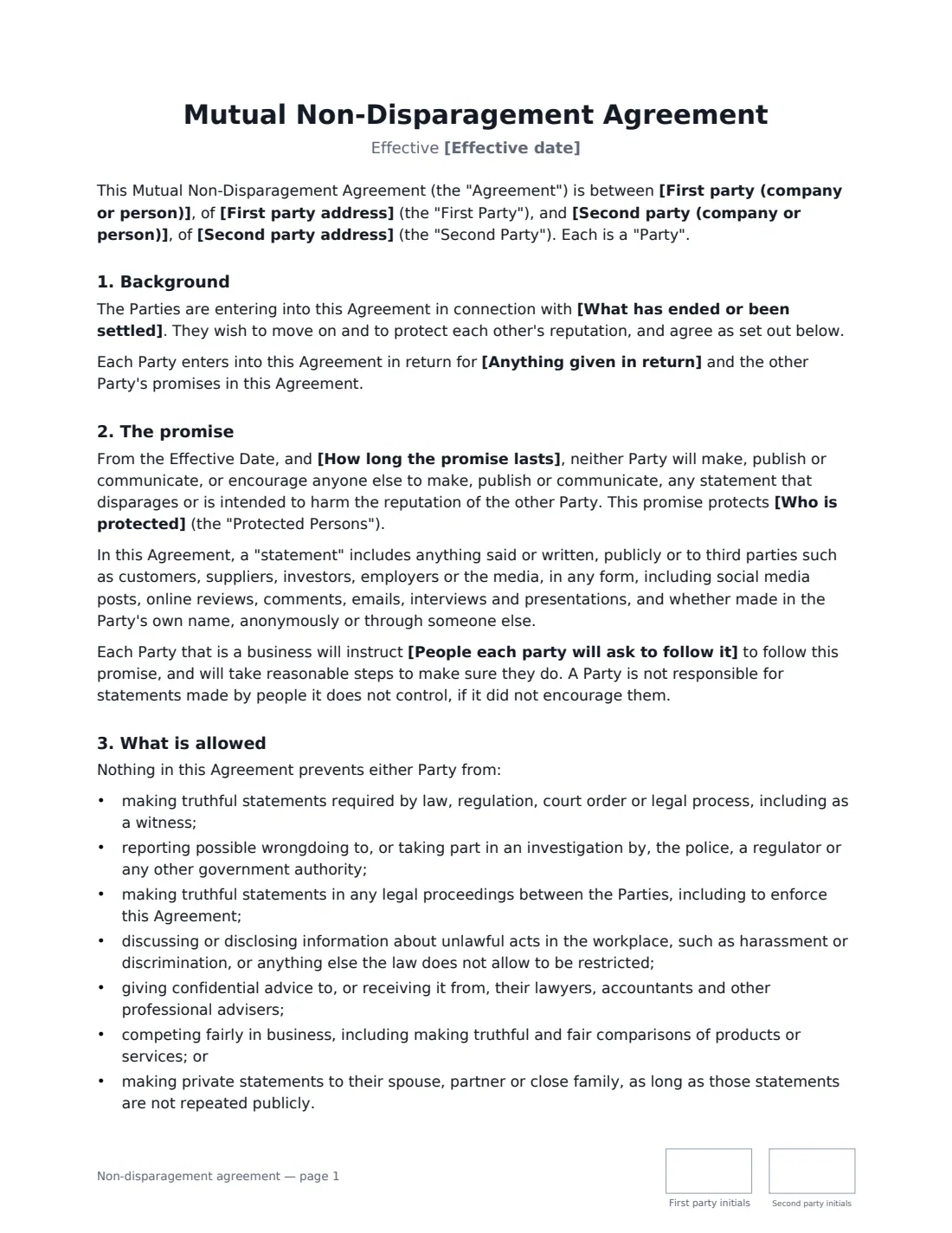
A non-disparagement agreement is a promise not to make negative statements about the other party. It is common when a business partnership, joint venture or supplier relationship ends, when a dispute is settled, or when co-owners go their separate ways. Each side wants to move on without their reputation being damaged online or in the market. This template is mutual, so both parties give the same promise.
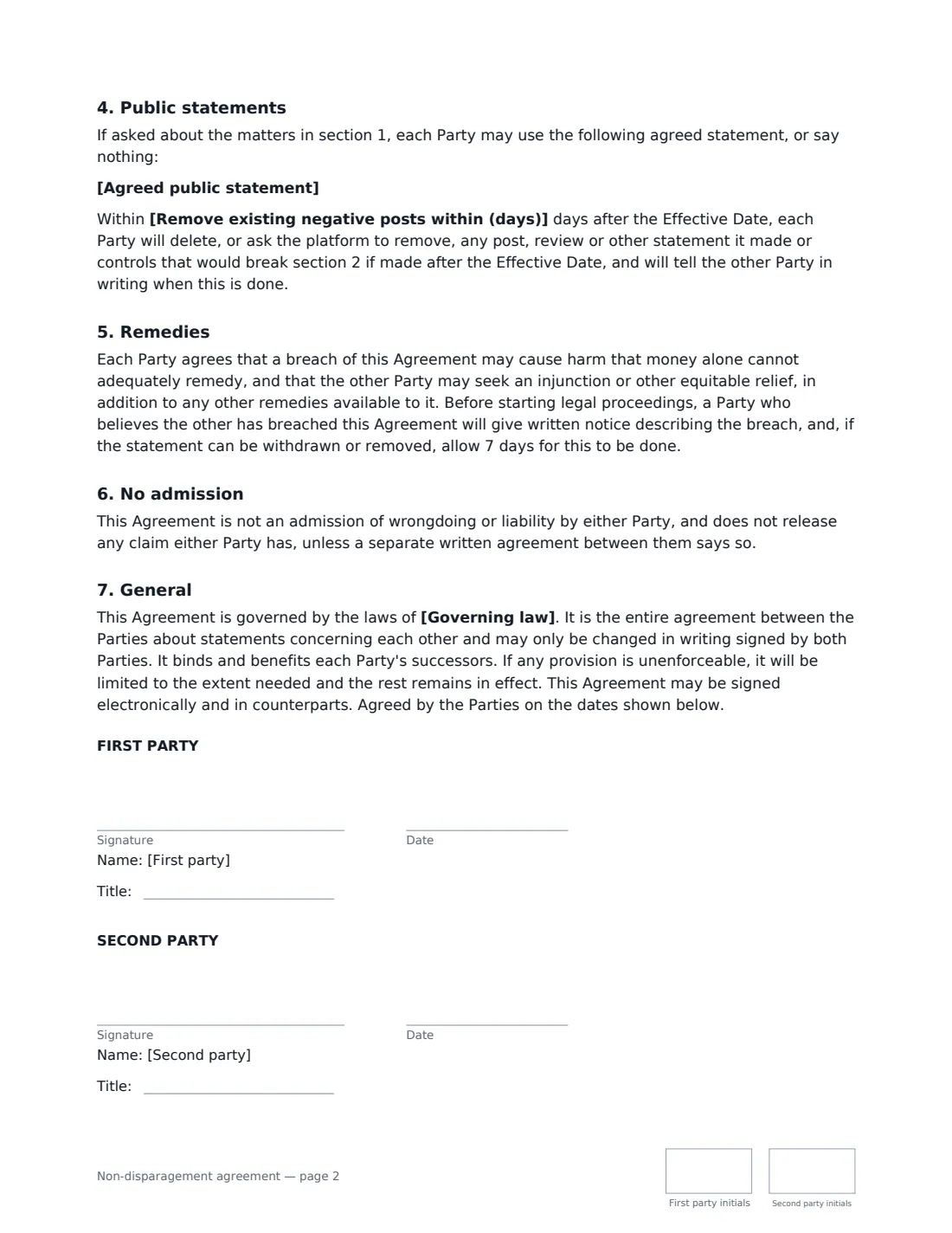
You describe what has ended or been settled, choose who is protected (each party alone, or also its owners, directors, officers and employees) and how long the promise lasts (1, 2, 3 or 5 years, or with no end date). The promise covers statements in any form, including social media, reviews, emails and interviews, and statements made anonymously or through others. Businesses can name the people they will instruct to follow it. Truthful statements required by law, reports to regulators or the police, statements in legal proceedings and disclosures about unlawful conduct in the workplace are always allowed, as are fair competition and private statements to close family. You can add an agreed public statement and a deadline for taking down existing negative posts.
- Best for
- Ending a partnership, joint venture or supplier relationship; settling a business dispute
- Signed by
- Both parties
- Duration
- 1, 2, 3 or 5 years, or with no end date
- Length
- About 2 pages, initialled on every page
When to Use a non-disparagement agreement
- Two business partners ending a joint venture and agreeing to part on good terms
- Settling a dispute with a supplier or customer, alongside a settlement agreement
- A founder or co-owner leaving a company
- Ending a franchise, agency or distribution relationship
- Agreeing a joint announcement after a public disagreement
What You Fill In
13 blanks, then the name and email of each person who signs: first party, second party.
1 The parties
- Effective date*
- First party (company or person)*
- First party address
- Second party (company or person)*
- Second party address
2 The background
- What has ended or been settled*
3 The promise
- Who is protected* each Party and its owners, directors, officers and employees · each Party only
- How long the promise lasts* for 1 year · for 2 years · for 3 years · for 5 years · with no end date
- People each party will ask to follow it
4 Statements
- Remove existing negative posts within (days)
- Agreed public statement
- Anything given in return
- Governing law*
5 Who signs
- First party signature and date, job title, initials on every page
- Second party signature and date, job title, initials on every page
What the non-disparagement agreement Covers
- Background
- The promise
- What is allowed
- Public statements
- Remedies
- No admission
- General
Using the non-disparagement agreement, step by step
1 Describe the background
Say what has ended or been settled, such as "the end of their joint venture to run the Riverside Market". If something is given in return, such as payments under a settlement, refer to it; otherwise the mutual promises are enough.
2 Choose who is protected and for how long
Protect each party only, or also its owners, directors, officers and employees. Choose the duration. A time limit is often easier to justify than a promise with no end date.
3 Agree what may be said
Optionally write an agreed statement either party may use if asked, and set a number of days to take down existing negative posts or reviews. Businesses can name who they will instruct, such as their directors and senior managers.
4 Send for signature
Add the governing law and the other party's signer, check the PDF in the editor, and send.
Tips Before You Send It
- Do not use this to stop customers posting honest reviews. Laws in some places, including the US Consumer Review Fairness Act, restrict that in consumer contracts.
- Keep the carve-outs. Promises that try to stop people reporting wrongdoing or giving evidence are unenforceable in many places, and can make the whole clause look unfair.
- An agreed statement stops awkward improvising when customers or the press ask what happened.
- For an employee leaving a job, use a separation agreement. It has its own non-disparagement option and the protections that employment law expects.
Sign It Online In Minutes
- Fill in the blanks. Names, dates and amounts go straight into the agreement — the preview shows exactly where.
- Name who signs. Tick “This is me” for your own part. VergeHR builds the PDF with every signature, date and initials box on the right line, and you can check or move anything before sending.
- Send it. Each signer gets a secure link and signs from any device — no account needed. The signed PDF, with an audit trail and a Certificate of Completion, is filed in Files and emailed to everyone.
Non-disparagement agreement: frequently asked questions
Does a non-disparagement agreement stop truthful statements?
It stops statements that disparage the other party, which can include true ones made to damage reputation. But this template always allows truthful statements required by law, reports to authorities, statements in legal proceedings, disclosures about unlawful workplace conduct and fair business comparisons.
Is it the same as a confidentiality agreement?
No. A confidentiality agreement stops information being shared. A non-disparagement agreement stops negative statements, whether or not they involve confidential information. Many settlements include both.
What happens if one side breaks it?
The other side can seek an injunction and damages. Before going to court, the template requires written notice and 7 days to withdraw or remove the statement where that is possible.
Can it be signed electronically?
Electronic signatures are generally valid for ordinary agreements like this in the US (ESIGN Act and UETA), the UK, the EU (eIDAS) and Canada. VergeHR keeps an audit trail and a Certificate of Completion with the signed PDF.