

What is a employment termination letter?
An employment termination letter confirms a decision that has usually already been discussed in person: that someone's job is ending, when, and what happens next. Putting it in writing gives the employee the facts they need — their last day, how their notice works, what their final pay includes and who to call with questions — and gives the employer a clear record of what was communicated and when.
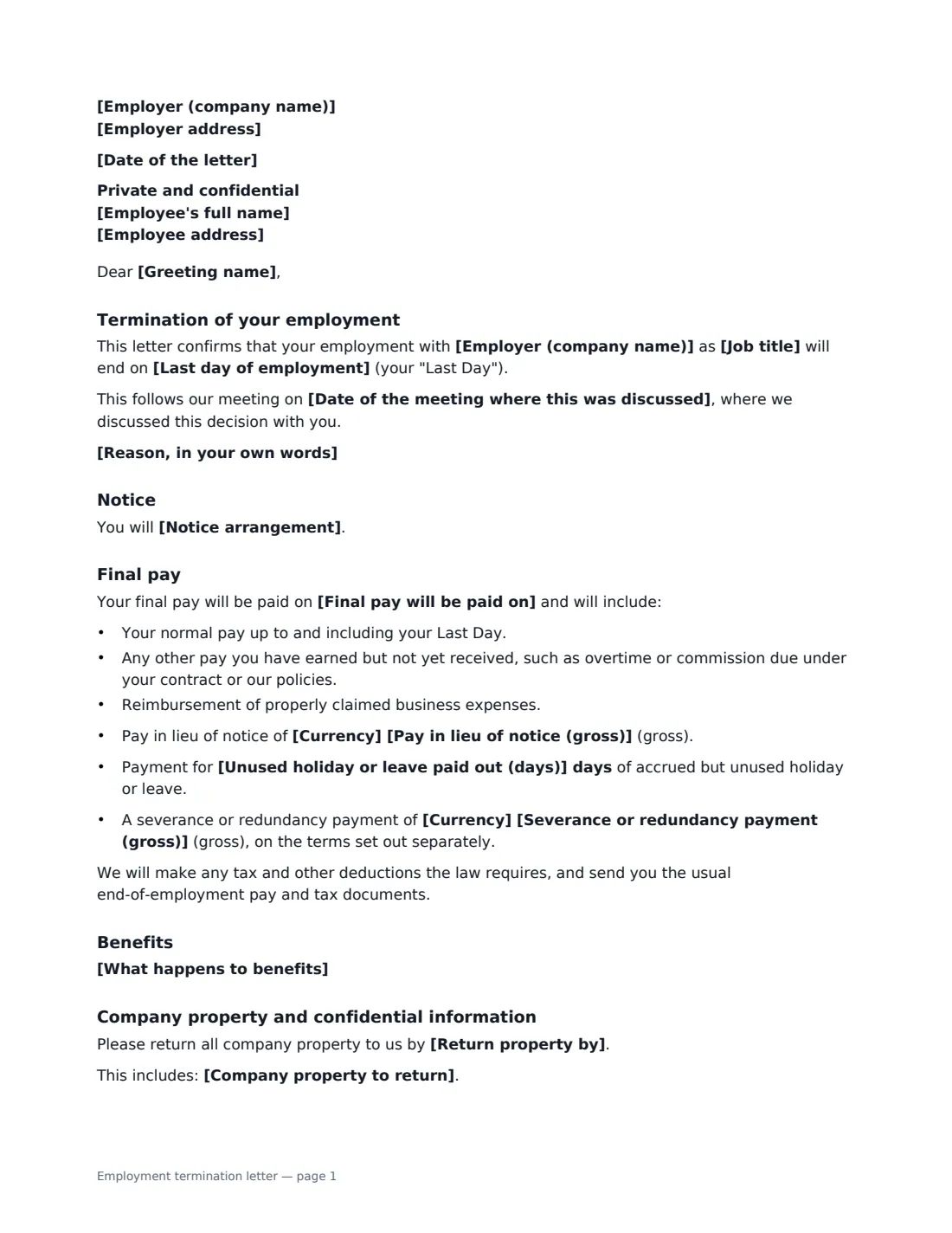
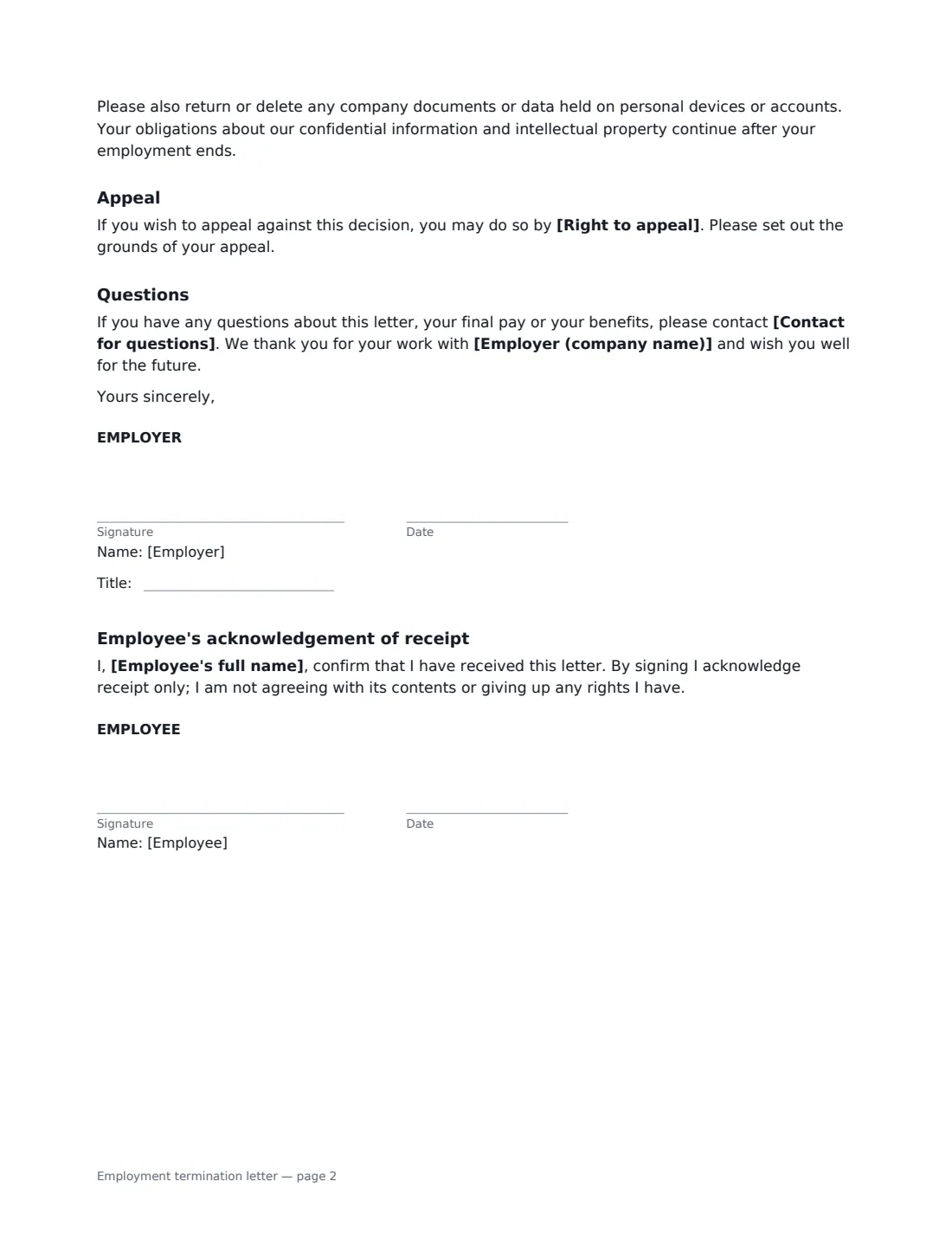
This template covers the practical points most termination letters share. You choose the reason (redundancy, the end of a fixed-term contract, not confirming employment after probation, a reason in your own words, or no reason in the letter) and how the notice period works: working it as normal, garden leave, pay in lieu of notice, or ending immediately. The final pay section lists normal pay up to the last day, earned pay and expenses, plus optional pay in lieu, unused holiday and a severance payment. It then covers benefits, returning company property and data, an optional right of appeal and a contact for questions. The employee signs only to acknowledge receipt — the letter says plainly that signing doesn't mean they agree or give up any rights.
- Best for
- Confirming a dismissal, redundancy, end of a fixed-term contract or failed probation in writing
- Signed by
- The employer, then the employee to acknowledge receipt
- Notice options
- Work the notice, garden leave, pay in lieu of notice, or immediate
- Length
- About 2 pages
When to Use a employment termination letter
- Confirming a redundancy after consultation meetings
- Ending employment at the close of a fixed-term contract that won't be renewed
- Not confirming a new hire at the end of their probation period
- Confirming a dismissal after a performance or disciplinary process
- Setting out final pay, benefits and property return when an employee is put on garden leave
What You Fill In
22 blanks, then the name and email of each person who signs: employer, employee.
1 The parties
- Date of the letter*
- Employer (company name)*
- Employer address
- Employee's full name*
- Employee address
- Greeting name*
- Job title*
2 The decision
- Reason for the termination* Stated below · Redundancy (the role is no longer needed) · End of a fixed-term contract · Not confirmed after probation · Not stated in this letter
- Reason, in your own words
- Date of the meeting where this was discussed
3 Notice
- Last day of employment*
- Notice arrangement* work your notice period as normal until your Last Day · not be required to work between now and your Last Day, but will stay employed and receive your normal pay and benefits (garden leave) · not work a notice period, and will receive pay in lieu of notice as set out below · not work a notice period, because your employment ends with immediate effect on your Last Day
4 Final pay
- Currency*
- Pay in lieu of notice (gross)
- Unused holiday or leave paid out (days)
- Final pay will be paid on
- Severance or redundancy payment (gross)
5 Benefits and property
- What happens to benefits
- Company property to return
- Return property by
- Contact for questions*
- Right to appeal
6 Who signs
- Employer signature and date, job title · A manager or HR person authorised to end employment.
- Employee signature and date · Signs only to confirm they received the letter.
What the employment termination letter Covers
- Termination of your employment
- Notice
- Final pay
- Benefits
- Company property and confidential information
- Appeal
- Questions
- Employee's acknowledgement of receipt
Using the employment termination letter, step by step
1 Enter the parties and the job
Add your company name and address, the employee's name, address, job title and the first name for the greeting.
2 Record the decision
Choose the reason. "Stated below" prints your own words; the other options print a standard sentence, and anything you type in "Reason, in your own words" is added underneath. Choose "Not stated in this letter" if you have communicated the reason another way. Add the date of the meeting where the decision was discussed, if there was one.
3 Set the last day and final pay
Enter the last day of employment and choose the notice arrangement. Add pay in lieu of notice, unused holiday days and any severance amount only if they apply; each prints as its own line in the final pay list. Leave the final pay date empty to say it is paid on the next normal payroll date.
4 Benefits, property and questions
Describe what happens to benefits, or leave it empty for a general statement. List the property to return and the return date, name the contact for questions, and add the appeal route if your procedure or local law provides one. Then add the employee as signer and send.
Tips Before You Send It
- Have the conversation first. A termination letter should confirm a decision the employee has already heard from you, not deliver it.
- Check the notice and final pay deadlines that apply where the employee works — many places set minimums, and some require a written reason or a fair process before dismissal.
- If you are offering severance in exchange for a release of claims, use a separation agreement for that and give the employee time to take advice.
- Keep the reason factual and consistent with your records. Avoid adding opinions or new allegations in the letter.
- Make sure the person signing for the company has authority to end employment.
Sign It Online In Minutes
- Fill in the blanks. Names, dates and amounts go straight into the agreement — the preview shows exactly where.
- Name who signs. Tick “This is me” for your own part. VergeHR builds the PDF with every signature, date box on the right line, and you can check or move anything before sending.
- Send it. Each signer gets a secure link and signs from any device — no account needed. The signed PDF, with an audit trail and a Certificate of Completion, is filed in Files and emailed to everyone.
Employment termination letter: frequently asked questions
Does the employee have to sign the termination letter?
No — their signature only confirms they received it, and the letter says so. If they decline, VergeHR's audit trail still shows when the letter was sent to them and when they opened it.
Should the letter state the reason for termination?
It depends on your situation and where you are. Some places require a written reason on request or in the letter; elsewhere employers often keep it brief. The reason is a choice in the template, including leaving it out. Take advice if you are unsure.
What is the difference between this and a separation agreement?
A termination letter informs the employee and confirms the practical details. A separation agreement is a contract: the employee usually gets a severance payment in exchange for releasing claims, and both sides sign to agree to it.
Can a termination letter be signed electronically?
Yes. Electronic signatures are generally valid for employment documents like this in the US (ESIGN Act and UETA), the UK, the EU (eIDAS) and Canada. Check whether your contract or local rules say how notice must be given, and send a paper copy as well if they require it.