

What is a general release of claims?
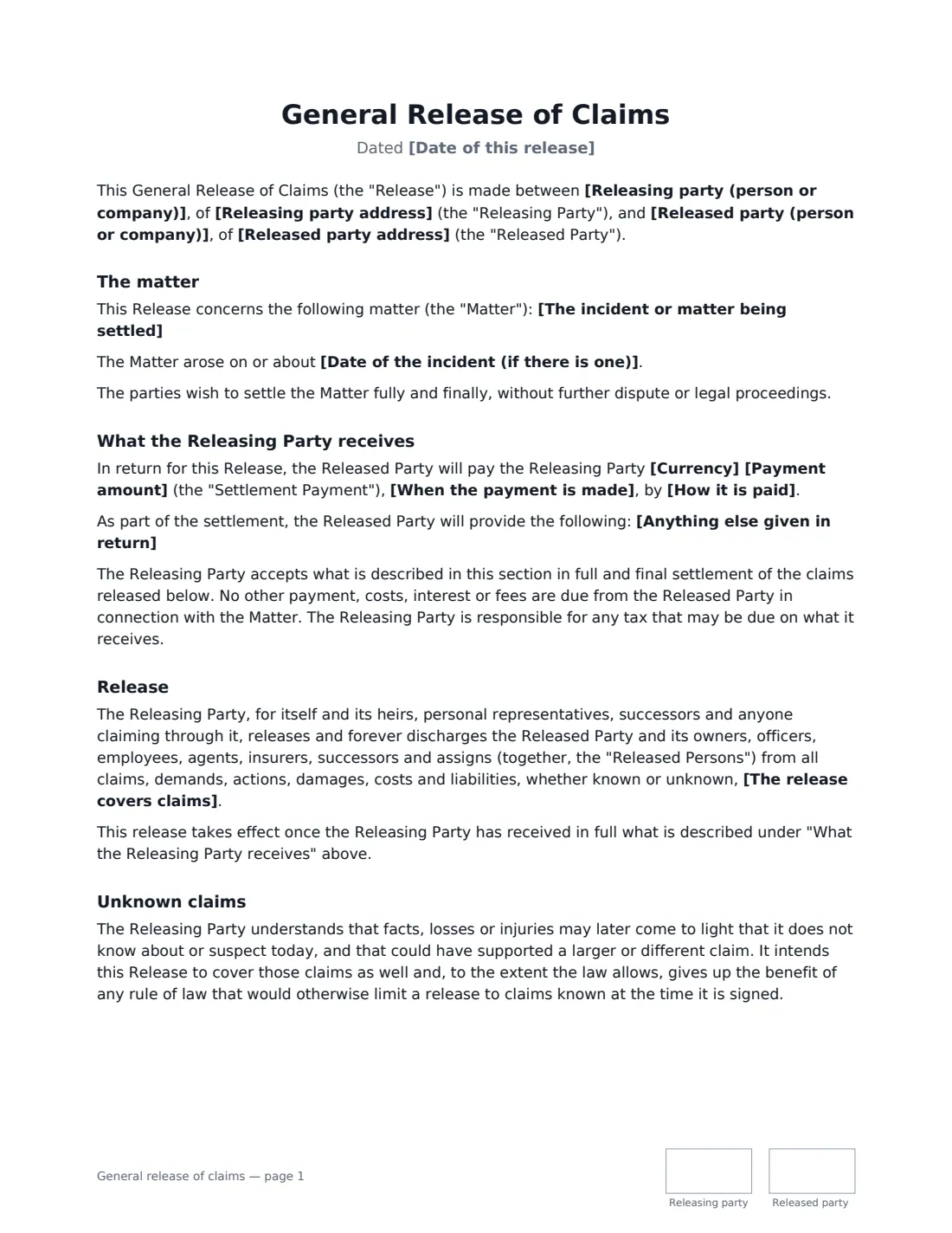
A general release of claims is the document that turns a settlement into a final one. One party (the releasing party) accepts a payment, a repair or something else of value, and in return gives up its right to sue the other party (the released party) about a particular incident or matter. It is used after car scrapes and property damage, disputes with contractors or neighbours, customer complaints, and minor injuries where both sides would rather settle than go to court.
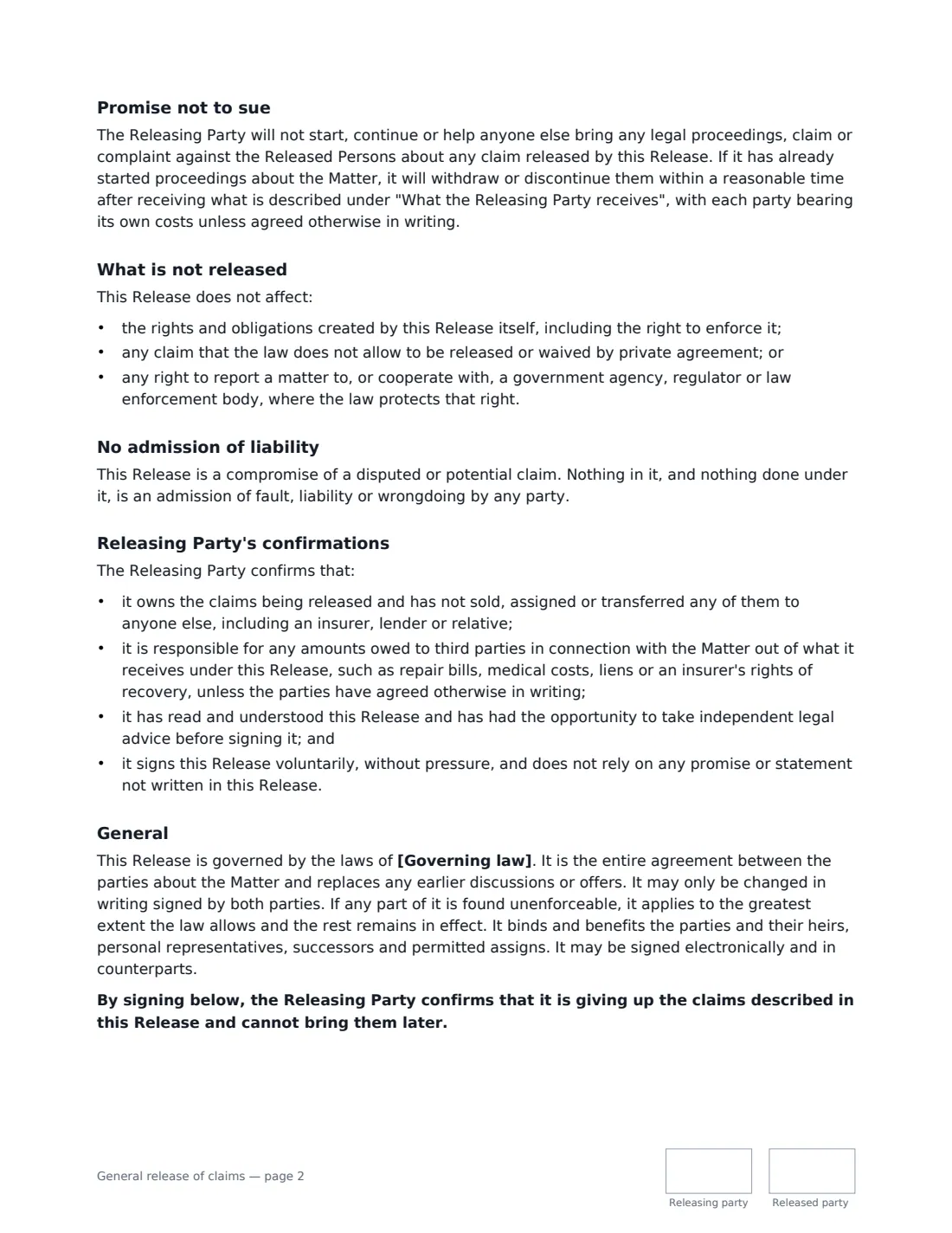
In this template you describe the matter precisely, set the payment (amount, timing and method) and/or anything else given in return, and choose whether the release covers only claims about that matter or every claim up to today. It includes a clause covering claims that are not yet known, a promise not to sue and to withdraw any proceedings already started, a no-admission-of-liability clause, and the releasing party's confirmations that it has not assigned its claims and is responsible for any liens or third-party bills out of what it receives. You can make the release mutual and keep the terms confidential. The release only takes effect once the releasing party has actually been paid.
- Best for
- Settling property damage, minor accidents, contractor or neighbour disputes and customer complaints
- Signed by
- The releasing party and the released party
- Scope
- You choose: claims about the matter only, or all claims up to the date of the release
- Length
- 2–3 pages, initialled on every page
When to Use a general release of claims
- A driver pays for damage to another car without going through insurance
- A neighbour pays for a fence or tree damaged during building work
- A business compensates a customer for a faulty product or service and closes the complaint
- A contractor and homeowner settle a dispute over unfinished or defective work
- A landlord or host settles a claim for damaged belongings
What You Fill In
16 blanks, then the name and email of each person who signs: releasing party, released party.
1 The parties
- Date of this release*
- Released party (person or company)*
- Released party address
- Releasing party (person or company)*
- Releasing party address
2 The matter
- The incident or matter being settled*
- Date of the incident (if there is one)
- The release covers claims* arising out of or connected with the Matter · of any kind arising up to the date of this Release, including the Matter
- Does the released party also give a release?* No · Yes
3 What is given in return
- Currency
- Payment amount
- When the payment is made
- How it is paid
- Anything else given in return
4 Other terms
- Keep the terms confidential?* Yes · No
- Governing law*
5 Who signs
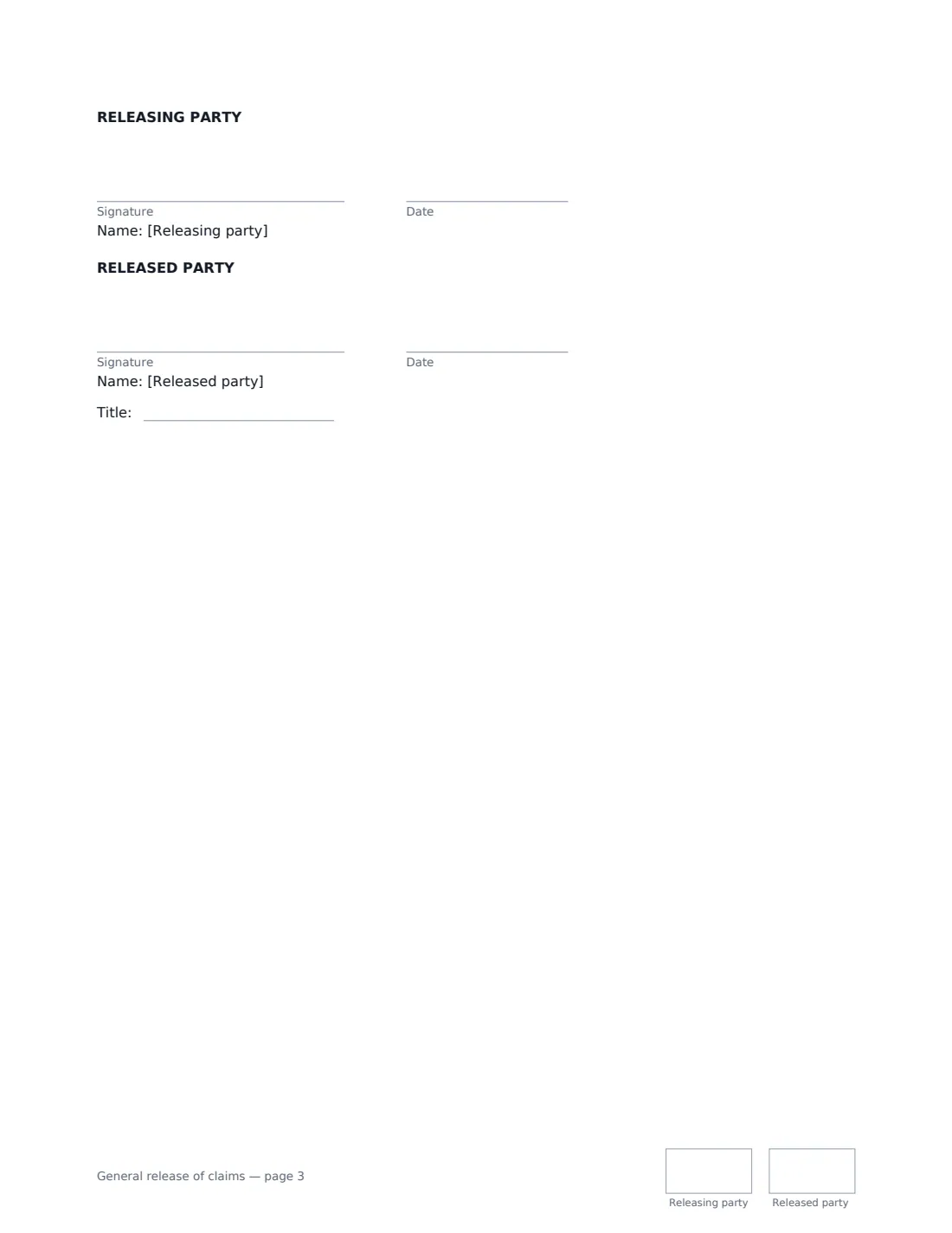
- Releasing party signature and date, initials on every page · The person or business giving up its claims, usually the one receiving the payment.
- Released party signature and date, job title, initials on every page · The person or business being released, usually the one paying.
What the general release of claims Covers
- The matter
- What the Releasing Party receives
- Release
- Unknown claims
- Release by the Released Party
- Promise not to sue
- What is not released
- No admission of liability
- Releasing Party's confirmations
- Confidentiality
- General
Using the general release of claims, step by step
1 Describe the matter
Say what happened, where and when, specifically enough that nobody can later argue about what was settled — "water damage to the ground-floor flat at 14 Elm Street from the leaking pipe in the flat above", not "the leak". Add the incident date if there is one.
2 Set what is given in return
Enter the payment amount, currency, when it is paid and how. If the settlement is a repair, a replacement or an apology instead of (or as well as) money, describe it in the second box. The release only takes effect once everything described has been received.
3 Choose the scope and options
Most settlements release claims about the matter only. Pick the wider option only if you mean to end every claim between you. Choose whether the released party gives a release back (useful when both sides had complaints) and whether the terms stay confidential, then set the governing law.
4 Send for signature
The released party (usually the one paying) typically sends it. Both sides sign and initial each page online; the signed PDF is filed in Files. Make the payment on the agreed terms and keep proof of it.
Tips Before You Send It
- Don't sign until the full extent of any injury or damage is known — a release covers unknown claims about the matter too.
- If an insurer, lender or health provider may have rights in the claim, involve them before settling; the releasing party promises that it has not assigned its claims.
- For personal injury, employment or consumer claims, or anything involving a large sum, take legal advice: some places require specific wording, cooling-off periods or court approval, and some claims cannot be released at all.
- Keep the description of the matter factual. The release says it is not an admission of liability, so there is no need to argue about fault in it.
Sign It Online In Minutes
- Fill in the blanks. Names, dates and amounts go straight into the agreement — the preview shows exactly where.
- Name who signs. Tick “This is me” for your own part. VergeHR builds the PDF with every signature, date and initials box on the right line, and you can check or move anything before sending.
- Send it. Each signer gets a secure link and signs from any device — no account needed. The signed PDF, with an audit trail and a Certificate of Completion, is filed in Files and emailed to everyone.
General release of claims: frequently asked questions
What is the difference between a release and a liability waiver?
A liability waiver is signed before an activity and gives up claims that might arise in future. A release is signed after something has happened, usually in exchange for payment, and settles claims about that event.
Does the release cover problems we find out about later?
It is written to cover unknown claims about the matter as well as known ones, to the extent the law allows. Some jurisdictions have special rules for releasing unknown claims, so check local requirements if the matter is significant.
What if the payment is never made?
The release only takes effect once the releasing party has received in full what was promised. Until then it has not given up its claims, and it can also enforce the promise to pay.
Is an electronically signed release binding?
Electronic signatures are generally valid for ordinary contracts like this in the US (ESIGN Act and UETA), the UK, the EU (eIDAS) and Canada. VergeHR keeps an audit trail and a Certificate of Completion with the signed PDF. Settlements that need court approval, such as some claims involving minors, follow their own process.