

What is a hold harmless agreement?
A hold harmless agreement (also called an indemnity agreement) is used when one party lets another use its property. The user agrees that if anyone is hurt or anything is damaged because of that use, it will deal with the claim and cover the cost rather than leaving the owner to pay. It is common when a landowner lets a club use a field, a business lends equipment, a homeowner hosts an event run by someone else, or a venue lets a group use a room free of charge.
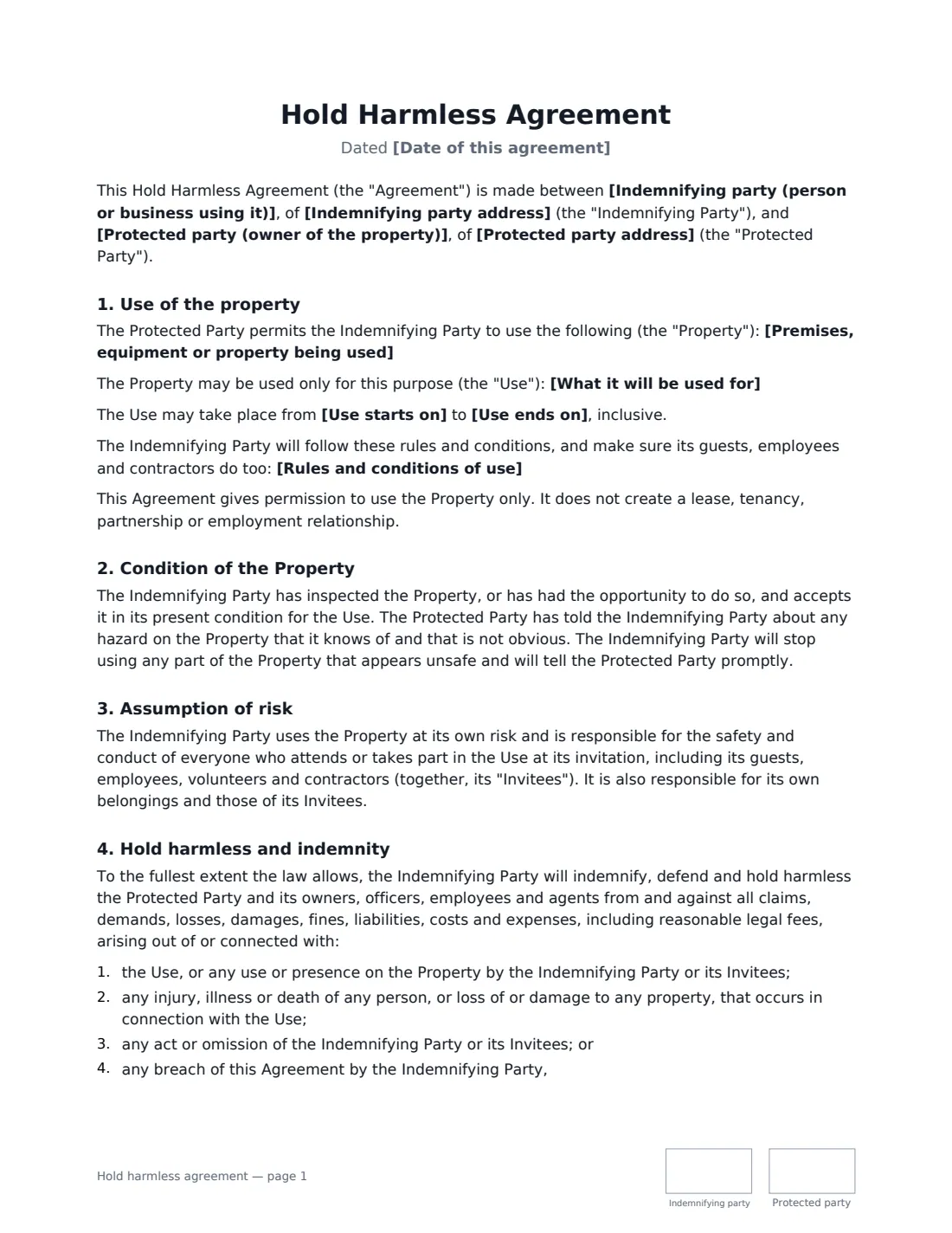
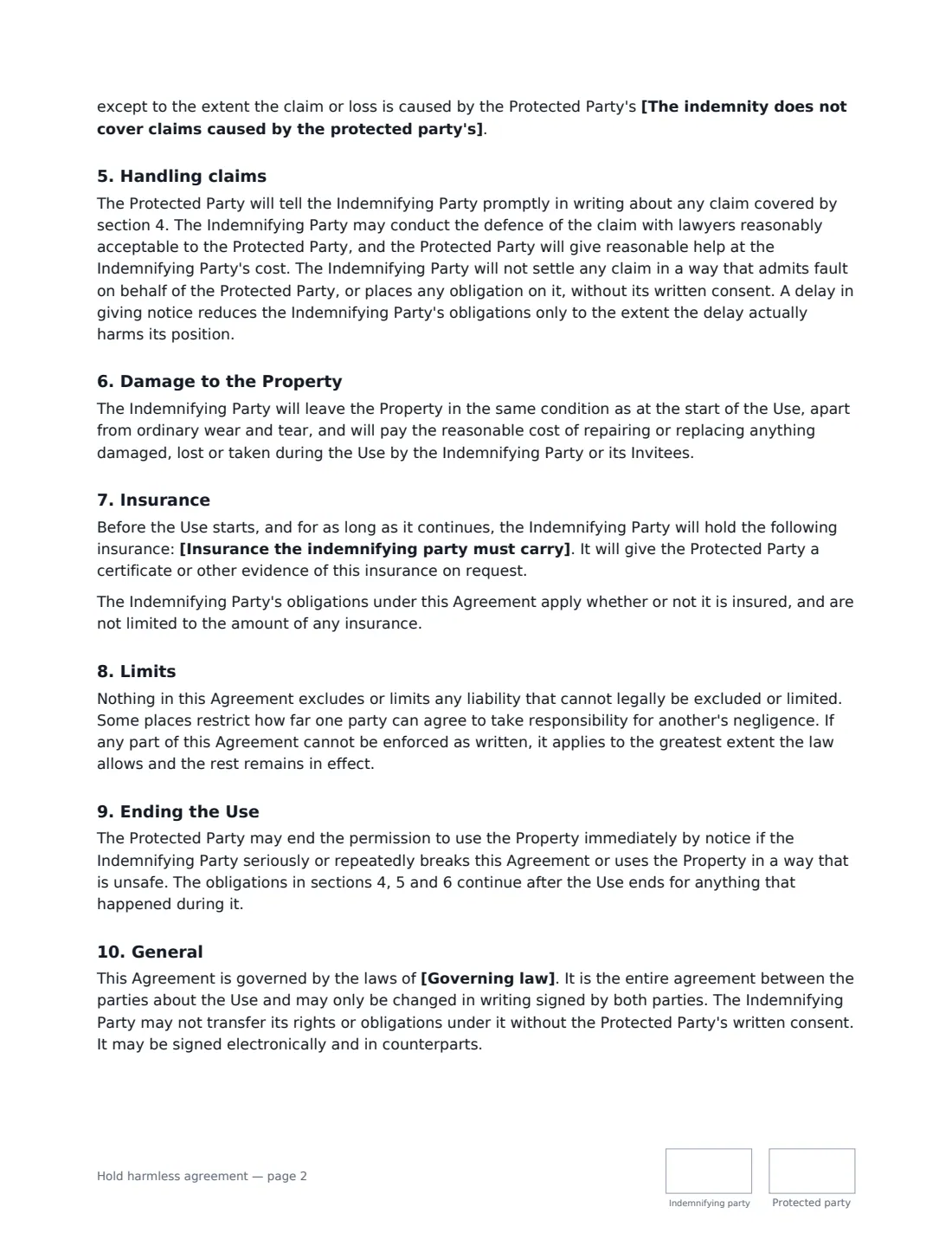
This template names exactly what may be used, for what purpose and for which dates, and lists any rules. The indemnifying party accepts the property as inspected, takes responsibility for its guests, staff and contractors, and indemnifies, defends and holds the owner harmless against claims, losses and legal fees arising from the use, except where the owner's own negligence (or, if you choose, only its gross negligence) caused them. It sets out how claims are handled, makes the user pay for damage, lets you require insurance, and includes a limits clause because some places restrict how far such promises can go.
- Best for
- Letting someone use your premises, land, vehicle or equipment for an event, activity or project
- Signed by
- The indemnifying party (the user) and the protected party (the owner)
- Insurance
- Optional — describe the cover the user must hold
- Length
- 2–3 pages, initialled on every page
When to Use a hold harmless agreement
- A farmer lets a running club or dog show use a field for a day
- A business lends a stage, marquee or trailer to a community group
- A homeowner lets an event organiser run a party or wedding in the garden
- A church or school lets an outside group use its hall or sports pitch
- A company lets a contractor store equipment in its yard
What You Fill In
13 blanks, then the name and email of each person who signs: indemnifying party, protected party.
1 The parties
- Date of this agreement*
- Protected party (owner of the property)*
- Protected party address
- Indemnifying party (person or business using it)*
- Indemnifying party address
2 The use
- Premises, equipment or property being used*
- What it will be used for*
- Use starts on*
- Use ends on
- Rules and conditions of use
3 Responsibility
- The indemnity does not cover claims caused by the protected party's* own negligence or wilful misconduct · gross negligence or wilful misconduct
- Insurance the indemnifying party must carry
- Governing law*
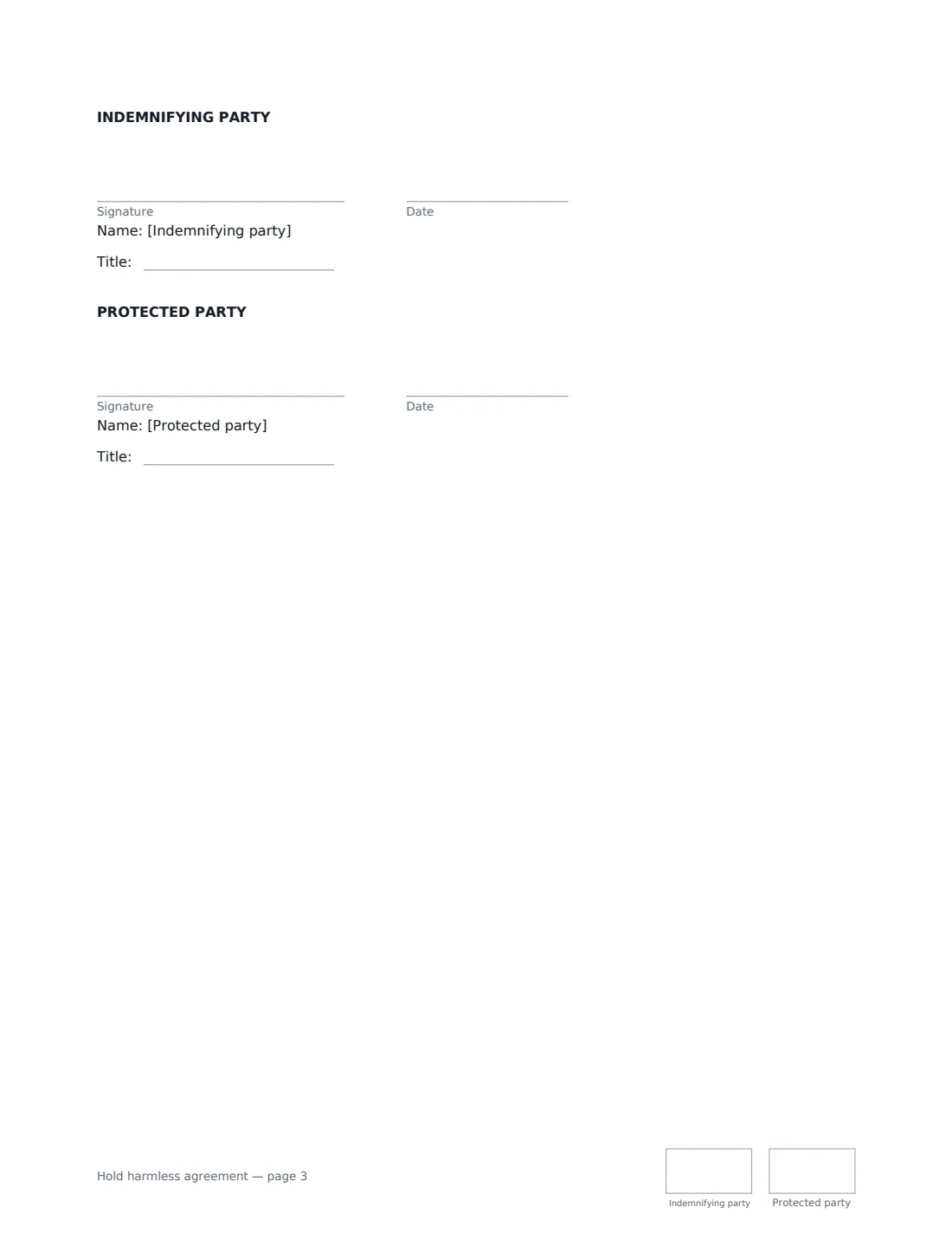
4 Who signs
- Indemnifying party signature and date, job title, initials on every page · The person or business using the property, who takes on responsibility for claims.
- Protected party signature and date, job title, initials on every page · The owner of the premises, equipment or property, who is protected by the agreement.
What the hold harmless agreement Covers
- Use of the property
- Condition of the Property
- Assumption of risk
- Hold harmless and indemnity
- Handling claims
- Damage to the Property
- Insurance
- Limits
- Ending the Use
- General
Using the hold harmless agreement, step by step
1 Describe the property and the use
Say exactly what may be used and what is off limits — "the barn, yard and paddock, excluding the farmhouse" — and what it will be used for. Add the dates; leave the end date empty for ongoing use that either side can end in writing.
2 Add house rules
List any conditions the user and its guests must follow: no open flames, parking areas, finishing times, areas that are out of bounds. The user promises its guests, staff and contractors will follow them too.
3 Set the responsibility terms
Choose whether the indemnity excludes claims caused by your ordinary negligence (the usual, fairer option) or only your gross negligence. If you want the user to carry insurance, describe it; otherwise leave the box empty.
4 Sign before the use starts
Send it to the user well before the event. Both of you sign and initial each page online, and the signed PDF is filed in Files. If insurance is required, ask for the certificate at the same time.
Tips Before You Send It
- Tell the user about hidden hazards you know of — the agreement records that you have, and it is safer for everyone.
- A hold harmless promise is only as good as the user's ability to pay. For anything risky, require insurance and ask your own insurer what to request.
- Some places, particularly for construction work and consumer contracts, limit or void clauses that make someone responsible for another party's negligence. Take local advice for high-value or high-risk uses.
- For participants in a risky activity you run yourself, use a liability waiver instead — this agreement is for someone else using your property.
Sign It Online In Minutes
- Fill in the blanks. Names, dates and amounts go straight into the agreement — the preview shows exactly where.
- Name who signs. Tick “This is me” for your own part. VergeHR builds the PDF with every signature, date and initials box on the right line, and you can check or move anything before sending.
- Send it. Each signer gets a secure link and signs from any device — no account needed. The signed PDF, with an audit trail and a Certificate of Completion, is filed in Files and emailed to everyone.
Hold harmless agreement: frequently asked questions
What does "hold harmless" mean?
It means one party agrees not to hold the other responsible for certain losses, and to protect it if someone else makes a claim. In this template the user of the property also agrees to indemnify (reimburse) and defend the owner.
Is it the same as a liability waiver?
Not quite. A waiver mainly stops the signer from suing you. A hold harmless agreement also makes the signer responsible for claims brought by other people — for example a guest injured at an event the signer organised on your land.
Does the owner lose all responsibility?
No. The indemnity excludes claims caused by the owner's own negligence (or gross negligence, if you choose), and nothing in it excludes liability that cannot legally be excluded.
Can we sign it electronically?
Yes. Electronic signatures are generally valid for ordinary contracts like this in the US (ESIGN Act and UETA), the UK, the EU (eIDAS) and Canada. VergeHR keeps an audit trail and a Certificate of Completion with the signed PDF.