

What is a debt settlement agreement?
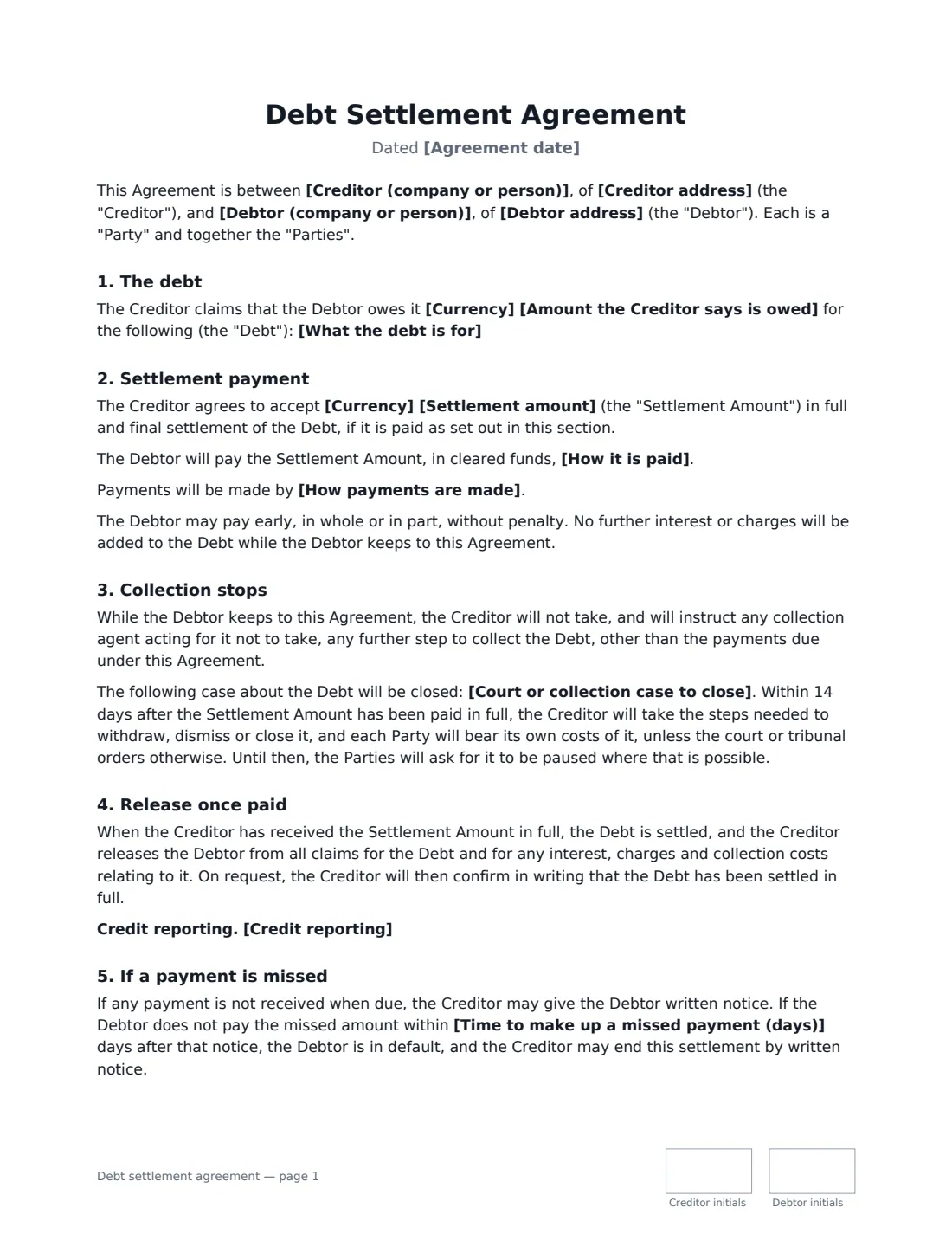
A debt settlement agreement records a deal between a creditor and a debtor: the creditor accepts less than the full balance, or payment over time, and in return the debt is treated as settled in full once the agreed amount is paid. It's used for unpaid invoices between businesses, overdue customer accounts, and loans where both sides would rather settle than go to court or a collection agency.
This template identifies the debt and the balance claimed, records whether the debtor accepts it or settles without admitting liability, sets the settlement amount and how it's paid (one payment by a due date, or instalments), stops collection while the debtor keeps to the deal, closes any court or collection case once paid, releases the debt on full payment, and sets out what happens on a missed payment — a cure period, and whether the full original balance comes back. It also flags that forgiven debt can have tax consequences.
- Best for
- Unpaid invoices, overdue accounts and loans settled for less or over time
- Signed by
- The creditor and the debtor
- If a payment is missed
- Written notice and a cure period you set, then the settlement can be ended
- Length
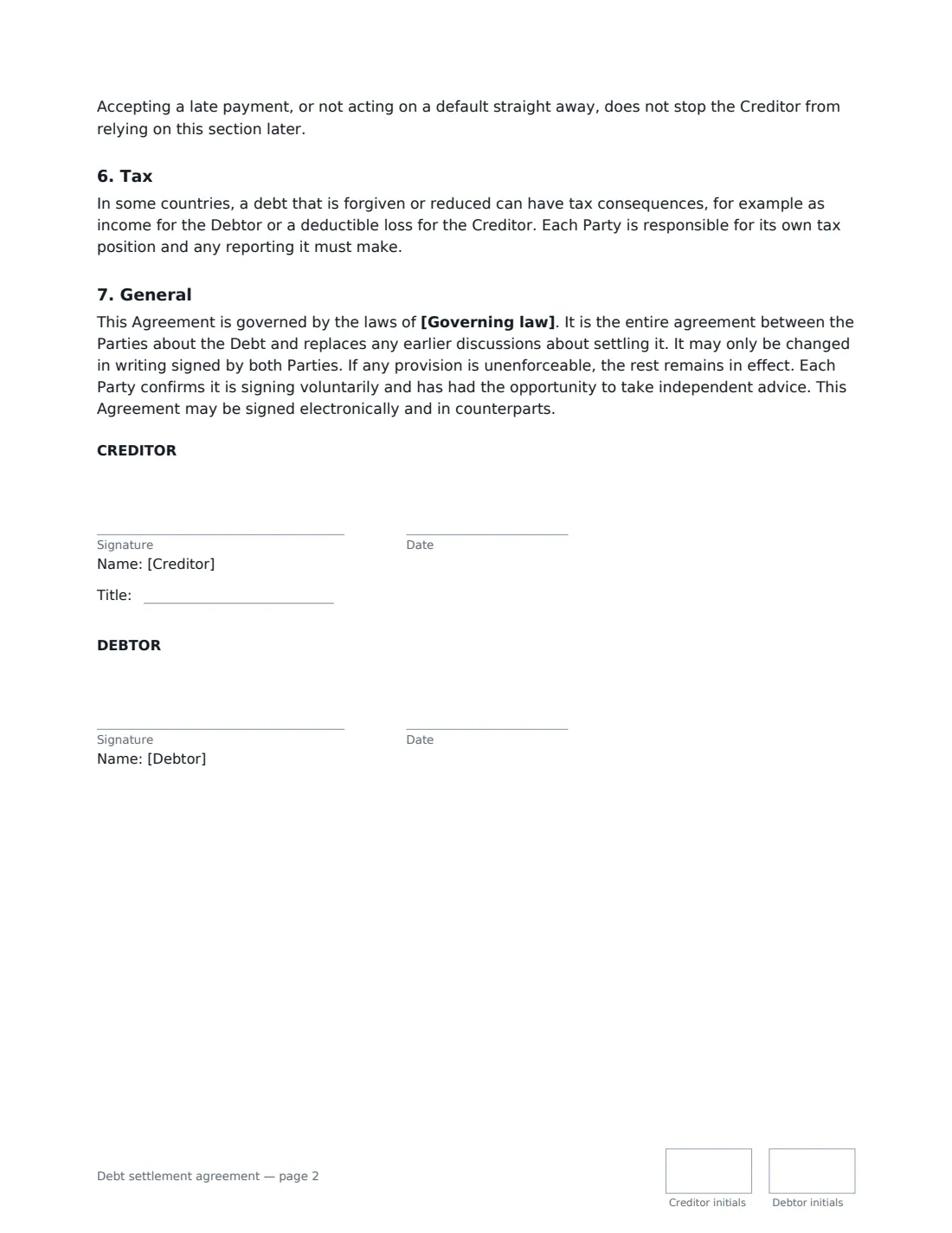
- 2 pages, initialled on every page
When to Use a debt settlement agreement
- A supplier accepting part of a long-overdue invoice paid now, rather than chasing the full amount
- A business agreeing an instalment plan with a customer who can't pay a large bill at once
- A landlord and a former commercial tenant settling unpaid rent and charges
- Settling a disputed bill where both sides want to avoid court
- Closing a small-claims or collection case once an agreed amount is paid
What You Fill In
19 blanks, then the name and email of each person who signs: creditor, debtor.
1 The parties
- Agreement date*
- Creditor (company or person)*
- Creditor address
- Debtor (company or person)*
- Debtor address
2 The debt
- What the debt is for*
- Currency*
- Amount the Creditor says is owed*
- The Debtor's position* The Debtor accepts the balance is owed · The Debtor disputes some or all of it and settles without admitting liability
3 The settlement
- Settlement amount*
- How it is paid* in one payment, by the due date below · in instalments, as set out below
- Due date (one payment)
- Instalment schedule
- How payments are made
4 If a payment is missed
- Time to make up a missed payment (days)*
- If the Debtor defaults* The full original balance, less payments made, becomes due · Only the unpaid part of the settlement amount becomes due
5 Other terms
- Court or collection case to close
- Credit reporting
- Governing law*
6 Who signs
- Creditor signature and date, job title, initials on every page · The business or person who is owed the money.
- Debtor signature and date, initials on every page · The business or person who owes the money. If a company, the person signing for it.
What the debt settlement agreement Covers
- The debt
- Settlement payment
- Collection stops
- Release once paid
- If a payment is missed
- Tax
- General
Using the debt settlement agreement, step by step
1 Identify the debt
Describe exactly what the debt is for — invoice numbers, a loan, an account — and the full balance the creditor claims. Then choose whether the debtor accepts it or settles without admitting it's owed.
2 Set the settlement and payments
Enter the amount the creditor will accept in full settlement. Choose one payment and enter the due date, or instalments and write out the schedule. Add bank details or a payment reference if you want them in the agreement.
3 Decide what a missed payment means
The debtor gets written notice and a cure period (10 days by default). If it still isn't paid, the creditor can end the settlement and either the full original balance (less payments made) or just the unpaid settlement amount becomes due. The first is common; the second is gentler.
4 Add signers and send
Add the debtor's signer and send. VergeHR places both signature blocks and the initials boxes. Once the settlement is paid, the creditor confirms in writing that the debt is settled.
Tips Before You Send It
- If the debt is old, take advice first: in some places a written acknowledgement of a debt can restart or extend the time limit for collecting it.
- Make sure the instalments add up to the settlement amount.
- If a court case or collection agency is involved, name it so the agreement can close it.
- Only include credit-reporting wording the creditor can actually deliver — it can't control how an agency records the account.
- Keep proof of every payment; the release happens only when the full settlement amount has been received.
Sign It Online In Minutes
- Fill in the blanks. Names, dates and amounts go straight into the agreement — the preview shows exactly where.
- Name who signs. Tick “This is me” for your own part. VergeHR builds the PDF with every signature, date and initials box on the right line, and you can check or move anything before sending.
- Send it. Each signer gets a secure link and signs from any device — no account needed. The signed PDF, with an audit trail and a Certificate of Completion, is filed in Files and emailed to everyone.
Debt settlement agreement: frequently asked questions
Does the debtor admit owing the money?
You choose. One option records that the debtor accepts the balance; the other says the debtor disputes some or all of it and settles without admitting liability — and the creditor doesn't admit its claim was wrong either.
When is the debt released?
Only when the creditor has received the full settlement amount. Until then, collection pauses while the debtor keeps to the agreement. Once paid, the creditor confirms settlement in writing on request.
Is forgiven debt taxable?
It can be. In some countries the forgiven part can count as income for the debtor, or be a deductible loss for the creditor. The template tells each party to take its own tax advice rather than stating a rule, because it depends on where you are and who the parties are.
Can it be signed electronically?
In most countries, including the US (ESIGN Act and UETA), the UK, the EU (eIDAS) and Canada, an electronic signature is generally valid for an ordinary commercial contract like this one. VergeHR keeps an audit trail and a Certificate of Completion with the signed PDF as evidence of who signed and when.
Is this template free?
Yes. The template is free to use with the eSignature app in VergeHR, and the people you send it to don't need a VergeHR login to sign.