

What is a payment plan agreement?
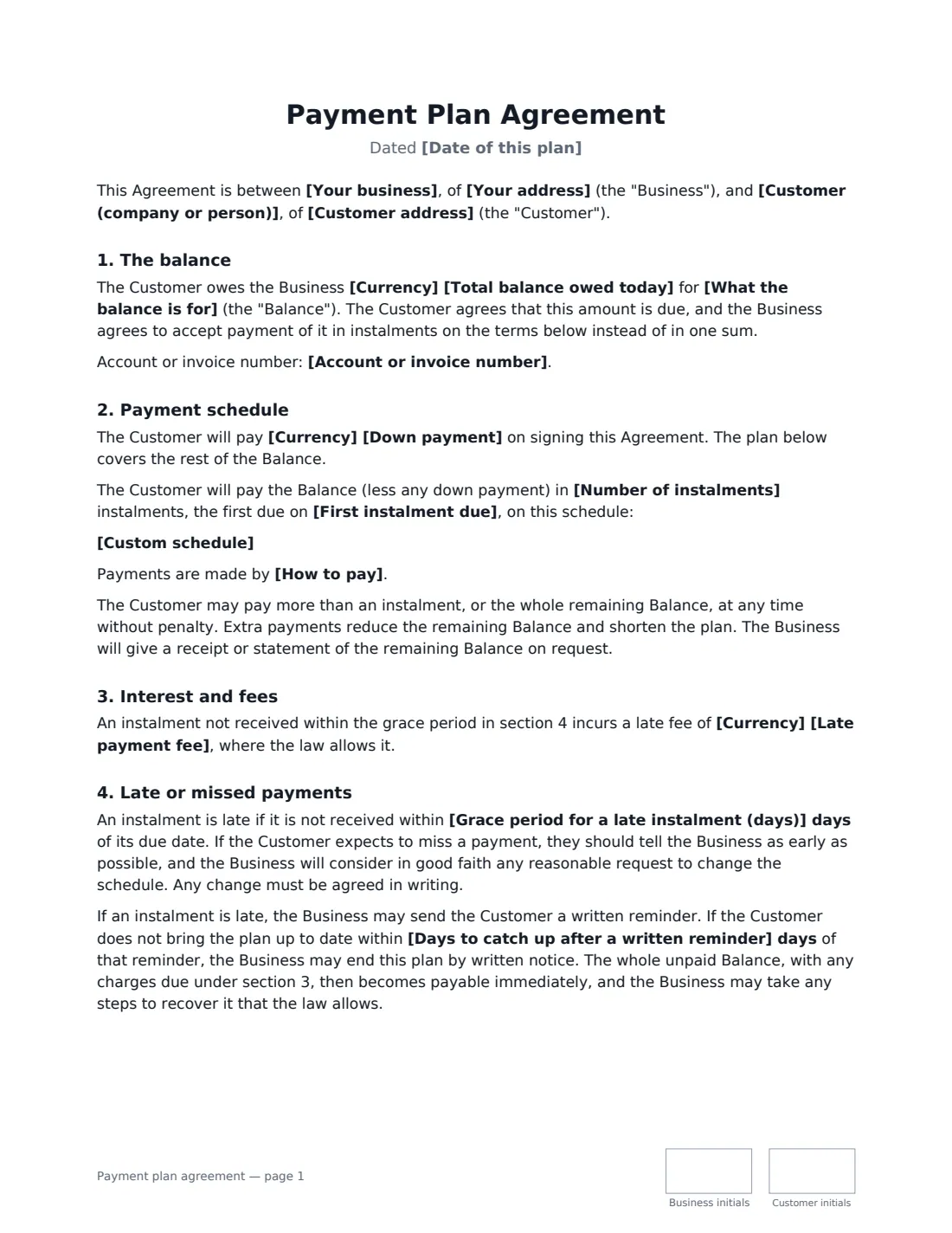
A payment plan agreement lets a customer pay off a balance over time instead of in one sum. Tradespeople, clinics, schools, landlords, garages and small businesses use it when a customer can't pay an invoice in full but wants to settle it. Writing the plan down protects both sides: the customer knows exactly what's due and when, and the business has a signed acknowledgement of the balance and the schedule.
This template records what the balance is for, the amount owed and any invoice or account number. It sets an optional down payment, then either equal instalments (amount, how often, how many and when the first is due) or a custom schedule you type in. You choose whether any interest or charges apply, and can add a late fee. If an instalment is late past the grace period, the business sends a written reminder; if the customer doesn't catch up within the cure period, the business can end the plan and the remaining balance becomes due. While the plan is kept, the business won't pursue further collection, and it confirms in writing when the account is settled.
- Best for
- Overdue invoices, large bills, treatment or tuition fees, repair bills
- Signed by
- The customer and the business
- Schedule
- Equal weekly, fortnightly or monthly instalments, or a custom schedule
- Length
- About 2 pages, initialled on every page
When to Use a payment plan agreement
- A contractor agreeing monthly payments on a large renovation or repair bill
- A dental, vet or therapy practice spreading the cost of treatment
- A school, tutor or course provider accepting tuition in instalments
- A business settling an overdue invoice with a regular customer instead of using a collection agency
- A garage letting a customer pay off a large repair bill over a few months
What You Fill In
22 blanks, then the name and email of each person who signs: business, customer.
1 The parties
- Your business*
- Your address
- Customer (company or person)*
- Customer address
2 The balance
- Date of this plan*
- What the balance is for*
- Account or invoice number
- Currency*
- Total balance owed today*
3 Instalments
- Down payment
- Each instalment
- Paid every* week · two weeks · month
- Number of instalments*
- First instalment due*
- Custom schedule
- How to pay
4 Fees
- Interest and charges* No interest or charges are added · Interest or charges are added as described below
- Interest or charges
- Late payment fee
5 If a payment is missed
- Grace period for a late instalment (days)*
- Days to catch up after a written reminder*
- Governing law*
6 Who signs
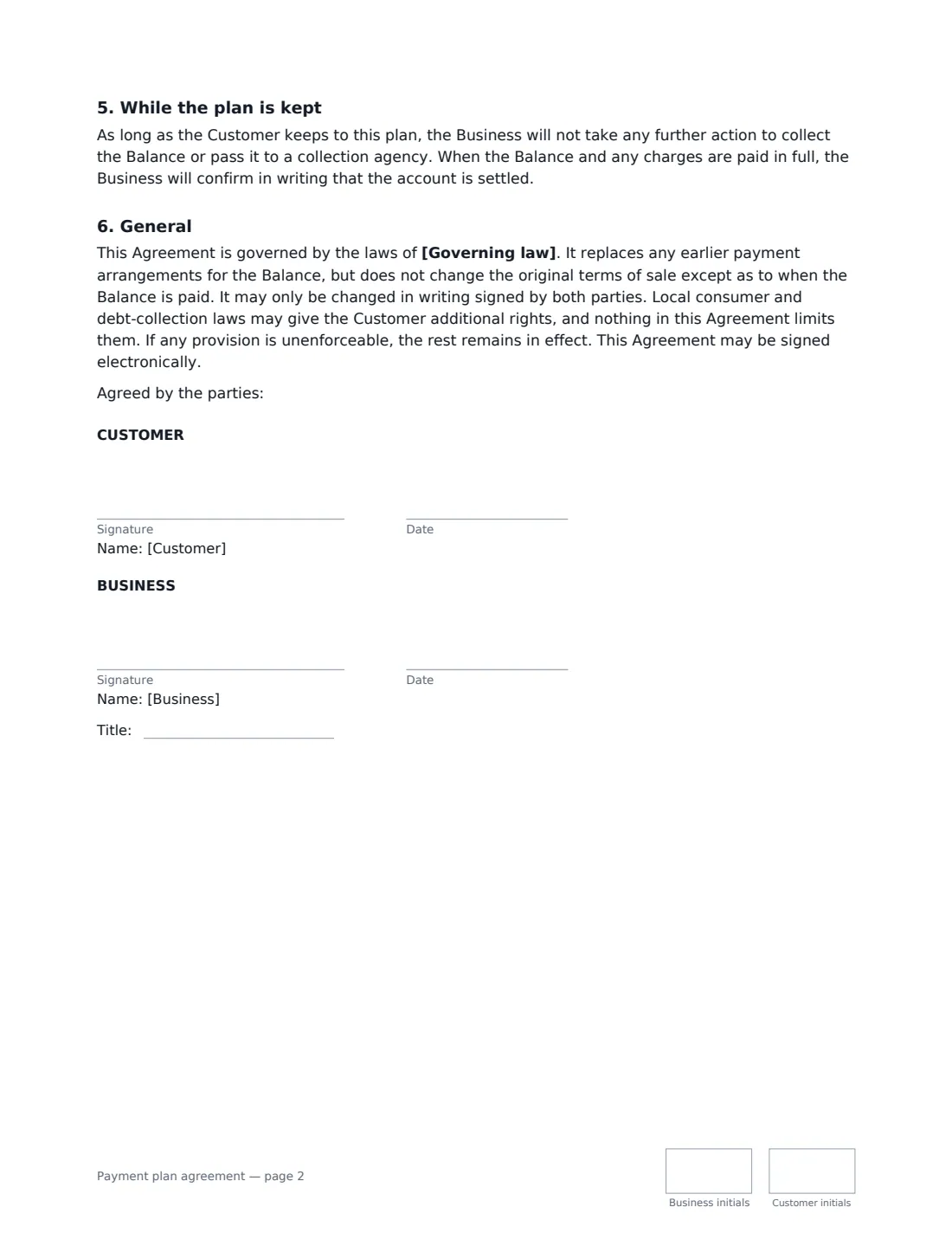
- Business signature and date, job title, initials on every page · The business that is owed the balance.
- Customer signature and date, initials on every page · The person or company that owes the balance.
What the payment plan agreement Covers
- The balance
- Payment schedule
- Interest and fees
- Late or missed payments
- While the plan is kept
- General
Using the payment plan agreement, step by step
1 Describe the balance
Say what it's for and include the invoice or account number, so there's no doubt which debt the plan covers. Enter the total owed today.
2 Build the schedule
Add any down payment, then the instalment amount, how often and how many, and the first due date. If payments differ, list them line by line in the custom schedule instead — it replaces the equal-instalment wording.
3 Decide on fees
The default adds no interest or charges. If you add interest or a late fee, check local consumer-credit and late-fee rules first — the Help text flags this.
4 Set the grace and cure periods
The grace period is how late a payment can be before it counts as missed; the cure period is how long the customer has to catch up after a written reminder. Then add the customer and send.
Tips Before You Send It
- Make sure the instalments add up to the balance. The agreement adjusts the final instalment for rounding.
- The customer can always pay early without penalty — say so when you offer the plan.
- Signing a plan acknowledges the debt. In some places that can affect legal time limits for collecting it, so take advice if the debt is old or disputed.
- Keep the signed plan in Files and record payments against it.
Sign It Online In Minutes
- Fill in the blanks. Names, dates and amounts go straight into the agreement — the preview shows exactly where.
- Name who signs. Tick “This is me” for your own part. VergeHR builds the PDF with every signature, date and initials box on the right line, and you can check or move anything before sending.
- Send it. Each signer gets a secure link and signs from any device — no account needed. The signed PDF, with an audit trail and a Certificate of Completion, is filed in Files and emailed to everyone.
Payment plan agreement: frequently asked questions
Can I charge interest on a payment plan?
The template lets you choose "no interest or charges" (the default) or describe interest or charges yourself. Charging interest to consumers can bring in credit rules, disclosures or caps in some places, so check local law before adding it.
What happens if the customer misses a payment?
After the grace period, the business may send a written reminder. If the plan isn't brought up to date within the cure period, the business may end the plan by written notice, and the remaining balance becomes due and recoverable as the law allows.
Does this change the original contract?
Only as to when the balance is paid. It replaces earlier payment arrangements for that balance but otherwise leaves the original terms of sale in place.
Is an e-signed payment plan valid?
Electronic signatures are generally valid for ordinary contracts like this in the US (ESIGN Act and UETA), the UK, the EU (eIDAS) and Canada. VergeHR keeps an audit trail and a Certificate of Completion with the signed PDF.