

What is a dispute settlement agreement?
A settlement agreement ends a dispute between two businesses, or a business and an individual, on agreed terms. One side usually pays something, one or both promise to do something — return equipment, hand over code, withdraw a claim — and both give up their claims about the dispute in exchange. It avoids the time, cost and uncertainty of litigation or arbitration, or ends a case that has already started.
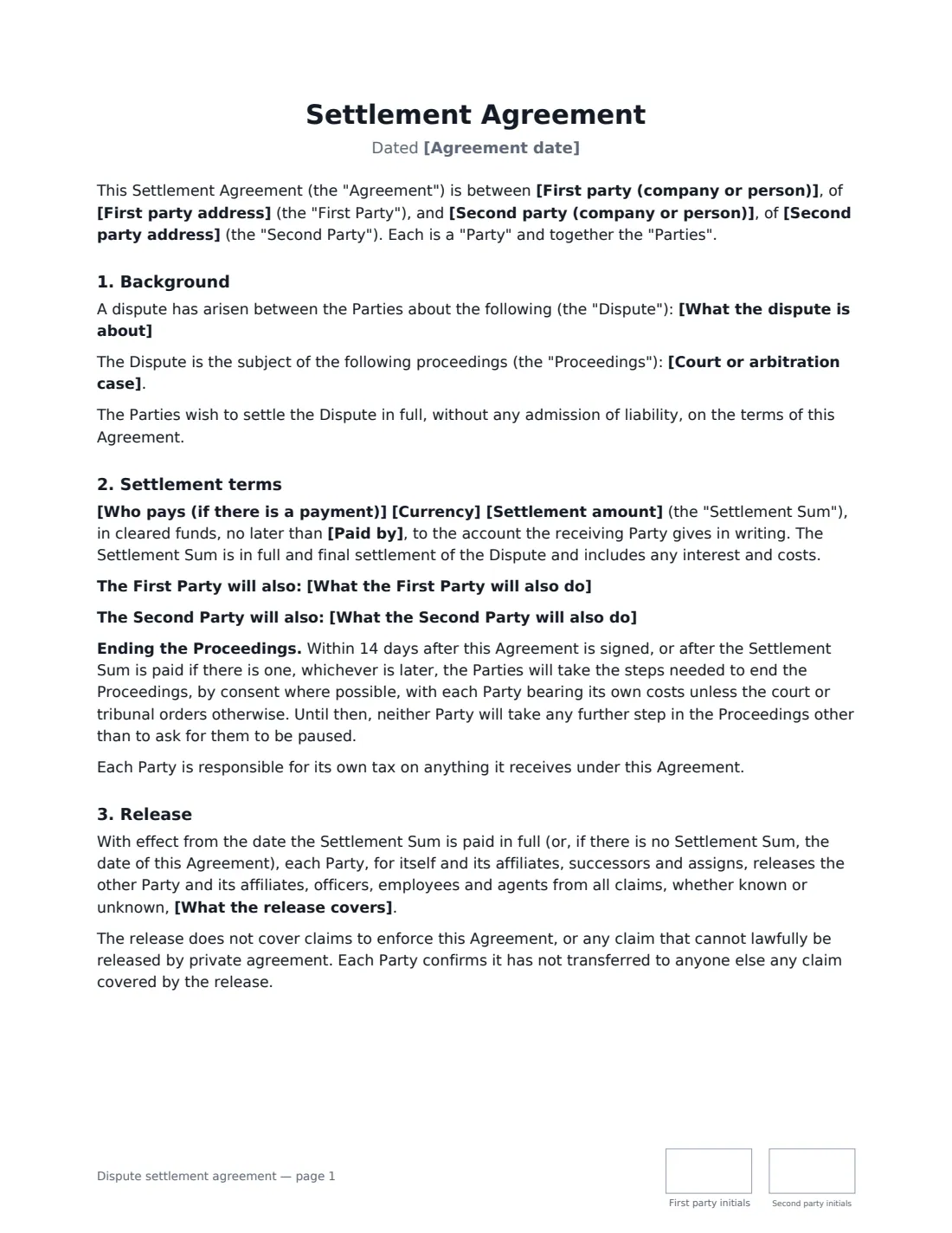
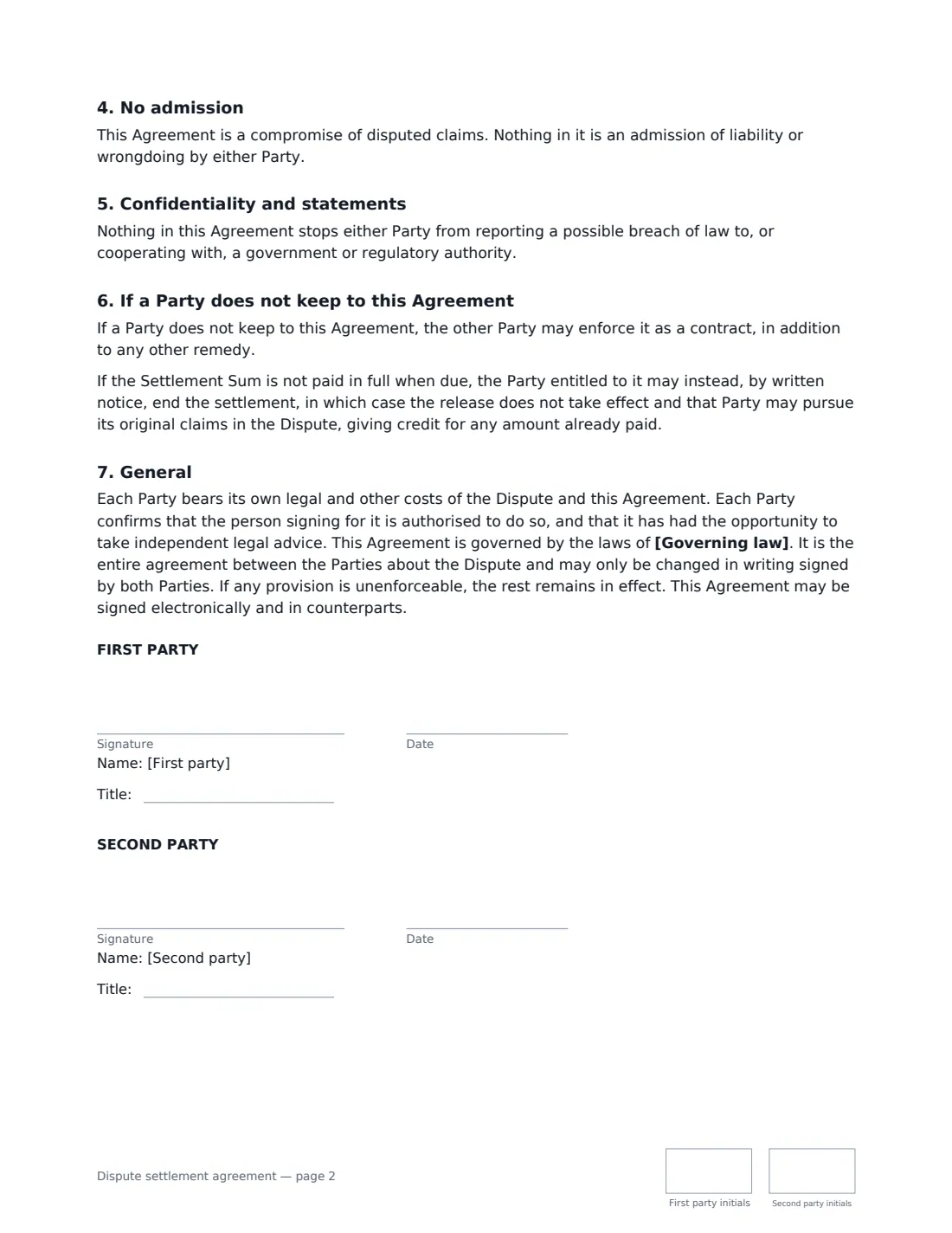
This template records the dispute neutrally and any court or arbitration case, sets out who pays whom, how much and by when (or that no money changes hands), the other promises each party makes, ending the case with each side bearing its own costs, a mutual release — either of claims about this dispute only or of everything between you up to signing — no admission of liability, optional confidentiality and non-disparagement, and what happens if the settlement sum isn't paid. It's for business disputes: for an employee leaving, use the separation agreement, and for a one-way release after an accident or complaint, the general release of claims.
- Best for
- Contract, payment, quality and supplier disputes between businesses
- Signed by
- Both parties to the dispute
- Release
- You choose: claims about this dispute only, or all claims up to signing
- Length
- 2–3 pages, initialled on every page
When to Use a dispute settlement agreement
- A client and a software developer settling a fight over unpaid fees and defective work
- A buyer and supplier resolving a claim about late or faulty goods
- Ending a small-claims or commercial court case on agreed terms
- Two former business partners resolving a disagreement over money owed
- A landlord and commercial tenant settling a dispute over repairs and rent
What You Fill In
17 blanks, then the name and email of each person who signs: first party, second party.
1 The parties
- Agreement date*
- First party (company or person)*
- First party address
- Second party (company or person)*
- Second party address
2 The dispute
- What the dispute is about*
- Court or arbitration case
3 Payment
- Who pays (if there is a payment)* The Second Party will pay the First Party · The First Party will pay the Second Party
- Currency
- Settlement amount
- Paid by
4 Other promises
- What the First Party will also do
- What the Second Party will also do
5 Release and confidentiality
- What the release covers* arising out of or connected with the Dispute · arising out of or connected with the Dispute or any other matter between them up to the date of this Agreement
- Confidentiality* The terms are confidential · The terms are not confidential
- Mutual non-disparagement* Yes · No
- Governing law*
6 Who signs
- First party signature and date, job title, initials on every page
- Second party signature and date, job title, initials on every page
What the dispute settlement agreement Covers
- Background
- Settlement terms
- Release
- No admission
- Confidentiality and statements
- If a Party does not keep to this Agreement
- General
Using the dispute settlement agreement, step by step
1 Describe the dispute
Write a neutral description of what the dispute is about — the contract and the claims on each side. The release covers what you describe, so be complete. Add the case number if proceedings have started.
2 Set the payment and other promises
If money changes hands, choose who pays whom and enter the amount and the date; leave the amount empty and the agreement says no money is payable. Add anything else each side will do, such as returning property or delivering files, with dates.
3 Choose the release, confidentiality and non-disparagement
A release limited to the dispute is the safer default. The wider release ends every claim between you up to the date of the agreement — use it only when you are sure there is nothing else.
Then choose whether the terms are confidential and whether to add a two-way promise not to make false and damaging statements about each other.
4 Send for signature
Add both signers and send. VergeHR places the signature, title and initials boxes. The release takes effect once the settlement sum is paid in full, or on signing if no money changes hands.
Tips Before You Send It
- Take legal advice before signing a release — it gives up claims, including ones you may not know about yet.
- Make sure the person signing for each company has authority to settle.
- If there is a court case, check what the court needs to close it; the template commits both sides to take those steps.
- Put dates on every non-money promise so there's no argument about when it was due.
- Keep the description of the dispute factual and neutral — both sides have to sign it.
Sign It Online In Minutes
- Fill in the blanks. Names, dates and amounts go straight into the agreement — the preview shows exactly where.
- Name who signs. Tick “This is me” for your own part. VergeHR builds the PDF with every signature, date and initials box on the right line, and you can check or move anything before sending.
- Send it. Each signer gets a secure link and signs from any device — no account needed. The signed PDF, with an audit trail and a Certificate of Completion, is filed in Files and emailed to everyone.
Dispute settlement agreement: frequently asked questions
Does settling mean admitting we were wrong?
No. The agreement states that it is a compromise of disputed claims and not an admission of liability or wrongdoing by either party.
What if the other side doesn't pay?
The agreement can be enforced as a contract. If the settlement sum isn't paid in full when due, the party owed it can instead, by written notice, end the settlement — the release then never takes effect — and pursue its original claims, giving credit for anything already paid.
Can we keep the settlement confidential?
Yes, if you choose that option. Either side may still tell its advisers, insurers, auditors and lenders, disclose what the law requires, and say the dispute "has been resolved". Nothing stops a party reporting a possible breach of law to a regulator.
Is an e-signed settlement agreement valid?
In most countries, including the US (ESIGN Act and UETA), the UK, the EU (eIDAS) and Canada, an electronic signature is generally valid for an ordinary commercial contract like this one. VergeHR keeps an audit trail and a Certificate of Completion with the signed PDF as evidence of who signed and when. If a court case is involved, check whether the court needs its own form or order to close it.
Is this template free?
Yes. The template is free to use with the eSignature app in VergeHR, and the people you send it to don't need a VergeHR login to sign.