

What is a non-circumvention agreement?
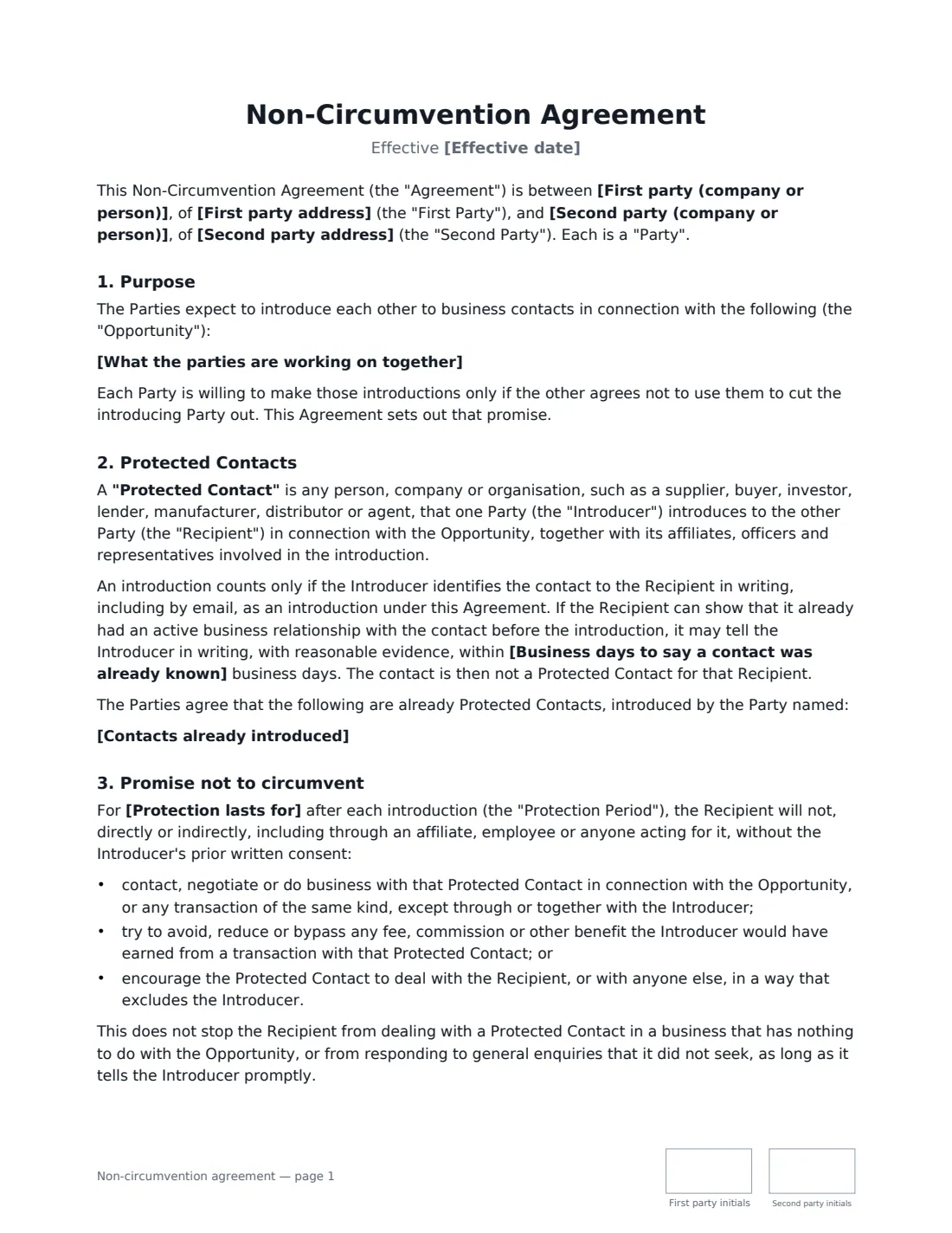
A non-circumvention agreement protects a party who makes introductions. Brokers, sourcing agents, consultants and business partners often bring valuable contacts to a deal, such as a factory, a buyer, an investor or a distributor. They risk the other side taking the contact and dealing with them directly once the introduction is made. This agreement is a promise by each side not to do that for a set period, and to keep the contacts confidential. It is often combined with, or signed alongside, a non-disclosure agreement.
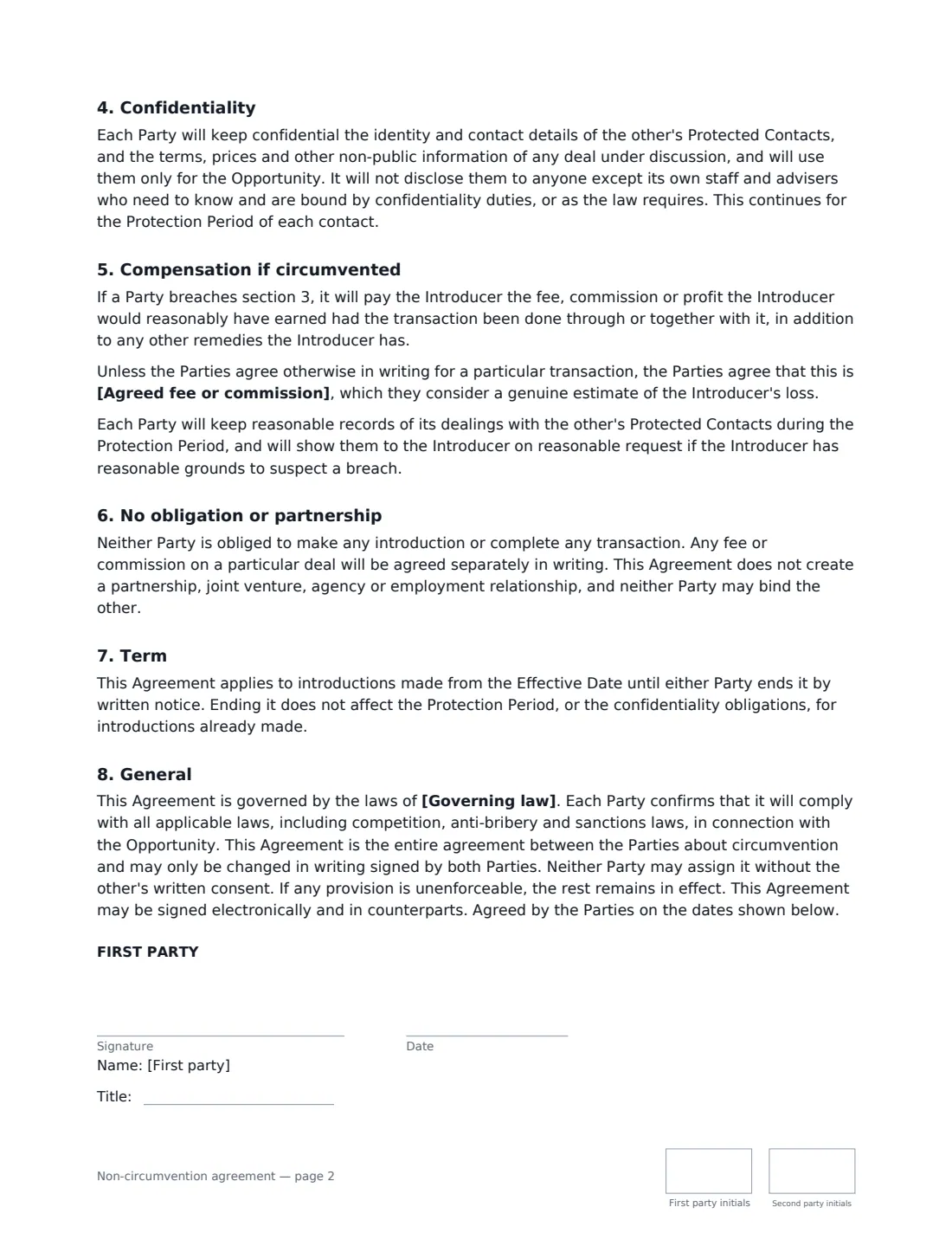
The template is mutual: either party can be the introducer. An introduction counts once it is identified in writing, and the recipient has a few business days to show it already knew the contact. You can list contacts already introduced. For 12, 24 or 36 months after each introduction, the recipient may not deal with the contact on the same kind of business except through or with the introducer. If it does, it pays the introducer what it would have earned, optionally fixed at a fee or commission you enter. The agreement also covers confidentiality of contacts and deal terms, record-keeping, no obligation to do any deal, and compliance with competition, anti-bribery and sanctions laws.
- Best for
- Brokers, sourcing agents, consultants and partners sharing contacts and deals
- Signed by
- Both parties
- Protection
- 12, 24 or 36 months from each written introduction
- Length
- About 2 to 3 pages, initialled on every page
When to Use a non-circumvention agreement
- A sourcing agent introducing overseas manufacturers to a brand
- A commodity or equipment broker connecting a buyer and a seller
- Two companies sharing distributor or reseller contacts for a joint project
- A consultant introducing investors or lenders to a client
- Partners in an import-export venture each bringing their own suppliers and customers
What You Fill In
11 blanks, then the name and email of each person who signs: first party, second party.
1 The parties
- Effective date*
- First party (company or person)*
- First party address
- Second party (company or person)*
- Second party address
2 The opportunity
- What the parties are working on together*
- Contacts already introduced
3 The protection
- Protection lasts for* 12 months · 24 months · 36 months
- Agreed fee or commission
- Business days to say a contact was already known*
- Governing law*
4 Who signs
- First party signature and date, job title, initials on every page
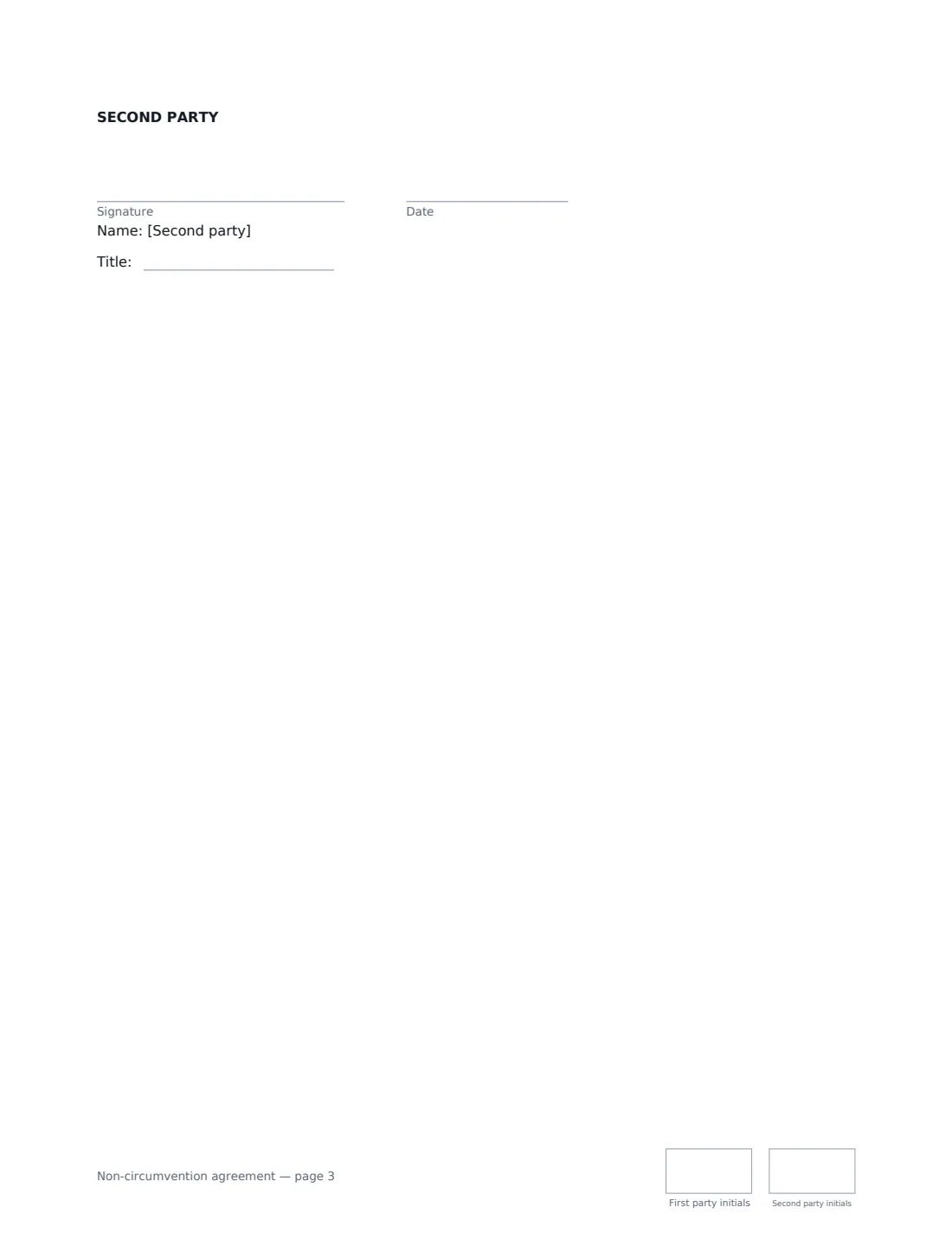
- Second party signature and date, job title, initials on every page
What the non-circumvention agreement Covers
- Purpose
- Protected Contacts
- Promise not to circumvent
- Confidentiality
- Compensation if circumvented
- No obligation or partnership
- Term
- General
Using the non-circumvention agreement, step by step
1 Describe the opportunity
Say what the parties are working on together, such as sourcing a product from a region or selling into a market. The protection covers dealings with introduced contacts on that kind of business.
2 List contacts already introduced
If introductions have already happened, name the contacts and who introduced each one. Future introductions are added by written notice, and email counts.
3 Set the protection
Choose how long each introduction is protected, and how many business days the recipient has to show it already knew a contact. Optionally enter the fee or commission the introducer would normally earn.
4 Send for signature
Add the governing law and the other party's signer, then send. Keep copies of your introduction emails with the signed agreement.
Tips Before You Send It
- Put every introduction in writing and label it as an introduction under the agreement. It is the easiest way to prove who introduced whom.
- Agree your actual commission on each deal separately in writing. This agreement protects the relationship; it does not set your fee.
- If you also share pricing, specifications or other sensitive information, sign a mutual NDA as well.
- Protection that is too long or too broad may be hard to enforce. Match the period to how long a typical deal takes to close.
Sign It Online In Minutes
- Fill in the blanks. Names, dates and amounts go straight into the agreement — the preview shows exactly where.
- Name who signs. Tick “This is me” for your own part. VergeHR builds the PDF with every signature, date and initials box on the right line, and you can check or move anything before sending.
- Send it. Each signer gets a secure link and signs from any device — no account needed. The signed PDF, with an audit trail and a Certificate of Completion, is filed in Files and emailed to everyone.
Non-circumvention agreement: frequently asked questions
What does "circumvent" mean here?
Going around the party who made an introduction: dealing directly with the introduced supplier, buyer or investor on the same kind of business, or arranging things to avoid paying the introducer's fee or commission.
Is a non-circumvention agreement the same as an NCNDA?
An NCNDA combines non-circumvention and non-disclosure in one document. This template includes confidentiality of contacts and deal terms. For broader confidential information, sign a mutual NDA alongside it.
What if we already knew the contact?
The recipient can tell the introducer in writing, with reasonable evidence, within the number of business days you set. The contact is then not protected for that recipient.
Is it binding if signed electronically?
Electronic signatures are generally valid for ordinary commercial contracts in the US (ESIGN Act and UETA), the UK, the EU (eIDAS) and Canada. Whether the compensation clause is enforced as written depends on the governing law.