

What is a employment agreement?
An employment agreement (or contract of employment) sets out the terms both employer and employee are bound by. An offer letter says "we'd like you to join"; the employment agreement says exactly what the job is, what it pays and how it works day to day, what happens to confidential information and the work the employee creates, and how either side can end it. Many countries require employers to give employees written terms, and a signed agreement is the clearest way to do it.
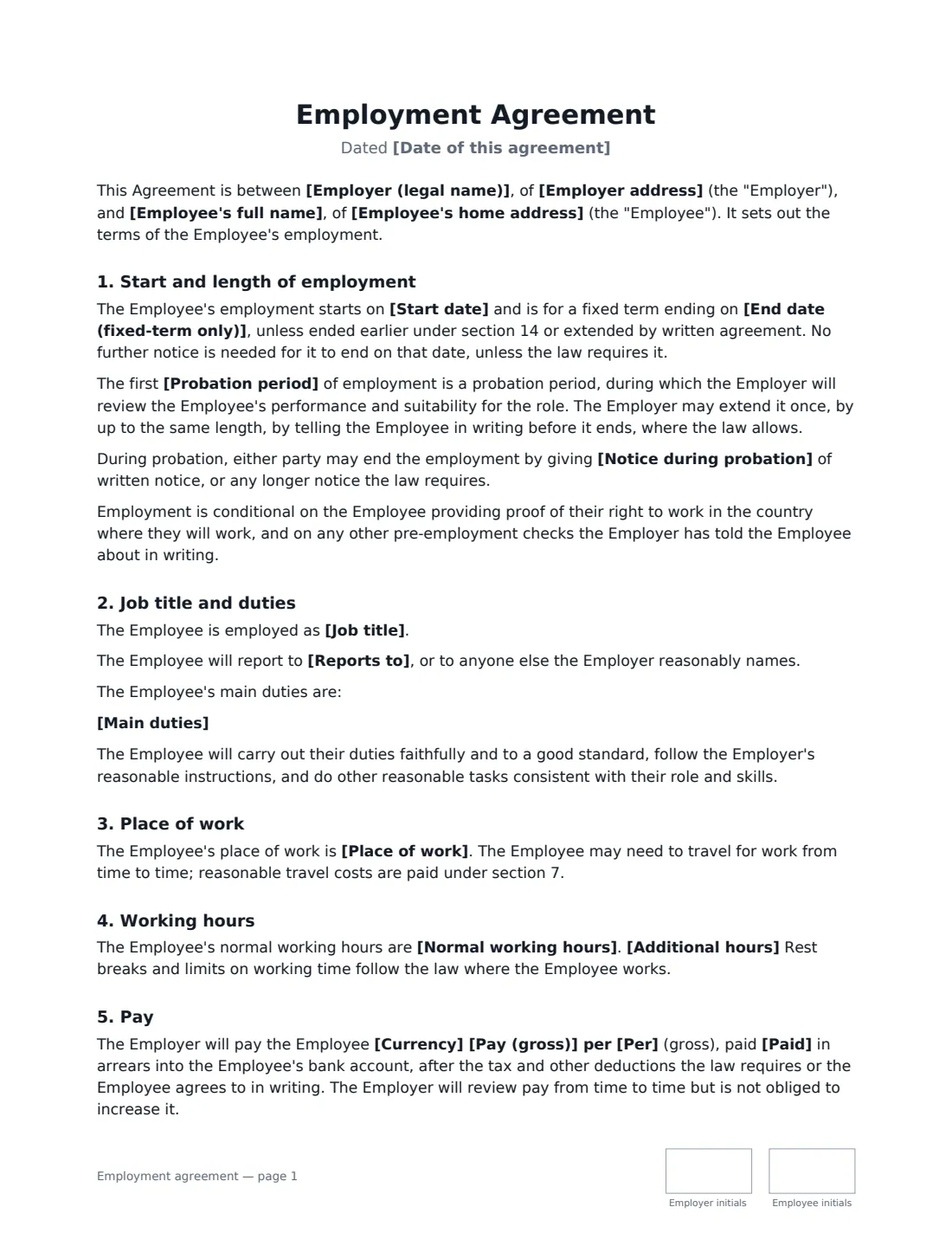
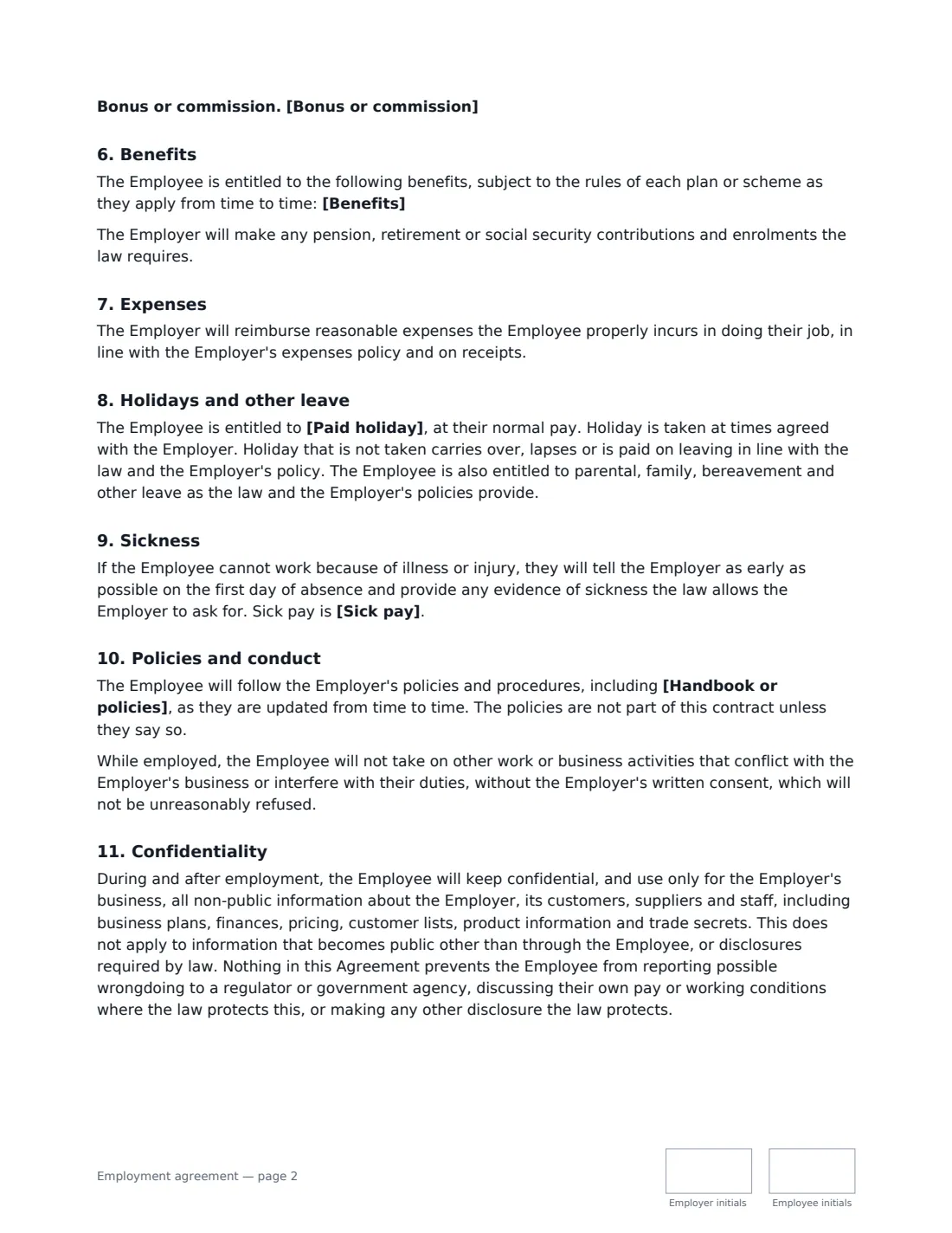
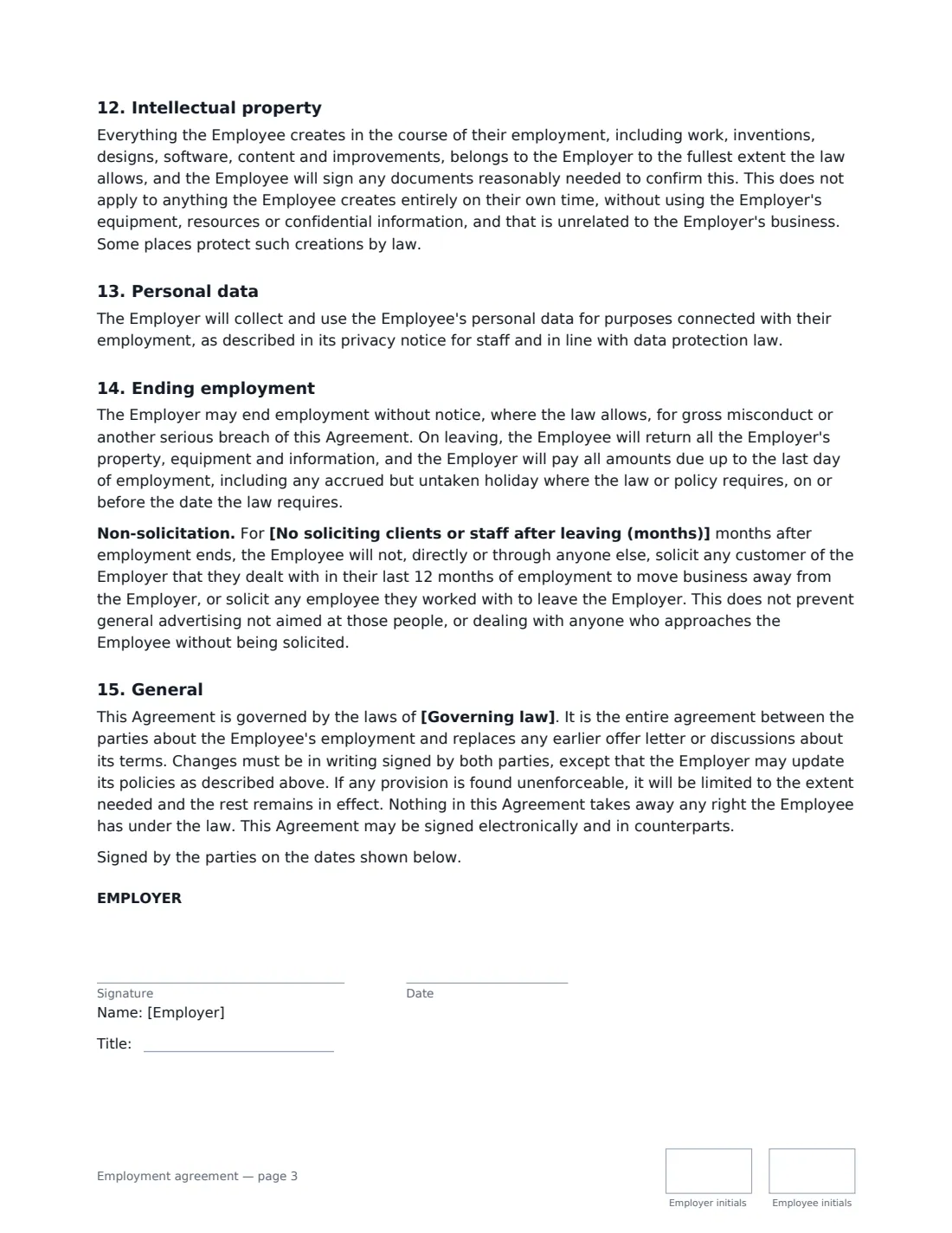
This template covers the start date and whether the job is permanent or fixed-term, an optional probation period, job title, duties and reporting line, place of work, working hours and overtime, pay and pay frequency, bonus or commission, benefits, expenses, holiday, sickness, policies and outside work, confidentiality (with the usual whistleblowing and pay-discussion protections), intellectual property, personal data, notice or at-will employment, an optional non-solicitation clause, and general terms. Wherever the law sets a minimum — holiday, notice, overtime — the agreement defers to it.
- Best for
- Hiring full-time or part-time employees, permanent or fixed-term
- Signed by
- The employer (an authorised manager) and the employee
- Ending employment
- Notice periods you choose, or at-will employment (US only)
- Length
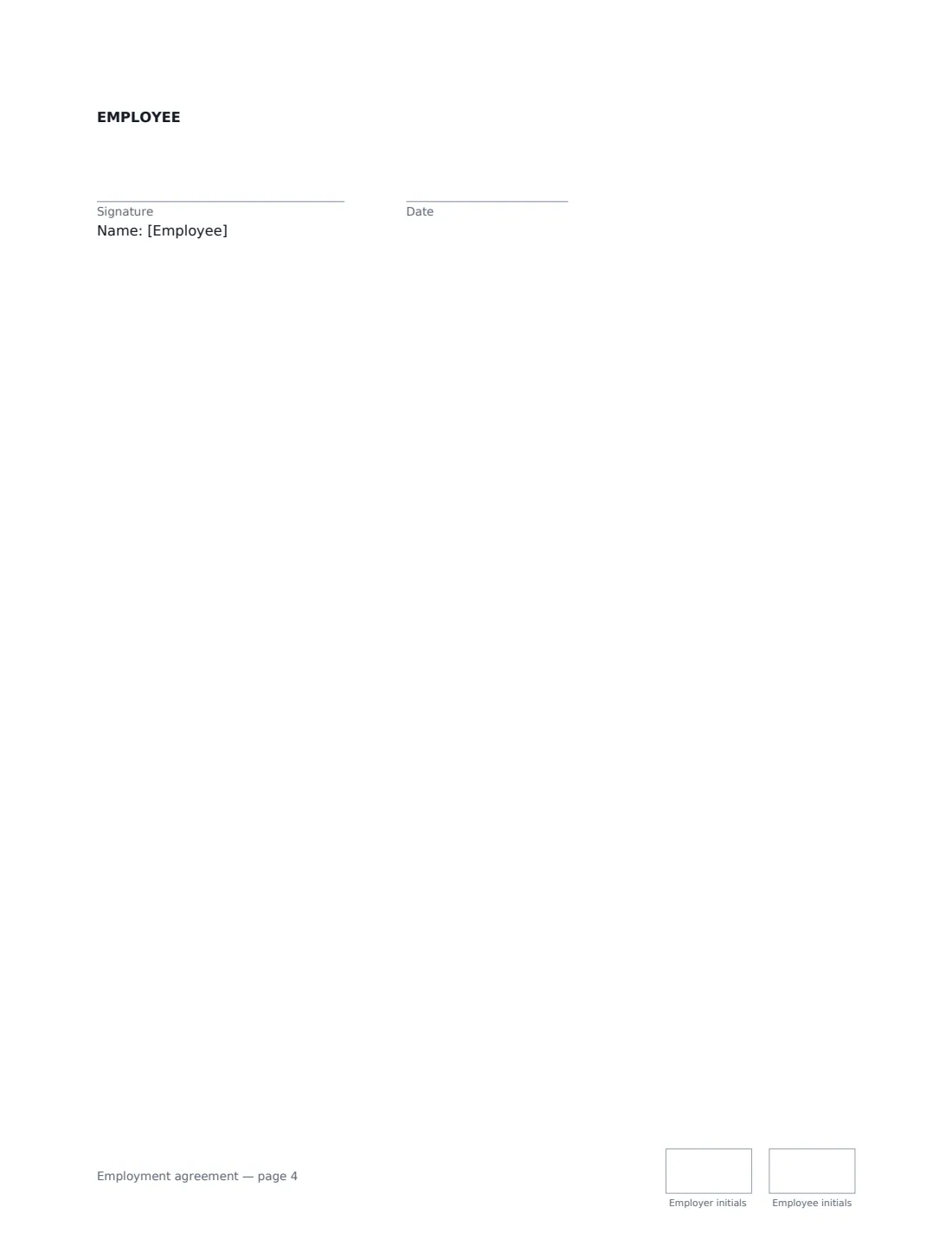
- 3–4 pages, initialled on every page
When to Use a employment agreement
- A small business hiring its first full-time employee
- Replacing an informal arrangement with written terms for existing staff
- Hiring on a fixed-term contract to cover a project or parental leave
- Following up an accepted offer letter with the full contract
- Standardising contracts across a growing team
What You Fill In
29 blanks, then the name and email of each person who signs: employer, employee.
1 The parties
- Date of this agreement*
- Employer (legal name)*
- Employer address
- Employee's full name*
- Employee's home address
2 The job
- Job title*
- Reports to
- Main duties
- Start date*
- End date (fixed-term only)
- Place of work*
- Probation period
- Notice during probation
3 Hours and pay
- Normal working hours*
- Additional hours* Overtime is paid in line with the law and the Employer's overtime policy. · The pay covers reasonable additional hours the role needs from time to time, except where the law requires overtime pay.
- Currency*
- Pay (gross)*
- Per* year · month · week · hour
- Paid* monthly · twice a month · every two weeks · weekly
- Bonus or commission
4 Benefits and leave
- Benefits
- Paid holiday*
- Sick pay*
- Handbook or policies
5 Ending employment
- How employment can be ended* By notice · At will (US only)
- Notice the employer gives
- Notice the employee gives
- No soliciting clients or staff after leaving (months)
- Governing law*
6 Who signs
- Employer signature and date, job title, initials on every page · An owner, director or HR manager authorised to sign for the business.
- Employee signature and date, initials on every page · The person being employed.
What the employment agreement Covers
- Start and length of employment
- Job title and duties
- Place of work
- Working hours
- Pay
- Benefits
- Expenses
- Holidays and other leave
- Sickness
- Policies and conduct
- Confidentiality
- Intellectual property
- Personal data
- Ending employment
- General
Using the employment agreement, step by step
1 Set out the job
Enter the job title, who the employee reports to, a short summary of duties, the start date and place of work. Add an end date only for a fixed-term contract, and an optional probation period with its notice.
2 Enter hours and pay
Describe normal working hours and choose how additional hours are handled. Enter the gross pay, whether it is per year, month, week or hour, and how often it is paid. Add any bonus or commission terms and benefits.
3 Leave and policies
Enter paid holiday — at least the legal minimum where the employee works — and how sick pay works. Name your handbook or policies if you have them; the agreement keeps them outside the contract so you can update them.
4 Decide how employment can end
Choose notice periods for each side, or at-will employment if the job is in a US state that allows it. Add an optional non-solicitation period, then the governing law — usually where the employee works — and send it for signature.
Tips Before You Send It
- Check local minimums before you fill in holiday, notice, probation and pay — the contract can give more than the law, never less.
- At-will employment is a US concept. Outside the US, choose notice periods.
- Send the agreement before the start date so the employee has time to read it and ask questions.
- Pair it with an employee confidentiality and invention assignment agreement for roles with access to sensitive information or product development.
Sign It Online In Minutes
- Fill in the blanks. Names, dates and amounts go straight into the agreement — the preview shows exactly where.
- Name who signs. Tick “This is me” for your own part. VergeHR builds the PDF with every signature, date and initials box on the right line, and you can check or move anything before sending.
- Send it. Each signer gets a secure link and signs from any device — no account needed. The signed PDF, with an audit trail and a Certificate of Completion, is filed in Files and emailed to everyone.
Employment agreement: frequently asked questions
What is the difference between an offer letter and an employment agreement?
An offer letter summarises the main terms of a job offer for the candidate to accept. An employment agreement is the full contract: duties, hours, pay, leave, confidentiality, intellectual property and how employment ends. Many employers send an offer letter first and the agreement to sign before the start date.
Can I use this for a fixed-term contract?
Yes. Enter an end date and the agreement becomes fixed-term, ending on that date unless it is ended earlier or extended in writing. Some places limit how fixed-term contracts can be used or renewed, so check the rules where the employee works.
Does the template include a non-compete?
No. It includes an optional non-solicitation clause covering customers and colleagues for a period you choose. Non-competes are restricted or banned in many places, and non-solicitation promises also vary in how far they can be enforced.
Is an employment contract signed electronically valid?
In most countries, including the US (ESIGN Act and UETA), the UK, the EU (eIDAS) and Canada, electronic signatures are generally valid for employment contracts. VergeHR keeps an audit trail and a Certificate of Completion with the signed PDF, and files a copy in Files.