

What is a iP assignment agreement?
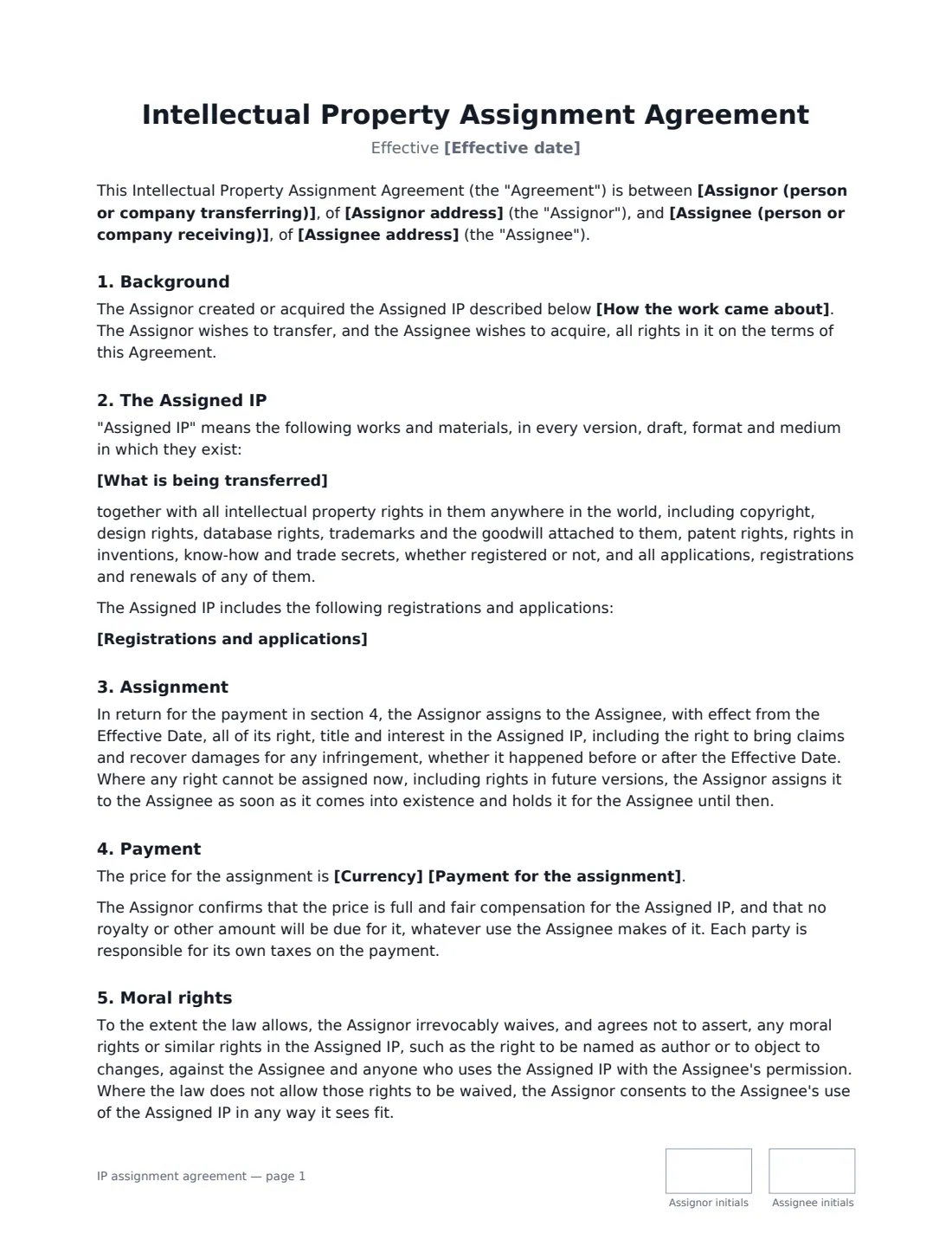
An IP assignment agreement transfers ownership of intellectual property from one person or company (the assignor) to another (the assignee). It is how a business makes sure it owns a logo a freelancer designed, code a founder wrote before the company existed, or content bought from another business. Paying for work does not always mean owning the copyright in it, and in many countries a transfer of copyright must be in writing and signed by the owner.
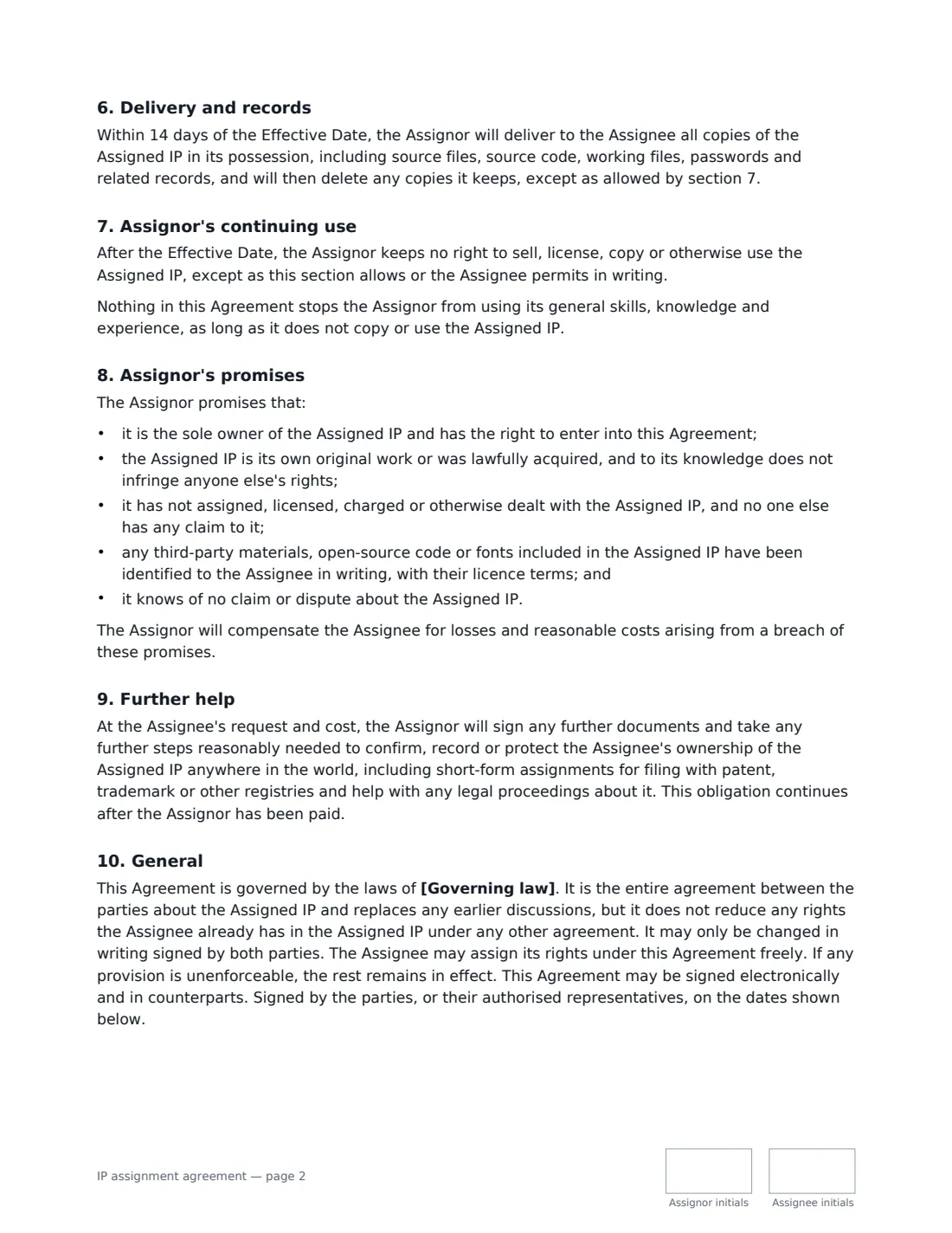
You describe exactly what is transferred and can list registered trademarks, patents or domain names by number. The template assigns every intellectual property right in that work worldwide, including the right to sue for past infringement, and covers future versions. It records the price and when it is paid (or that it has already been paid), and includes a waiver of moral rights as far as the law allows. The assignor delivers all source and working files and promises that it owns the work and has not licensed it elsewhere. It will also sign any short-form documents a registry needs. You can let the assignor keep showing the work in a portfolio, or not.
- Best for
- Buying a logo, code, design, content or a trademark; tidying up ownership before investment
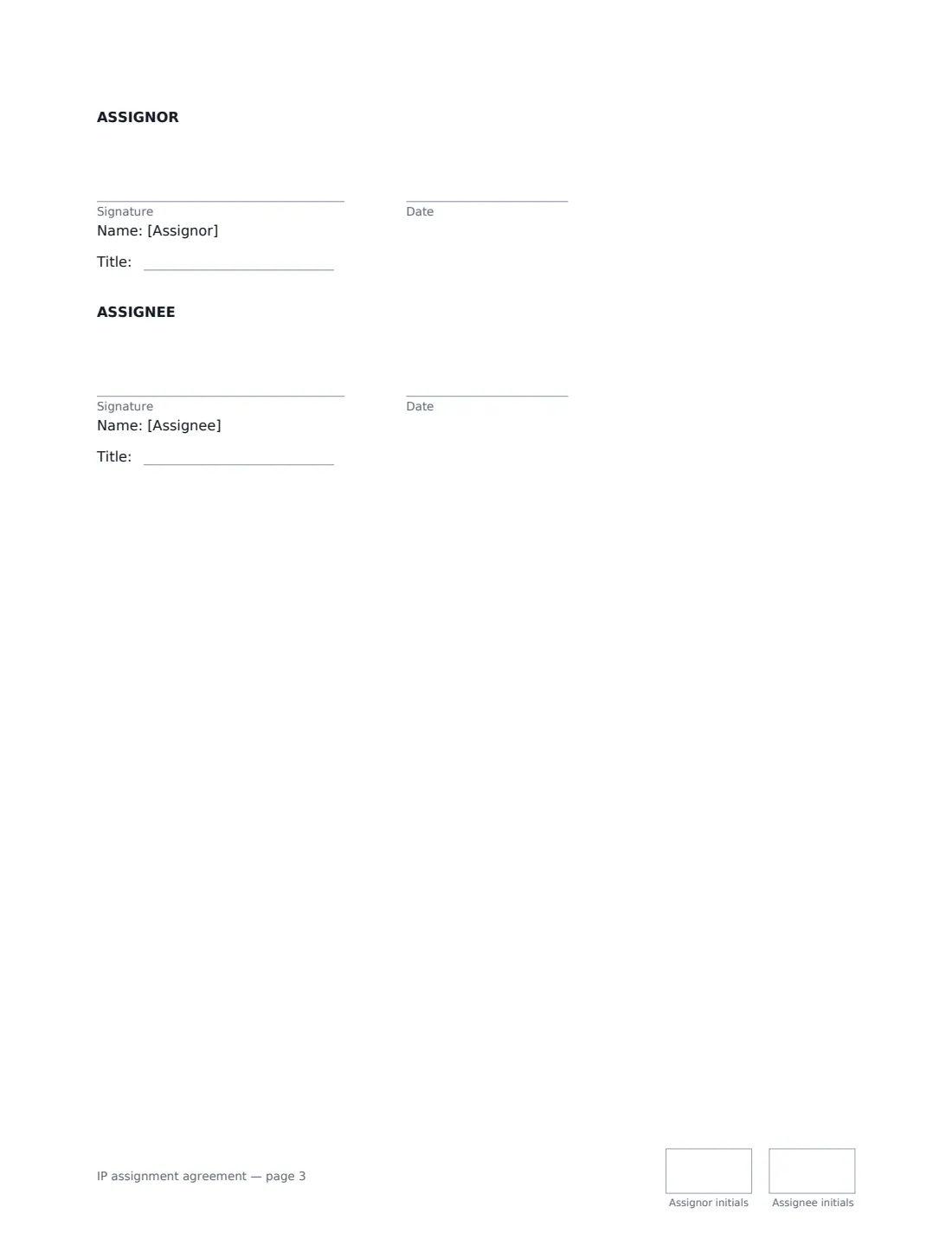
- Signed by
- The assignor (who transfers) and the assignee (who receives)
- Payment
- Any amount, including a nominal 1 where the work was already paid for
- Length
- About 3 pages, initialled on every page
When to Use a iP assignment agreement
- A freelancer transfers the copyright in a logo or website design to the client
- A founder assigns code or designs created before the company was formed
- A business buys a domain name, trademark or content library from another business
- Confirming ownership of work done under an old contract that had no IP clause
- Investors ask you to show the company owns its core IP before closing a round
What You Fill In
13 blanks, then the name and email of each person who signs: assignor, assignee.
1 The parties
- Effective date*
- Assignor (person or company transferring)*
- Assignor address
- Assignee (person or company receiving)*
- Assignee address
2 The intellectual property
- What is being transferred*
- How the work came about
- Registrations and applications
3 Payment
- Currency*
- Payment for the assignment*
- When it is paid* within 14 days after both parties sign · within 30 days after both parties sign · on signing · already paid in full
4 Other terms
- Let the Assignor show the work in a portfolio?* Yes · No
- Governing law*
5 Who signs
- Assignor signature and date, job title, initials on every page · The person or company transferring the intellectual property.
- Assignee signature and date, job title, initials on every page · The person or company receiving ownership.
What the iP assignment agreement Covers
- Background
- The Assigned IP
- Assignment
- Payment
- Moral rights
- Delivery and records
- Assignor's continuing use
- Assignor's promises
- Further help
- General
Using the iP assignment agreement, step by step
1 Describe what is transferred
Be precise: titles, versions, file names, repositories or creation dates. A stranger reading it should be able to tell what is included. Optionally add how the work came about and any registrations or applications by number.
2 Set the price and timing
Enter the price and choose when it is paid: on signing, within 14 or 30 days, or already paid in full. For work paid for under an earlier contract, a nominal payment of 1 is common.
3 Decide on portfolio use
Choose whether the assignor may keep displaying the work in a portfolio. Designers and developers often ask for this, and it does not allow any commercial use.
4 Add the governing law and send
Name the governing law, add the other party's signer and send. After signing, record the change of owner with any trademark, patent or domain registry, which usually needs its own filing.
Tips Before You Send It
- Registries such as trademark and patent offices generally need their own filing to record a new owner. The assignor agrees to sign any short-form assignment needed.
- Moral rights, such as the right to be named as author, cannot be waived everywhere. The template waives them where the law allows and otherwise records consent.
- Ask the assignor to list any third-party code, fonts or stock images in the work. The template requires this, and those parts stay under their own licences.
- For work not yet created, put the IP clause in the contractor or employment agreement too. This template is best for work that already exists.
Sign It Online In Minutes
- Fill in the blanks. Names, dates and amounts go straight into the agreement — the preview shows exactly where.
- Name who signs. Tick “This is me” for your own part. VergeHR builds the PDF with every signature, date and initials box on the right line, and you can check or move anything before sending.
- Send it. Each signer gets a secure link and signs from any device — no account needed. The signed PDF, with an audit trail and a Certificate of Completion, is filed in Files and emailed to everyone.
IP assignment agreement: frequently asked questions
Doesn't paying for the work mean I own it?
Not always. Under many copyright laws the creator owns the work unless it was made by an employee in the course of employment, or ownership is transferred in writing. An assignment removes the doubt.
What is the difference between an assignment and a licence?
An assignment transfers ownership outright, so the assignee can use, license or sell the IP. A licence only gives permission to use it while the owner keeps it. For contributors to a software project, a contributor license agreement is the usual licence route.
Can an IP assignment be signed electronically?
Generally yes. Electronic signatures are valid for ordinary commercial contracts in the US (ESIGN Act and UETA), the UK, the EU (eIDAS) and Canada. Some registries or countries have their own formality rules for recording assignments, so check before filing.
Does the assignor keep any rights?
Only what you choose. The assignor can keep a portfolio licence to display the work, and keeps its general skills and know-how. It gives up every other right, including the right to sell or license the work.