

What is a contributor license agreement?
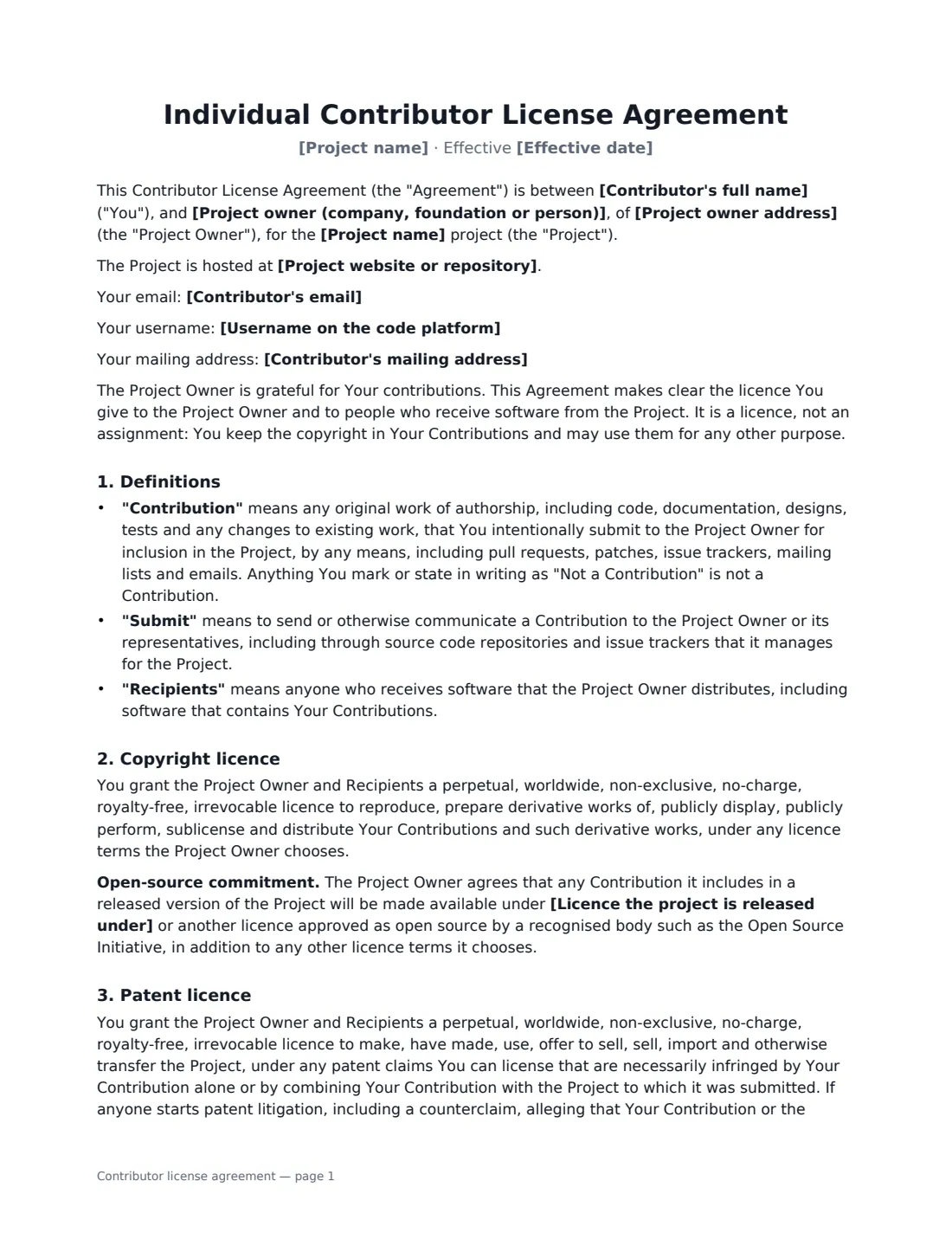
A contributor license agreement (CLA) is signed by people who contribute code, documentation or other work to a software project. It gives the project owner, whether a company, a foundation or an individual maintainer, a clear written licence to use, change, relicense and distribute each contribution. It also gives a patent licence so a contributor cannot later claim the project infringes their patents. Many open-source and commercial projects ask for one before accepting a first pull request.
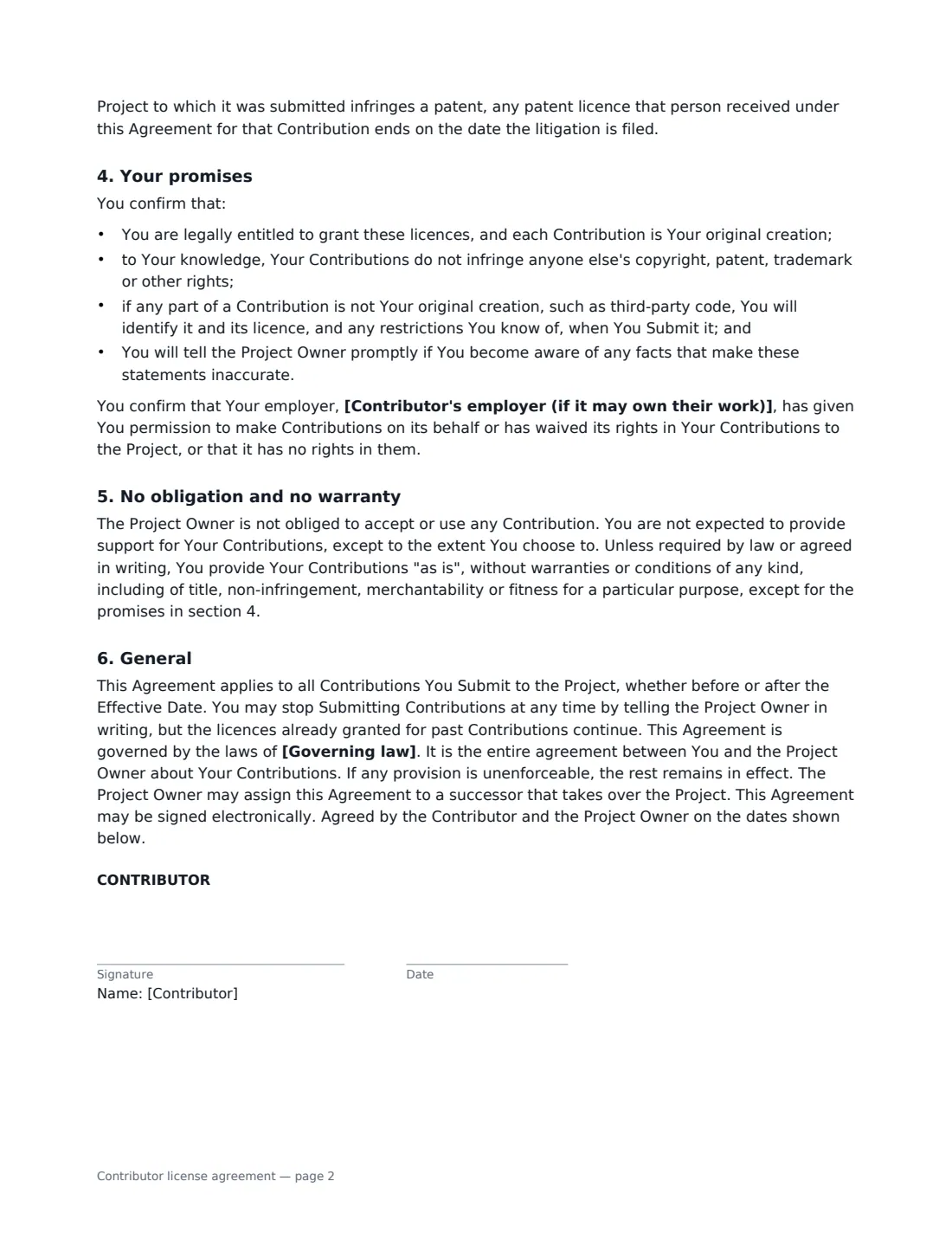
This is an individual CLA modelled on the widely used licence-style approach: it is a licence, not an assignment, so the contributor keeps ownership and can reuse their work elsewhere. It covers what counts as a contribution (anything submitted by pull request, patch, issue tracker or email, unless marked "Not a Contribution"), a perpetual copyright licence, a patent licence that ends for anyone who sues over the project, and the contributor's promises about originality and third-party code. It also covers employer permission, and a no-warranty clause. Optionally, the project owner can promise to keep accepted contributions available under your open-source licence.
- Best for
- Open-source and source-available projects, company-run repositories, foundations
- Signed by
- The contributor and the project owner
- Ownership
- The contributor keeps copyright; the project gets a broad, perpetual licence
- Length
- About 2 to 3 pages
When to Use a contributor license agreement
- A company that runs an open-source project and wants clear rights before merging outside contributions
- A maintainer who may later want to relicense the project or offer a commercial edition
- A foundation onboarding a new regular contributor
- A contributor whose employer needs to see what rights they are giving the project
- Replacing an informal "by submitting, you agree" note in a CONTRIBUTING file with a signed record
What You Fill In
12 blanks, then the name and email of each person who signs: contributor, project owner.
1 The project
- Effective date*
- Project owner (company, foundation or person)*
- Project owner address
- Project name*
- Project website or repository
- Licence the project is released under
2 The contributor
- Contributor's full name*
- Contributor's email
- Username on the code platform
- Contributor's mailing address
- Contributor's employer (if it may own their work)
- Governing law*
3 Who signs
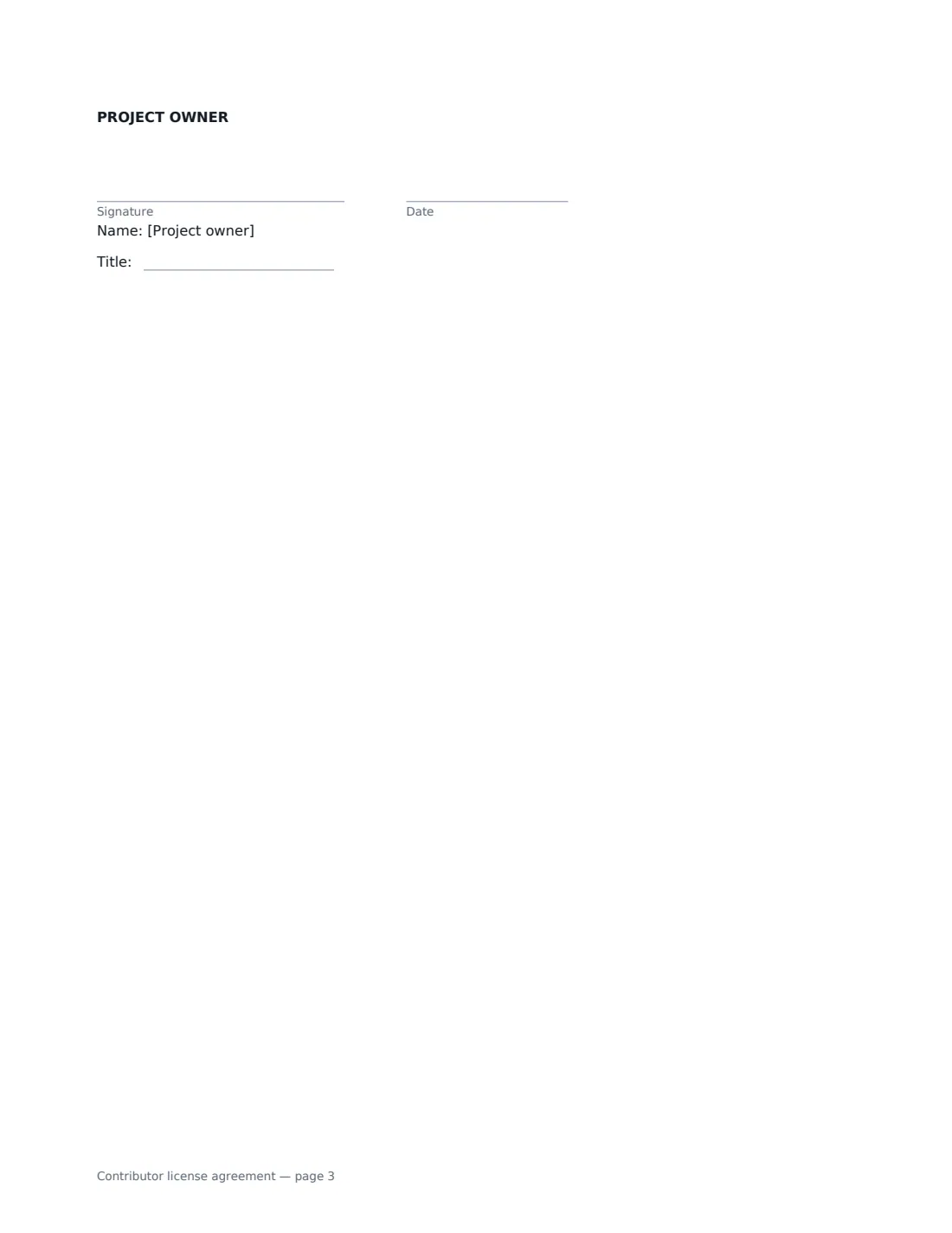
- Contributor signature and date · The person submitting code, documentation or other contributions.
- Project owner signature and date, job title · The company, foundation or person who runs the project and receives the licence.
What the contributor license agreement Covers
- Definitions
- Copyright licence
- Patent licence
- Your promises
- No obligation and no warranty
- General
Using the contributor license agreement, step by step
1 Name the project and owner
Enter the project owner, the project name and, optionally, its repository or website. If you want to reassure contributors, add the licence the project is released under. The owner then promises to keep accepted contributions available under it or another open-source licence.
2 Add the contributor's details
Enter the contributor's name and, optionally, email, username on the code platform and mailing address. The username helps you match pull requests to the signed CLA.
3 Deal with employer rights
If the contributor's employer may own code they write, name the employer. The contributor confirms the employer has given permission or waived its rights. If not named, the contributor still confirms they have any permission needed.
4 Send for signature
Choose the governing law, send it to the contributor and sign as project owner. Keep the signed PDF with your records of who has signed. The CLA covers all their past and future contributions to the project.
Tips Before You Send It
- Link to the signing process from your CONTRIBUTING file and check new pull requests against your list of signed contributors.
- If a contributor writes code as part of their job, a corporate CLA signed by the employer may be needed as well. This template is for individuals.
- Some contributors prefer a Developer Certificate of Origin (a sign-off line in each commit) to a CLA. Decide which your project uses and say so clearly.
- The optional open-source commitment answers the common worry that a CLA lets the owner take contributions closed-source.
Sign It Online In Minutes
- Fill in the blanks. Names, dates and amounts go straight into the agreement — the preview shows exactly where.
- Name who signs. Tick “This is me” for your own part. VergeHR builds the PDF with every signature, date box on the right line, and you can check or move anything before sending.
- Send it. Each signer gets a secure link and signs from any device — no account needed. The signed PDF, with an audit trail and a Certificate of Completion, is filed in Files and emailed to everyone.
Contributor license agreement: frequently asked questions
Does the contributor give up ownership of their code?
No. This is a licence, not an assignment. The contributor keeps the copyright and can use their contribution for anything else. The project owner gets a broad, irrevocable licence to use and distribute it.
Why include a patent licence?
Without one, a contributor who holds a patent covering their contribution could later claim that users of the project infringe it. The patent licence prevents this, and it ends for anyone who starts patent litigation over the project.
What if I need the contributor to transfer ownership?
Use an IP assignment agreement instead. Some projects choose assignment so they can enforce copyright centrally, but many contributors are more comfortable with a licence.
Is a CLA signed electronically valid?
Electronic signatures are generally valid for ordinary agreements like a CLA in the US (ESIGN Act and UETA), the UK, the EU (eIDAS) and Canada. VergeHR keeps an audit trail and a Certificate of Completion with each signed copy.