

What is Form 1310?
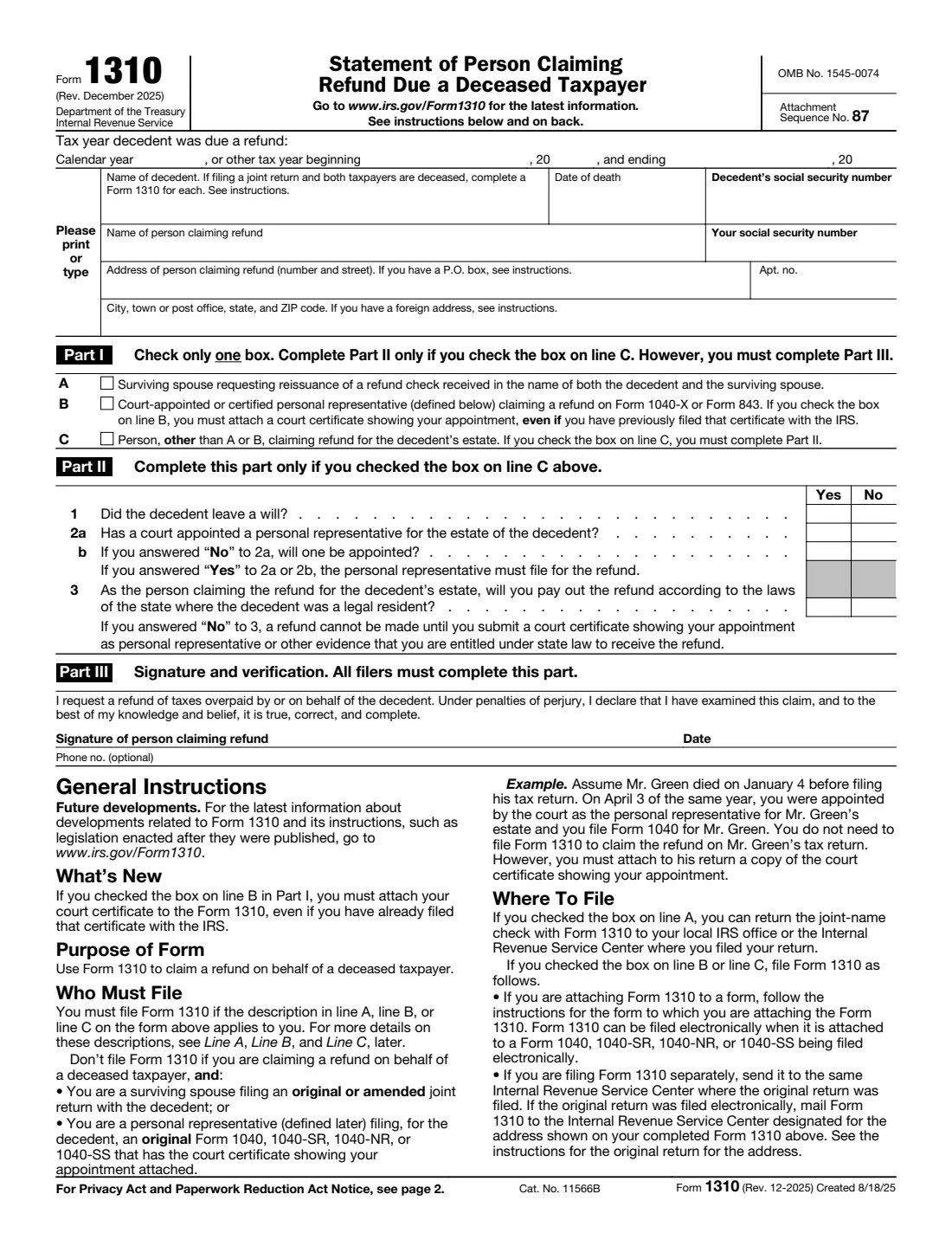
Form 1310, Statement of Person Claiming Refund Due a Deceased Taxpayer, tells the Internal Revenue Service who is entitled to a refund owed to a person who has died. It's short — one page — but which of its three boxes you check decides what else you must do. The current edition is Rev. December 2025.
Line A is for a surviving spouse who received a refund check made out to both spouses and wants it reissued in their own name. Line B is for a court-appointed or certified personal representative claiming the refund on Form 1040-X or Form 843, who must attach the court certificate. Line C is for anyone else — often an heir when no representative has been appointed — who also answers the questions in Part II and must keep proof of death.
Many people don't need it at all: a surviving spouse filing a joint return with the decedent, or a personal representative filing the original Form 1040 with the court certificate attached, doesn't file Form 1310. VergeHR walks you through each question, prints your answers into the IRS's own PDF and saves it in Files. You then attach it to the decedent's return or send it yourself — VergeHR never submits anything to the IRS.
- Who fills it
- The person claiming the refund: a surviving spouse (line A), a personal representative (line B) or another person claiming for the estate (line C).
- Sent to
- Usually attached to the decedent's final return; on its own, to the service center where the original return was filed. Line A: with the voided check to a local IRS office or that service center.
- E-filing
- Can be filed electronically when attached to an e-filed Form 1040, 1040-SR, 1040-NR or 1040-SS.
- Signatures
- The person claiming the refund signs under penalties of perjury (Part III).
- Edition
- Rev. December 2025
- Agency
- Internal Revenue Service (IRS), Department of the Treasury
Who needs to fill out Form 1310?
- A surviving spouse holding a refund check made out to both spouses, who wants it reissued in their own name.
- A court-appointed or certified executor or administrator claiming the decedent's refund on an amended return (Form 1040-X) or Form 843.
- An heir or other person claiming the refund for the estate when no personal representative has been or will be appointed.
- Families filing a deceased relative's final return who aren't a joint-filing spouse or a court-appointed representative.
When to Use Form 1310
- When filing the decedent's final return and you're neither a joint-filing surviving spouse nor a personal representative attaching the court certificate.
- When a joint refund check arrives after a spouse's death and needs reissuing in the survivor's name.
- When a personal representative files an amended return or Form 843 to claim a refund.
- If both spouses on a joint return have died: one Form 1310 for each, both attached to the return.
What You Need Before You Start
- The tax year the refund is for (calendar year, or the start and end of a fiscal year).
- The decedent's name, date of death and social security number.
- Your name, social security number and address.
- Line A: the joint-name refund check, marked "VOID", and a written request for reissuance.
- Line B: a copy of the court certificate showing your appointment.
- Line C: proof of death — a copy of the death certificate or a formal government notification — kept for your records, not attached.
What’s On Form 1310
The 2025 edition has 2 pages. VergeHR asks for it in 6 parts, and it is signed by Person claiming the refund:
- Tax year the refund is forPerson claiming the refund
- The person who diedPerson claiming the refund
- You — the person claiming the refundPerson claiming the refund
- Part I: Who you arePerson claiming the refund
- Part II: Questions for line CPerson claiming the refund
- Part III: Signature and verificationPerson claiming the refund
How to fill out Form 1310, step by step
1 Tax year
Enter the calendar year the refund is for, or the dates a fiscal tax year began and ended.
2 Decedent and claimant
Enter the decedent's name, date of death and SSN, then your own name, SSN and address. Use a P.O. box only if the post office doesn't deliver to your home. For a foreign address, give the city, province or state, and country, and don't abbreviate the country name.
3 Part I, line A: Surviving spouse
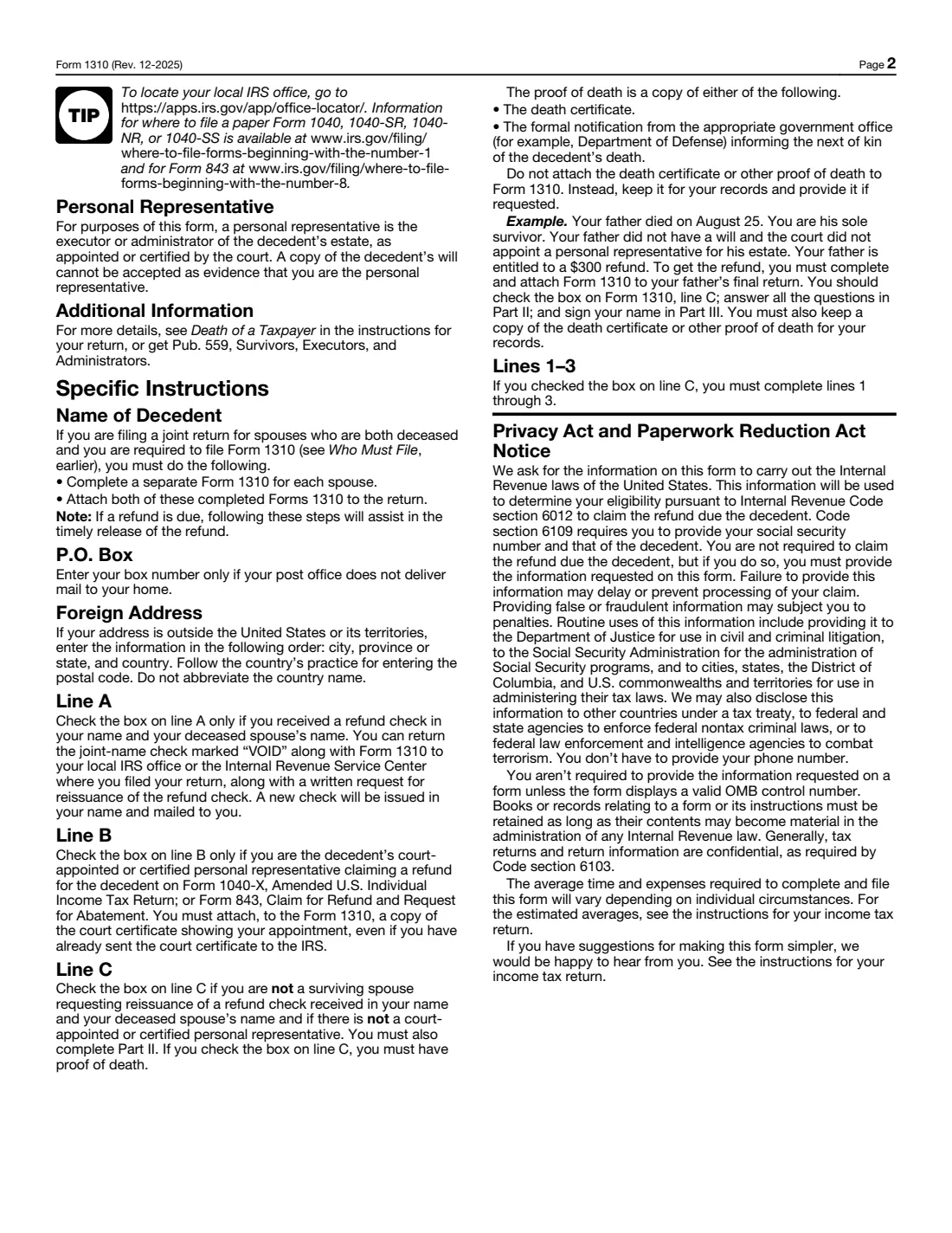
Check A only if you received a refund check in your name and your deceased spouse's name. Return the check marked "VOID" with Form 1310 and a written request for reissuance to your local IRS office or the service center where you filed. A new check is issued in your name.
4 Part I, line B: Personal representative
Check B if you're the court-appointed or certified personal representative (the executor or administrator) claiming the refund on Form 1040-X or Form 843. Attach a copy of the court certificate showing your appointment, even if you've already sent it. A copy of the will isn't accepted as evidence.
5 Part I, line C: Anyone else
Check C if you're neither of the above and there's no court-appointed or certified personal representative. You must complete Part II and have proof of death, which you keep rather than attach.
6 Part II: Questions for line C
Say whether the decedent left a will, whether a court has appointed a personal representative (and if not, whether one will be), and whether you'll pay out the refund under the laws of the state where the decedent lived. If a representative has been or will be appointed, the representative must file for the refund. If you answer No to question 3, no refund is made until you submit a court certificate or other evidence you're entitled to it under state law.
7 Part III: Signature
Sign and date the statement under penalties of perjury. A phone number is optional.
Common Mistakes to Avoid
- Filing Form 1310 when it isn't needed — a surviving spouse filing a joint return, or a personal representative filing the original return with the court certificate attached.
- Checking more than one box in Part I.
- On line B, not attaching the court certificate, or attaching a copy of the will instead.
- On line C, skipping Part II.
- Attaching the death certificate — for line C keep it, and provide it only if the IRS asks.
- Using one Form 1310 when both spouses on a joint return have died.
After You Fill It Out
Print the PDF and sign it. If it goes with a return, attach it to that return (it can be e-filed with a Form 1040, 1040-SR, 1040-NR or 1040-SS). If you're filing it separately, send it to the service center where the original return was filed. For line A, send it with the voided joint-name check and your written request.
Keep the proof of death and any court certificate with the estate's papers. VergeHR stores the completed form in Files, so you can file it beside the decedent's final return and other estate documents.
Pub. 559, Survivors, Executors, and Administrators, has more on the tax side of settling an estate.
Fill Out Form 1310 Online with VergeHR
- Pick the employee. Choose an employee and VergeHR fills in their name, date of birth, email and other details it already knows.
- Answer plain-language questions. One part of the form at a time, with the official help text beside each question — 25 fields in all. Your answers save as you go.
- Check the live preview. Watch your answers land on the real Internal Revenue Service (IRS) form, and let VergeHR do any worksheet arithmetic.
- Generate the official PDF. VergeHR prints your answers into the agency’s own PDF and files it with that employee’s documents. Sign it, or send it for e-signature.
VergeHR fills the form — it never files or submits anything for you. Deliver the finished form to whoever asked for it, the way the form’s instructions say.
Start Form 1310 Now — It’s FreeForm 1310: frequently asked questions
Can I fill out Form 1310 online?
Yes — with VergeHR you answer guided questions and the answers are printed into the official IRS PDF, saved in Files. You then sign it and attach it to the return or send it yourself.
Does a surviving spouse need Form 1310?
Not when filing an original or amended joint return with the decedent. A surviving spouse uses it (line A) to have a joint-name refund check reissued in their own name.
Does the executor need Form 1310?
Not when the court-appointed personal representative files the decedent's original Form 1040 with the court certificate attached. The representative does use it (line B) to claim a refund on Form 1040-X or Form 843.
Do I attach the death certificate?
No. The instructions say not to attach the death certificate or other proof of death — keep it and provide it if the IRS asks.
Can Form 1310 be e-filed?
Yes, when it's attached to a Form 1040, 1040-SR, 1040-NR or 1040-SS that's filed electronically.
What if both spouses on a joint return have died?
Complete a separate Form 1310 for each spouse and attach both to the return.
Official Sources
- Blank form (PDF), published by Internal Revenue Service (IRS): https://www.irs.gov/pub/irs-pdf/f1310.pdf
- Official instructions and guidance: https://www.irs.gov/forms-pubs/about-form-1310
- Edition shown on this page: Rev. December 2025 (checked 2026-09-28).
VergeHR is not affiliated with or endorsed by Internal Revenue Service (IRS) or any government. This page explains the form in general terms and is not legal, tax or immigration advice. Always read the official instructions, and check that you are using the edition the recipient accepts. Page last reviewed 2026-09-28.