

What is Form 56?
Form 56, Notice Concerning Fiduciary Relationship, notifies the Internal Revenue Service that a fiduciary relationship has been created or has ended. A fiduciary is someone acting on behalf of another person: the executor or administrator of a deceased person's estate, a guardian or conservator, a trustee, a receiver or an assignee for the benefit of creditors. Once the IRS has the notice, it treats the fiduciary as if they were the taxpayer — with both the right and the responsibility to file returns and pay tax. The current edition is Rev. June 2026.
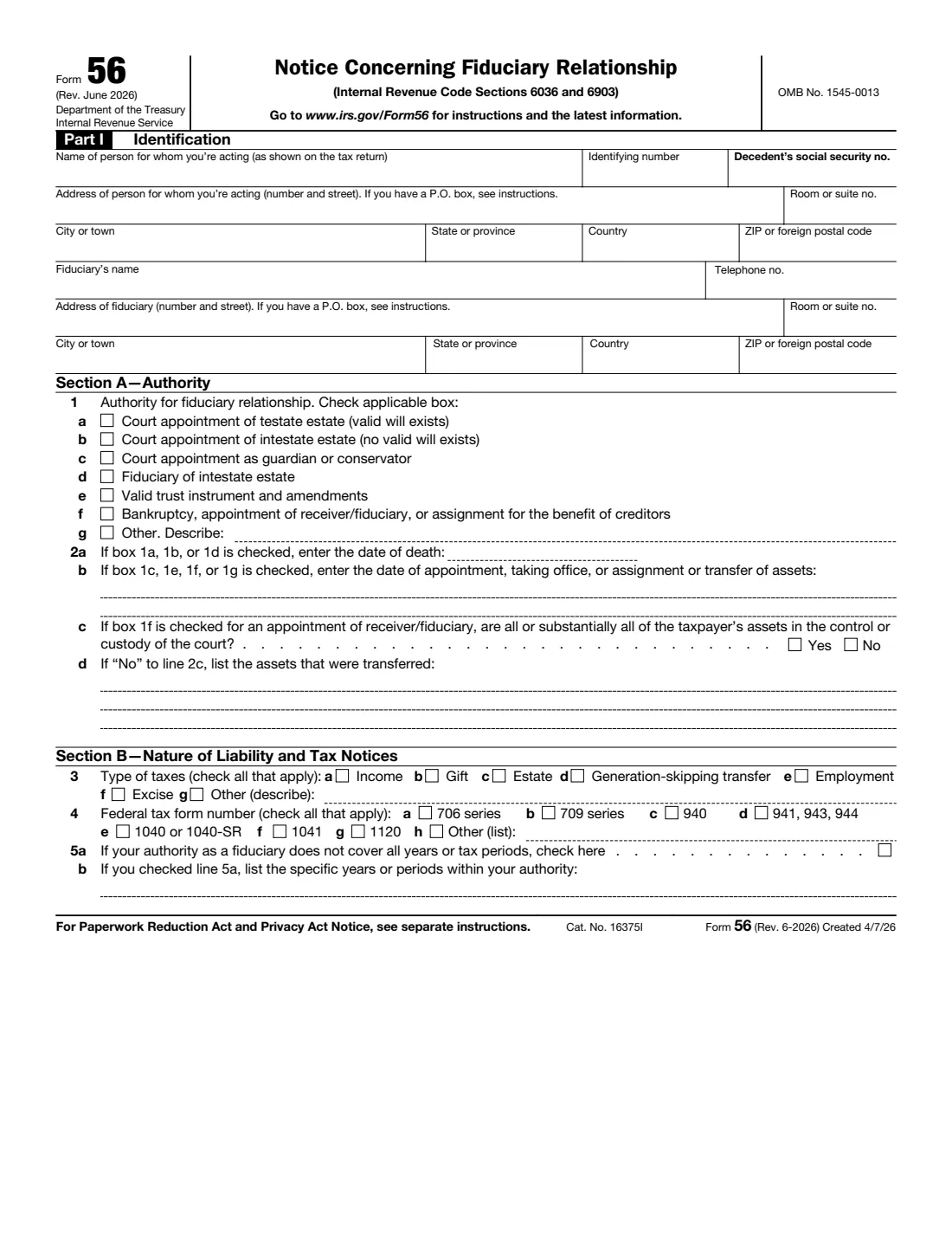
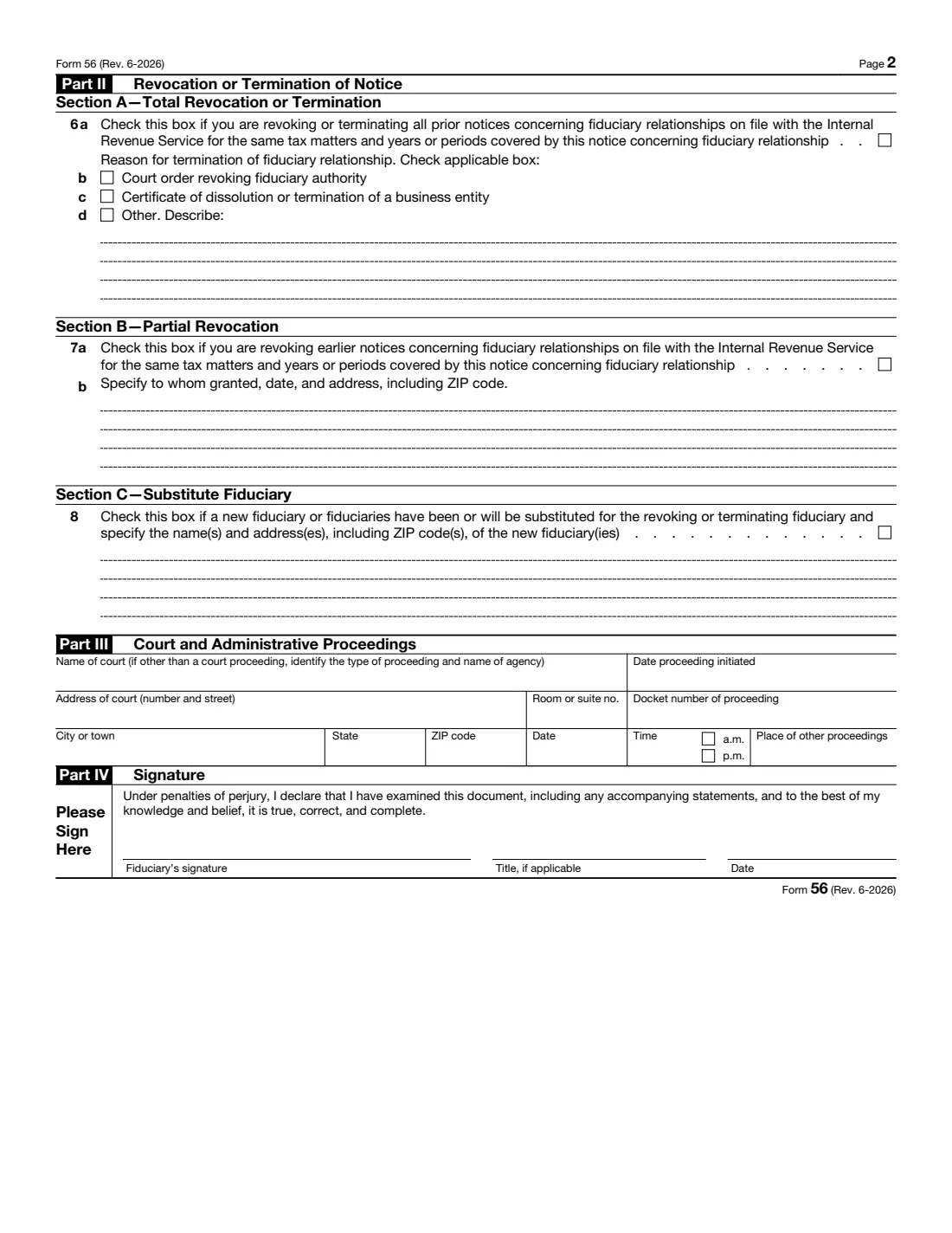
Part I identifies the person you act for and you, then asks what gives you authority (a court appointment, a trust instrument and so on) and which taxes, forms and years are covered. Part II is for revoking or ending an earlier notice, Part III for court proceedings other than bankruptcy, and Part IV is your signature.
Form 56 is not a power of attorney — an authorized representative such as an accountant uses Form 2848 — and it can't be used to change an address (use Form 8822). VergeHR walks you through each part, prints your answers into the IRS's own PDF and saves it in Files; you sign and mail it yourself. VergeHR never submits anything to the IRS.
- Who fills it
- The fiduciary: executor, administrator, personal representative, guardian, conservator, trustee, receiver or assignee.
- Sent to
- The IRS service center where the person you act for files returns. Receivers and assignees for the benefit of creditors: IRS Insolvency, MS 5027 DAL, Dallas, TX 75242.
- When
- When the fiduciary relationship is created or ends. Receivers and assignees: on or within 10 days of appointment.
- Signatures
- The fiduciary signs under penalties of perjury, with a title describing the role.
- Edition
- Rev. June 2026
- Agency
- Internal Revenue Service (IRS), Department of the Treasury
Who needs to fill out Form 56?
- An executor or administrator settling the estate of a family member who has died.
- A surviving relative in charge of a decedent's property when there's no will and no court-appointed administrator.
- A court-appointed guardian or conservator managing someone else's affairs.
- A trustee named under a trust instrument.
- A receiver, bankruptcy trustee or assignee for the benefit of creditors.
- A fiduciary whose role has ended and who wants to terminate an earlier notice.
When to Use Form 56
- Right after you're appointed or begin acting, so the IRS deals with you on the person's tax matters.
- When your role ends, or a new fiduciary replaces you (Part II).
- Once for each person you act for — an executor typically files one naming the decedent (for the final Form 1040) and one naming the estate (for Form 1041).
- Receivers and assignees for the benefit of creditors: on or within 10 days of the appointment.
What You Need Before You Start
- The name, identifying number and address of the person or estate you act for (SSN or ITIN for an individual, EIN for an estate or trust).
- For a decedent: their SSN or ITIN and date of death.
- Your own name, address and phone number.
- What gives you authority, and the date of death or the date you were appointed or assets were transferred.
- For a court appointment: current letters testamentary or a court certificate to attach.
- The types of tax, federal tax forms and years or periods your authority covers.
- For Part III: the court's name and address, the docket number and any hearing dates.
What’s On Form 56
The 2026 edition has 2 pages. VergeHR asks for it in 7 parts, and it is signed by Fiduciary:
- Part I: The person you're acting forFiduciary
- Part I: You, the fiduciaryFiduciary
- Section A: Your authorityFiduciary
- Section B: Taxes, forms and yearsFiduciary
- Part II: Revoking or ending a noticeFiduciary
- Part III: Court and administrative proceedingsFiduciary
- Part IV: SignatureFiduciary
How to fill out Form 56, step by step
1 Part I: Identification
Enter the name of the person you're acting for as shown on the tax return, their identifying number and, if you act for a decedent, the decedent's SSN from the final Form 1040. Then give their address and yours. If there's more than one fiduciary, each files their own Form 56.
2 Section A, line 1: Authority
Check one box: court appointment for a testate estate (a valid will exists) or an intestate estate (no will), guardian or conservator, fiduciary of an intestate estate with no court appointment, trustee under a valid trust instrument, bankruptcy or receivership or assignment for creditors, or other (describe it). For a court appointment of an executor or administrator, attach current letters testamentary or a court certificate.
3 Section A, line 2: Dates
Enter the date of death for boxes 1a, 1b or 1d, or the date of appointment, taking office, or assignment or transfer of assets for 1c, 1e, 1f or 1g. A court-appointed receiver or fiduciary under 1f also says whether substantially all of the taxpayer's assets are in the court's custody and, if not, lists the assets transferred.
4 Section B: Taxes, forms and years
Check every type of tax (income, gift, estate, generation-skipping transfer, employment, excise, other) and every federal form you'll file — for example 706, 709, 1040 or 1041. If your authority doesn't cover all years, check 5a and list the years or periods on 5b.
5 Part II: Revocation or termination
Only if you're revoking or ending an earlier notice: check 6a for a total revocation with the reason (court order, dissolution of an entity, or other), 7a for a partial revocation with to whom it was granted, the date and address, and line 8 if a new fiduciary is substituted, with their names and addresses.
6 Part III: Court proceedings
Only if a court or other governmental unit appointed you in a proceeding other than bankruptcy: the court's name and address, date the proceeding began, docket number, and the date, time and place of any proceedings.
7 Part IV: Signature
Sign under penalties of perjury and enter a title describing your role — for example executor, guardian, trustee, personal representative or sole heir in possession of the decedent's property — and the date.
Common Mistakes to Avoid
- Using Form 56 to appoint an accountant or other representative — that's Form 2848.
- Using Form 56 to change the taxpayer's address — use Form 8822 or 8822-B.
- Filing one Form 56 for both the decedent and the estate; each needs its own.
- Forgetting to attach letters testamentary or a court certificate for a court appointment.
- Not filing again when the role ends, so the IRS keeps treating you as the fiduciary.
- Expecting Form 56 to get you copies of notices and correspondence — the instructions say it can't be used for that.
After You Fill It Out
Print the PDF, sign it, attach any court documents, and mail it to the IRS service center where the person you act for files returns — for a Form 1040 filer, the address in the Form 1040 instructions. Receivers and assignees for the benefit of creditors send it to IRS Insolvency in Dallas.
Keep evidence of your authority handy: the instructions say you must be prepared to furnish it. From now on you're responsible for the person's filings — for example the decedent's final Form 1040 and the estate's Form 1041. An estate usually needs its own EIN, which you can request with Form SS-4.
VergeHR keeps the completed notice in Files, so it sits alongside the will, letters testamentary and other estate papers. When your role ends, file a new Form 56 using Part II.
Fill Out Form 56 Online with VergeHR
- Pick the employee. Choose an employee and VergeHR fills in their name, date of birth, email and other details it already knows.
- Answer plain-language questions. One part of the form at a time, with the official help text beside each question — 63 fields in all. Your answers save as you go.
- Check the live preview. Watch your answers land on the real Internal Revenue Service (IRS) form, and let VergeHR do any worksheet arithmetic.
- Generate the official PDF. VergeHR prints your answers into the agency’s own PDF and files it with that employee’s documents. Sign it, or send it for e-signature.
VergeHR fills the form — it never files or submits anything for you. Deliver the finished form to whoever asked for it, the way the form’s instructions say.
Start Form 56 Now — It’s FreeForm 56: frequently asked questions
Can I fill out Form 56 online?
Yes — with VergeHR you answer guided questions and the answers are printed into the official IRS PDF, saved in Files. You then sign it and mail it to the IRS yourself.
Is Form 56 the same as a power of attorney?
No. A fiduciary is treated as if they were the taxpayer and must file returns and pay tax on their behalf. An authorized representative acts only as the taxpayer's agent under Form 2848.
Where do I send Form 56?
To the IRS service center where the person you're acting for is required to file tax returns. Receivers and assignees for the benefit of creditors file with IRS Insolvency, MS 5027 DAL, Dallas, TX 75242.
Does an executor need to file two Forms 56?
Usually, yes: the instructions give the example of one Form 56 naming the decedent (for the final Form 1040) and another naming the estate.
What if there's no will and no court appointment?
If you're the sole person charged with the decedent's property, check box 1d, Fiduciary of intestate estate, and enter the date of death.
How do I end a fiduciary relationship with the IRS?
File a new Form 56 and complete Part II: a total revocation (6a) with the reason, a partial revocation (7a), and line 8 if a new fiduciary is taking over.
Official Sources
- Blank form (PDF), published by Internal Revenue Service (IRS): https://www.irs.gov/pub/irs-pdf/f56.pdf
- Official instructions and guidance: https://www.irs.gov/forms-pubs/about-form-56
- Edition shown on this page: Rev. June 2026 (checked 2026-09-28).
VergeHR is not affiliated with or endorsed by Internal Revenue Service (IRS) or any government. This page explains the form in general terms and is not legal, tax or immigration advice. Always read the official instructions, and check that you are using the edition the recipient accepts. Page last reviewed 2026-09-28.