

What is a tenant notice to vacate?
A notice to vacate (also called a notice to move out or notice of intent to vacate) is the tenant's written statement that they will end the tenancy and leave on a particular date. Most leases require notice in writing, and a dated, signed notice is the simplest way to prove when you gave it — which matters if there is ever a question about whether you gave enough notice or owe rent for an extra period.
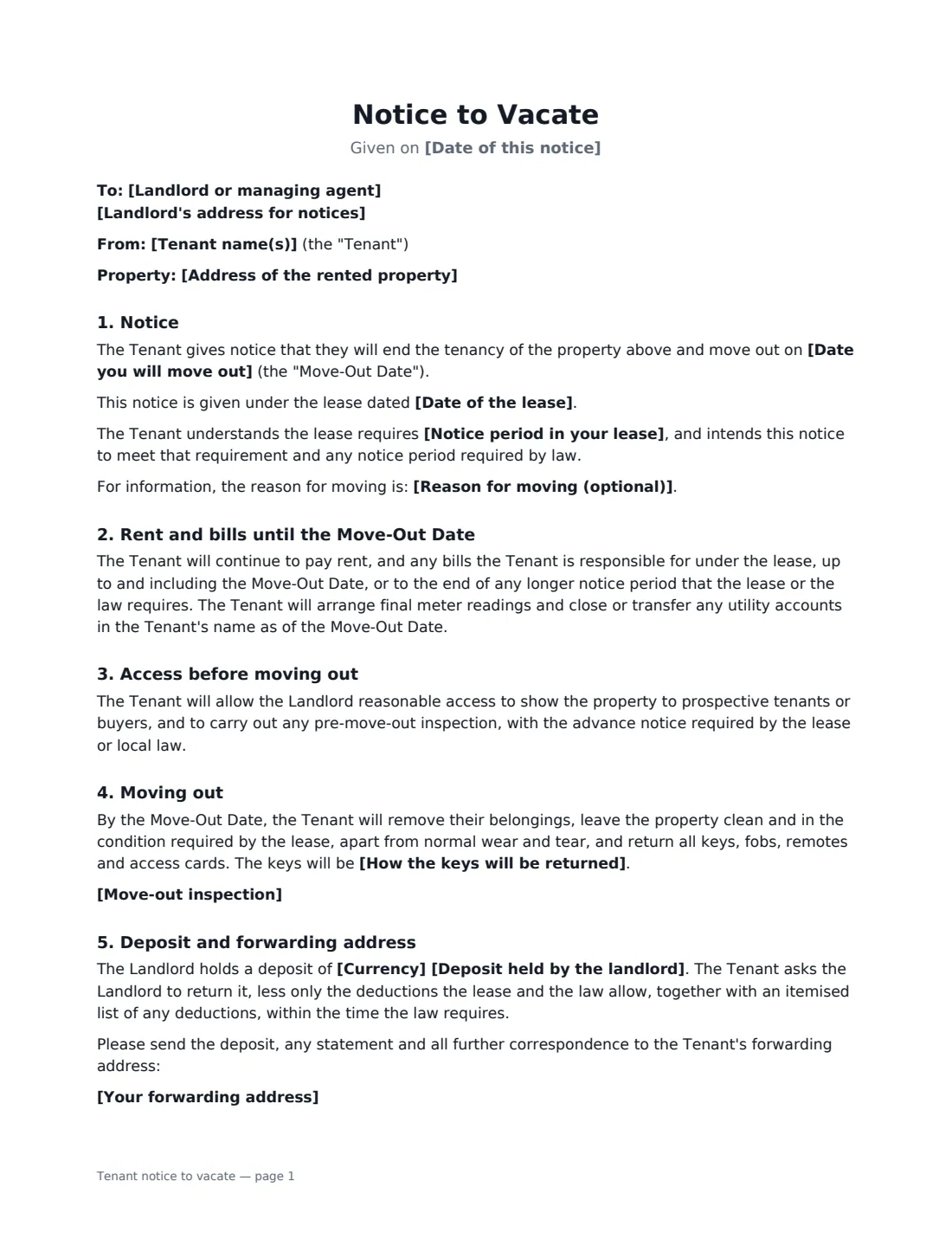
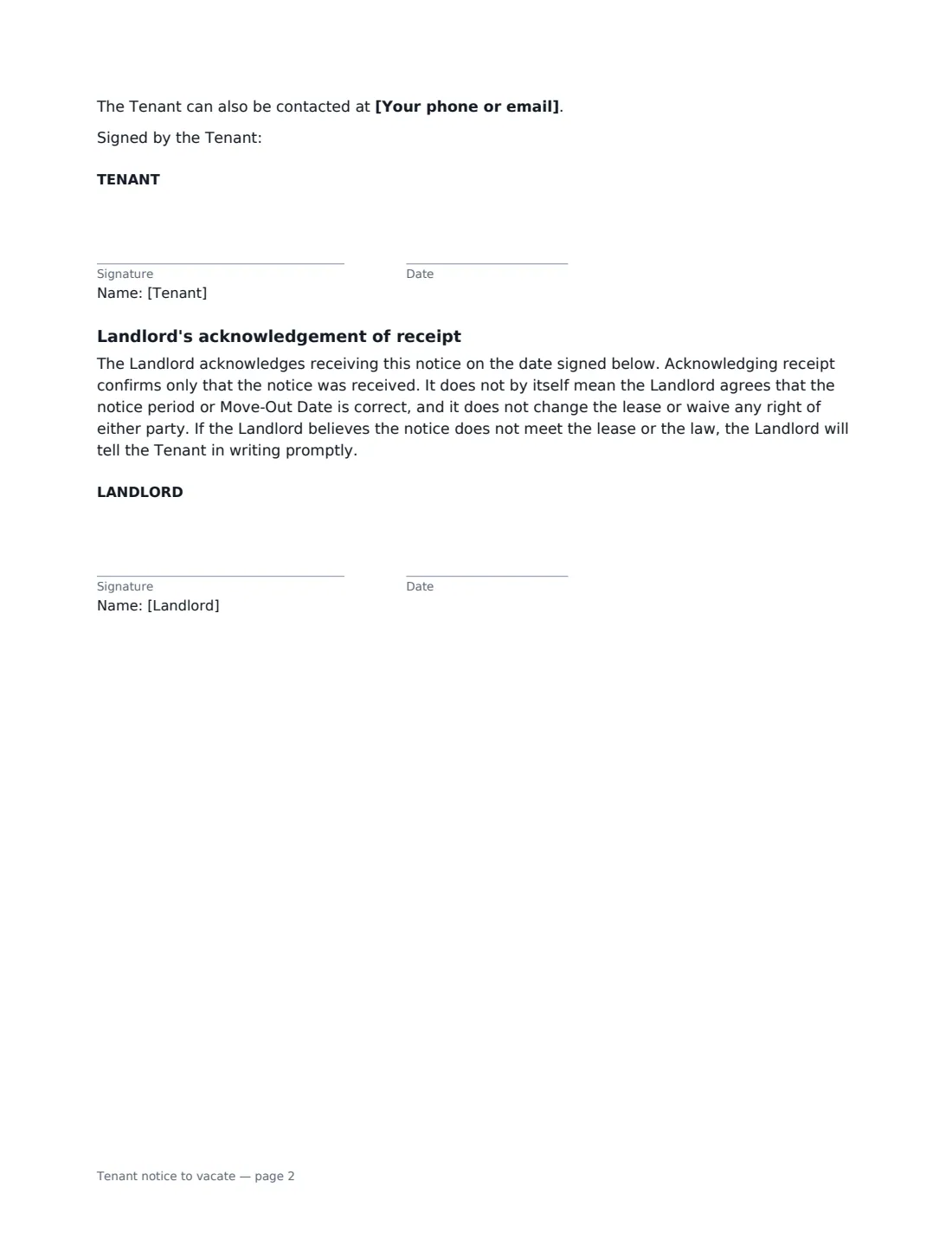
This template is a short, clear notice from the tenant. It names the property, the lease date if you have it, and your move-out date, and says you intend it to meet the notice period in your lease and the law. It confirms you will pay rent until you leave, allow reasonable viewings with proper notice, leave the property clean and return all keys, fobs and remotes, and says whether you want to attend the move-out inspection. It gives your forwarding address and asks for the deposit back, less only lawful deductions, with an itemised list. The landlord then signs a separate acknowledgement of receipt, which confirms only that the notice arrived, not that they agree with the date.
- Best for
- Tenants ending a periodic or fixed-term tenancy, or not renewing a lease
- Signed by
- The tenant (the notice) and the landlord or agent (acknowledgement of receipt)
- Notice period
- Not set by the template — check your lease and local law
- Length
- 2 pages
When to Use a tenant notice to vacate
- Ending a month-to-month or other periodic tenancy
- Telling the landlord you won't renew a fixed-term lease when it ends
- Moving out early where the lease has a break clause or the landlord has agreed
- Giving a forwarding address so the deposit and any deductions statement reach you
- Getting written proof of the date the landlord received your notice
What You Fill In
15 blanks, then the name and email of each person who signs: tenant, landlord.
1 The tenancy
- Date of this notice*
- Tenant name(s)*
- Landlord or managing agent*
- Landlord's address for notices
- Address of the rented property*
- Date of the lease
2 Moving out
- Date you will move out*
- Notice period in your lease
- Reason for moving (optional)
- How the keys will be returned*
- Move-out inspection* The Tenant asks to be present at the move-out inspection and asks the Landlord to suggest a date and time. · The Tenant does not need to be present at the move-out inspection.
3 Deposit and contact
- Currency*
- Deposit held by the landlord
- Your forwarding address*
- Your phone or email
4 Who signs
- Tenant signature and date · The tenant giving notice. If several tenants are on the lease, send one copy for each tenant to sign, or check that the lease lets one tenant give notice for all.
- Landlord signature and date · The landlord or the managing agent who receives the notice and acknowledges it.
What the tenant notice to vacate Covers
- Notice
- Rent and bills until the Move-Out Date
- Access before moving out
- Moving out
- Deposit and forwarding address
- Landlord's acknowledgement of receipt
Using the tenant notice to vacate, step by step
1 Check how much notice you need
Read the notice clause in your lease, then check local rules — notice periods vary by country, state, province and type of tenancy, and some places require the notice to end on a rent day. Pick a move-out date that gives at least that much notice. You can quote the lease's requirement in the optional notice-period box.
2 Fill in the tenancy details
Enter every tenant who is giving notice, the landlord or managing agent, and the property address. Add the landlord's address for notices if the lease names one, and the lease date if you have it — it helps the landlord find the right file.
3 Plan the move-out
Choose whether you want to be at the move-out inspection, and say how you'll return the keys. Enter your forwarding address and, if you know it, the deposit the landlord holds. A reason for moving is optional; you usually don't have to give one.
4 Sign it and send it to the landlord
Tick "This is me" for the tenant and add the landlord's name and email. You sign first; the landlord then signs the acknowledgement. The signed PDF, with a dated audit trail, is filed in Files and emailed to both of you.
Tips Before You Send It
- Send the notice early enough that it arrives before the deadline — the date that usually counts is when the landlord receives it, not when you wrote it.
- If the lease says notice must be delivered in a specific way (for example by post to a named address), do that too, and keep proof.
- If several people are on the lease, check whether one tenant can give notice for all. If not, each tenant should sign.
- Book the move-out inspection and take dated photos of every room when you leave — they are your best evidence if the deposit is disputed.
Sign It Online In Minutes
- Fill in the blanks. Names, dates and amounts go straight into the agreement — the preview shows exactly where.
- Name who signs. Tick “This is me” for your own part. VergeHR builds the PDF with every signature, date box on the right line, and you can check or move anything before sending.
- Send it. Each signer gets a secure link and signs from any device — no account needed. The signed PDF, with an audit trail and a Certificate of Completion, is filed in Files and emailed to everyone.
Tenant notice to vacate: frequently asked questions
How much notice do I have to give my landlord?
It depends on your lease and where the property is. Many periodic tenancies need a month or a full rental period, but the rules vary a lot, and local law can override the lease. The template leaves the period to you and says the notice is intended to meet the lease and the law.
Does the landlord's signature mean they agree with my move-out date?
No. The acknowledgement says it confirms only that the notice was received and does not change the lease. If the landlord thinks the notice is too short, the acknowledgement says they will tell you in writing promptly.
Can I give notice by email or e-signature?
Often yes — many leases allow written notice by email, and electronic signatures are generally valid in the US (ESIGN Act and UETA), the UK, the EU (eIDAS) and Canada. If your lease requires a particular delivery method, follow it as well; once the landlord signs, the signed PDF and audit trail show when they acknowledged it.
What if the landlord doesn't sign the acknowledgement?
Your notice is still a notice. VergeHR's audit trail records when it was sent to the landlord. If you need more proof, also deliver it the way the lease requires and keep a copy.