

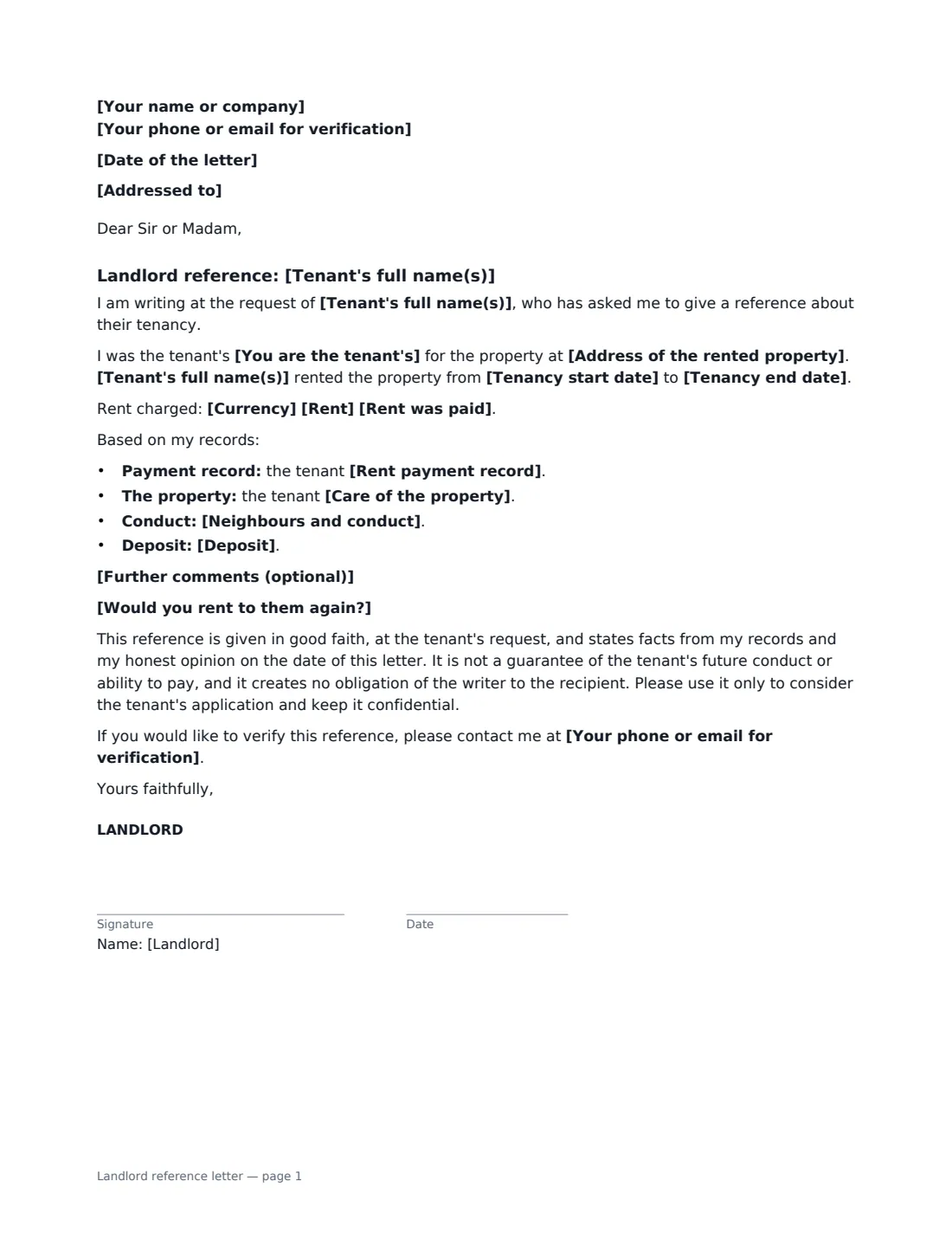
What is a landlord reference letter?
Letting agents and landlords often ask applicants for a reference from their current or previous landlord. A landlord reference letter confirms the facts of the tenancy — how long the tenant lived there, what they paid and whether they paid on time — and gives the landlord's honest view of how they looked after the property and got on with neighbours.
This template produces a one-page letter from the landlord, letting agent or property manager, addressed to a named recipient or "to whom it may concern". It confirms the property and the tenancy dates (or that the tenant still lives there), optionally the rent, and then four short statements chosen from balanced options: the payment record, care of the property, neighbours and conduct, and what happened to the deposit. You can add factual comments to explain arrears, damage or complaints — or to say something positive — and say whether you'd rent to the tenant again or prefer not to comment. It states that the reference is given in good faith at the tenant's request, is not a guarantee, and gives a contact for verification. Only the landlord signs.
- Best for
- Tenants applying for a new rental who need a reference from their landlord
- Signed by
- The landlord, letting agent or property manager
- Tone
- Factual options for good, mixed or poor tenancies
- Length
- 1 page
When to Use a landlord reference letter
- A good tenant is moving and their new landlord asks for a reference
- A letting agent's referencing company requests a landlord reference
- A current tenant applying for a mortgage or a new rental while still living there
- A tenant who had arrears but cleared them and needs a fair, factual reference
- A property manager giving references for tenants in a building they manage
What You Fill In
18 blanks, then the name and email of each person who signs: landlord.
1 The landlord
- Date of the letter*
- Your name or company*
- You are the tenant's* landlord · letting agent · property manager
- Your phone or email for verification*
- Addressed to
2 The tenancy
- Tenant's full name(s)*
- Address of the rented property*
- Tenancy start date*
- Tenancy end date
- Currency*
- Rent
- Rent was paid* per month · every four weeks · per week
3 The reference
- Rent payment record* always paid the rent in full and on time · paid the rent in full, occasionally a few days late · fell behind with the rent at times, but cleared all arrears · has rent arrears outstanding, as explained below
- Care of the property* kept the property clean and in good condition · kept the property in reasonable condition, allowing for normal wear and tear · caused some damage to the property, as explained below
- Neighbours and conduct* I received no complaints about the tenant from neighbours or other residents · I received a small number of minor complaints, which were resolved · I received complaints about the tenant, as explained below
- Deposit* the deposit was returned in full · the deposit was returned with some deductions · the deposit has not yet been dealt with, as the tenancy has not ended · no deposit was held
- Would you rent to them again?* I would be happy to rent to the tenant again. · I would rent to the tenant again. · I prefer not to comment on whether I would rent to the tenant again.
- Further comments (optional)
4 Who signs
- Landlord signature and date · The landlord, or the letting agent or property manager who managed the tenancy.
Using the landlord reference letter, step by step
1 Wait for the tenant's request
Give a reference when the tenant asks for one, and ask who it's for. The letter says it's provided at the tenant's request. Add the recipient's name and address if you have them, or leave it empty for "To whom it may concern".
2 Confirm the tenancy facts
Enter the tenant's name, the property, the start date and — if they've left — the end date. The wording switches between "has rented since" and "rented from … to …". Rent is optional.
3 Choose fair statements
Pick the options that match your records for rent payments, the property's condition, neighbours and conduct, and the deposit. Use the comments box to explain anything negative factually, or add positives.
4 Sign and send
Add a phone or email for verification and sign it yourself — no one else needs to. Send the signed PDF to the tenant or straight to the new landlord.
Tips Before You Send It
- Only state what your records support — dates, rent ledgers and inspection reports.
- Be honest but fair: a reference that hides serious problems can mislead the next landlord, and one that overstates them can be unfair to the tenant.
- If you'd rather not give a view on renting to them again, choose "prefer not to comment" instead of leaving a negative remark.
- Keep a copy of the signed reference in Files in case you're asked about it later.
Sign It Online In Minutes
- Fill in the blanks. Names, dates and amounts go straight into the agreement — the preview shows exactly where.
- Name who signs. Tick “This is me” for your own part. VergeHR builds the PDF with every signature, date box on the right line, and you can check or move anything before sending.
- Send it. Each signer gets a secure link and signs from any device — no account needed. The signed PDF, with an audit trail and a Certificate of Completion, is filed in Files and emailed to everyone.
Landlord reference letter: frequently asked questions
Do I have to give a tenant a reference?
Generally not, though some leases or local rules say otherwise. If you do give one, it should be accurate and fair. This template keeps to facts from your records and your honest opinion.
What if the tenant had rent arrears or caused damage?
Choose the matching option — for example arrears that were cleared, or some damage — and explain briefly in the comments. Keep it factual and supported by records.
Does the tenant sign the reference?
No. It's the landlord's statement, so only the landlord signs. The tenant receives the signed PDF to pass on, or you send it to the new landlord.
Will a new landlord accept an e-signed reference?
Most do. Electronic signatures are generally valid in the US (ESIGN Act and UETA), the UK, the EU (eIDAS) and Canada, and the letter includes a contact so the new landlord can verify it.