

What is a parent moving in agreement?
Inviting an ageing parent to live with you is an act of love — and a big change for everyone in the house. The questions that cause friction are rarely asked out loud: Will they contribute to bills? Which rooms are theirs? How much care can the family really give, and who pays when more is needed? What happens if it stops working? A written family agreement lets you have those conversations once, calmly, before the boxes arrive.
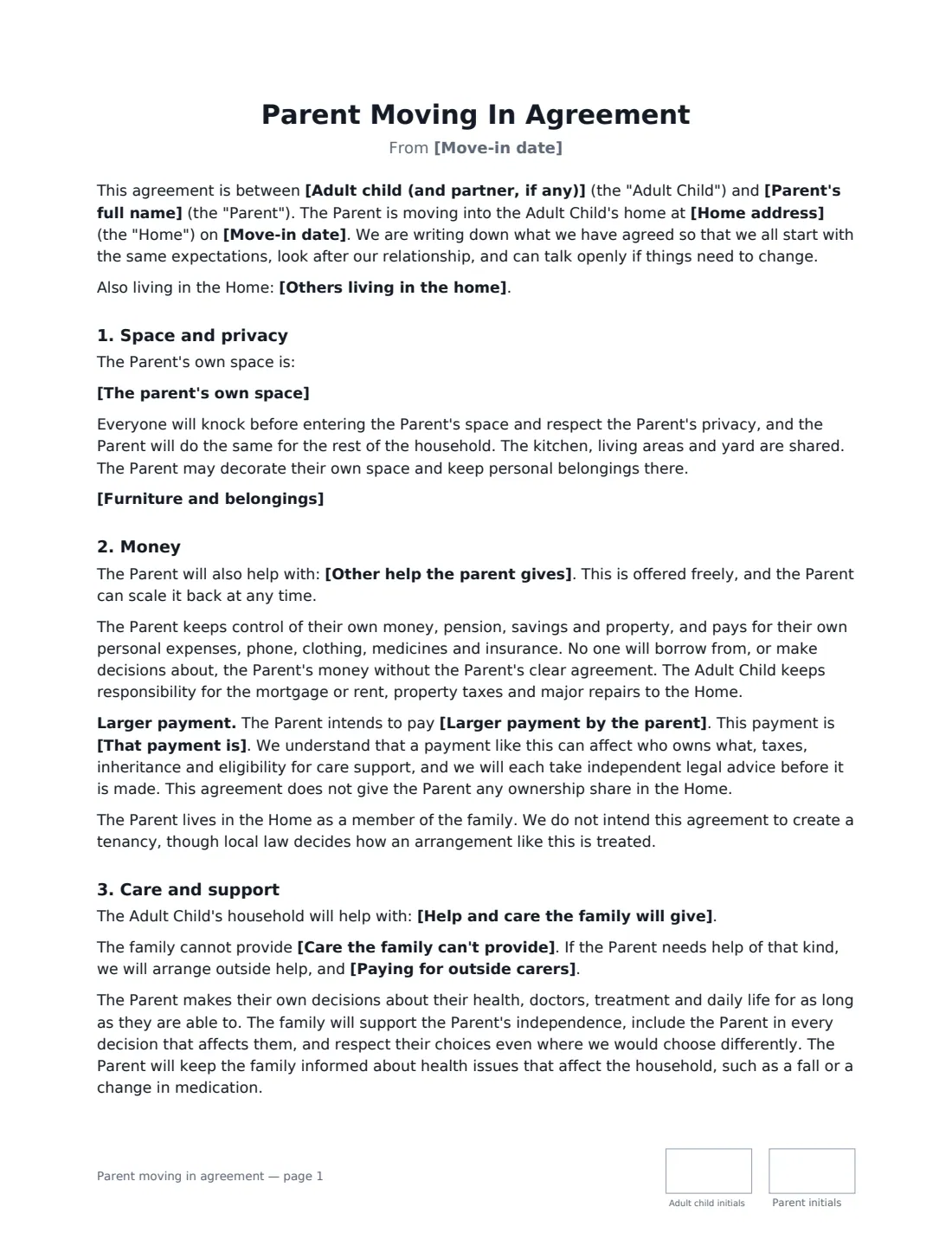
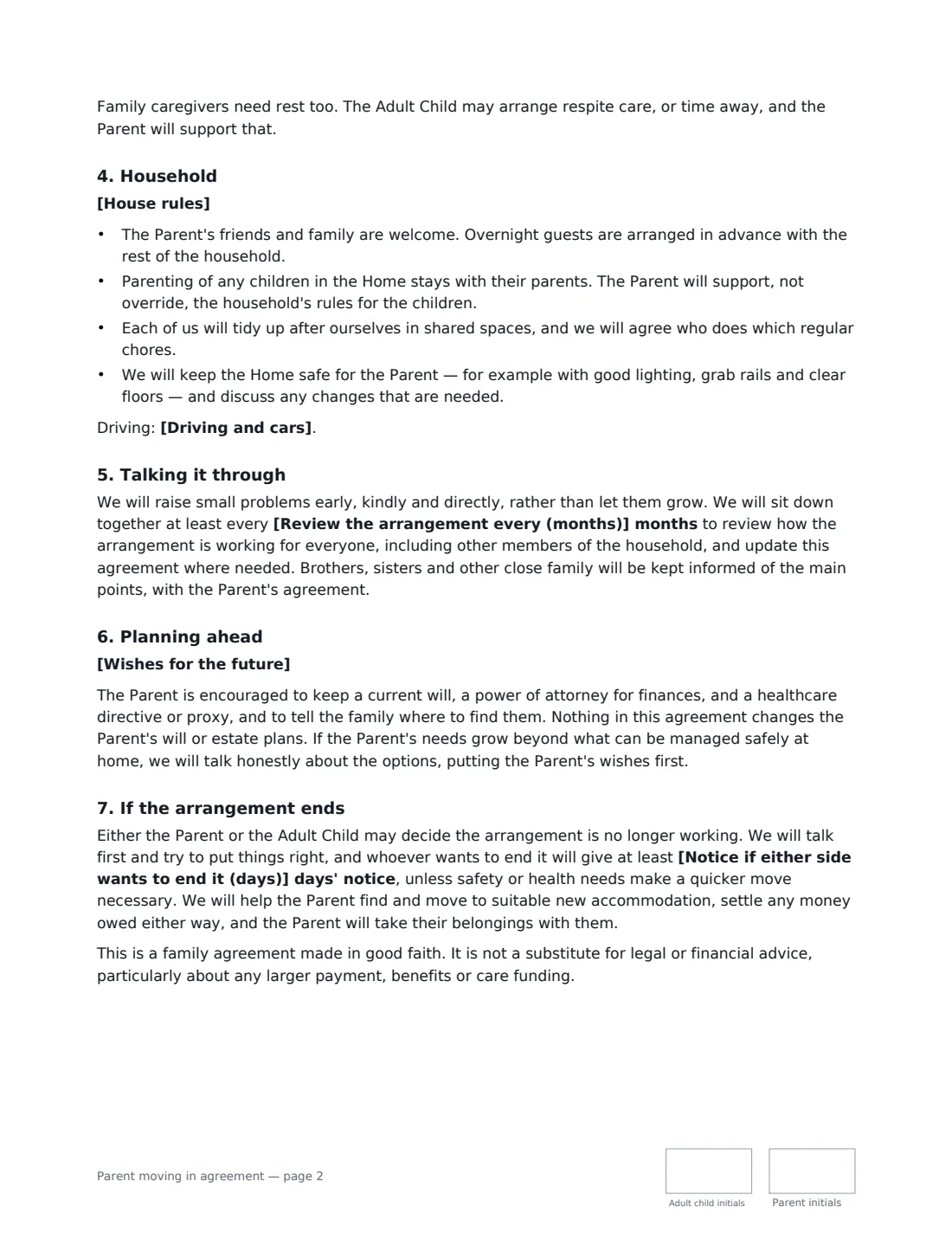
This template covers the parent's own space and privacy, furniture, a monthly contribution or share of bills (or none), other help the parent offers, the parent keeping control of their own money, an optional larger payment towards the home with a clear note to take legal advice, the parent living as family rather than as a tenant, the help and care the family will and won't provide, paying for outside carers, the parent's independence in their own decisions, caregiver respite, house rules, children and guests, home safety, driving, regular reviews, planning ahead with a will, power of attorney and healthcare directive, and what happens if the arrangement ends.
- Best for
- Adult children and ageing parents starting to live together, including in an annex or in-law suite
- Signed by
- The adult child (and partner) and the parent
- Money options
- A fixed monthly amount, a share of bills, or no regular contribution
- Length
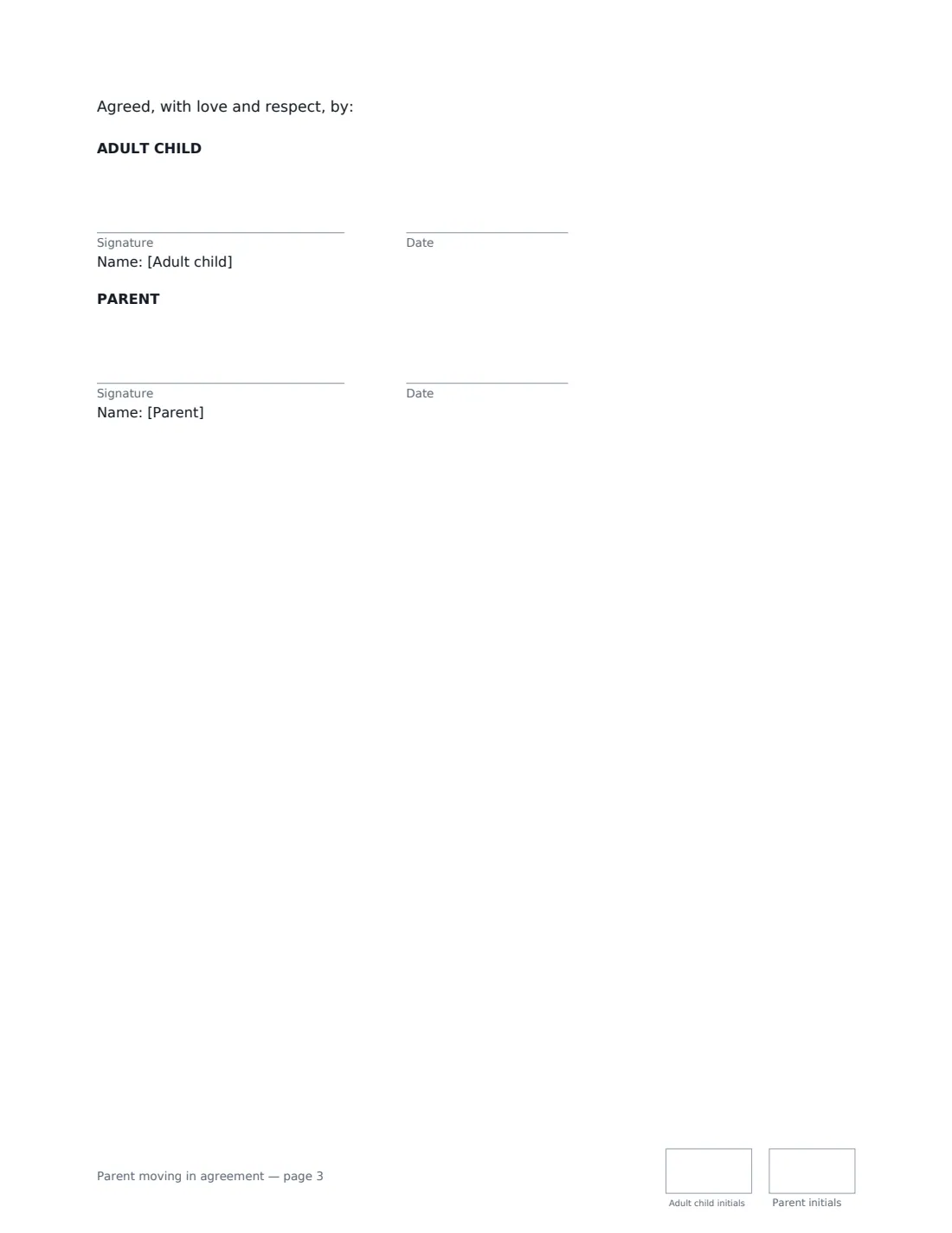
- About 3 pages, initialled on every page
When to Use a parent moving in agreement
- A widowed parent moving into a family home with grandchildren
- A parent selling their house and moving into a newly built in-law suite
- A parent recovering from illness moving in for extra support
- Siblings agreeing which of them the parent lives with, and on what terms
- Writing down an arrangement that began informally years ago
What You Fill In
22 blanks, then the name and email of each person who signs: adult child, parent.
1 The household
- Adult child (and partner, if any)*
- Parent's full name*
- Home address*
- Others living in the home
- Move-in date*
2 Space and privacy
- The parent's own space*
- Furniture and belongings
3 Money
- Currency*
- The parent's contribution* a fixed monthly amount · a share of the household bills · no regular money contribution
- Monthly amount
- Parent's share of bills
- Other help the parent gives
- Larger payment by the parent
- That payment is a gift · a loan, repayable as set out in a separate written agreement · to be recorded in a separate written agreement
4 Care and support
- Help and care the family will give
- Care the family can't provide
- Paying for outside carers* the Parent pays for outside care from their own funds · the Parent and the Adult Child share the cost of outside care as agreed at the time · the Adult Child pays for outside care
5 Household
- House rules
- Driving and cars
6 The future
- Review the arrangement every (months)*
- Notice if either side wants to end it (days)*
- Wishes for the future
7 Who signs
- Adult child signature and date, initials on every page · The adult son or daughter whose home the parent is moving into. Add a spouse or partner as an extra signer in the editor.
- Parent signature and date, initials on every page · The parent moving in.
What the parent moving in agreement Covers
- Space and privacy
- Money
- Care and support
- Household
- Talking it through
- Planning ahead
- If the arrangement ends
Using the parent moving in agreement, step by step
1 Describe the household and the parent's space
Add the adult child (and partner), the parent, the home and the move-in date, plus others who live there. Describe the parent's own rooms and what furniture they're bringing.
2 Agree the money
Choose a fixed monthly contribution, a share of bills, or none, and note any help the parent gives in kind. If the parent is paying towards buying or altering the home, describe it and say whether it's a gift or a loan — and take legal advice before it's paid.
3 Be honest about care
List the help the family will give and, just as important, what it can't provide. Choose who pays if outside carers are needed.
4 House rules, reviews and the future
Add house rules and driving arrangements, how often you'll review things, the notice either side gives to end it, and the parent's wishes for the future. Add the parent as signer and send.
Tips Before You Send It
- Include your partner and, where appropriate, your children in the conversation — they live there too.
- Money a parent puts into your home can affect ownership, taxes, inheritance and eligibility for care support. Get independent legal advice and record it in a separate document.
- Tell brothers and sisters what's been agreed, with the parent's consent. It avoids misunderstandings later.
- Encourage the parent to keep a current will, power of attorney and healthcare directive — and store copies in VergeHR so the family can find them.
Sign It Online In Minutes
- Fill in the blanks. Names, dates and amounts go straight into the agreement — the preview shows exactly where.
- Name who signs. Tick “This is me” for your own part. VergeHR builds the PDF with every signature, date and initials box on the right line, and you can check or move anything before sending.
- Send it. Each signer gets a secure link and signs from any device — no account needed. The signed PDF, with an audit trail and a Certificate of Completion, is filed in Files and emailed to everyone.
Parent moving in agreement: frequently asked questions
Should an elderly parent pay rent when living with their children?
There's no single right answer. Many families agree a modest monthly contribution or a share of bills; others agree no money at all, especially where the parent helps with childcare or other tasks. The template supports all three.
Does this make my parent a tenant?
The template says the parent lives in the home as a member of the family and that you do not intend to create a tenancy. Whether an arrangement is treated as a tenancy depends on local law and the facts, so take advice if the parent is paying a substantial amount or contributing to the home itself.
What if the parent needs more care than we can give?
The template asks you to list what care the family can't provide and to choose who pays for outside help. It also commits everyone to an honest conversation about options if needs grow beyond what can be managed safely at home, putting the parent's wishes first.
Is it legally binding?
It's written as a family agreement made in good faith, not as a substitute for legal or financial advice. Whether any part of a family arrangement like this can be enforced depends on local law and the circumstances — its main value is a clear, shared record of what you agreed. Electronic signatures are generally valid in the US (ESIGN Act and UETA), the UK, the EU (eIDAS) and Canada. Wills, powers of attorney and property transfers usually have their own signing and witnessing rules and are not covered by this agreement.
Is this template free?
Yes. The template is free to use with the eSignature app in VergeHR. Your parent doesn't need a VergeHR login to sign.