

What is a farmland lease agreement?
A farmland lease is the agreement between a landowner and the farmer who works their land — whether that's cropland rented for cash, pasture for grazing cattle or sheep, or hay ground. Plenty of farm leases are still verbal handshakes, which leaves room for disputes over notice, fences, who gets programme payments, and the condition of the land when the lease ends. Writing it down protects both sides.
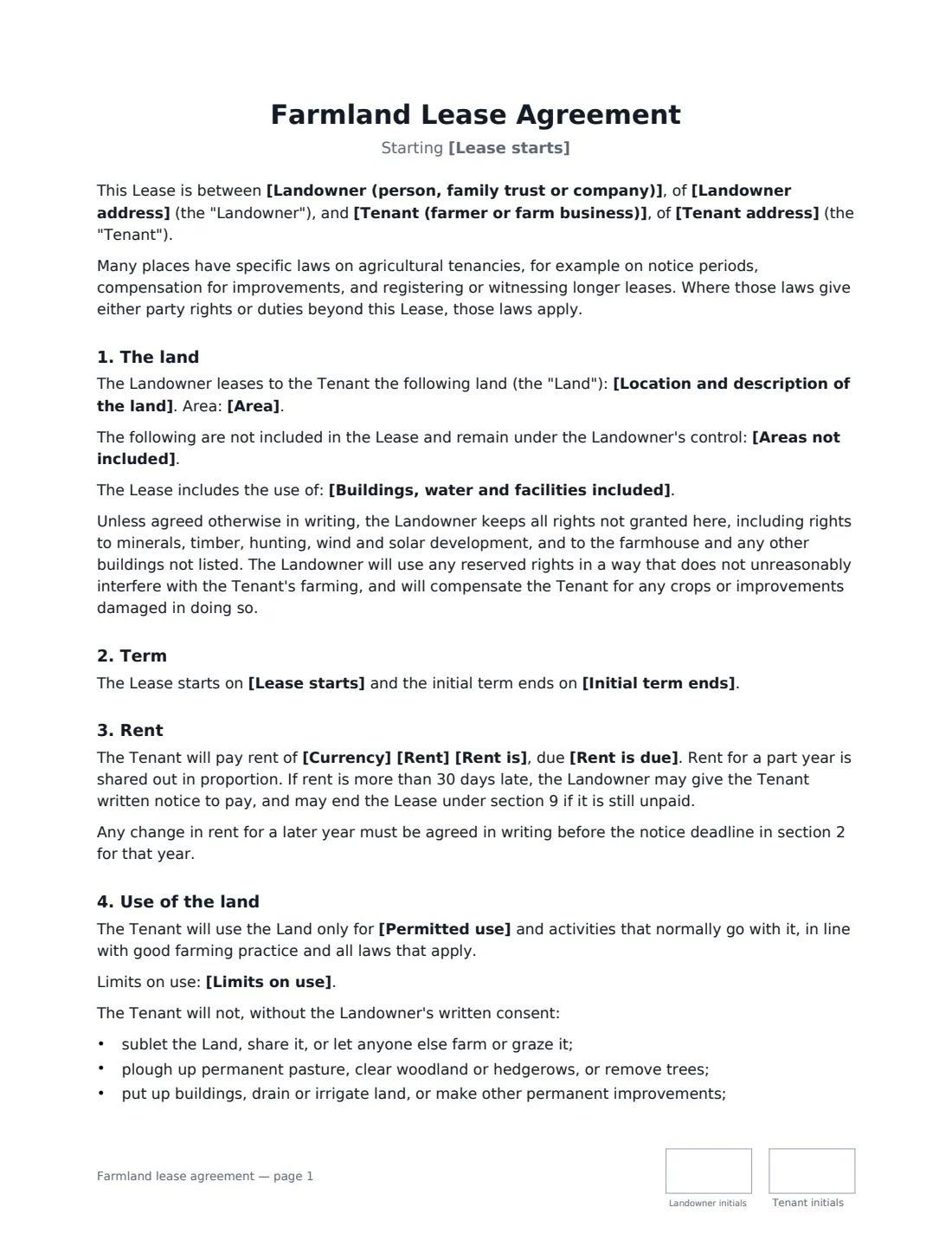
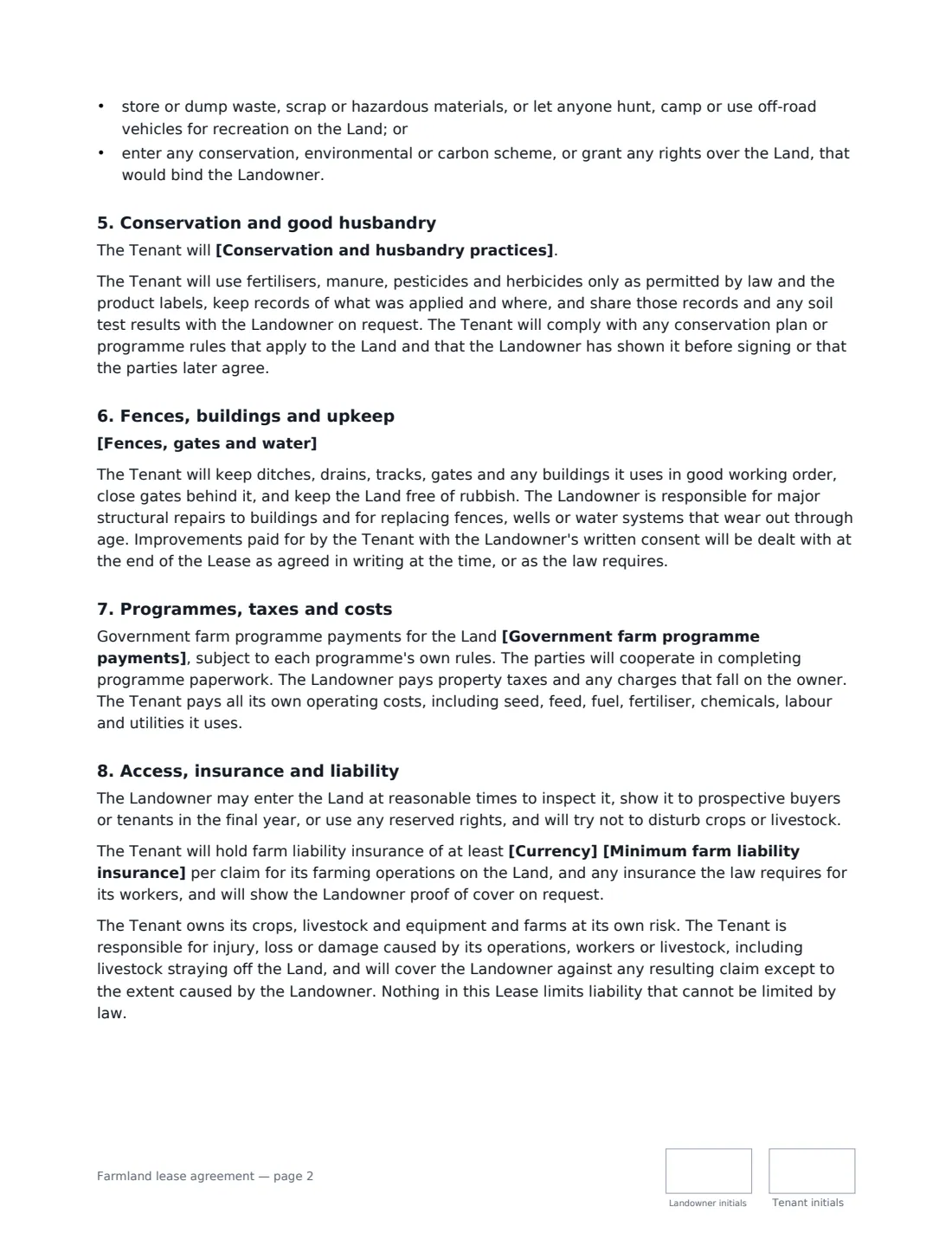
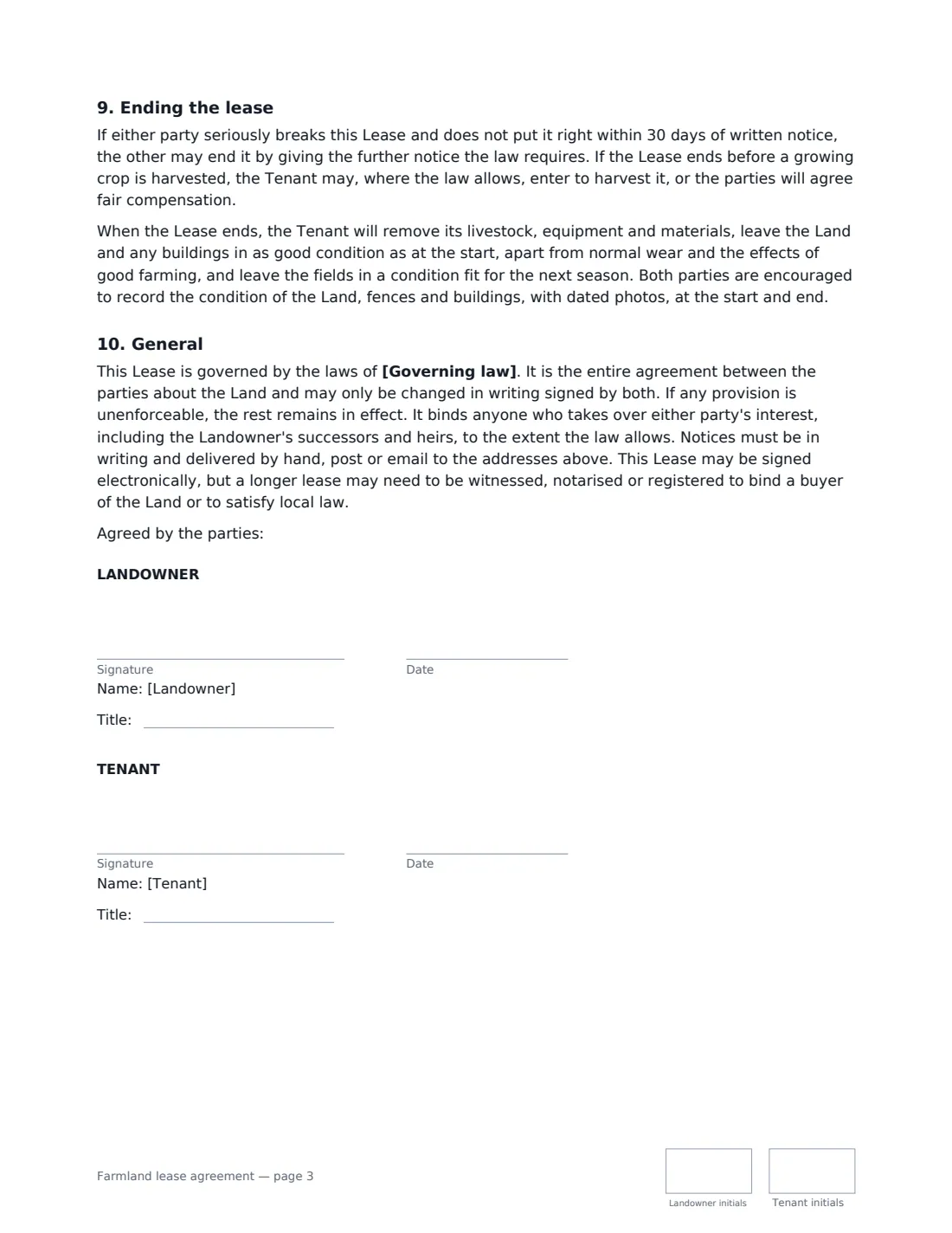
This template is a cash-rent lease. It covers the land, acreage and excluded areas, buildings and water included, the landowner's reserved rights (minerals, timber, hunting, wind and solar), crops, grazing or hay use with optional limits such as stocking numbers, an initial term that either ends or rolls on year to year, rent per acre, hectare or for the whole land, conservation and good husbandry, fertiliser and chemical records, fences and water, government programme payments, access, insurance, livestock straying, ending the lease and harvesting growing crops. It defers to local agricultural tenancy law where that sets notice periods or other rights.
- Best for
- Cash-rent leases of cropland, pasture, grazing and hay ground
- Signed by
- The landowner and the tenant farmer
- Term
- An initial term, then year to year until notice — or ends unless renewed
- Length
- 3 pages, initialled on every page
When to Use a farmland lease agreement
- A retired farmer or inherited-land owner renting fields to a neighbour
- A landowner leasing pasture to a cattle or sheep farmer for the grazing season
- Putting a long-standing verbal farm lease into writing
- Leasing hay ground with conservation practices spelled out
- A family trust or company leasing farmland it holds as an investment
What You Fill In
23 blanks, then the name and email of each person who signs: landowner, tenant.
1 The parties
- Landowner (person, family trust or company)*
- Landowner address*
- Tenant (farmer or farm business)*
- Tenant address*
2 The land
- Location and description of the land*
- Area*
- Areas not included
- Buildings, water and facilities included
3 Use
- Permitted use* growing crops · grazing livestock · growing crops and grazing livestock · producing hay and forage
- Limits on use
- Conservation and husbandry practices*
4 Term
- Lease starts*
- Initial term ends*
- After the initial term* The lease continues from year to year until ended by notice · The lease ends on the end date unless renewed in writing
- Notice to end (months before the end of a lease year)*
5 Rent
- Currency*
- Rent*
- Rent is* per year for the whole land · per acre per year · per hectare per year
- Rent is due*
6 Upkeep
- Fences, gates and water* The Tenant maintains fences, gates and water supplies, and the Landowner supplies materials for major repairs. · The Tenant maintains all fences, gates and water supplies at its own cost. · The Landowner maintains fences, gates and water supplies, and the Tenant reports damage promptly.
- Government farm programme payments* go to the Tenant as the farm operator · are shared between the parties as they agree in writing · go to the Landowner
7 Other terms
- Minimum farm liability insurance
- Governing law*
8 Who signs
- Landowner signature and date, job title, initials on every page · The owner of the land, or someone authorised to lease it.
- Tenant signature and date, job title, initials on every page · The farmer or farm business leasing the land.
What the farmland lease agreement Covers
- The land
- Term
- Rent
- Use of the land
- Conservation and good husbandry
- Fences, buildings and upkeep
- Programmes, taxes and costs
- Access, insurance and liability
- Ending the lease
- General
Using the farmland lease agreement, step by step
1 Describe the land
Give the location with parcel or title numbers if you have them, the acreage, and any areas excluded — farmhouse, woodland, machinery shed. Attach a map to the envelope. List buildings, water and facilities the tenant may use.
2 Set the use and practices
Choose crops, grazing, both, or hay and forage, and add limits such as stocking numbers. Edit the conservation practices to match the land — rotation, erosion control, buffer strips, weed control, no overgrazing.
3 Agree term, notice and rent
Enter the start date and initial term, choose whether it rolls on year to year, and set the notice in months before the end of a lease year. Enter the rent per acre, hectare or for the whole land and when it's due.
4 Upkeep and programmes, then send
Choose who maintains fences, gates and water, and who receives government farm programme payments. Set a minimum farm liability insurance if you want one, then send for signature.
Tips Before You Send It
- Many places set a minimum notice period, and sometimes a fixed date, for ending a farm lease — use at least that in the notice field.
- Walk the boundaries together at the start and record fence and building condition with dated photos.
- Agree the rent for next year before the notice deadline, so neither side is caught out.
- Programme rules, not just the lease, often decide who is eligible for government payments — check with the relevant agency.
Sign It Online In Minutes
- Fill in the blanks. Names, dates and amounts go straight into the agreement — the preview shows exactly where.
- Name who signs. Tick “This is me” for your own part. VergeHR builds the PDF with every signature, date and initials box on the right line, and you can check or move anything before sending.
- Send it. Each signer gets a secure link and signs from any device — no account needed. The signed PDF, with an audit trail and a Certificate of Completion, is filed in Files and emailed to everyone.
Farmland lease agreement: frequently asked questions
Does a farm lease need to be witnessed or registered?
It depends on where the land is and how long the lease is. Some places require longer leases to be witnessed, notarised or registered to bind a later buyer of the land or to be valid at all. The template flags this; check local requirements for your term.
What happens to crops in the ground if the lease ends early?
The template lets the tenant, where the law allows, come back to harvest a growing crop, or the parties agree fair compensation instead.
Who pays for fence repairs?
You choose: the tenant maintains fences and water with the landowner supplying materials for major repairs, the tenant does it all at its own cost, or the landowner maintains them and the tenant reports damage.
Can a farm lease be signed electronically?
An electronic signature is generally valid for ordinary contracts in the US (ESIGN Act and UETA), the UK, the EU (eIDAS) and Canada, and a short farm lease is often fine to e-sign. Some longer leases and land documents need wet-ink signatures, witnesses or notarisation to be registered, so check before relying on e-signing alone.
Is this template free?
Yes. The template is free to use with the eSignature app in VergeHR, and the tenant doesn't need a VergeHR login to sign.