

What is a commercial lease agreement?
A commercial lease sets the terms on which a business occupies someone else's property. Unlike a home, business premises come with questions a residential lease never has to answer: who pays for the building's shared costs, what the space may be used for, who repairs the roof and the air conditioning, whether the tenant can put up a sign, sell its business with the lease, or stay on when the term ends. Getting these right at the start avoids the disputes that are expensive to fix once a business has fitted out and opened.
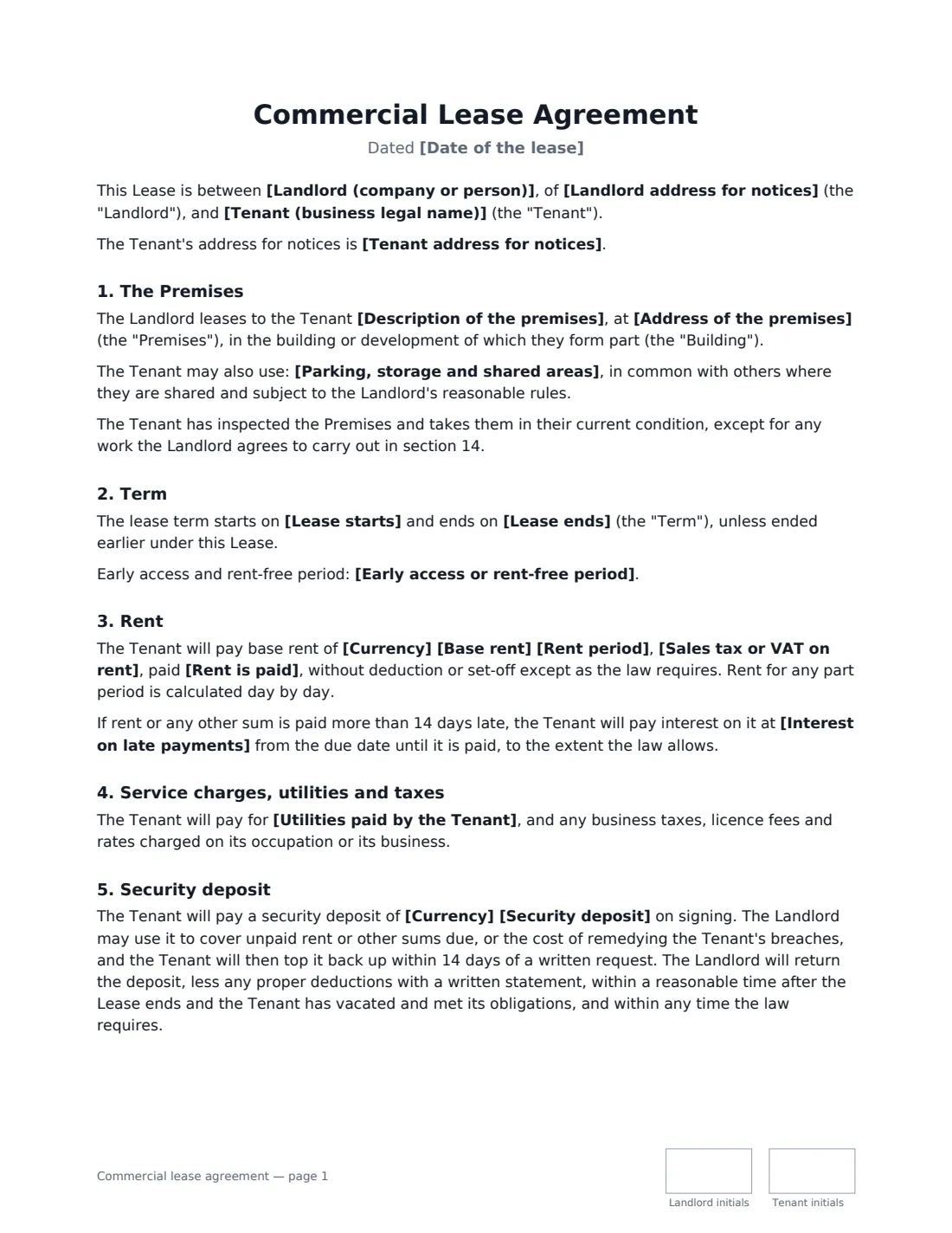
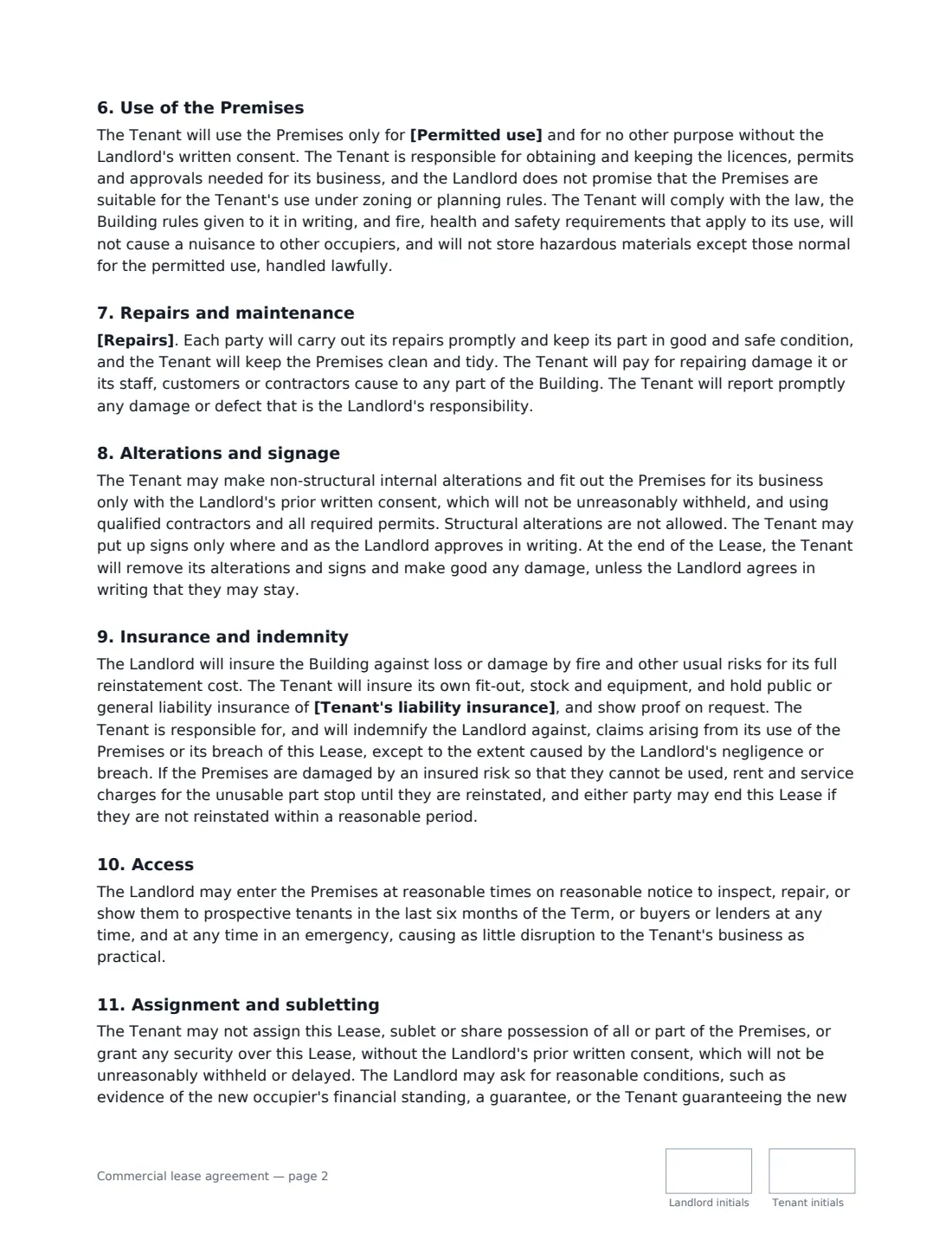
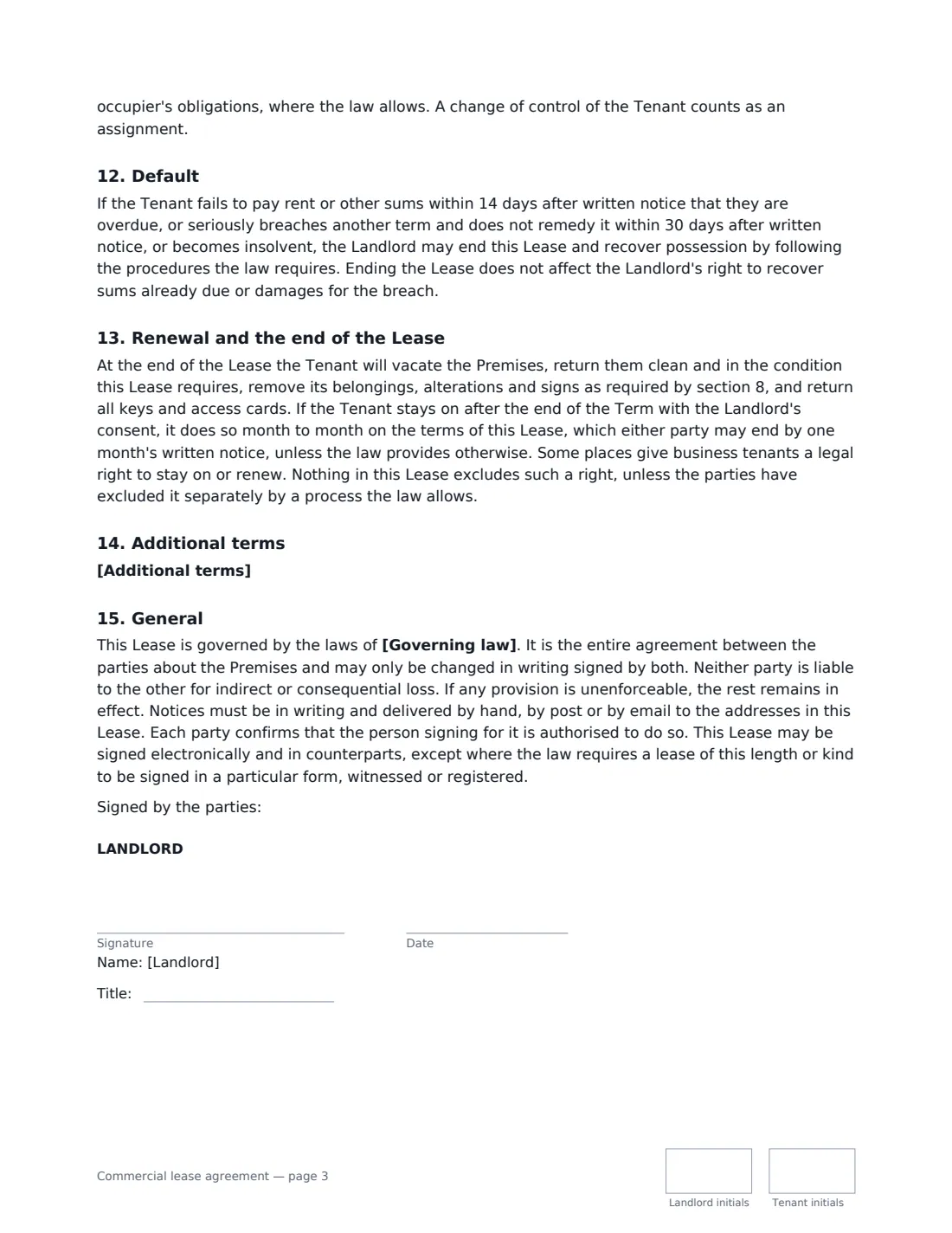
This template describes the premises, parking and shared areas, and the permitted use, and sets the term with an optional rent-free or early-access period. Rent can be fixed, rise by a set percentage each year, or rise as you describe, with a choice of tax treatment and optional late-payment interest. You choose whether the tenant pays a share of building operating costs — with a yearly statement, inspection rights and exclusions — or the rent is all-inclusive. It covers the deposit, use and compliance, a choice of repair split, alterations and signage, insurance and damage, access, assignment and subletting with consent not unreasonably withheld, default, renewal, the end of the lease and additional terms.
- Best for
- Small and mid-sized office, retail, restaurant, clinic and industrial lettings
- Signed by
- The landlord and the tenant, each by an authorised person
- Rent options
- Fixed, fixed yearly percentage increase, or your own review wording
- Length
- About 3-4 pages, initialled on every page
When to Use a commercial lease agreement
- Leasing a shop unit to a retailer or café
- Letting an office suite to a growing company
- Leasing a warehouse or light-industrial unit
- Renting clinic, studio or salon premises to a practitioner
- Putting an informal business tenancy onto a written lease
What You Fill In
33 blanks, then the name and email of each person who signs: landlord, tenant.
1 The parties
- Date of the lease*
- Landlord (company or person)*
- Landlord address for notices*
- Tenant (business legal name)*
- Tenant address for notices
2 The premises
- Address of the premises*
- Description of the premises*
- Parking, storage and shared areas
- Permitted use*
3 Term
- Lease starts*
- Lease ends*
- Early access or rent-free period
4 Rent
- Currency*
- Base rent*
- Rent period* per month · per quarter · per year
- Rent is paid*
- Sales tax or VAT on rent* plus any sales tax or VAT that applies · including any sales tax or VAT
- Rent increases* No increases during the term · A fixed percentage each year · As described below
- Yearly increase (%)
- How rent increases
- Interest on late payments
5 Service charges and outgoings
- Building costs* The Tenant pays a share of building operating costs · The rent includes building operating costs
- Tenant's share and how it is paid
- Utilities paid by the Tenant*
- Security deposit
6 Repairs and insurance
- Repairs* The Tenant repairs the interior; the Landlord repairs the structure, roof, exterior and shared building systems · The Tenant repairs the interior and all systems serving only the premises; the Landlord repairs the structure, roof and exterior
- Tenant's liability insurance*
7 Renewal
- Renewal option* No renewal option · The Tenant may renew
- Renewal term
- Tenant gives notice to renew (months before the end)
- Rent for the renewal term
8 Other terms
- Additional terms
- Governing law*
9 Who signs
- Landlord signature and date, job title, initials on every page · The owner of the premises, signed by someone authorised to bind it.
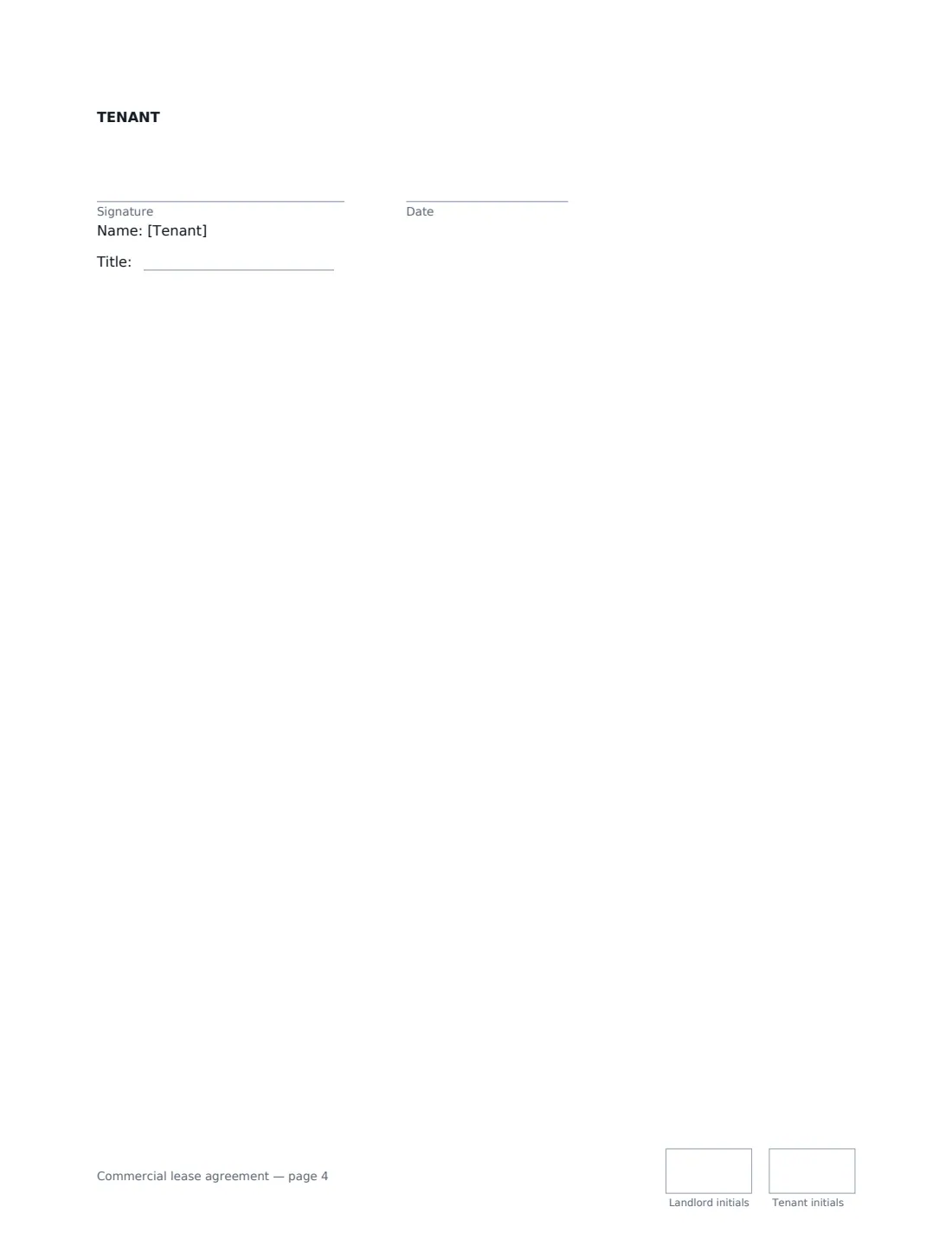
- Tenant signature and date, job title, initials on every page · The business taking the lease, signed by someone authorised to bind it.
What the commercial lease agreement Covers
- The Premises
- Term
- Rent
- Service charges, utilities and taxes
- Security deposit
- Use of the Premises
- Repairs and maintenance
- Alterations and signage
- Insurance and indemnity
- Access
- Assignment and subletting
- Default
- Renewal and the end of the Lease
- Additional terms
- General
Using the commercial lease agreement, step by step
1 Describe the premises and use
Enter the address and a description — unit, floor, approximate area, and "as shown on the attached plan" if you attach one. Add parking, storage and shared areas, and the permitted use. The tenant is responsible for zoning, planning and licences for its business.
2 Set the term and rent
Enter the start and end dates and any rent-free or early-access period for fit-out. Add the base rent, period and due dates, the tax treatment, how rent increases, and optional interest on late payments.
3 Decide who pays what
Choose whether the tenant pays a share of building operating costs and describe the share, the estimate and how it is reconciled, or make the rent all-inclusive. List the tenant's utilities, add any deposit, choose the repair split and set the minimum liability insurance.
4 Renewal, extras and signing
Choose whether the tenant has a renewal option, for how long, how many months' notice it gives and how the renewal rent is set. Add any special terms, such as landlord works before opening, then send to the tenant's authorised signer.
Tips Before You Send It
- Attach a floor plan and a schedule of condition with photos — they settle most end-of-lease repair arguments.
- Ask for a personal guarantee from the owners of a new or small company tenant.
- In some places a lease beyond a certain length must be signed in a particular form, witnessed or registered, or business tenants get statutory renewal rights unless a formal process is followed — check before signing.
- Diarise the renewal notice deadline; a missed deadline usually means a missed option.
Sign It Online In Minutes
- Fill in the blanks. Names, dates and amounts go straight into the agreement — the preview shows exactly where.
- Name who signs. Tick “This is me” for your own part. VergeHR builds the PDF with every signature, date and initials box on the right line, and you can check or move anything before sending.
- Send it. Each signer gets a secure link and signs from any device — no account needed. The signed PDF, with an audit trail and a Certificate of Completion, is filed in Files and emailed to everyone.
Commercial lease agreement: frequently asked questions
What is a service charge or CAM?
A tenant's share of the costs of running a multi-tenant building — cleaning, security, shared utilities, repairs, insurance and often property taxes. If you choose it, the template requires a yearly statement of actual costs, lets the tenant inspect the records, balances over- and under-payments, and excludes improvements, original defects and letting costs.
Can the tenant sell its business and pass on the lease?
Only with the landlord's written consent, which the landlord may not unreasonably withhold or delay. The landlord can ask for reasonable conditions such as proof of the new tenant's finances or a guarantee. A change of control of the tenant counts as an assignment.
Does the tenant have a right to renew?
Only if you choose the renewal option: the tenant gives notice by your deadline and renews once for the term you set, at the rent you describe. Some places also give business tenants a legal right to stay on or renew; this lease doesn't exclude such a right unless the parties do so separately through a process the law allows.
Can a commercial lease be signed electronically?
Electronic signatures are generally valid for ordinary commercial contracts in the US (ESIGN Act and UETA), the UK, the EU (eIDAS) and Canada. Some leases — often longer ones — must be made as a deed, witnessed or registered, so check the local rules for your term. VergeHR keeps an audit trail and a Certificate of Completion with the signed PDF.