


What is a tenant estoppel certificate?
When a commercial property is sold or refinanced, the buyer or lender wants to know that the leases are what the landlord says they are. A tenant estoppel certificate is the tenant's signed confirmation of the key lease facts. Because the buyer or lender relies on it, the tenant generally can't later claim facts contrary to what it certified — which is why tenants should check every line carefully.
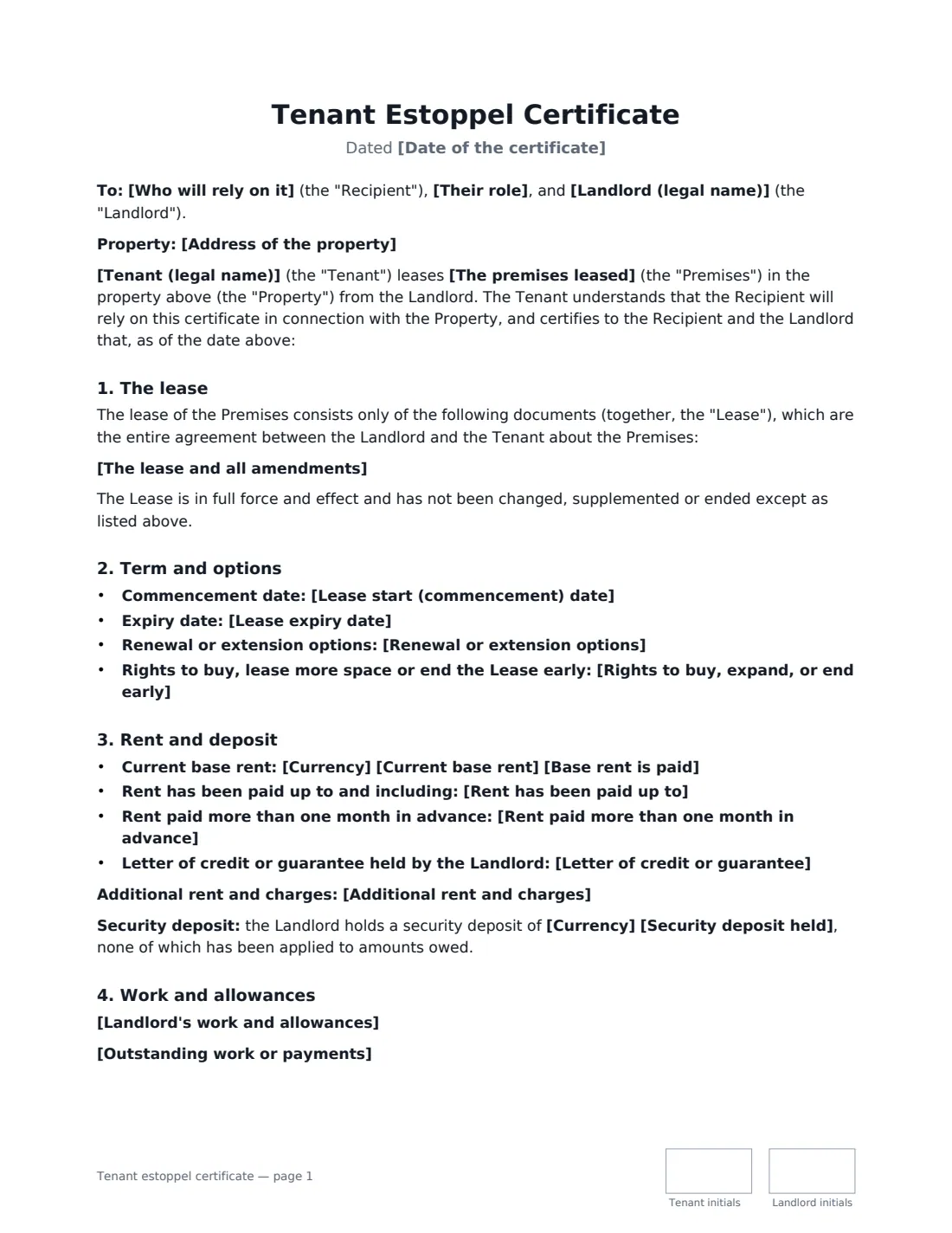
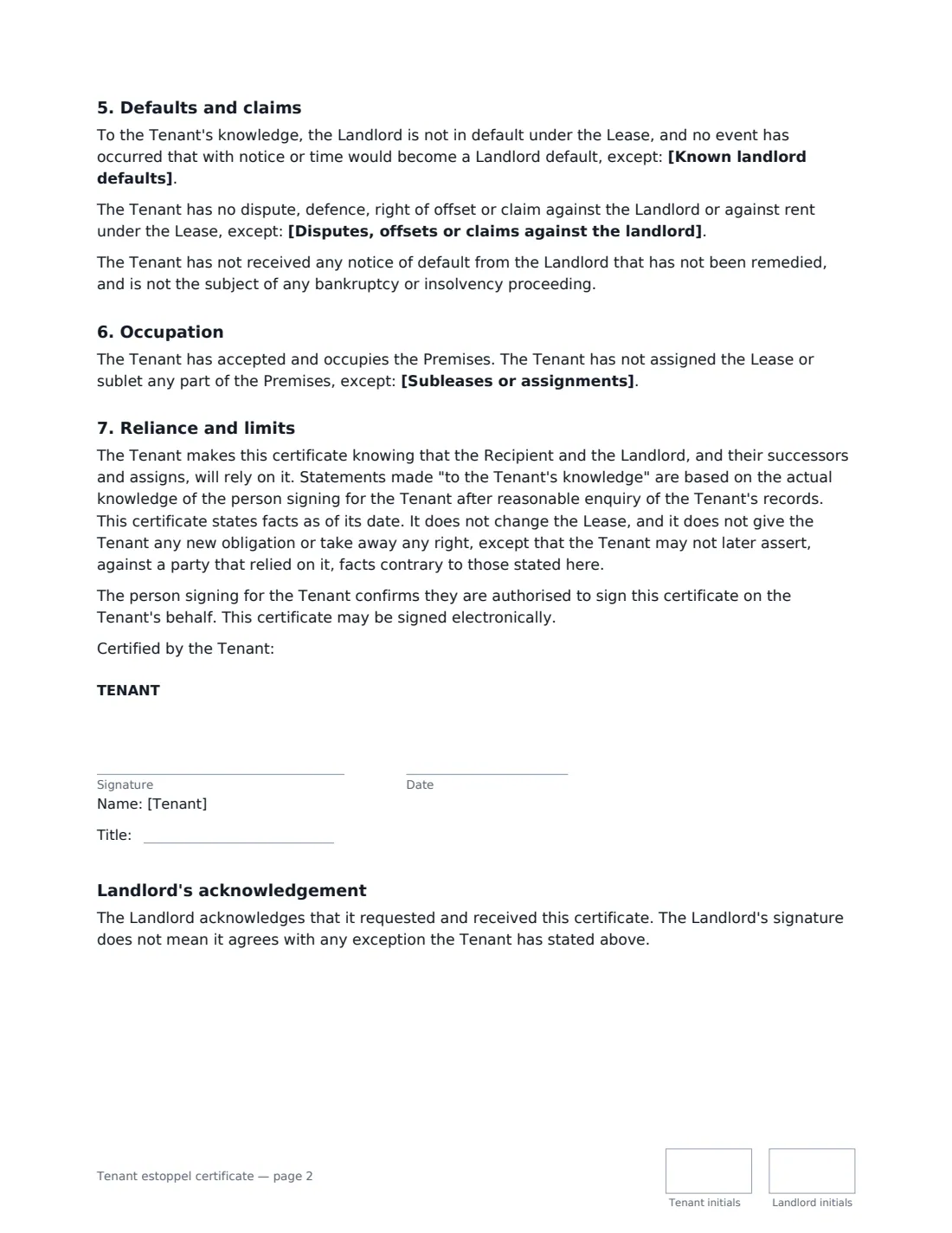
This template addresses the certificate to the named recipient and the landlord. The tenant lists every document making up the lease and confirms it's in effect, then certifies the commencement and expiry dates, renewal options, and any rights to buy, expand or end early; the base rent, additional rent, the date rent is paid to, any prepaid rent, the security deposit and any letter of credit or guarantee; whether the landlord's work and allowances are complete or still outstanding; any landlord defaults, tenant claims or offsets; and any subleases or assignments. Statements are made to the tenant's knowledge after reasonable enquiry, and the certificate doesn't amend the lease. The landlord countersigns to acknowledge receipt without agreeing to the tenant's exceptions.
- Best for
- Sales and refinancing of offices, retail units, industrial and mixed-use property
- Signed by
- The tenant's authorised signatory, with the landlord acknowledging it
- Relied on by
- The buyer, the lender, or both — named in the certificate
- Length
- 2 pages, initialled on every page
When to Use a tenant estoppel certificate
- A landlord selling a commercial building and the buyer's due diligence asks for estoppels
- Refinancing a property where the new lender needs tenant confirmations
- A lender reviewing an existing loan secured on a multi-tenant property
- A tenant responding to a landlord's request under an estoppel clause in its lease
- Confirming the rent roll before a portfolio transfer
What You Fill In
25 blanks, then the name and email of each person who signs: tenant, landlord.
1 The parties
- Date of the certificate*
- Tenant (legal name)*
- Landlord (legal name)*
- Who will rely on it*
- Their role* a prospective lender secured on the Property · a prospective buyer of the Property · a prospective buyer of the Property and its lender · an existing lender
2 The premises
- Address of the property*
- The premises leased*
3 The lease
- The lease and all amendments*
- Lease start (commencement) date*
- Lease expiry date*
- Renewal or extension options*
- Rights to buy, expand, or end early*
4 Rent and deposit
- Currency*
- Current base rent*
- Base rent is paid* per month · per quarter · per year
- Additional rent and charges
- Rent has been paid up to*
- Rent paid more than one month in advance*
- Security deposit held
- Letter of credit or guarantee*
5 Defaults and claims
- Landlord's work and allowances* All work the Landlord was required to carry out for the Tenant has been completed, and all tenant improvement allowances and other payments due to the Tenant have been paid. · The following work or payments owed by the Landlord to the Tenant are still outstanding:
- Outstanding work or payments
- Known landlord defaults*
- Disputes, offsets or claims against the landlord*
- Subleases or assignments*
6 Who signs
- Tenant signature and date, job title, initials on every page · An officer or authorised signatory of the tenant business. They should check every statement against the lease and their records before signing.
- Landlord signature and date, job title, initials on every page · The landlord that requested the certificate. Its signature confirms it requested and received it.
What the tenant estoppel certificate Covers
- The lease
- Term and options
- Rent and deposit
- Work and allowances
- Defaults and claims
- Occupation
- Reliance and limits
- Landlord's acknowledgement
Using the tenant estoppel certificate, step by step
1 Name the recipient and parties
Enter the tenant's and landlord's legal names, and who will rely on the certificate — the buyer, the lender, or both — and their role.
2 List the lease documents and dates
List the lease and every amendment, side letter and extension. Add the commencement and expiry dates, renewal options and any rights to buy, expand or terminate early. Write "None" where there are none.
3 Confirm rent, deposit and outstanding items
Enter the base rent, any additional rent, the date rent is paid up to, prepaid rent, the deposit and any letter of credit. Choose whether the landlord's work and allowances are complete, or list what's outstanding.
4 Record defaults and send to the tenant
Enter any known landlord defaults, claims or offsets, and subleases — or "None". Send it to the tenant's authorised signatory to review and sign, then countersign as landlord.
Tips Before You Send It
- Tenants: check every statement against the lease and your records — once relied on, you may be held to it.
- List every amendment and side letter. A document left out may not bind the buyer or lender.
- If you believe the landlord owes you work, money or a fix, say so under defaults or claims rather than signing "None".
- Check the lease for an estoppel clause — it often sets how quickly the tenant must respond and what the certificate must cover.
Sign It Online In Minutes
- Fill in the blanks. Names, dates and amounts go straight into the agreement — the preview shows exactly where.
- Name who signs. Tick “This is me” for your own part. VergeHR builds the PDF with every signature, date and initials box on the right line, and you can check or move anything before sending.
- Send it. Each signer gets a secure link and signs from any device — no account needed. The signed PDF, with an audit trail and a Certificate of Completion, is filed in Files and emailed to everyone.
Tenant estoppel certificate: frequently asked questions
Why is it called an estoppel certificate?
"Estoppel" is the legal idea that a party who made a statement another party relied on can't later deny it. The certificate says the tenant may not later assert, against a party that relied on it, facts contrary to those stated.
Is this for residential tenants?
It's designed for commercial leases, where estoppel certificates are common in sales and financing. Residential tenancies rarely use them.
Does the certificate change the lease?
No. It says it states facts as of its date, doesn't change the lease, and doesn't create new obligations for the tenant.
Will a lender accept an e-signed estoppel?
Many do. Electronic signatures are generally valid in the US (ESIGN Act and UETA), the UK, the EU (eIDAS) and Canada, but a lender or its lawyers may ask for their own form — check what they need first.