

What is a personal guarantee?
A personal guarantee is a promise by an individual — usually a director or owner — to pay a company's debts if the company doesn't. Suppliers ask for one before opening a trade credit account, landlords before leasing premises to a new company, and lenders before a small business loan. For the creditor it is extra security; for the guarantor it puts personal savings and property on the line, so the terms matter to both sides.
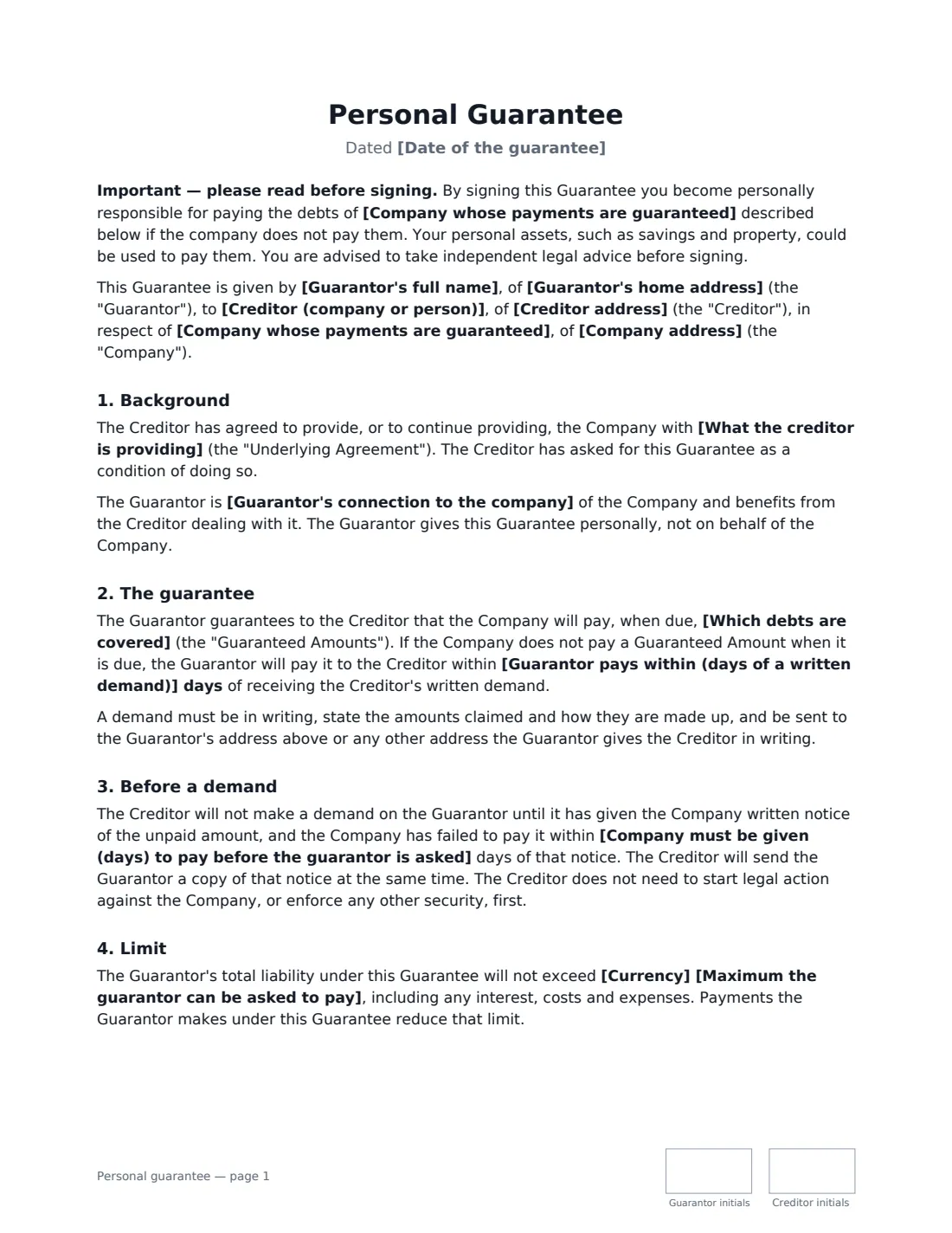
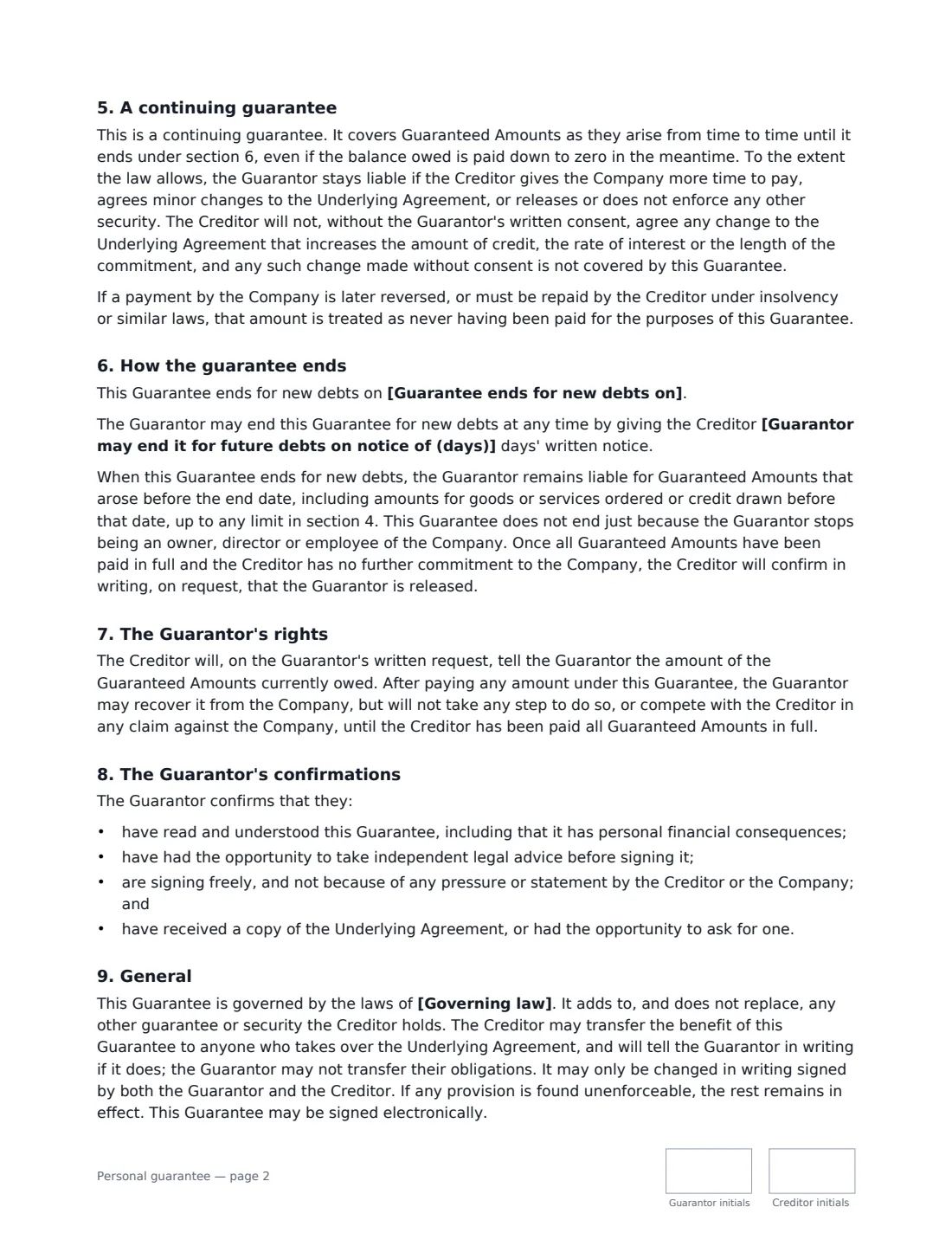
This template opens with a plain warning to the guarantor and then sets out what is guaranteed: debts under a specific agreement, or everything the company owes the creditor. You can set a maximum the guarantor can be asked to pay, require the creditor to give the company time to pay before turning to the guarantor, and fix how many days the guarantor has to pay a written demand. It also covers how the guarantee ends (an end date, notice for future debts, or not until everything is repaid), the rule that stepping down as a director doesn't end it by itself, protection against changes that increase the debt without the guarantor's consent, and the guarantor's right to be told the balance.
- Best for
- Trade credit accounts, small business loans and commercial leases to a company
- Signed by
- The guarantor personally, and the creditor
- Limit
- Optional maximum amount, including interest and costs — or unlimited
- Length
- 2–3 pages, initialled on every page
When to Use a personal guarantee
- A wholesaler opens a credit account for a new restaurant company and asks the owner to guarantee it
- A landlord leases a shop to a newly formed company and wants a director's guarantee of the rent
- A private lender makes a loan to a small company backed by its founder
- An equipment supplier extends payment terms to a start-up
- A company with a short trading history needs a guarantee to open an account with a key supplier
What You Fill In
17 blanks, then the name and email of each person who signs: guarantor, creditor.
1 The parties
- Date of the guarantee*
- Guarantor's full name*
- Guarantor's home address*
- Creditor (company or person)*
- Creditor address
- Company whose payments are guaranteed*
- Company address
- Guarantor's connection to the company
2 What is guaranteed
- What the creditor is providing*
- Which debts are covered* all amounts the Company owes the Creditor under the Underlying Agreement · all amounts the Company owes the Creditor, now or in the future, under any agreement or account
- Currency*
- Maximum the guarantor can be asked to pay
3 Demands
- Company must be given (days) to pay before the guarantor is asked
- Guarantor pays within (days of a written demand)*
4 How it ends
- Guarantee ends for new debts on
- Guarantor may end it for future debts on notice of (days)
- Governing law*
5 Who signs
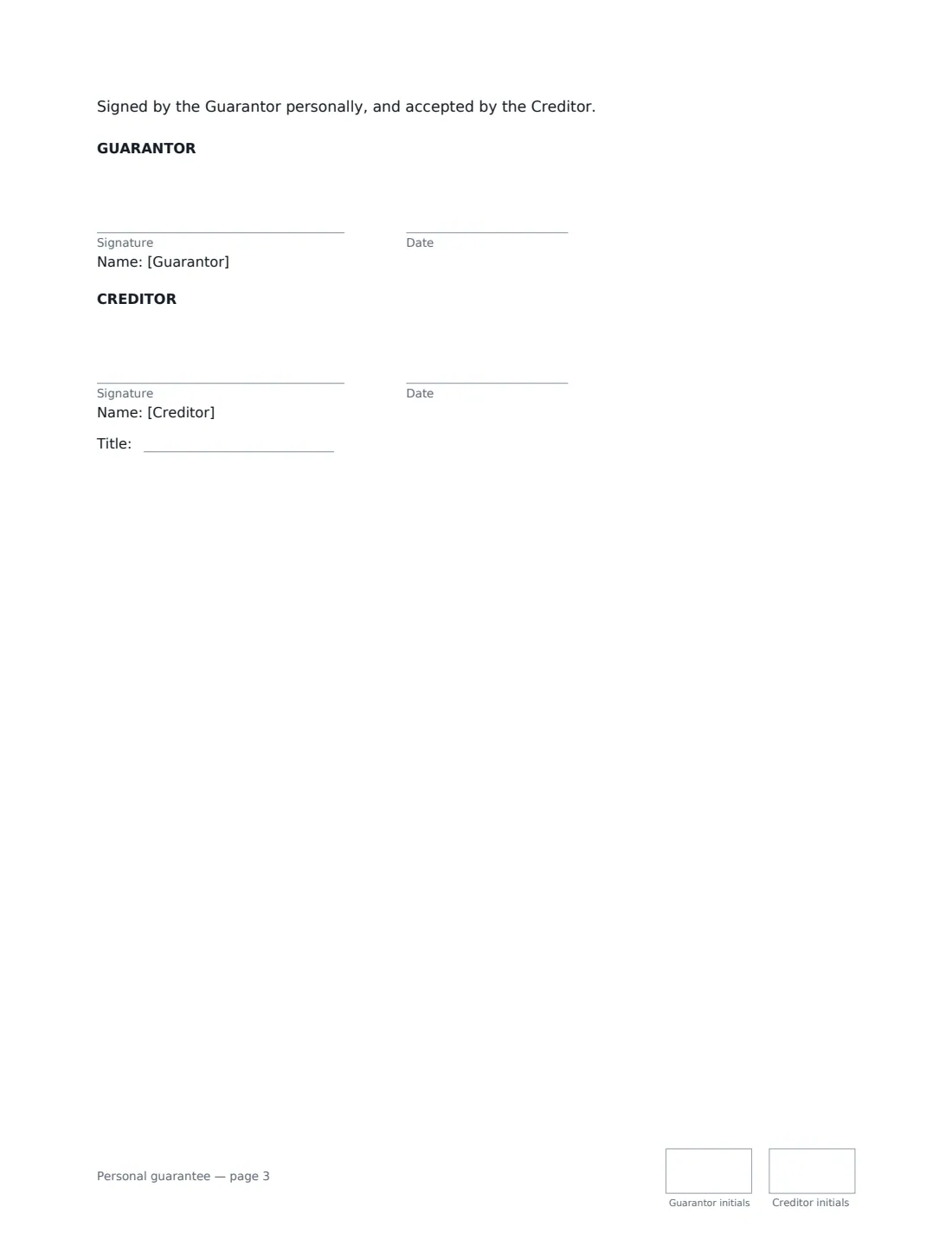
- Guarantor signature and date, initials on every page · The individual giving the guarantee, usually an owner or director of the company. They sign personally, not for the company.
- Creditor signature and date, job title, initials on every page · The supplier, lender or landlord receiving the guarantee.
What the personal guarantee Covers
- Background
- The guarantee
- Before a demand
- Limit
- A continuing guarantee
- How the guarantee ends
- The Guarantor's rights
- The Guarantor's confirmations
- General
Using the personal guarantee, step by step
1 Name the three people involved
The guarantor (an individual, with their home address), the creditor receiving the guarantee, and the company whose payments are guaranteed. Add the guarantor's connection to the company, such as "a director and the majority owner".
2 Say what is guaranteed and set a limit
Describe what the creditor is providing — for example, "a trade credit account under the credit application dated 3 October 2026" — and choose whether the guarantee covers only that agreement or everything the company owes. A maximum amount is strongly recommended for the guarantor; leave it empty only if both sides intend an unlimited guarantee.
3 Set the demand process
Choose how many days the company gets to pay after a default notice before the creditor can turn to the guarantor (or leave it empty to allow a direct demand), and how many days the guarantor has to pay a written demand.
4 Decide how it ends, then sign
Add an end date and/or a notice period for the guarantor to stop covering new debts. Leave the notice empty for loans and leases, where the guarantee usually lasts until the debt is repaid. Debts that arose before the end stay guaranteed. Then send it — the guarantor signs personally, without a job title.
Tips Before You Send It
- Guarantors: take independent legal advice before signing, and ask for a copy of the agreement you are guaranteeing.
- Set a cap wherever you can — an unlimited guarantee can reach far beyond the credit limit you had in mind.
- If you leave the company, stepping down as a director does not end the guarantee — give notice under it as well.
- Some places require guarantees to be signed in a particular form, witnessed or made as a deed; check the rules where you are before relying on it.
Sign It Online In Minutes
- Fill in the blanks. Names, dates and amounts go straight into the agreement — the preview shows exactly where.
- Name who signs. Tick “This is me” for your own part. VergeHR builds the PDF with every signature, date and initials box on the right line, and you can check or move anything before sending.
- Send it. Each signer gets a secure link and signs from any device — no account needed. The signed PDF, with an audit trail and a Certificate of Completion, is filed in Files and emailed to everyone.
Personal guarantee: frequently asked questions
What is the difference between a limited and an unlimited personal guarantee?
A limited guarantee caps the total the guarantor can be asked to pay — in this template, including interest and costs. An unlimited guarantee has no cap, so the guarantor may be liable for everything covered plus the creditor's reasonable enforcement costs.
Can a guarantor get out of a personal guarantee?
Only as the guarantee allows. With this template, the guarantor can end it for new debts from an end date or by giving the notice you set, if you include one. Debts that arose before it ends remain guaranteed until paid.
Does the creditor have to chase the company first?
If you set a number of days in the demand section, the creditor must first give the company written notice and wait that long before demanding payment from the guarantor. If you leave it empty, the creditor can go straight to the guarantor once a payment is overdue.
Can a personal guarantee be signed electronically?
In many places, including the US (ESIGN Act and UETA), the UK, the EU (eIDAS) and Canada, an electronic signature is generally valid for a guarantee that simply needs to be in writing and signed. Where the law requires a deed, witnesses or a notary, you may need to sign it in that form instead.