

What is a data sharing agreement?
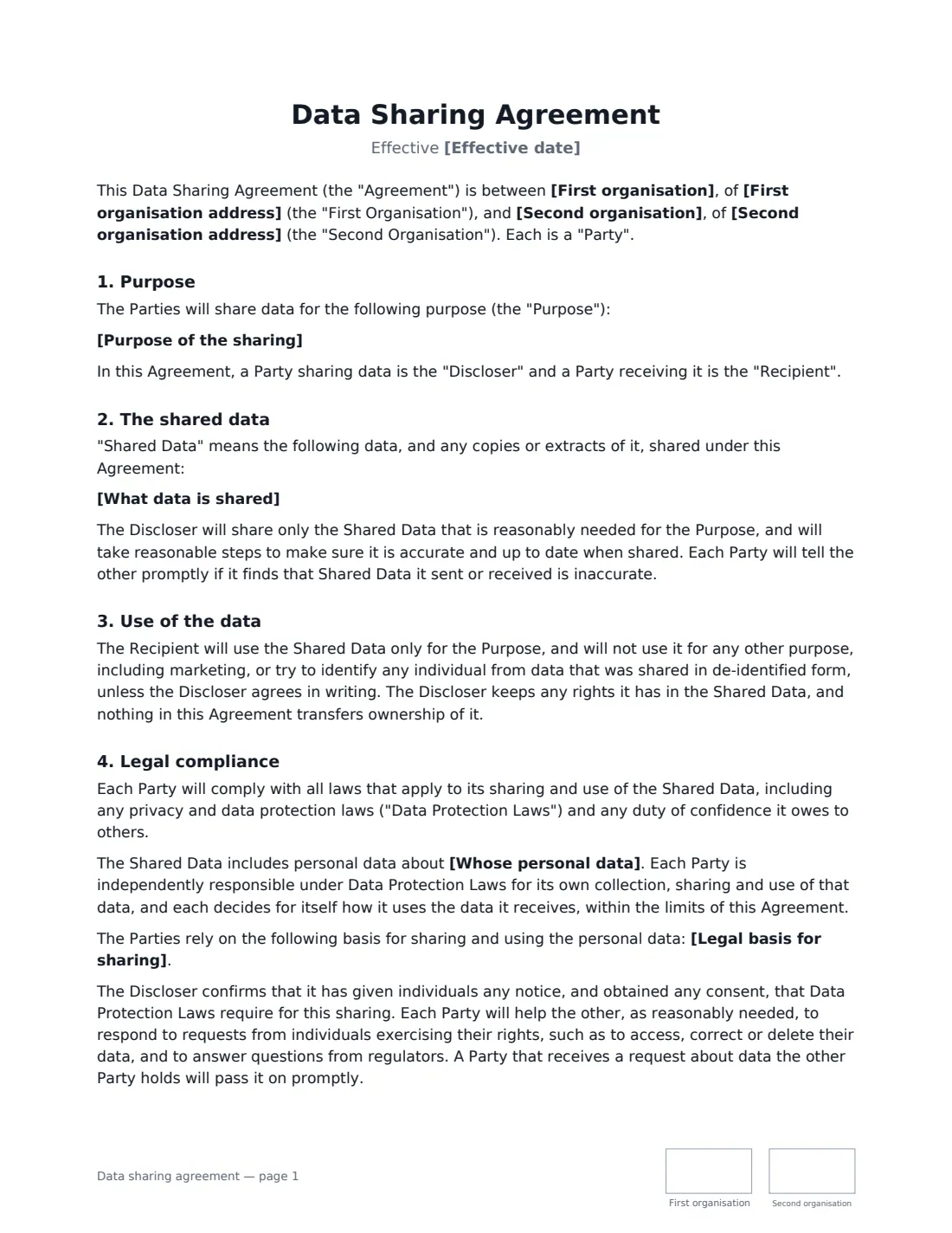
A data sharing agreement, sometimes called an information sharing agreement, sets the rules when two organisations pass data to each other and each uses it for its own purposes. Examples include two clinics sharing referrals, a charity and a council coordinating services, research partners pooling data, or two businesses in a joint marketing project. Unlike a data processing agreement, neither side is simply working for the other. Each is responsible for its own use.
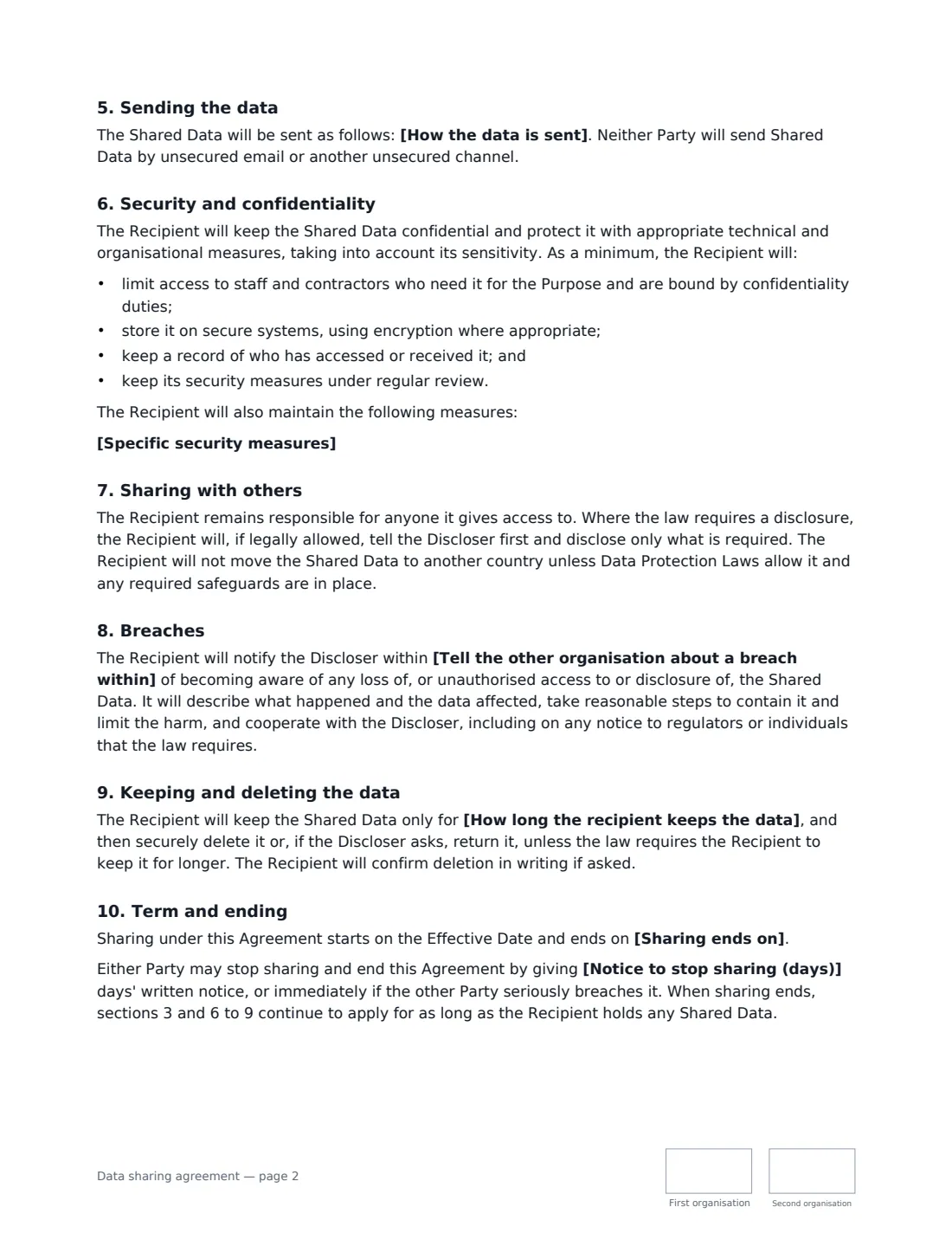
The template works one way or both ways: you choose whether the first organisation shares, the second shares, or both do. It records the purpose, the data, how it is sent and a baseline of security measures, with room to add more. It sets whether the recipient may pass the data on and to whom, a breach notice period, how long the data is kept and when sharing ends. If the data is about identifiable people, fill in whose data it is. This adds the privacy clauses: each organisation's own responsibility for the personal data, notices and consents, and help with individuals' rights requests. You can also record the lawful basis you rely on.
- Best for
- Partner organisations, clinics, charities, researchers and businesses sharing data for a joint purpose
- Signed by
- Both organisations, through an authorised person
- Direction
- One way or both ways, chosen when you fill it in
- Length
- About 3 pages, initialled on every page
When to Use a data sharing agreement
- Two healthcare or care providers sharing referral and follow-up information
- A charity and a local authority coordinating support for the same clients
- Research partners sharing survey or study data for a joint project
- Two businesses sharing customer lists for a co-branded campaign, where the law allows
- A franchisor and franchisee exchanging customer and sales data
What You Fill In
21 blanks, then the name and email of each person who signs: first organisation, second organisation.
1 The parties
- Effective date*
- First organisation*
- First organisation address
- Second organisation*
- Second organisation address
2 The sharing
- Who shares data with whom* Both organisations share data with each other · The First Organisation shares data with the Second Organisation · The Second Organisation shares data with the First Organisation
- Purpose of the sharing*
3 The data
- What data is shared*
- Whose personal data
- Legal basis for sharing
4 Sending and security
- How the data is sent*
- Specific security measures
- May the recipient pass the data on?* Only to its own service providers · Not to anyone else · To service providers and the partners named below
- Partners who may also receive it
5 Keeping and deleting
- How long the recipient keeps the data*
- Sharing ends on
- Notice to stop sharing (days)*
- Tell the other organisation about a breach within* 24 hours · 48 hours · 72 hours
6 Contacts
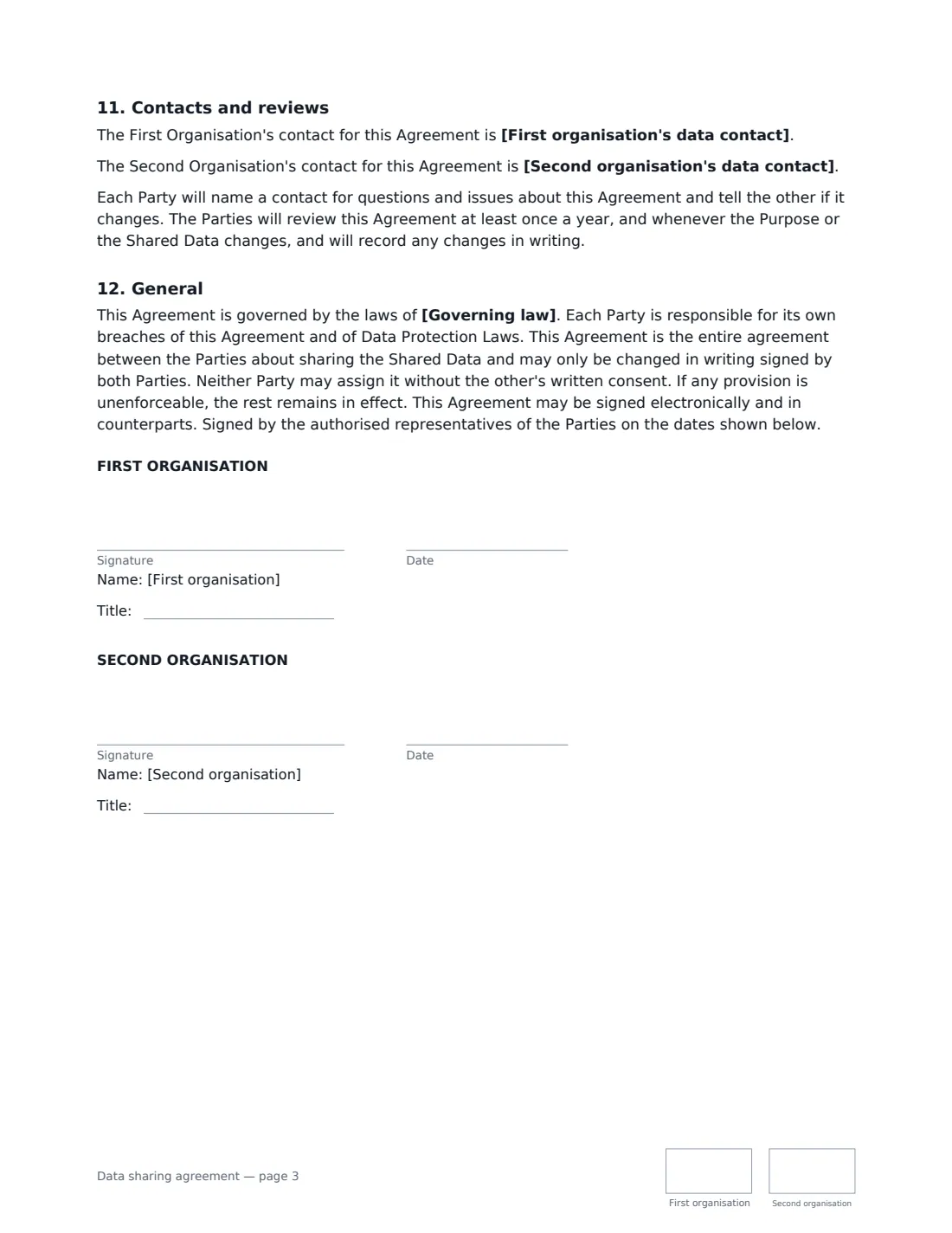
- First organisation's data contact
- Second organisation's data contact
- Governing law*
7 Who signs
- First organisation signature and date, job title, initials on every page
- Second organisation signature and date, job title, initials on every page
What the data sharing agreement Covers
- Purpose
- The shared data
- Use of the data
- Legal compliance
- Sending the data
- Security and confidentiality
- Sharing with others
- Breaches
- Keeping and deleting the data
- Term and ending
- Contacts and reviews
- General
Using the data sharing agreement, step by step
1 State the purpose and direction
Describe why the data is shared, specifically enough to limit its use. Then choose who shares with whom. When both organisations share, each is bound as recipient for the data it receives.
2 Describe the data
List the data items shared. If they are about people, say whose data it is and, if you know it, the lawful basis for sharing, such as consent collected on a form. Leave "whose personal data" empty for purely aggregate or non-personal data.
3 Agree how it is sent and protected
Say how the data travels, for example an encrypted upload to a secure folder. Add any security measures beyond the baseline. Choose whether the recipient may pass it on, only to its own service providers or also to named partners.
4 Set retention, contacts and send
Say how long the recipient keeps the data, when sharing ends, the notice to stop sharing and the breach notice time. Name a data contact for each side, then add the other organisation's signer and send.
Tips Before You Send It
- Share only what the purpose needs. The agreement commits the discloser to that, and it reduces what can go wrong.
- Some sectors (health, education, finance) have their own rules on sharing and retention. Check any that apply before relying on this template.
- Review the agreement at least once a year, as it provides, and whenever the purpose or the data changes.
- If one organisation is only handling data on the other's behalf, use a data processing agreement instead.
Sign It Online In Minutes
- Fill in the blanks. Names, dates and amounts go straight into the agreement — the preview shows exactly where.
- Name who signs. Tick “This is me” for your own part. VergeHR builds the PDF with every signature, date and initials box on the right line, and you can check or move anything before sending.
- Send it. Each signer gets a secure link and signs from any device — no account needed. The signed PDF, with an audit trail and a Certificate of Completion, is filed in Files and emailed to everyone.
Data sharing agreement: frequently asked questions
What is the difference between a data sharing agreement and a data processing agreement?
A data processing agreement is for a vendor that handles data only on a business's instructions. A data sharing agreement is for organisations that each use the shared data for their own purposes within agreed limits, so each is responsible for its own compliance.
Is a data sharing agreement a legal requirement?
It depends on the law that applies and the data involved. Regulators such as the UK Information Commissioner's Office recommend one for regular sharing of personal data, and it is the practical way to show what was agreed. Check the rules in your country and sector.
Can we use it for non-personal data?
Yes. Leave "whose personal data" empty. The confidentiality, use, security, onward sharing, breach and deletion clauses still apply.
Is it valid when signed electronically?
Electronic signatures are generally valid for ordinary agreements like this in the US (ESIGN Act and UETA), the UK, the EU (eIDAS) and Canada. VergeHR keeps an audit trail and a Certificate of Completion with the signed PDF.