

What is a dress code policy acknowledgement?
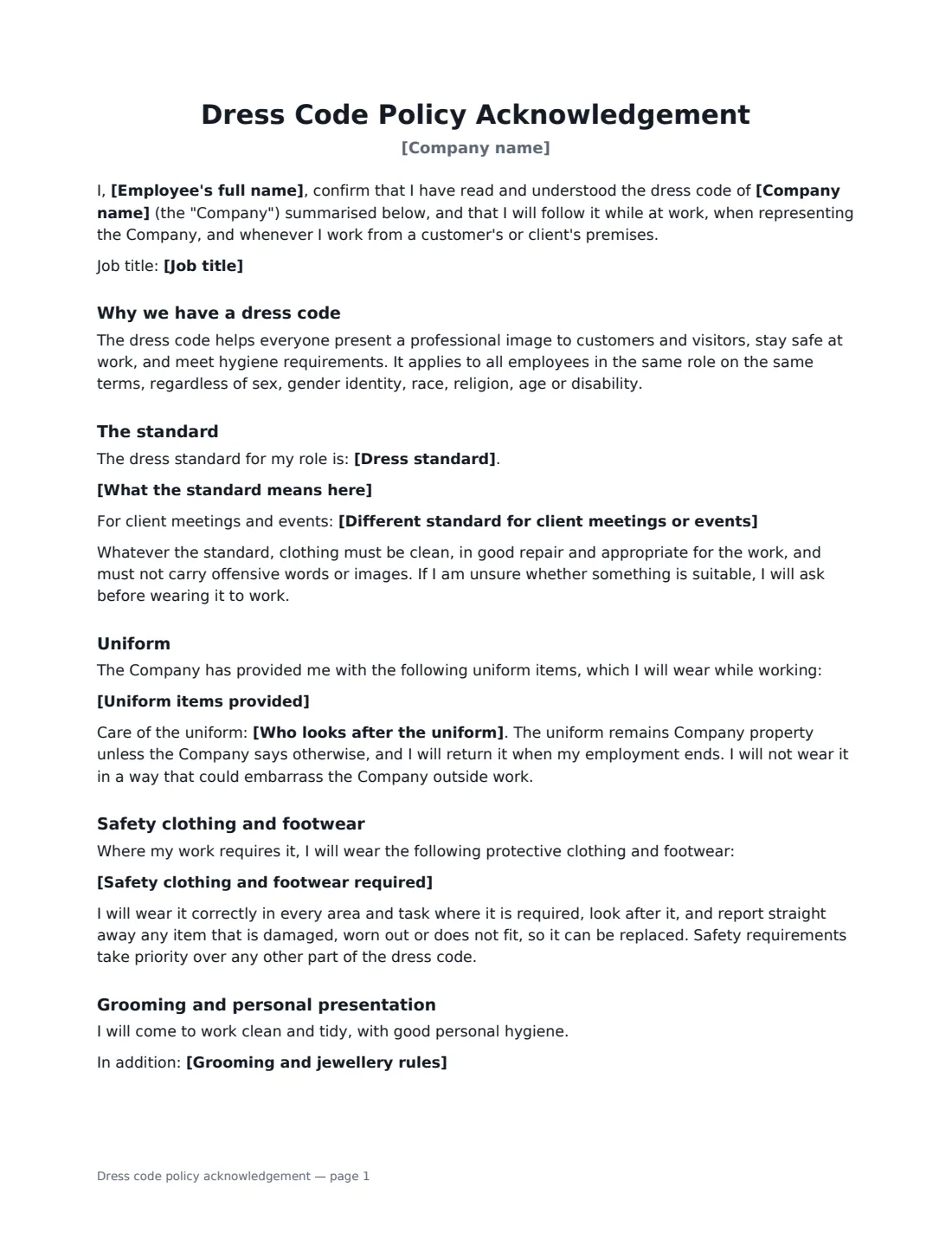
A dress code works when it is clear, applies equally to everyone in the same role, and makes room for people's religious, cultural, medical and disability needs. A signed acknowledgement records that the employee has seen the rules, so a later conversation about a missing safety boot or a slogan T-shirt starts from an agreed standard rather than an argument.
This template lets you choose the dress standard — business formal, business casual, smart casual, company uniform, or casual, safe and tidy — and describe what it means in your workplace, including a different standard for client meetings. Optional sections list uniform items and who looks after them, required safety clothing and footwear, and grooming or jewellery rules needed for safety or hygiene, plus an ID badge rule. It includes an equal-application statement, a reasonable-adjustments clause with a named contact, and a fair process when the dress code is not followed.
- Best for
- Offices, retail, hospitality, healthcare support, warehouses and customer-facing roles
- Signed by
- The employee and a manager or HR
- Standards
- Business formal, business casual, smart casual, uniform, or casual, safe and tidy
- Length
- 2 pages
When to Use a dress code policy acknowledgement
- Issuing uniforms to new retail or hospitality staff
- Introducing safety footwear and hi-vis rules in a warehouse
- Moving an office from business formal to business casual
- Setting hair and jewellery rules in food or machinery areas
- Clarifying what to wear for client meetings and events
What You Fill In
12 blanks, then the name and email of each person who signs: employee, employer.
1 Details
- Company name*
- Employee's full name*
- Job title
2 The dress code
- Dress standard* Business formal · Business casual · Smart casual · Company uniform · Casual, safe and tidy
- What the standard means here
- Different standard for client meetings or events
3 Uniform and safety clothing
- Uniform items provided
- Who looks after the uniform The employee washes it; the Company replaces worn items · The Company launders it · The employee washes and replaces it at their own cost
- Safety clothing and footwear required
4 Grooming
- Grooming and jewellery rules
- ID badge must be worn* Yes · No
- Who to ask about adjustments*
5 Who signs
- Employee signature and date
- Employer signature and date, job title · A manager or HR person signing for the company.
What the dress code policy acknowledgement Covers
- Why we have a dress code
- The standard
- Uniform
- Safety clothing and footwear
- Grooming and personal presentation
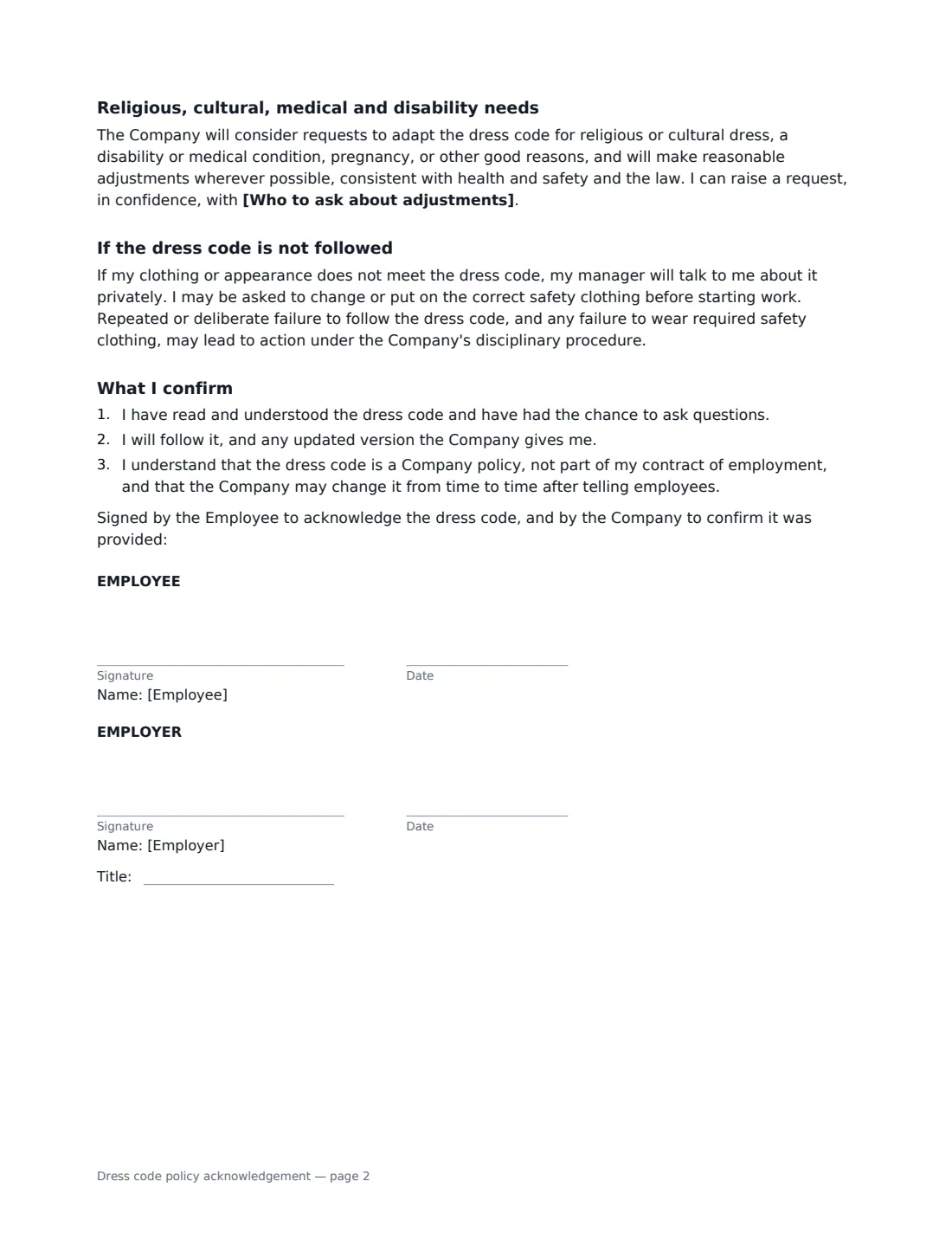
- Religious, cultural, medical and disability needs
- If the dress code is not followed
- What I confirm
Using the dress code policy acknowledgement, step by step
1 Choose the standard
Pick the dress standard for the role, then describe what it means in practice, one line each — the kinds of tops, trousers and shoes that are fine, and what is not. Write rules that apply the same way to everyone.
2 Add uniform and safety clothing
List any uniform items you provide and choose who launders and replaces them. List safety clothing and footwear required in particular areas; the document says safety rules come first.
3 Set grooming and badge rules
Only add grooming rules you need for safety or hygiene, such as tying back long hair near machinery. Choose whether an ID badge must be worn.
4 Name who handles adjustments
Say who employees can speak to, in confidence, about religious or cultural dress, a disability, pregnancy or a medical need.
5 Sign and keep
Send it for signature at onboarding or when the dress code changes, and keep the signed copy in Files.
Tips Before You Send It
- Base rules on the job, safety and hygiene, not personal taste, and apply them equally regardless of sex or gender identity.
- Whether you can charge employees for uniforms, or ask them to change in unpaid time, depends on local law — check before you decide.
- Required protective equipment is normally the employer's cost; list it under safety clothing.
- Handle breaches privately and start with a conversation, as the template does.
Sign It Online In Minutes
- Fill in the blanks. Names, dates and amounts go straight into the agreement — the preview shows exactly where.
- Name who signs. Tick “This is me” for your own part. VergeHR builds the PDF with every signature, date box on the right line, and you can check or move anything before sending.
- Send it. Each signer gets a secure link and signs from any device — no account needed. The signed PDF, with an audit trail and a Certificate of Completion, is filed in Files and emailed to everyone.
Dress code policy acknowledgement: frequently asked questions
Can a dress code treat men and women differently?
Rules that are stricter for one sex, or based on stereotypes, can be discriminatory in many countries. The template states that the dress code applies to everyone in the same role on the same terms.
What about religious dress or a disability?
The template commits the company to consider requests for religious or cultural dress, disability, medical needs and pregnancy, and to make reasonable adjustments wherever possible, and names who to ask.
Is the dress code part of the employment contract?
No. The acknowledgement says it is a company policy that may be changed after telling employees. The employee confirms they have read it and will follow it.
Can employees sign on their phones?
Yes. Signers don't need an account. Electronic signatures are generally valid for workplace documents like this in the US (ESIGN and UETA), the UK, the EU (eIDAS) and Canada.