


What is a attendance policy acknowledgement?
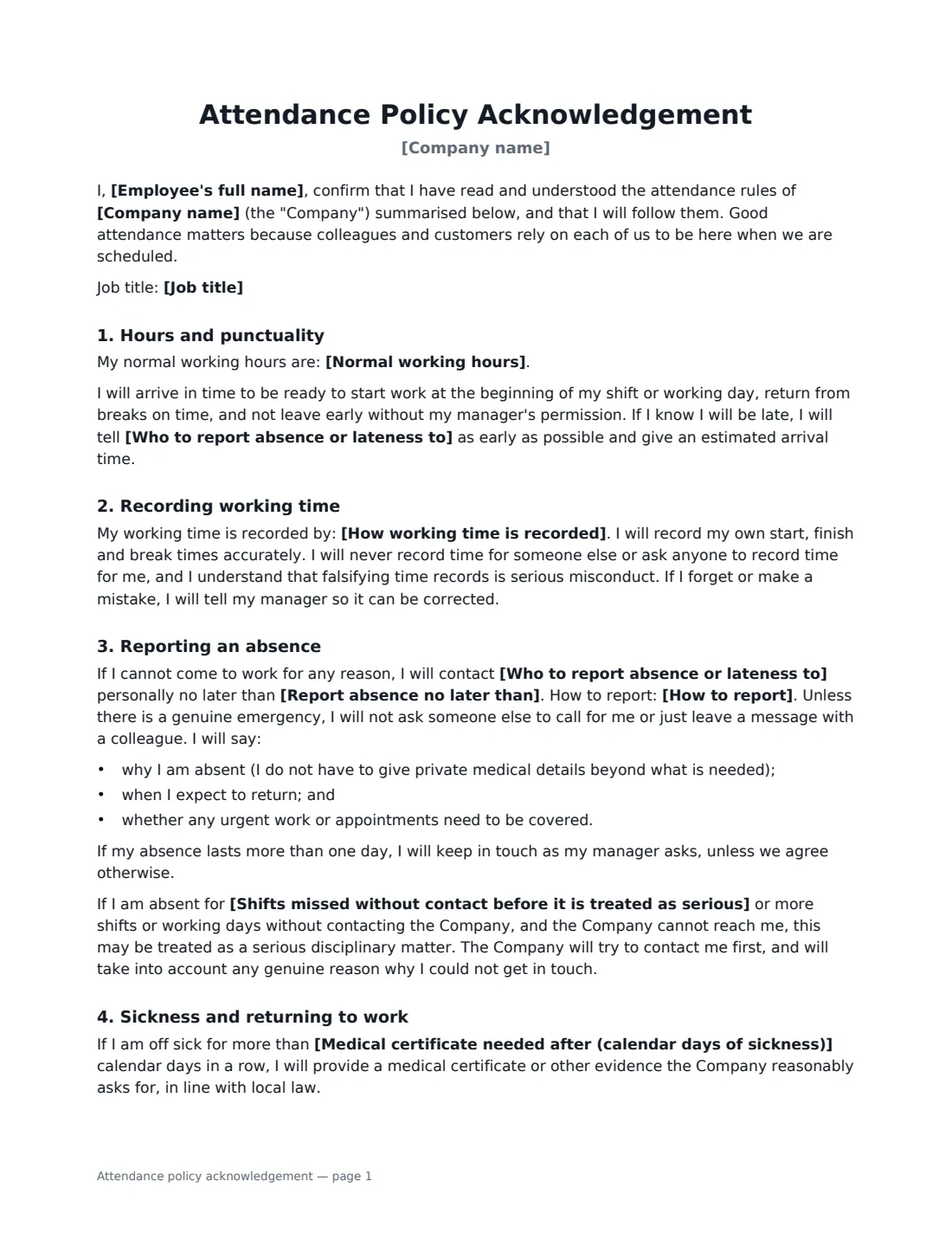
Attendance problems are much easier to handle when the rules were clear from day one. An attendance policy acknowledgement sets out, in plain language, when to arrive, how time is recorded, exactly who to call and by when if you are sick or late, and how repeated lateness or absence is handled — and records that the employee agreed to it.
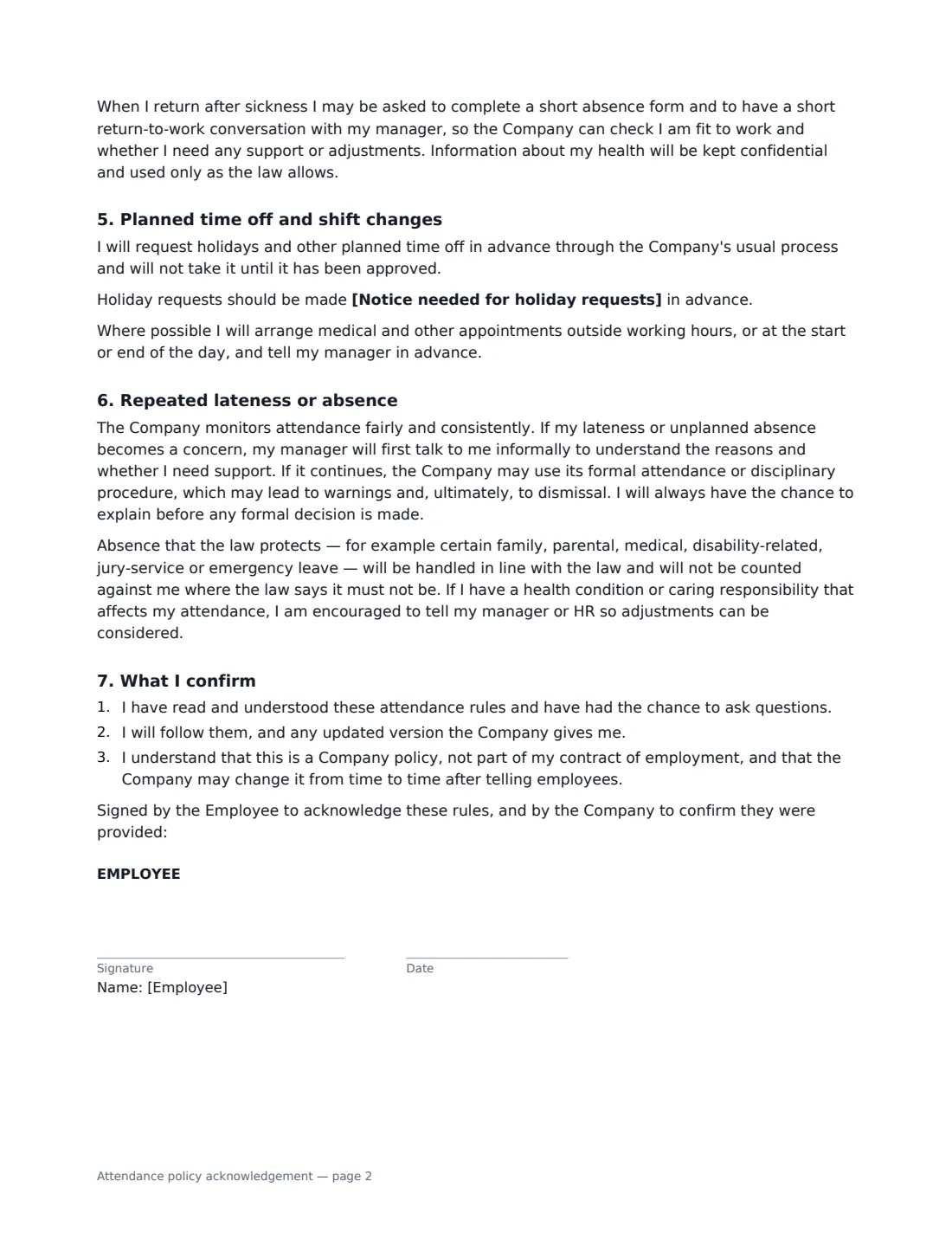
This template lets you fill in normal hours or rota arrangements, how time is recorded (clocking, timesheet or sign-in), who to report absence to, how (phone call only, call or text, the scheduling app, or call or email) and by when. Optional clauses cover when a medical certificate is needed, how many missed shifts without contact become a serious matter, and holiday notice; you choose whether shift swaps are allowed with approval. It also sets out a fair process — an informal conversation first, then the formal procedure — and makes clear that absence protected by law is not counted against the employee.
- Best for
- Shift-based and hourly teams: retail, hospitality, care, call centres, warehouses
- Signed by
- The employee and a manager or HR
- Choices
- Time recording, how and when to report, sick-note trigger, no-contact rule, shift swaps
- Length
- 2 pages
When to Use a attendance policy acknowledgement
- Onboarding new hourly or shift-working staff
- Introducing a new call-in rule, such as phone calls only
- Tightening up after a run of late arrivals or no-shows
- Launching a scheduling app for shift swaps and absence
- Giving managers a consistent standard across several locations
What You Fill In
12 blanks, then the name and email of each person who signs: employee, employer.
1 Details
- Company name*
- Employee's full name*
- Job title
2 Hours and timekeeping
- Normal working hours
- How working time is recorded* Clocking in and out on the time system · A timesheet approved by the manager · Signing in and out
3 Reporting absence
- Who to report absence or lateness to*
- How to report* By phone call, not by text or email · By phone call or text message · Through the scheduling app, followed by a call · By phone call or email
- Report absence no later than*
4 Sickness
- Medical certificate needed after (calendar days of sickness)
- Shifts missed without contact before it is treated as serious
5 Holidays and shift changes
- Shift swaps* Allowed with the manager's approval in advance · Not allowed · Not applicable — no shift work
- Notice needed for holiday requests
6 Who signs
- Employee signature and date
- Employer signature and date, job title · A manager or HR person signing for the company.
What the attendance policy acknowledgement Covers
- Hours and punctuality
- Recording working time
- Reporting an absence
- Sickness and returning to work
- Planned time off and shift changes
- Repeated lateness or absence
- What I confirm
Using the attendance policy acknowledgement, step by step
1 Set hours and time recording
Describe normal hours or how the rota works, then choose how time is recorded. The document forbids recording time for someone else and treats falsified records as serious misconduct.
2 Define the call-in rule
Say who to contact (and who if they are unavailable), how, and the deadline — for example one hour before the shift starts. The employee must call personally except in a genuine emergency.
3 Add sickness rules that fit local law
If you want a medical certificate after a number of days, enter it — but check your local rules first, as many places set when a doctor's note can be required.
4 Choose shift swap and holiday rules
Allow swaps only with a manager's approval, ban them, or mark shift work as not applicable. Add how much notice holiday requests need.
5 Sign and file
Send for signature and keep the signed copy in Files, so managers can refer to it when a conversation about attendance is needed.
Tips Before You Send It
- A phone-call rule makes sure a manager actually knows about an absence — texts are easy to miss at 6am.
- Start with a supportive conversation. Repeated absence sometimes points to a health or caring issue you can help with.
- Never count legally protected leave — such as family, disability-related or jury-service leave — against an employee. The template says so.
- Apply the policy consistently across the team; inconsistency is what makes attendance decisions hard to defend.
Sign It Online In Minutes
- Fill in the blanks. Names, dates and amounts go straight into the agreement — the preview shows exactly where.
- Name who signs. Tick “This is me” for your own part. VergeHR builds the PDF with every signature, date box on the right line, and you can check or move anything before sending.
- Send it. Each signer gets a secure link and signs from any device — no account needed. The signed PDF, with an audit trail and a Certificate of Completion, is filed in Files and emailed to everyone.
Attendance policy acknowledgement: frequently asked questions
Can I require a doctor's note after one day?
It depends on where you are. Many countries, states and provinces set rules on when employers can ask for medical evidence, so the template leaves the number of days as an optional blank for you to fill in after checking.
What is a 'no call, no show' rule?
It covers an employee who misses shifts without contacting anyone. The optional clause says that after the number of shifts you set, it may be treated as a serious disciplinary matter — but the company will try to contact the employee first and consider genuine reasons.
Does this replace my disciplinary procedure?
No. It refers to your formal attendance or disciplinary procedure and commits to an informal conversation first and a chance to explain before any formal decision.
Is an electronic signature valid for this?
Generally, yes. Electronic signatures are valid for a workplace policy acknowledgement in most places, including the US (ESIGN and UETA), the UK, the EU (eIDAS) and Canada. VergeHR records the audit trail.