

What is a escrow agreement?
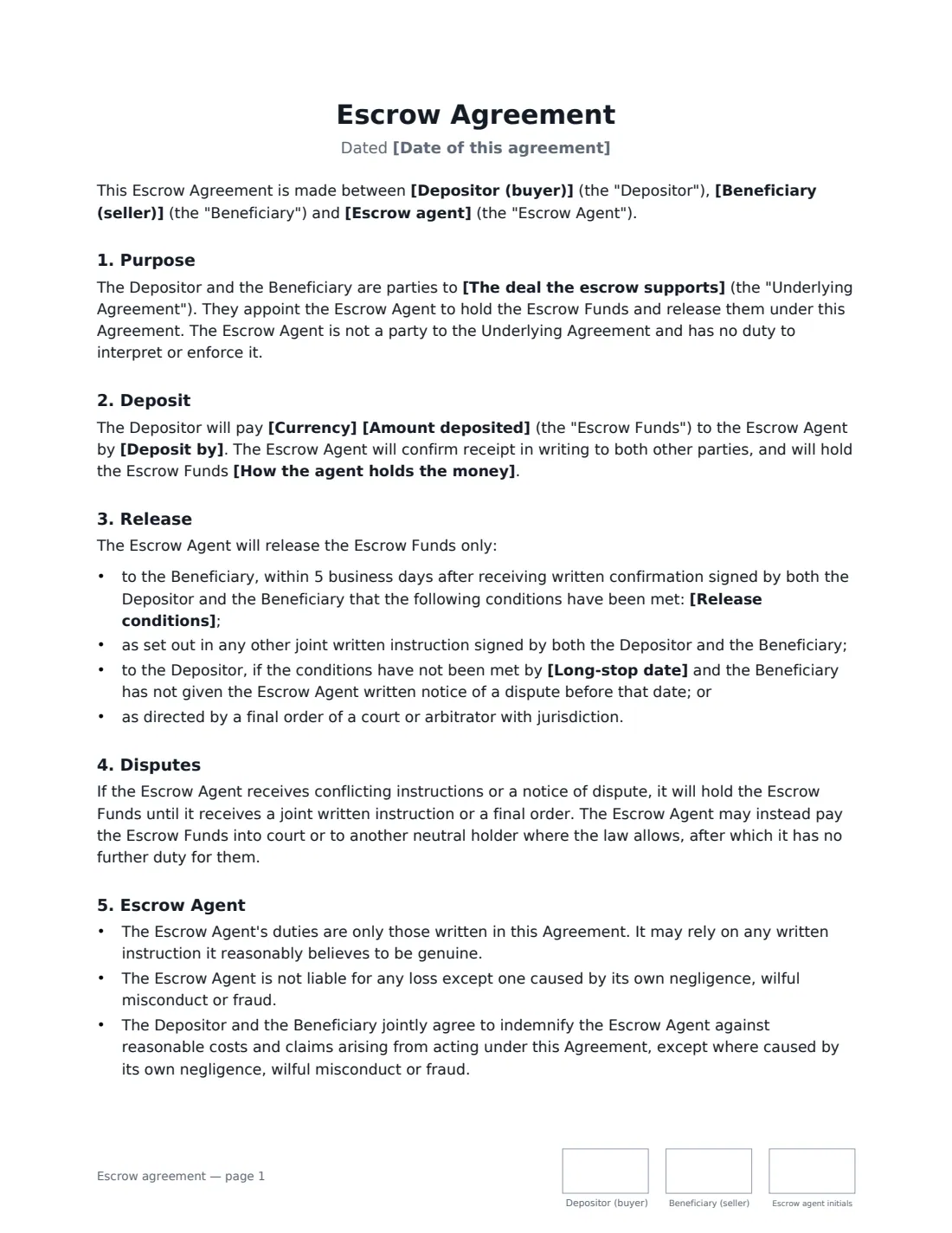
In many deals the buyer does not want to pay until something has happened, and the seller does not want to hand over until they know the money exists. An escrow solves this: a neutral escrow agent holds the funds and releases them when agreed conditions are met, or returns them if they are not.
This three-party template covers the underlying deal, the amount and deposit date, how the agent holds the money, objective release conditions, a long-stop date for return to the buyer, what happens if the parties disagree, the agent's limited duties, liability and indemnity, its fee and who pays, and the identity checks the agent may need to carry out.
- Best for
- Business sales, holdbacks, deposits and milestone payments
- Signed by
- Depositor (buyer), beneficiary (seller) and escrow agent
- Release
- Joint instruction, conditions met, long-stop return, or court order
- Length
- About 2 pages, initialled on every page
When to Use a escrow agreement
- Holding back part of the price in a small business sale
- Holding a deposit while a lease or licence is transferred
- Domain name or website sales between strangers
- Milestone payments under a development project
- Holding funds pending a regulatory approval
What You Fill In
14 blanks, then the name and email of each person who signs: depositor (buyer), beneficiary (seller), escrow agent.
1 The parties
- Date of this agreement*
- Depositor (buyer)*
- Beneficiary (seller)*
- Escrow agent*
2 The deal
- The deal the escrow supports*
3 The money
- Currency*
- Amount deposited*
- Deposit by*
- How the agent holds the money* in a separate client or trust account, not mixed with the agent's own money · in a separate interest-bearing client or trust account, with interest following the money
4 Release
- Release conditions*
- Long-stop date*
5 Fees
- Escrow agent's fee*
- Fee paid by* the Depositor and the Beneficiary equally · the Depositor · the Beneficiary
- Governing law*
6 Who signs
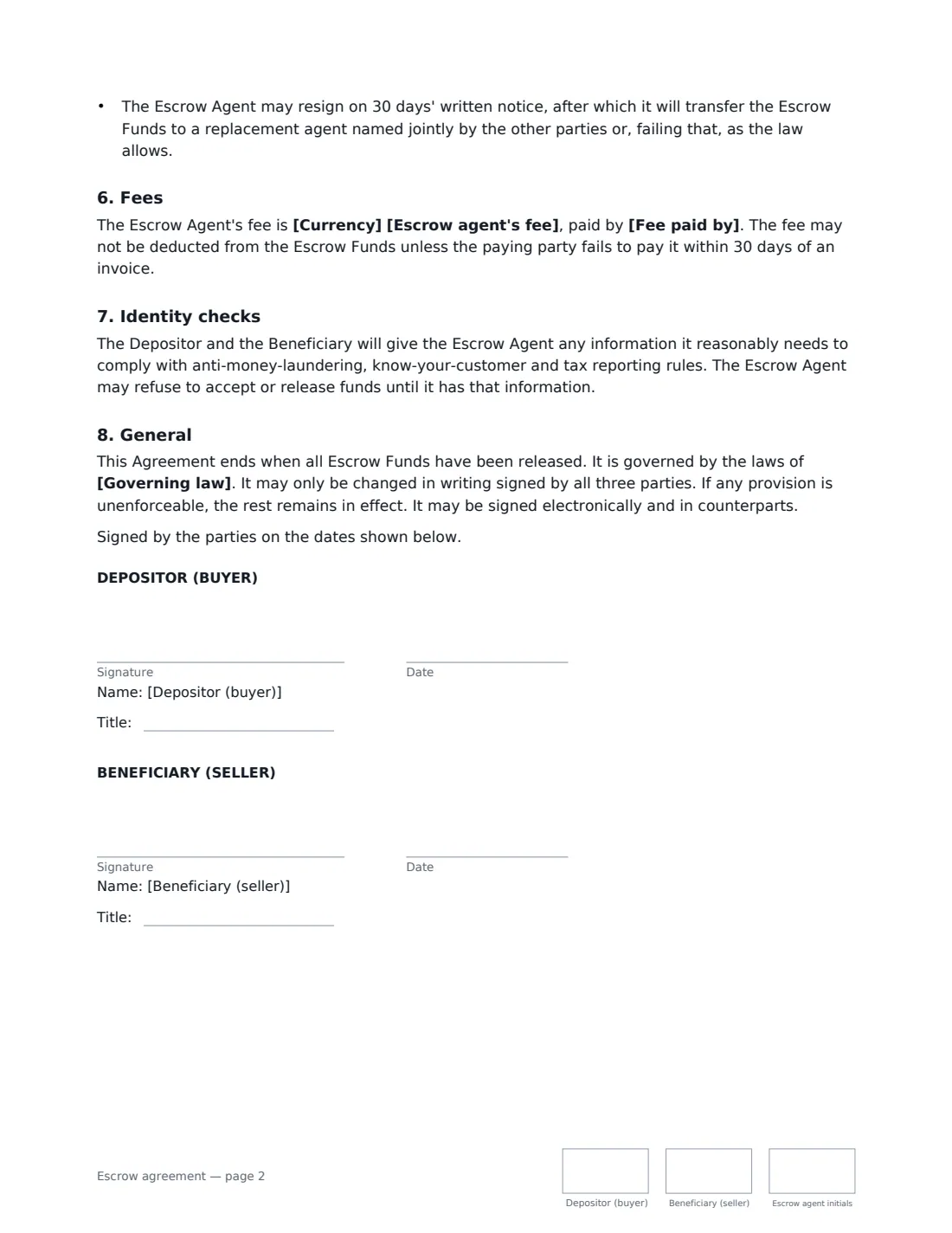
- Depositor (buyer) signature and date, job title, initials on every page · The party paying money into escrow.
- Beneficiary (seller) signature and date, job title, initials on every page · The party who receives the money when the conditions are met.
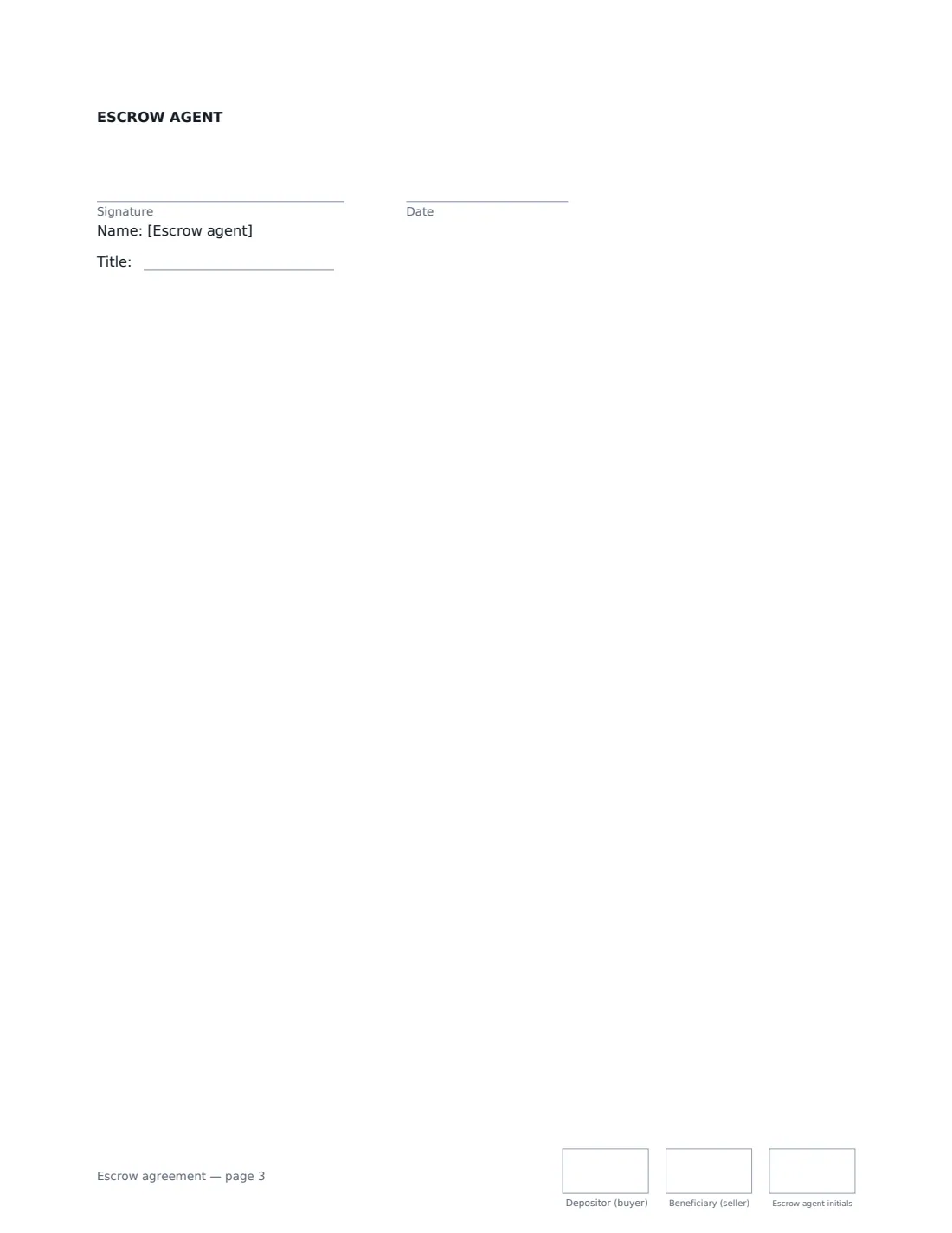
- Escrow agent signature and date, job title, initials on every page · A neutral party such as a lawyer, bank or licensed escrow company.
What the escrow agreement Covers
- Purpose
- Deposit
- Release
- Disputes
- Escrow Agent
- Fees
- Identity checks
- General
Using the escrow agreement, step by step
1 Name the three parties
Enter the buyer, the seller and the escrow agent: a lawyer, bank or escrow company that is genuinely neutral.
2 Describe the deal and money
Identify the underlying agreement, the amount, the deposit date and whether the account bears interest.
3 Write objective release conditions
Say what document or event proves each condition. Set a long-stop date for the money to go back if they are not met.
4 Agree the fee and sign
Set the agent's fee and who pays it, then send to all three. VergeHR places every party's signature and initials boxes.
Tips Before You Send It
- In some places holding money for others is a licensed activity. Make sure the agent may lawfully act.
- Conditions the agent can check from a document work best; avoid anything that needs the agent to make a judgment.
- Always confirm the agent's bank details by phone before transferring; escrow payments are a target for fraud.
- Keep the escrow agreement consistent with the release terms in the main deal document.
Sign It Online In Minutes
- Fill in the blanks. Names, dates and amounts go straight into the agreement — the preview shows exactly where.
- Name who signs. Tick “This is me” for your own part. VergeHR builds the PDF with every signature, date and initials box on the right line, and you can check or move anything before sending.
- Send it. Each signer gets a secure link and signs from any device — no account needed. The signed PDF, with an audit trail and a Certificate of Completion, is filed in Files and emailed to everyone.
Escrow agreement: frequently asked questions
Who can be an escrow agent?
Usually a lawyer, a bank, a licensed escrow company or another professional neutral to both sides. Rules on who may hold client money vary by place.
What happens if buyer and seller disagree?
The agent keeps holding the money until it receives a joint instruction or a final court or arbitration order, and may pay it into court where the law allows.
Does the agent decide whether conditions are met?
No. The agent only acts on written confirmations, joint instructions or orders. It does not interpret the main deal.
Is interest paid on the money?
Only if you choose an interest-bearing account, in which case interest follows the money.