

What is a asset purchase agreement?
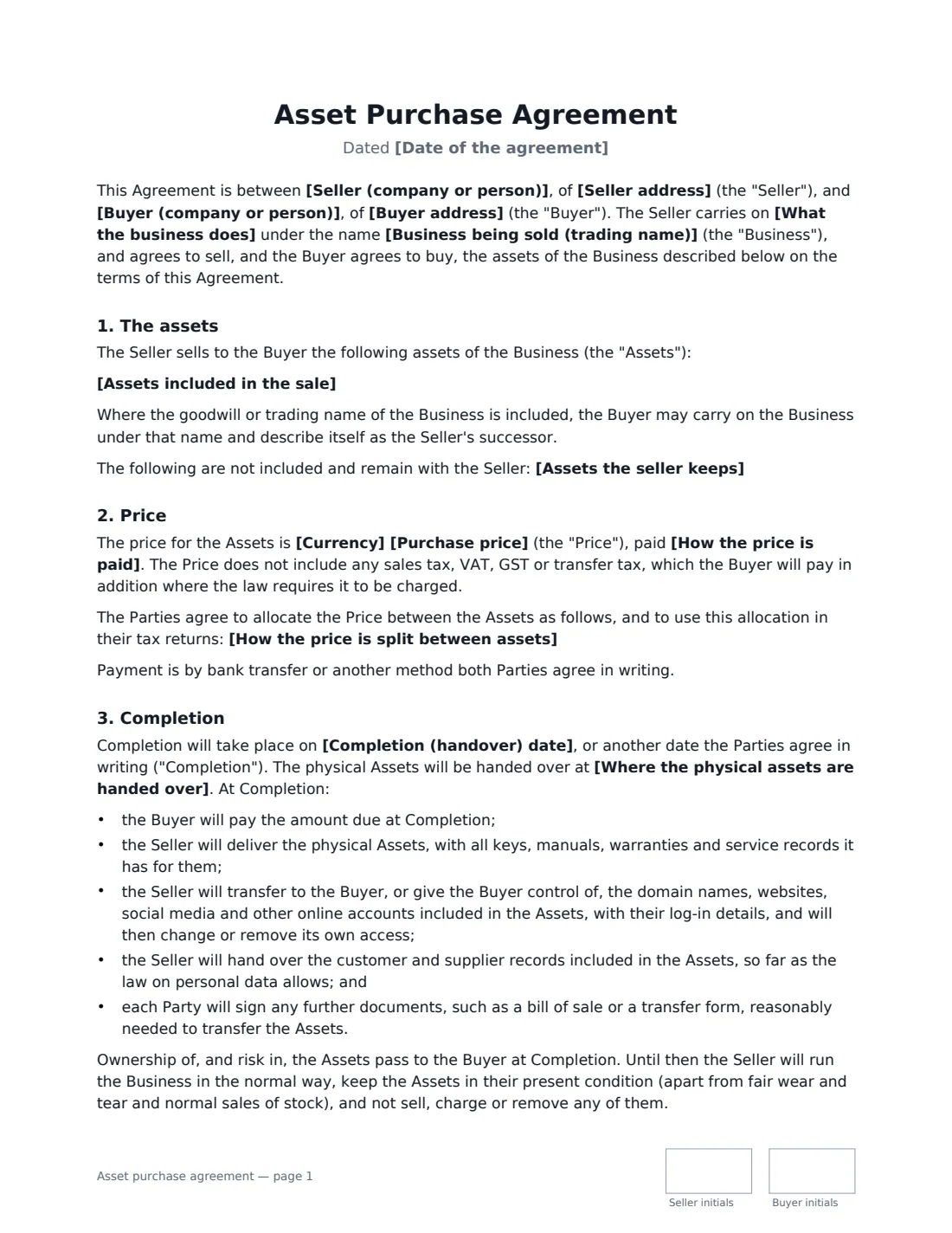
In an asset purchase the buyer takes over the things a business uses — its equipment, stock, trading name, website and domain names, social accounts, customer lists and goodwill — rather than buying the company that owns them. It is the usual way a sole trader or small company sells a café, an online shop, a studio or a service business, because the buyer chooses what it takes and, unless it agrees otherwise, leaves the seller's debts behind.
This template sets out the assets included and any the seller keeps, the price and whether it is paid in full, with a deposit or partly in instalments, an optional allocation of the price between assets, the completion date and handover steps (including online accounts), which obligations the buyer takes over, the seller's promises about ownership and condition, a claim period and liability cap, an optional handover support period and an optional promise not to compete.
- Best for
- Selling or buying a small business's assets, or an online business
- Signed by
- Seller and buyer — an authorised person for each
- Payment
- In full at completion, deposit then balance, or partly in instalments
- Length
- About 3 pages, initialled on every page
When to Use a asset purchase agreement
- Selling a café, salon, studio or shop's equipment, stock, name and goodwill
- Buying an e-commerce store with its domain, website, social accounts and customer list
- A sole trader selling their business to a new owner as a going concern
- Buying a competitor's equipment and client list without taking over the company
- Recording the terms after a letter of intent has been agreed
What You Fill In
24 blanks, then the name and email of each person who signs: seller, buyer.
1 The parties
- Date of the agreement*
- Seller (company or person)*
- Seller address
- Buyer (company or person)*
- Buyer address
2 The business
- Business being sold (trading name)*
- What the business does*
- Assets included in the sale*
- Assets the seller keeps
3 Price and payment
- Currency*
- Purchase price*
- How the price is paid* in full at completion · as a deposit now and the balance at completion · partly at completion and the rest in instalments
- Deposit (or amount paid at completion, for instalments)
- Instalment schedule
- How the price is split between assets
4 Handover
- Completion (handover) date*
- Where the physical assets are handed over
- Seller helps with the handover for (days)
- Obligations the buyer takes over
5 Seller's promises
- Known problems the seller discloses
- Buyer can claim under the seller's promises for (months)*
- Seller won't compete for (months)
- Area the seller won't compete in
6 Handover
- Governing law*
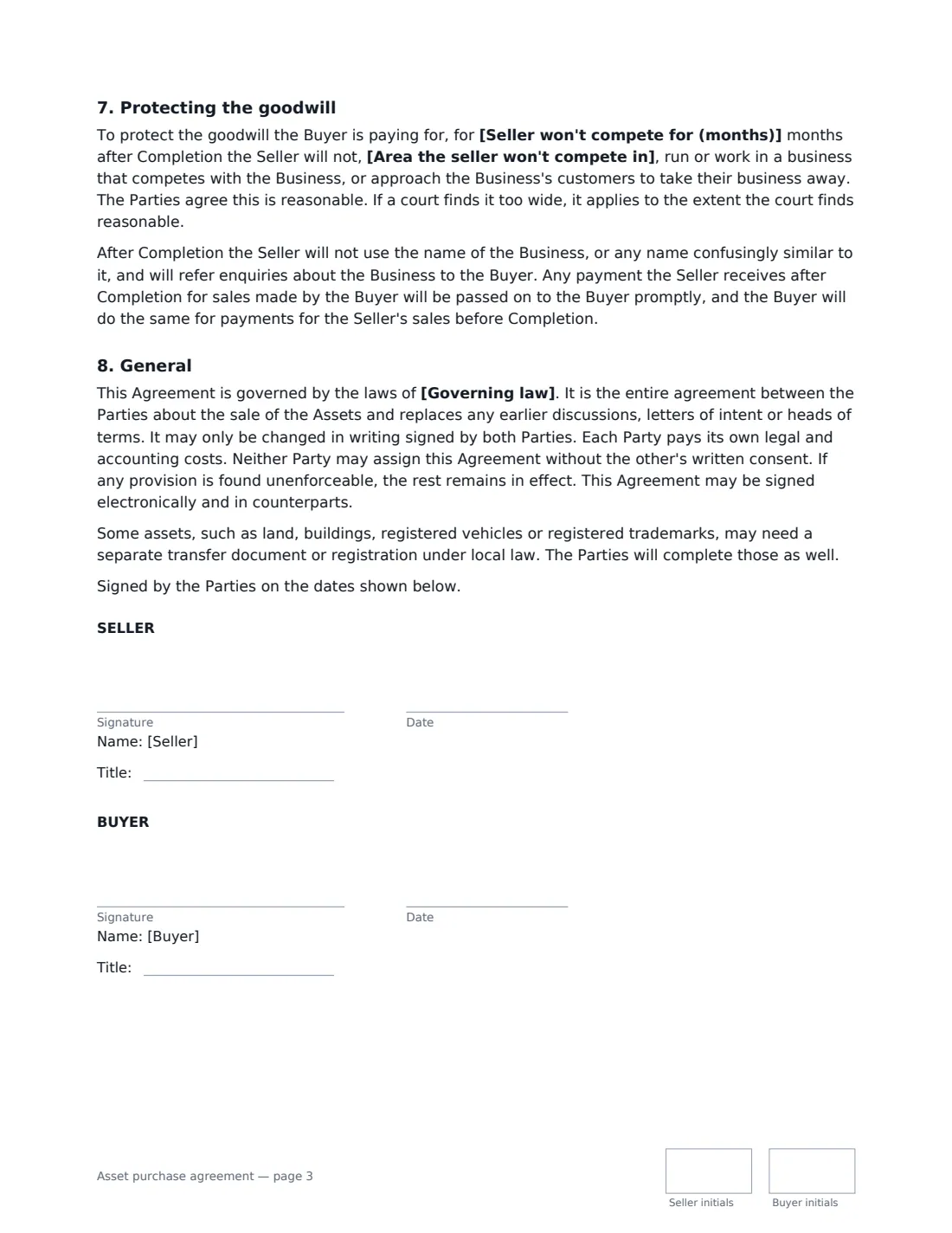
7 Who signs
- Seller signature and date, job title, initials on every page · The owner of the business assets — a company or the sole trader who runs it.
- Buyer signature and date, job title, initials on every page
What the asset purchase agreement Covers
- The assets
- Price
- Completion
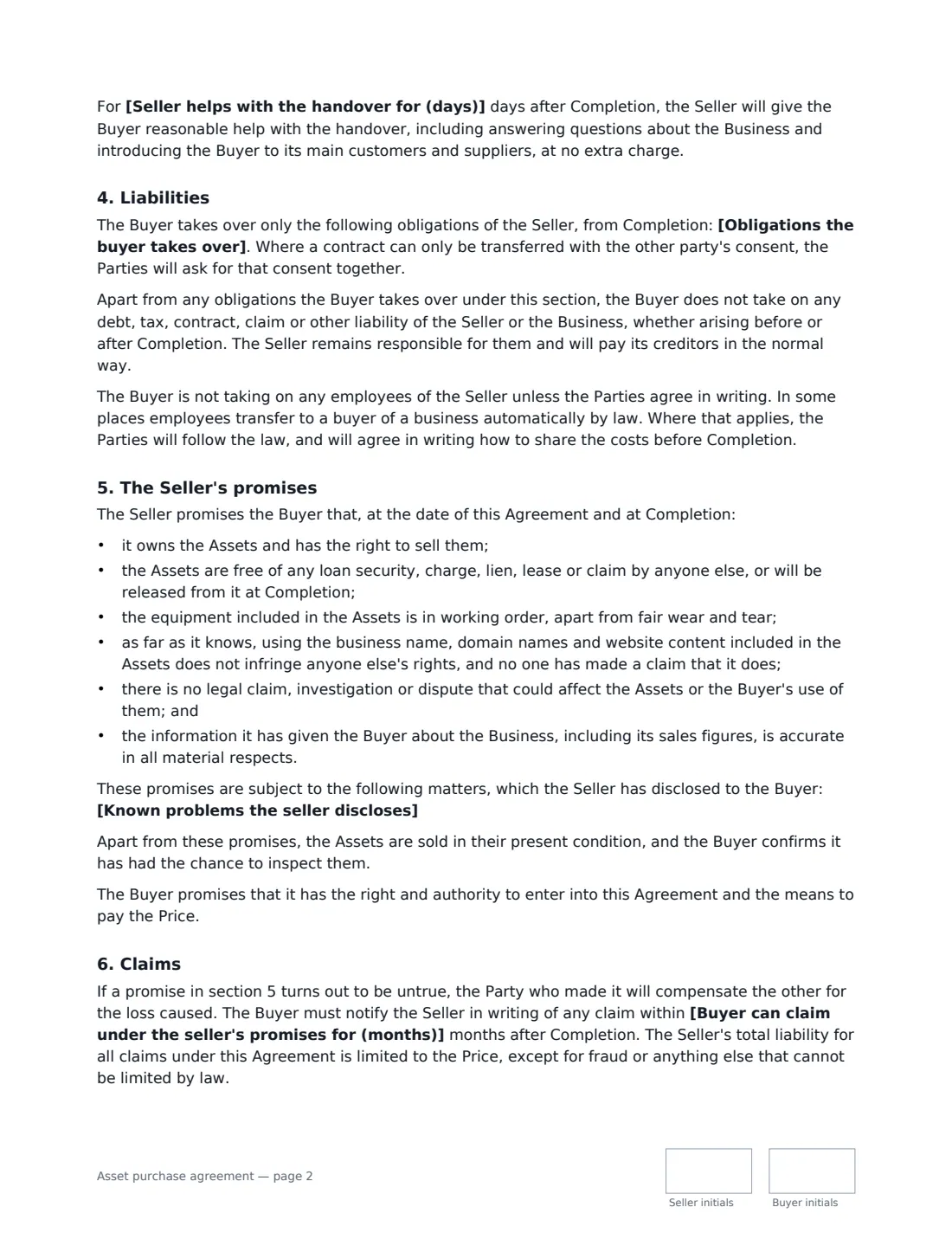
- Liabilities
- The Seller's promises
- Claims
- Protecting the goodwill
- General
Using the asset purchase agreement, step by step
1 List the assets
Describe everything the buyer gets, and anything the seller keeps, such as cash, bank accounts or a vehicle. For a long equipment list, write "the equipment listed in Schedule A" and attach the list to the envelope.
2 Set the price and how it is paid
Choose full payment at completion, a deposit now with the balance at completion, or part at completion and the rest in instalments. If you agree how the price is split between equipment, stock and goodwill, add it — an accountant can tell you whether it matters for your taxes.
3 Plan the handover
Pick the completion date and place. The template lists what happens at completion, from keys and manuals to passwords for the domain and social accounts. Add a support period if the seller will introduce the buyer to customers and suppliers.
4 Record liabilities, disclosures and protections
Name any contracts the buyer takes over, such as the lease. List known problems the seller discloses, set how long the buyer can bring a claim, and add a non-compete period and area only if it is reasonable where you are.
Tips Before You Send It
- Search for loans or security registered against the assets before paying — the seller promises they are free of them, but checking is cheaper than claiming.
- Land, buildings, registered vehicles and registered trademarks usually need their own transfer forms or registration. The template reminds the parties to complete them.
- In some places employees transfer to the buyer of a business automatically by law. Take advice early if the business has staff.
- Whether a promise not to compete can be enforced varies a lot by place. Keep the period and area no wider than you need.
Sign It Online In Minutes
- Fill in the blanks. Names, dates and amounts go straight into the agreement — the preview shows exactly where.
- Name who signs. Tick “This is me” for your own part. VergeHR builds the PDF with every signature, date and initials box on the right line, and you can check or move anything before sending.
- Send it. Each signer gets a secure link and signs from any device — no account needed. The signed PDF, with an audit trail and a Certificate of Completion, is filed in Files and emailed to everyone.
Asset purchase agreement: frequently asked questions
What is the difference between an asset purchase and buying the company?
In an asset purchase the buyer acquires only the listed assets and takes on only the obligations it agrees to. When you buy the company's shares instead, you take the whole company, including its history, contracts and debts. This template is for asset purchases.
Does the buyer take over the seller's debts?
Not under this template, unless they are listed as obligations the buyer takes over. Everything else stays with the seller, who remains responsible for paying its creditors.
Can the price be paid in instalments?
Yes. Choose "partly at completion and the rest in instalments", enter the amount paid at completion and describe the schedule. If an instalment is missed and not paid within 14 days of notice, the whole balance becomes due.
Is an asset purchase agreement valid if signed electronically?
Electronic signatures are generally valid for ordinary commercial contracts in the US (ESIGN Act and UETA), the UK, the EU (eIDAS) and Canada. Transfers of land, and some registered assets, may need a separate document signed in a particular way, such as a deed or a witnessed signature.