

What is a force majeure notice?
Many commercial contracts have a force majeure clause: if an event beyond a party's reasonable control prevents or delays performance, that party is excused for as long as the event lasts — but usually only if it gives prompt notice and tries to reduce the impact. Missing the notice can cost you the protection.
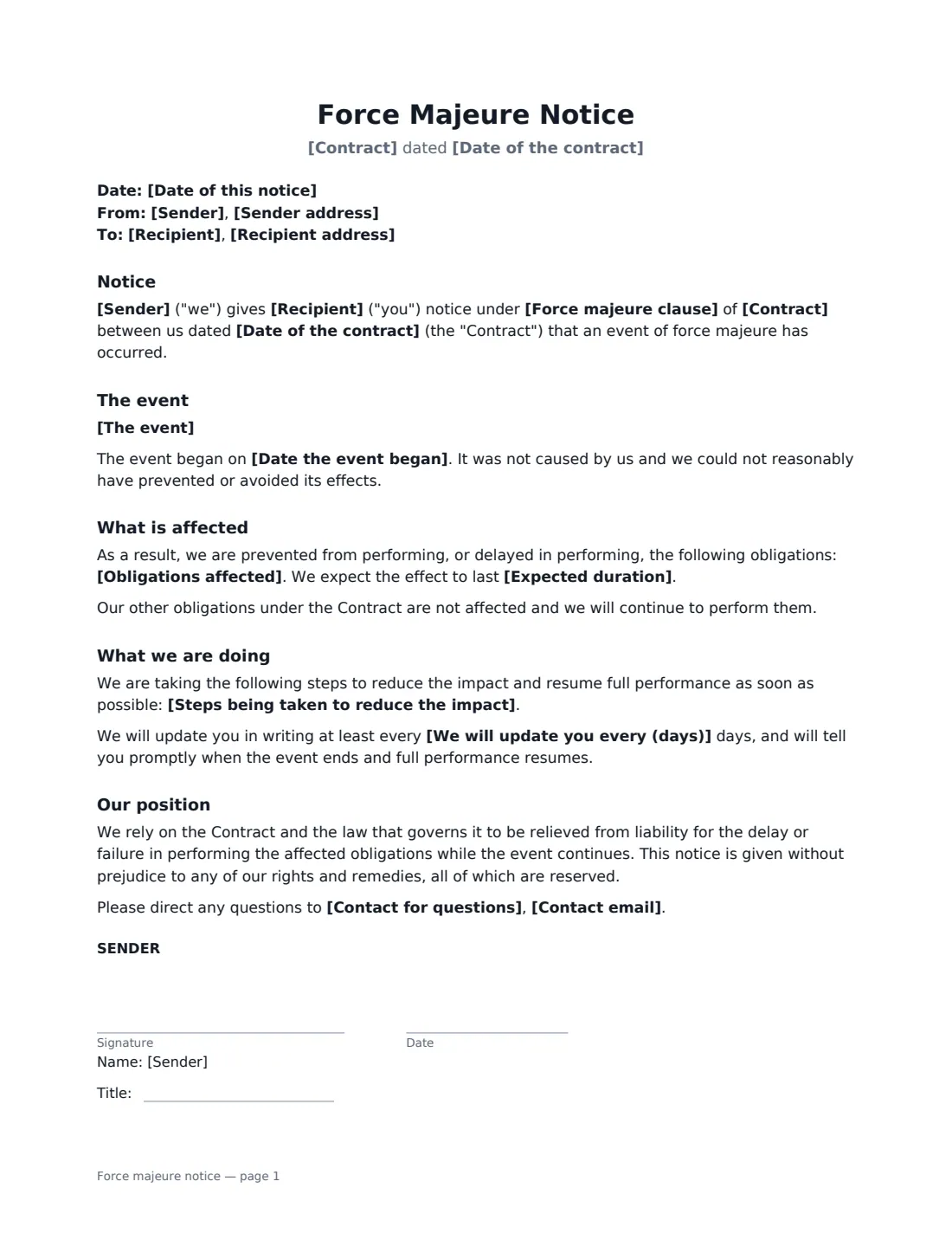
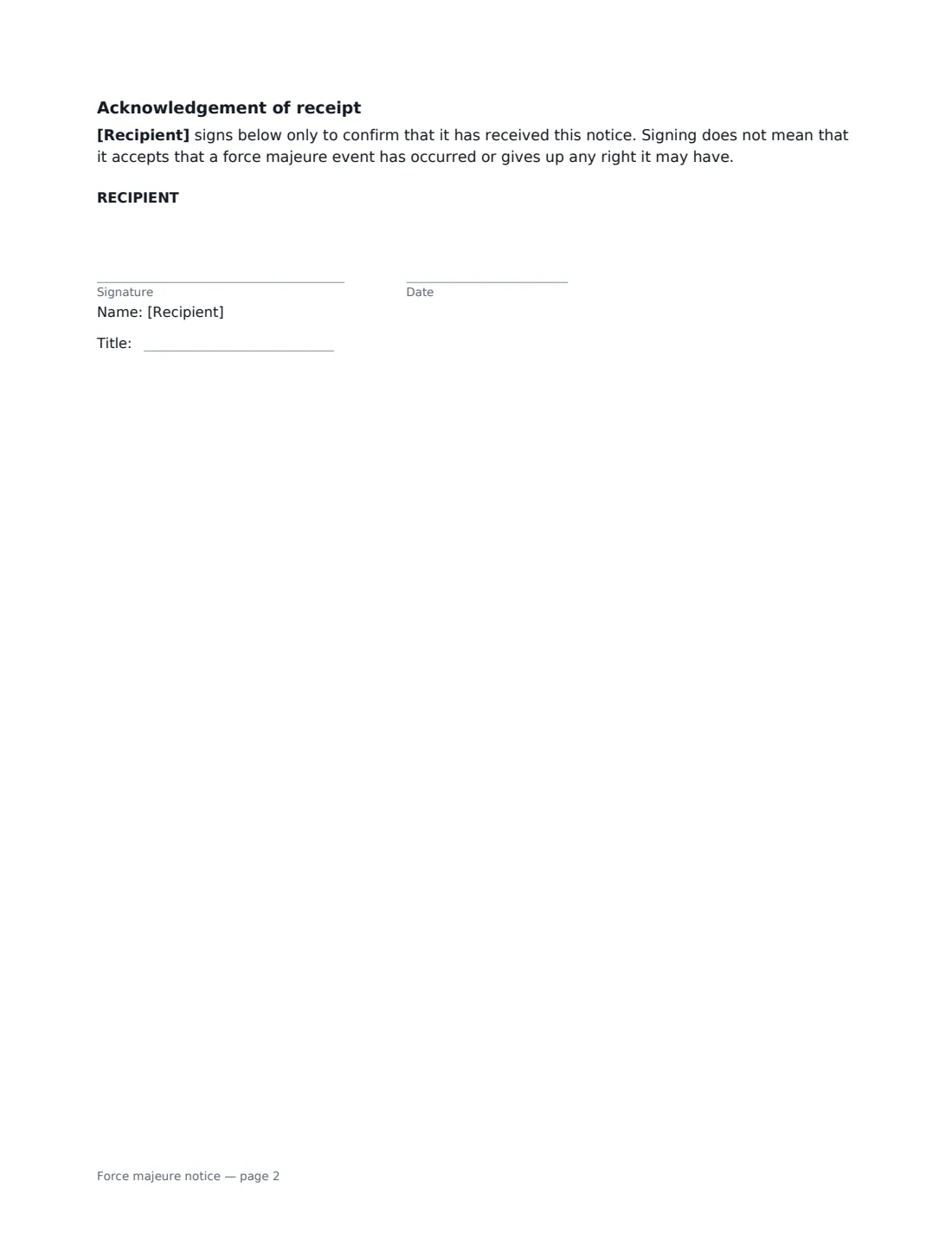
This notice identifies the contract and its force majeure clause, describes the event and when it started, lists the obligations affected and how long the disruption may last, sets out the steps you are taking, and commits you to regular updates. It reserves your rights, and the recipient signs only to acknowledge receipt, which gives you evidence the notice arrived.
- Best for
- Suppliers, contractors and service providers hit by an event they could not control
- Signed by
- The sender; the recipient acknowledges receipt
- Includes
- The event, affected obligations, expected duration, mitigation, update schedule
- Length
- 1–2 pages
When to Use a force majeure notice
- A factory closed by flood or fire
- A supplier hit by a port closure or transport strike
- An IT provider affected by a major utility outage
- An event organiser facing a government order cancelling events
- A contractor delayed by severe weather
What You Fill In
16 blanks, then the name and email of each person who signs: sender, recipient.
1 The parties
- Date of this notice*
- Sender*
- Sender address
- Recipient*
- Recipient address
2 The contract
- Contract*
- Date of the contract*
- Force majeure clause
3 The event
- The event*
- Date the event began*
- Obligations affected*
- Expected duration*
- Steps being taken to reduce the impact*
- We will update you every (days)*
- Contact for questions
- Contact email
4 Who signs
- Sender signature and date, job title · The party affected by the event.
- Recipient signature and date, job title · Signs only to acknowledge receipt.
What the force majeure notice Covers
- Notice
- The event
- What is affected
- What we are doing
- Our position
- Acknowledgement of receipt
Using the force majeure notice, step by step
1 Check the contract first
Find the force majeure clause, the events it covers, the notice deadline and the address for notices. Enter the clause number.
2 Describe the event factually
Say what happened, when, and why it was outside your control. Avoid speculation.
3 Explain the impact and your response
List the obligations affected, an honest estimate of how long, and what you are doing to reduce the impact. Choose how often you will update.
4 Send and keep the receipt
Send through VergeHR and ask the recipient to acknowledge. The audit trail records when it was sent and viewed, alongside the signed copy in Files.
Tips Before You Send It
- Send the notice as soon as you can. Many clauses set a short deadline.
- If the contract requires notice by a particular method, such as courier, also send it that way.
- Keep evidence of the event and of your mitigation efforts.
- If the contract has no force majeure clause, whether you are excused depends on its governing law. Take advice.
Sign It Online In Minutes
- Fill in the blanks. Names, dates and amounts go straight into the agreement — the preview shows exactly where.
- Name who signs. Tick “This is me” for your own part. VergeHR builds the PDF with every signature, date box on the right line, and you can check or move anything before sending.
- Send it. Each signer gets a secure link and signs from any device — no account needed. The signed PDF, with an audit trail and a Certificate of Completion, is filed in Files and emailed to everyone.
Force majeure notice: frequently asked questions
What counts as force majeure?
It depends on the contract's wording. Common examples are natural disasters, war, epidemics, government action and major utility failures. Price rises or ordinary business difficulty usually do not qualify.
Does the recipient have to agree?
No. The notice is one-sided. The recipient signs only to confirm receipt, and the wording says so.
Can the other party terminate the contract?
Some clauses let either party terminate if the event lasts beyond a set period. Check yours.
Do I still have to perform the rest of the contract?
Yes. The notice confirms that obligations not affected by the event continue.