


What is a home staging agreement?
A home staging agreement is the contract between a stager and the homeowner (or their agent or developer) when the stager furnishes a property to help it sell. The stager is lending valuable furniture, art and accessories into a home they don't control, often for weeks or months, with buyers, agents and sometimes occupants coming and going — so the agreement has to be clear about who pays for what, and when the items come back.
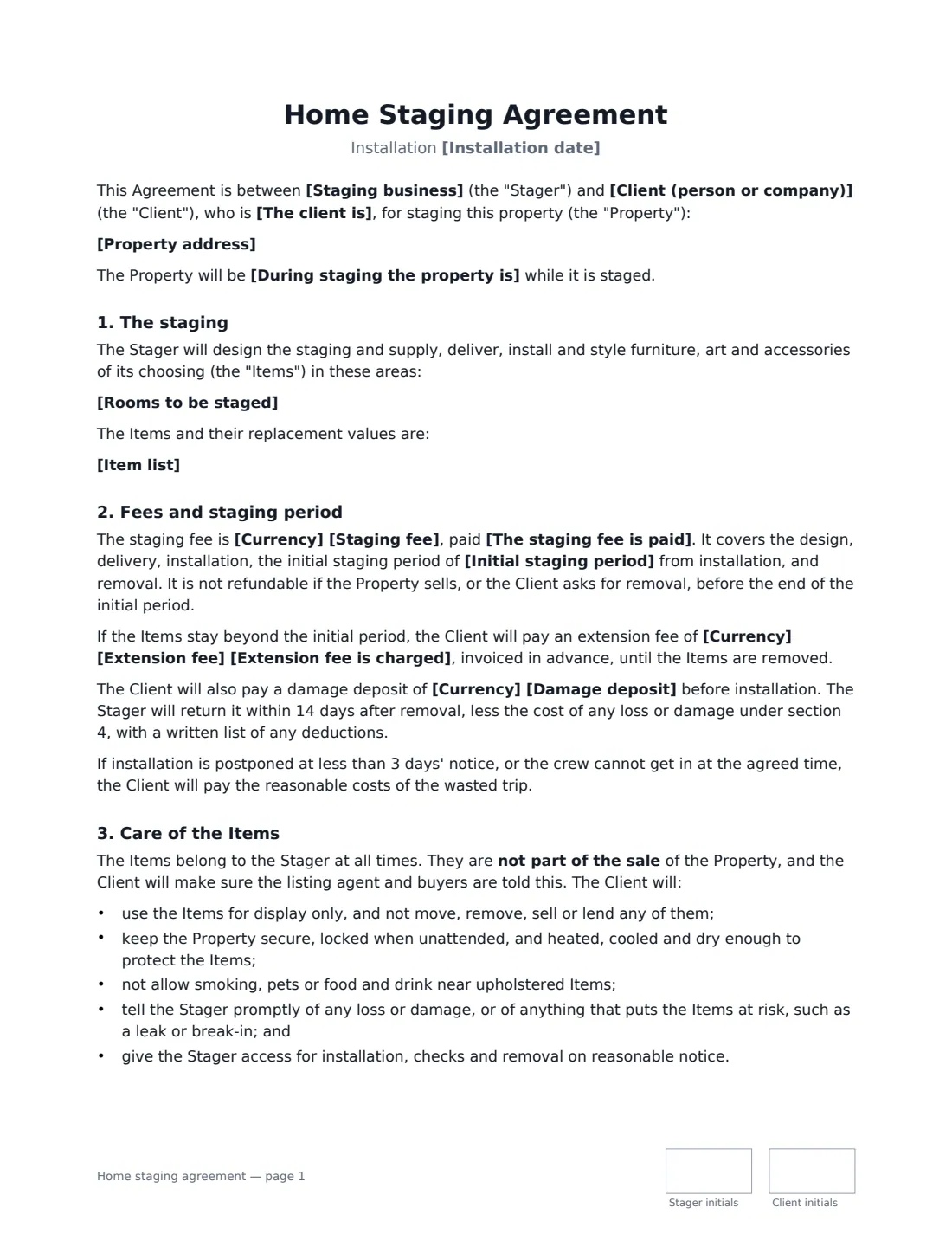
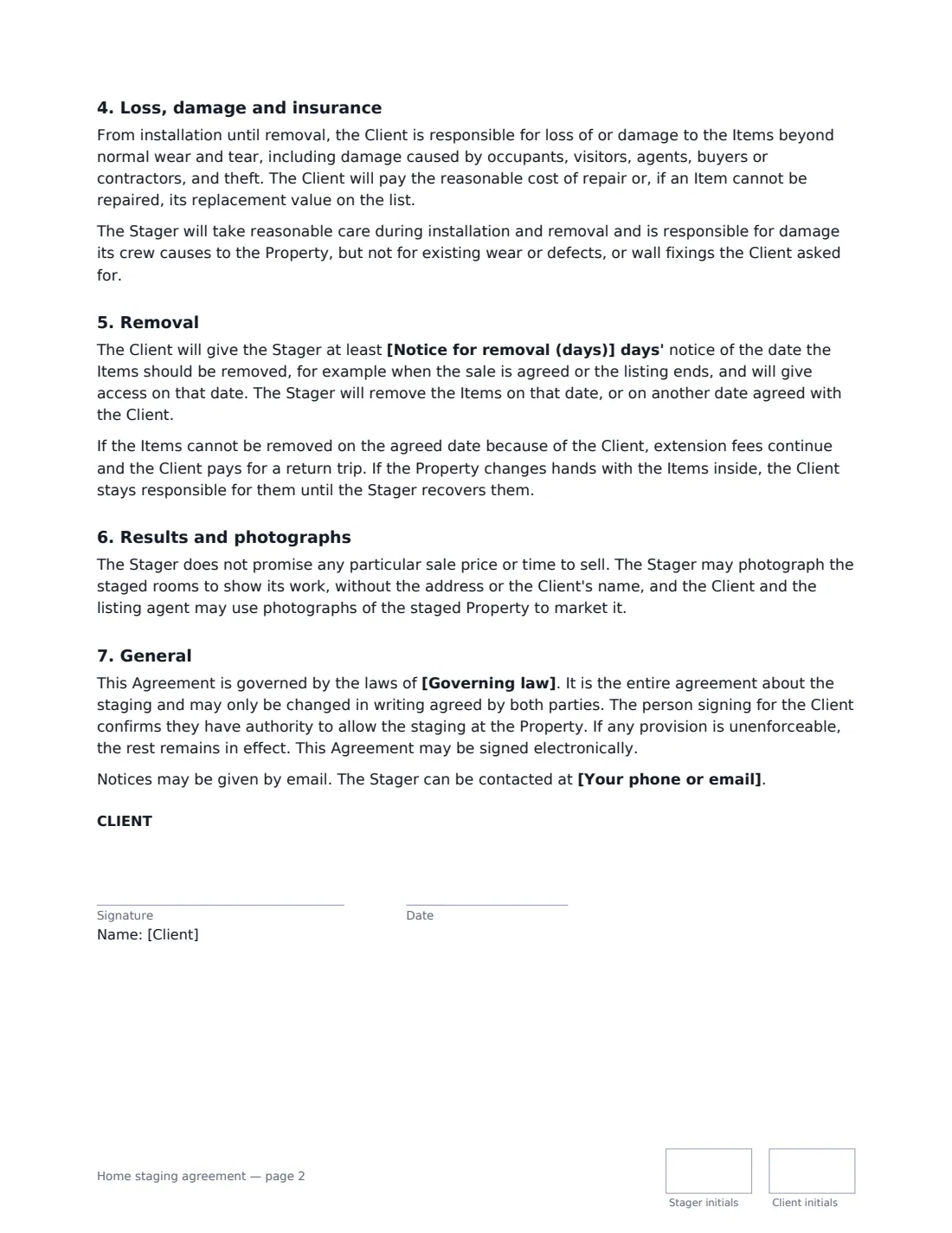
This template records the property, whether it's vacant or lived in, the rooms staged and the item list with replacement values (or a list and room photos given at installation). It sets the staging fee — covering design, delivery, installation, the initial period and removal — how it's paid, and the extension fee once the initial period ends, with an optional damage deposit. The client agrees to use the items for display only, keep the property secure, and tell buyers the items aren't included in the sale. It covers loss and damage, which insurance covers the items, the stager's responsibility for its own crew, notice for removal, and portfolio and listing photographs.
- Best for
- Home stagers, real estate agents and homeowners preparing a listing
- Signed by
- The client (owner or authorised agent) and the stager
- Staging period
- Initial 30, 45, 60 or 90 days, then an extension fee per month, fortnight or week
- Length
- 2–3 pages, initialled on every page
When to Use a home staging agreement
- Staging a vacant home before listing photos and viewings
- Partly staging a lived-in home with accent furniture and accessories
- A real estate agent hiring a stager on the seller's behalf
- A developer staging a show home or new-build apartment
- Staging an empty condo or apartment that is listed for sale
What You Fill In
19 blanks, then the name and email of each person who signs: stager, client.
1 The parties
- Staging business*
- Your phone or email
- Client (person or company)*
- The client is* the owner of the Property · the owner's agent, authorised to sign for the owner
2 The property
- Property address*
- During staging the property is* vacant · lived in
- Rooms to be staged*
- Item list
3 Dates and fees
- Installation date*
- Initial staging period* 30 days · 45 days · 60 days · 90 days
- Currency*
- Staging fee*
- The staging fee is paid* in full before installation · half on signing and half before installation
- Extension fee*
- Extension fee is charged* per month (or part month) · per two weeks (or part) · per week (or part week)
- Damage deposit
4 Insurance and removal
- Notice for removal (days)*
- Insurance of the items* the Client's property insurance · the Stager's own insurance
- Governing law*
5 Who signs
- Stager signature and date, job title, initials on every page · The staging business that owns and installs the items.
- Client signature and date, initials on every page · The homeowner, or the agent or developer who hires the stager.
What the home staging agreement Covers
- The staging
- Fees and staging period
- Care of the Items
- Loss, damage and insurance
- Removal
- Results and photographs
- General
Using the home staging agreement, step by step
1 Describe the property and rooms
Enter the address, whether it will be vacant or lived in, and which rooms and outdoor areas are staged. Choose whether the client is the owner or the owner's authorised agent.
2 List the items
Type the item list with replacement values, or leave it empty and give the client an item list and photos of each room at installation. Replacement values are what the client pays if an item is lost or can't be repaired.
3 Set fees and periods
Enter the staging fee and how it's paid, the initial staging period, the extension fee and how often it's charged, and any damage deposit.
4 Agree insurance and removal, then send
Choose whose insurance covers the items and the notice needed for removal. Add the client as a signer; the signed agreement is filed in Files.
Tips Before You Send It
- Ask the client to check with their insurer. Home policies often don't cover items belonging to someone else, especially in a vacant home.
- Photograph every room at installation — the agreement promises this when there's no typed item list.
- Make sure the listing agent tells buyers the staging isn't included in the sale; the agreement makes that the client's responsibility.
- Set removal notice long enough for your crew's schedule. Extension fees run until the items are actually removed.
Sign It Online In Minutes
- Fill in the blanks. Names, dates and amounts go straight into the agreement — the preview shows exactly where.
- Name who signs. Tick “This is me” for your own part. VergeHR builds the PDF with every signature, date and initials box on the right line, and you can check or move anything before sending.
- Send it. Each signer gets a secure link and signs from any device — no account needed. The signed PDF, with an audit trail and a Certificate of Completion, is filed in Files and emailed to everyone.
Home staging agreement: frequently asked questions
Who pays if staged furniture is damaged?
Under this agreement the client is responsible for loss or damage beyond normal wear and tear from installation until removal, including damage by visitors, agents, buyers or contractors, and theft. They pay the repair cost or the item's replacement value. If you choose the stager's own insurance, the stager claims on it first and the client pays only the excess or deductible and anything it doesn't cover. The stager is responsible for damage its own crew causes to the property.
What if the house sells before the staging period ends?
The staging fee covers the initial period and isn't refunded if the property sells early. The client gives the notice set in the agreement and the stager removes the items.
Does the stager guarantee a faster sale?
No. The agreement states that the stager doesn't promise any particular sale price or time to sell.
Can a staging contract be signed electronically?
Yes. Electronic signatures are generally valid for ordinary service contracts like this in the US (ESIGN Act and UETA), the UK, the EU (eIDAS) and Canada. VergeHR keeps an audit trail and a Certificate of Completion with the signed PDF.